A Bit of Humor at the Opera

It’s Friday, and I thought I’d share a little more fiction from my Phantom of the Opera novel.  This is a fun scene with the managers of the Paris Opera House, Andre and Firmin.  Context: this is a while after the usual story, but all you really need to know is that, with the Vicomte de Chagny fled in the night, the Opera has a new patroness who has thoroughly taken over.  Her nickname is Madame Laissez Faire–Lady Let It Be–because she doesn’t let anythng be.  She’s determined to wage war against the Phantom.  Meanwhile, Meg Giry and Erik (the Phantom) have become friends, though he’s still mourning Christine’s leaving, and is endlessly solemn.  But not above the occasional trick all the same.

One other note: this is mostly based on Webber, but I tried to work in at least one nod to every version of the Phantom I was familiar with.  This scene has my nod to Terry Pratchett’s brilliant parody, Maskerade.

*********************************

The first thing the managers did, as they did most mornings, was to go to their office, which for a rarity was empty of their patroness.  It was also empty of everything else.

André and Firmin stood in the open doorway and stared at the empty room.  There was no desk.  No cabinets.  No files or books.  Even the half-eaten sandwich Firmin had left behind the evening before had vanished.  There was, in fact, only one item in the entire room: a single scrap of paper lying on the bare floorboards (even the rug had gone) in the precise center of the room, held in place by a single nail driven into the ground.

Merde,” Andre muttered, as Firmin entered the room and yanked up the note from the floor.  He brought the note back to the doorway and they read it together.  It was very brief.

If you can invade my private domain, I see no reason why I can’t invade yours.

The Phantom

André groaned.  “He knows we were in the labyrinth.  I knew that was a bad idea.”

“What are we going to do?  This is bad, all our records and papers and…”  Firmin trailed off with a sudden thought.  “I left my favorite coat here last night.  He stole my favorite coat!”

“That red one?”

Firmin nodded vigorous assent.

André shrugged.  “Just as well.  It made you look like a turkey.”

Continue reading “A Bit of Humor at the Opera”

A Fascination with the Phantom

Today happens to be my birthday.  🙂  In honor of the occasion, I’ve decided to give myself over to emotive waxing on, run the risk of demonstrating a foolish attachment, and review one of my very favorite books: Susan Kay’s Phantom.
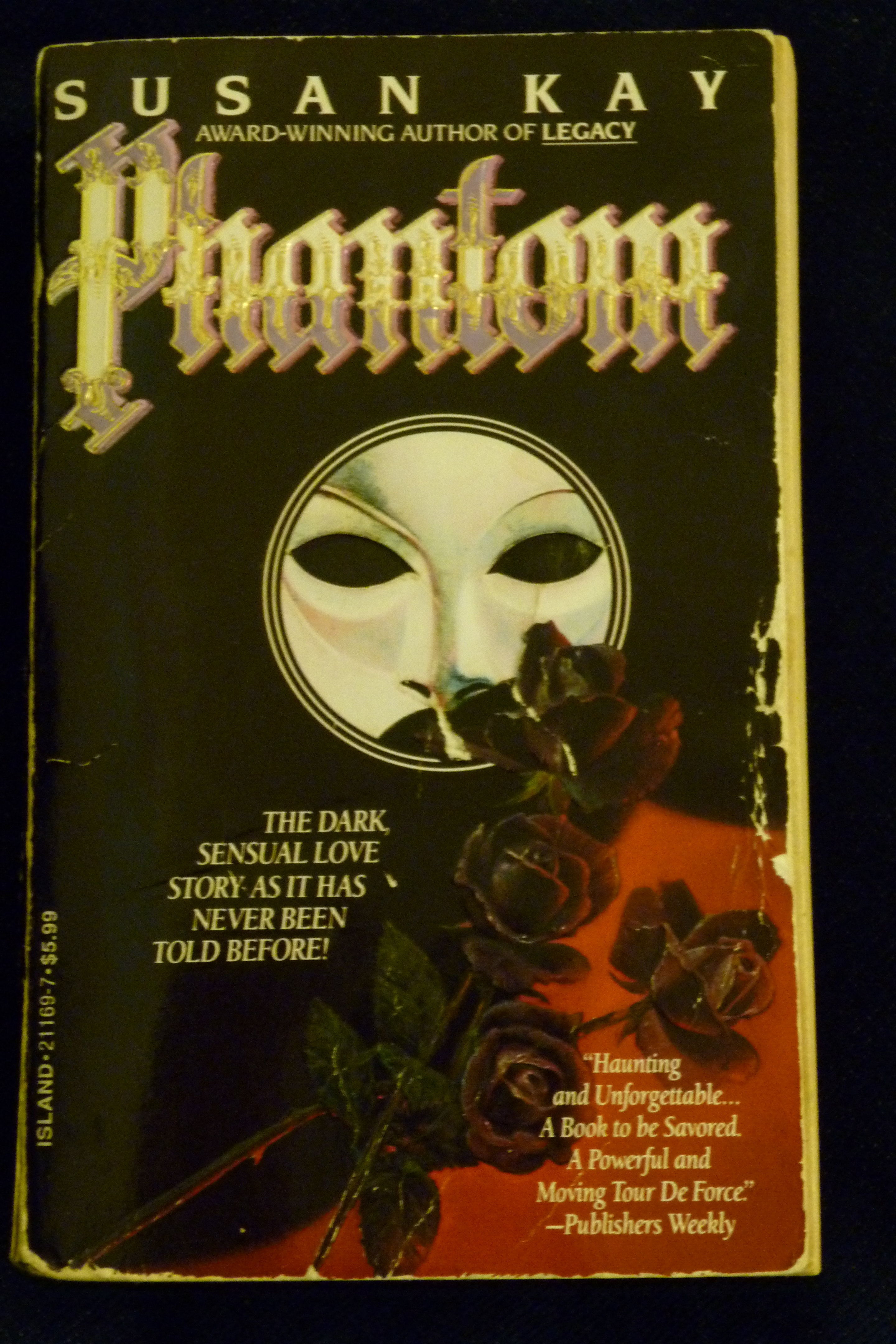
Technically it’s Phantom: The Novel of His Life by Susan Kay, but the convention is to always call it Susan Kay’s Phantom.  Maybe so that it can be put in a list with “the Claude Rains Phantom” or “the Lon Chaney Phantom” or “the Webber Phantom.”

I have a small (okay, enormous) obsession with The Phantom of the Opera.  I’m fascinated by the lead character: a brilliant musical genius who lurks in the shadows and, despite being a brilliant musical genius, is utterly convinced of his own unworthiness because he thinks he’s ugly–and by conventional standards he is, but I think the more imperative point is that he thinks he’s ugly.  I’m actually not that interested in the romance with Christine; it’s Erik, the Phantom, I’m fascinated by.  And I’m fascinated by exploring all the different versions, and how they’ve retold the plot and especially the character.  In this version he’s more arrogant–in that version he’s more shy–this version makes him more clearly a villain–that version emphasizes the romance.

And Susan Kay’s Phantom is one of the most fascinating of all the fascinating different versions.  Maybe it’s because the Christine romance is really just one part.  The book starts from before Erik’s birth and goes all the way to past his death.  With different parts of the book told by different characters, we follow the Phantom through childhood, to a gypsy freak show, to Italy where he learns from a master architect, to Persia and, finally, to the Paris Opera House.

For a long time this was out of print, and used versions averaged around $75.  So you see I’m not the only one with a considerable attachment here.  Fortunately for everyone, it’s been reprinted.

It’s beautiful, it’s tragic, it’s even funny and heartwarming at times.  The writing is amazing, rich and lush.  It reminds me a bit of Daphne du Maurier.  I feel I know all the characters personally.  There are few characters–maybe none–in fiction that I hate more than I hate Erik’s mother.  And there are few characters I’m more–here I go with that word again–fascinated by than Erik (and here I mean specifically this version).  Kay walks an amazingly fine line; he’s a very dark character, but just when he gets too dark,  something happens to make me love him again.  For example, things get bloody in Persia, and then some sweet bits turn it around again.

I found it a very emotionally intense book–not in the sense that it was a heavy subject matter, but that I was so drawn in.  And that may be the explanation for what might sound strange, after all this waxing on: I’ve only read it once.  I’ve flipped through it often–I’ve reread passages–I’ve marked all my favorite quotes–but I’ve never actually sat down and read it again.  I think it’s that I have to have a certain amount of emotional distance to a book before I feel I want to pick it up again.  If it’s too fresh, I don’t feel an urge to reread–it’s still there in my brain and there’s no reason to reread until it’s left.  And Susan Kay’s Phantom left such an impression that it’s still here in my brain.

It’s also saved the lives of a lot of spiders.  There’s a brilliant metaphor in here, relating Erik to a spider (and I so wanted to shake Christine for failing to see the connection).  Ever since reading this, I haven’t been able to bring myself to kill a spider–because “it’s not the spider’s fault that it’s ugly.”  So I’ve trapped a lot of spiders in glasses and released them into the wild instead.

I’d like to give you more quotes, but most of my favorites wouldn’t make any sense without a lot of context.  How do I explain why I melt into a puddle when Erik tells the Daroga, “Take care, mon ami.  Your tiresome health has become very dear to me.”  Or the incredible, heartbreaking power of “Please, God, let her love me and I’ll be good forever” and why I really, really want to yell at him, “No, no, don’t go up on the rooftop to pray, it’ll end badly!”

See, I knew I’d end up sounding crazy if I tried to review this book.  Here we go, one quote to demonstrate the wonderful language and convince you there’s something at the base of all this exhuberance: “My mind has touched the farthest horizons of mortal imagination and reaches ever outward to embrace infinity.  There is no knowledge beyond my comprehension, no art or skill upon this entire planet that lies beyond the mastery of my hand…  But as long as I live, no woman will ever look on me in love.”

One rational note: I seem to be straying from the young adult books this week, as this one isn’t YA either.  Probably appropriate for older young adults–things do get bloody in Persia, and there are some dark moments throughout.  The Phantom’s life is a tragic one.

But fascinating.  So very fascinating.

Hanging Out with Some Favorite Characters

In keeping with this week’s focus on picture books, I thought I’d share a drawing for Fiction Friday.  I never claimed to be a great artist, but every so often–usually when I’m having writer’s block–I’ll turn my hand towards drawing instead of writing for a little while.  I still think in terms of stories, so most of the time my drawings will still end up being of characters or some kind of story in themselves.

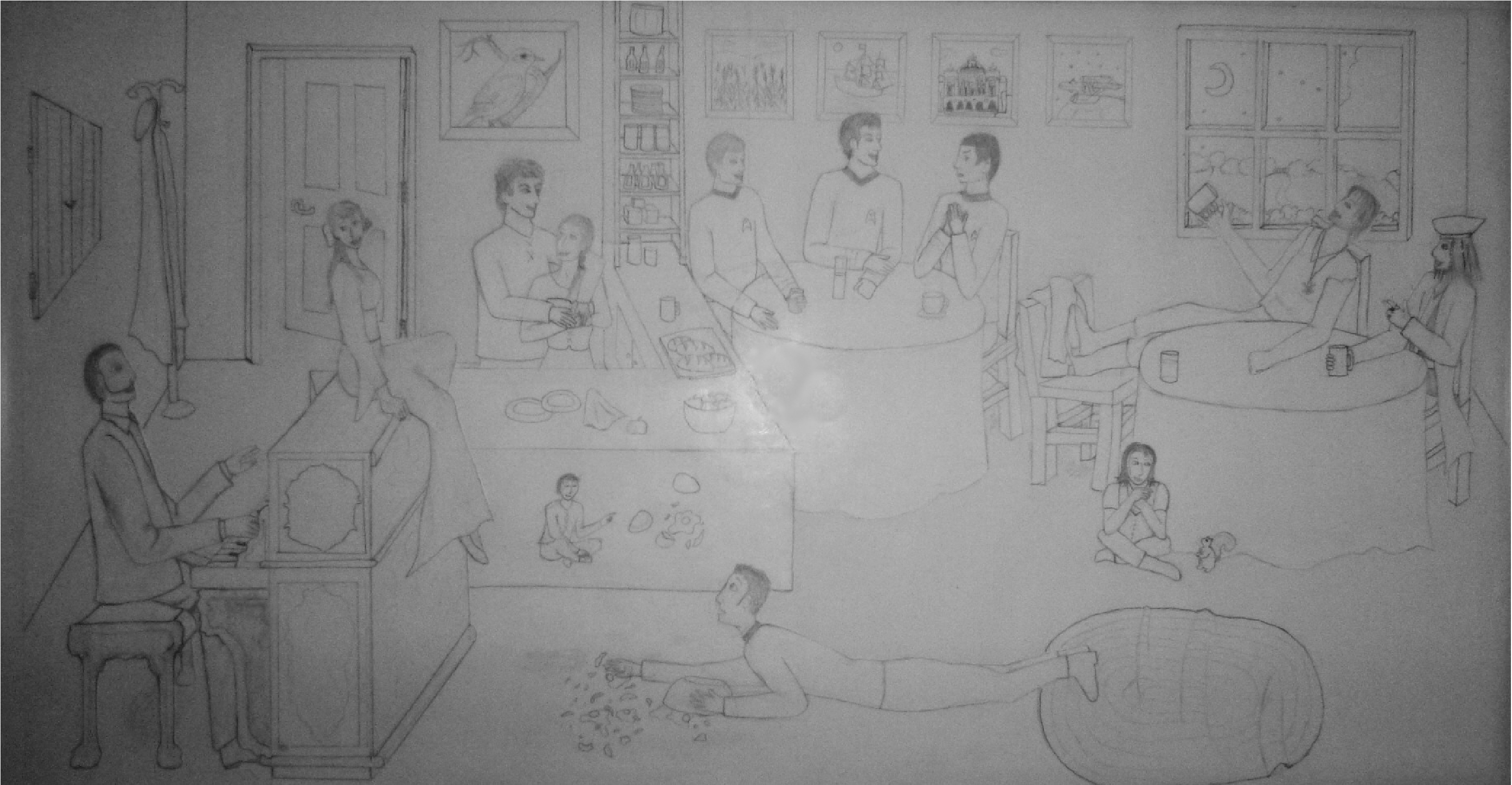
One of my favorite and by far most complicated drawings is a scene I did of the main characters from each of my major stories hanging out together.  If you click, you can see it larger.


The setting is The Nightingale, an inn which features in The People the Fairies Forget.

Starting from the far left, we have Erik, the Phantom of the Opera, playing the piano.  With him is Meg Giry, who has a small role in Leroux’s Phantom, a larger role in Webber’s, and a lead role in my Phantom story.

Behind the counter are Catherine and Anthony, major characters in the later part of The People the Fairies Forget.  Catherine gets into trouble when Cinderella’s shoe fits her.  When not dealing with problems like that, they run The Nightingale

Floating in midair in front of the counter is my fairy, Tarragon.  Tarry is magically repairing the eggs which were broken by Sam Jones, who tripped and fell across the floor.  Jones could be from any of these stories; he has at least a cameo in all of them, and is apt to trip in all of them too.

Sitting at the back table are Dr. McCoy, Captain Kirk, and Mr. Spock, who beamed down from the Enterprise.

At the other table we have Captain Red Ballantyne with his feet up on an adjoining chair, deep in conversation with Captain Jack Sparrow.  Tamara, who comes from the same story as Red, is sitting by the table chatting with Rodney the squirrel, who Jack met in my Pirates of the Caribbean story.  Red’s Girl isn’t a fantasy, but if I’m going to stretch things to bring all of these people together, I decided Tam could talk to Rodney.

If you’re curious about the little details, the pictures on the back wall are, from left, a nightingale, a cornfield, a sailing ship, the Paris Opera House, and the Starship Enterprise.

I find that when I spend a lot of time writing about characters, they stay in my head in a way that no other characters do.  So in a way, it makes perfect sense to think about them spending time together.  And it’s fun to imagine how they would interact.

If you could bring characters from any fictional source together to hang out for the evening, who would you choose?

Watching Opera with the Phantom

Looking back over my Fiction Fridays, I find there’s at least one representative of almost all my major writing projects.  My Golden Age of Piracy story and my Fairy Tale Retelling, as well as the significant interests of my fanfiction years, Star Trek and Pirates of the Caribbean.  But–I am missing my one other fanfiction interest.  And the Phantom of the Opera does not like to be ignored (somewhat paradoxically, he also doesn’t like being noticed–a complex character).

My Phantom Programs

To round things out, and keep the Phantom happy 🙂 I thought I’d share a scene from my Phantom novel.  There’s not a lot of context needed for this particular scene.  Backstory (spoilers for the original, you have been warned)–the Phantom is a masked musical genius who lives beneath the Paris Opera House.  One of his demands for the opera company is that Box Five be reserved for his exclusive use.  He falls in love with Christine, a singer at the Opera, there’s a romantic triangle and a lot of upheaval, and she eventually leaves and he’s left at the Opera House with a broken heart.

My story picks up from there.  It’s mostly but not exclusively based on the Webber musical (the original, NOT in any way, in any form, in the slightest bit, on the sequel–and if you don’t know what I’m talking about, good, you’ve been spared).  It primarily focuses on the Phantom, whose name is Erik (not something Webber mentioned), and on Meg Giry, a supporting character in the original.  She’s not actually in this scene, although she’s loosely referenced in the remarks about blondes.

This scene is a little while into the story, a few months after the original ends, and the management of the Opera has just decided to sell Box Five for the first time.

I think I’m okay on copyright here…Leroux’s Phantom has got to be public domain by now, and nothing here is directly from any other version.

********************************

            The young man who bought the seats in Box Five was named Pierre.  His lady friend, whom he had met exactly two days previously, was named Jacqueline, and so far he had done very well impressing her.  They greatly enjoyed Act One.  Then, in the middle of Act Two, the voice started.

            “You’re in my box, you know.”  It was really a very nice sounding voice.  Definitely male, almost melodious in nature, and conversational in tone.

            That didn’t stop Pierre from taking issue with the words.  He rose from his seat and turned to address the apparent direction of the speaker.  “It so happens that I paid for these seats—”  He broke off abruptly, looking wildly around the box.  There was no one there.

Continue reading “Watching Opera with the Phantom”