
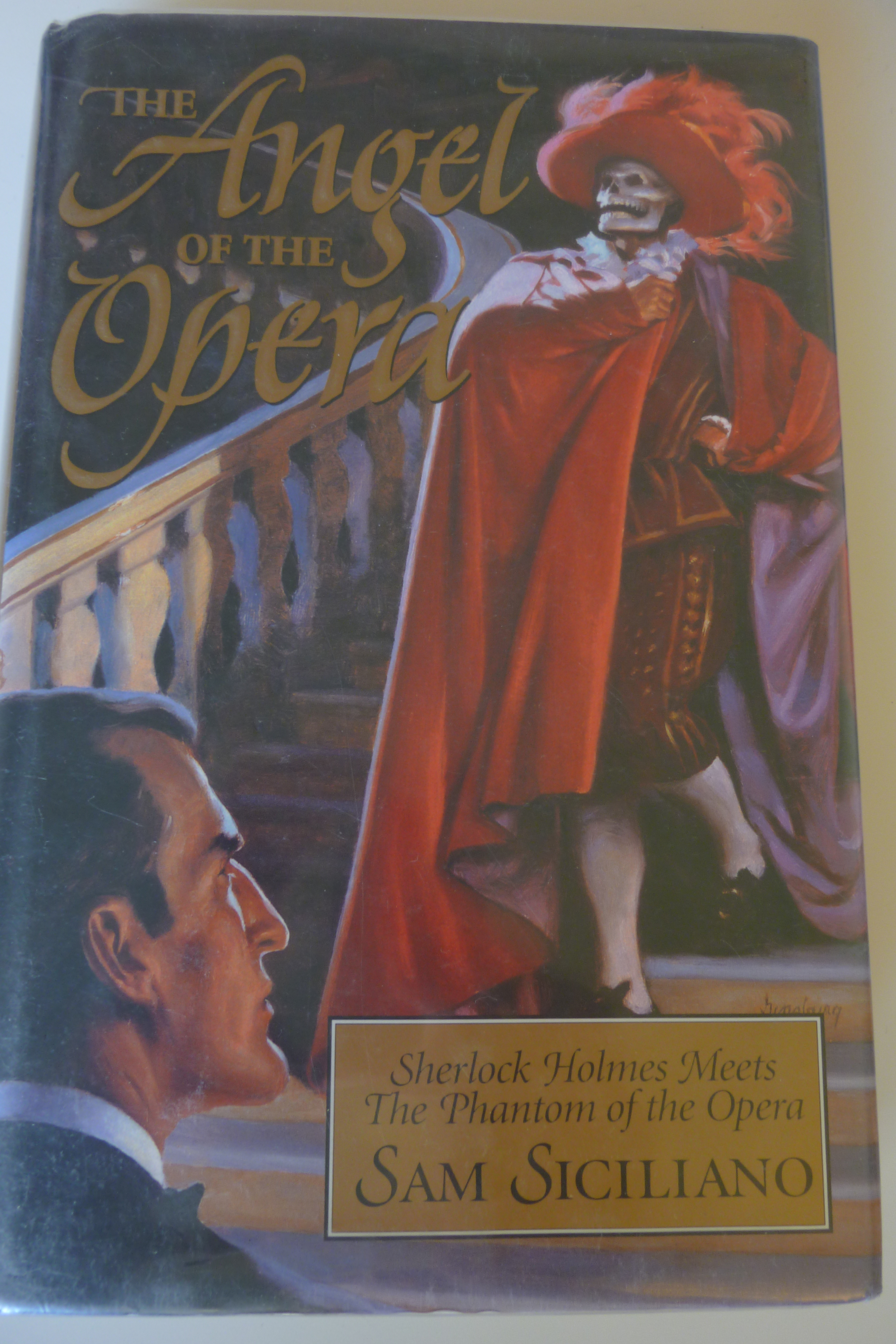
 My January post about the Phantom of the Opera inspired me to buy and reread Sam Siciliano’s Angel of the Opera. I last read it six or seven years ago, but I find my feeling toward it was much the same this time–and it’s an odd, odd feeling. When I look at the disparate elements of the book, I dislike far too much. And yet somehow, taken as a whole, I enjoyed the book. Baffling!
It may be the premise. Sherlock Holmes meets the Phantom of the Opera; I love both of them in their original forms, so it’s hard to resist a cross-over. People I tell about this seem to have trouble picturing the two stories coming together, but it actually makes a certain amount of sense. The premise is that the managers of the Opera are deeply distressed by this Ghost business (as they are in every version), and decide to hire a very famous London detective to come investigate–Mr. Holmes. Holmes arrives in Paris and goes exploring through the Opera in an effort to work out the mystery of the Phantom. Siciliano also makes much of Holmes’ love of music (which is an element in Arthur Conan Doyle) and that ties things together in an extra way too.
If only that clever emphasis on Holmes’ love of music had been part of a broader, equally clever portrayal of Holmes. But there’s where we begin to have problems. This book begins very, very badly. Watson has been booted from the scene and we have a new and original narrator, Holmes’ cousin, Henry Vernier. The second sentence of the book reads, “My purpose at the time was to reveal the real Sherlock Holmes as corrective to the ridiculous fictional creation of John Watson.”
Ouch. I mean, really, ouch. Henry goes on in this way for a couple of pages, maligning poor Dr. Watson and discounting Watson and Holmes’ friendship, then peppers the rest of the book with occasional caustic references to Watson and his writing, both from Henry and, even more painfully, from Holmes. It’s always a chancy business trying to write another author’s characters, and frankly, if you’re going to attempt it, you had better approach the original with a great deal of respect, bordering on reverence. It’s hard to believe that Siciliano even likes Doyle’s stories.
The particularly stupid part is that I don’t think all this added anything or was at all necessary. Henry is pointless as an original character. He fills exactly the same role as Watson, right down to being a doctor, and I nearly forgot at times that he wasn’t Watson. Other than a fear of heights and occasional musing about whether he ought to marry a girl he’s been courting, he has very little personality to add. And Holmes is almost Holmes, but not quite. Siciliano plays around a bit, and not to Holmes’ advantage. His attitudes towards women and religion are mucked about with, and his deduction skills are not shown to any great advantage. He doesn’t do much of the “I saw a telltale clue and drew 14 conclusions from it” that Holmes is so well-known for. He does figure out a lot about the Phantom, but it all seems like fairly obvious details–although I admit, Holmes doesn’t have my advantage of familiarity with some 14 versions of the story to help him along. Anyway, the whole thing ultimately comes off like Siciliano realized he couldn’t quite write Doyle’s Holmes, or that Doyle’s Holmes didn’t quite fit his novel, and decided he’d better come up with an excuse for the differences.
He does better with the Phantom side of things. This is plainly based on Leroux, not Webber–Raoul’s brother is in the story (delightfully awful), Meg Giry has dark hair, several minor characters from Leroux are at least mentioned, and there’s just an overall atmosphere of Leroux. That actually may be my favorite part. Siciliano brings the Opera, with all its confusing passages and dark cellars, to life in a wonderful, fascinating way. It really may be the atmosphere that carries this book more than anything else.
The Phantom characters were better handled than the Holmes ones too. Siciliano wrote what is probably the most annoying Raoul I’ve ever seen (which is saying something) and his Christine is a nice mix of well-meaning and flighty childishness. The managers, Carlotta and Madame Giry are well-portrayed. And I thought he did well with the Phantom (although we don’t see him as more than a shadow until two-thirds into the book). He’s dark, complex, a musical genius, and I actually really enjoyed Holmes’ insight into the Phantom. And points for getting his name right–Erik. Such a simple thing that is so rarely done correctly. Siciliano does slip on one character–like Watson, he maligns the poor Persian, who was the most heroic figure in Leroux but here is dark and villianous and (metaphorically) drenched in blood.
The plot is all right. Holmes and Henry poke around on the edges of the plotline of The Phantom of the Opera, trying to unravel the mystery. Siciliano doesn’t really add much, but neither does he do any harm to it.
So–decent plot, well-done Phantom characters, excellent atmosphere, poorly-done Holmes, pointless original narrator. And there is one more original character who absolutely gives me fits. There’s a mostly-irrelevant prologue, where Holmes and Henry are tying up an unrelated case, and in the midst of it they get a telegram about the Paris Opera situation. The main point, though, seems to be to introduce Susan Lowell. She lives in Wales, is half-British and half-Indian, and is despised by society for her mixed-race status. She’s all alone in the world. She’s very beautiful, but for a variety of reasons has always thought that she was very ugly. And she’s completely brilliant musically. Is this obvious enough yet? It gets better. She’s blind.
Well now. A novel with a musically-brilliant deformed man features a completely superflous musically-brilliant blind girl. I wonder where that could possibly be going? Honestly, I am all in favor of the Phantom getting over Christine, and if that means writing a new character to suit, fine, no problem, go to it. But at least be a bit more subtle about it! I also think it oversimplifies to assume that falling in love with a blind girl would solve all of the Phantom’s problems. I’m convinced that Erik’s problem is not really that he’s ugly–it’s that he knows he’s ugly, and is convinced of his own unworthiness as a consequence.
But that is a long and complex discussion. Suffice to say here, this book would be better off and far less obvious without the prologue or the epilogue–even if that meant leaving off a basically happy ending.
So where do I wind up in the end? I don’t know. I like some parts of this book. I dislike a lot of very key parts. And I enjoy it overall. Draw your own conclusions from that. I hear there’s another Holmes-meets-the-Phantom book out there, and I am definitely going to check that out to see if it does any better!
Author’s Site: http://samsiciliano.net/
Other reviews:
Better Holmes and Gardens (I love that title!)
My Den
Anyone else?
 Tales of the Marvelous