Favorites Friday: Male Characters

First, a bit of business: I’m going to be heading to D.C. next week (thanks to everyone who gave book suggestions!)  I scheduled posts ahead, so you shouldn’t see any drop in content.  But I won’t have internet access, so don’t be offended if I’m not responding to comments!  I’ll read them all when I get back.  🙂  Now, to today’s post…

Two weeks ago I shared five of my favorite female characters, so obviously that must mean that today it’s time for the other half of the population to have their turn.  In no particular order, a few favorite male book characters. Continue reading “Favorites Friday: Male Characters”

A Bit of Humor at the Opera

It’s Friday, and I thought I’d share a little more fiction from my Phantom of the Opera novel.  This is a fun scene with the managers of the Paris Opera House, Andre and Firmin.  Context: this is a while after the usual story, but all you really need to know is that, with the Vicomte de Chagny fled in the night, the Opera has a new patroness who has thoroughly taken over.  Her nickname is Madame Laissez Faire–Lady Let It Be–because she doesn’t let anythng be.  She’s determined to wage war against the Phantom.  Meanwhile, Meg Giry and Erik (the Phantom) have become friends, though he’s still mourning Christine’s leaving, and is endlessly solemn.  But not above the occasional trick all the same.

One other note: this is mostly based on Webber, but I tried to work in at least one nod to every version of the Phantom I was familiar with.  This scene has my nod to Terry Pratchett’s brilliant parody, Maskerade.

*********************************

The first thing the managers did, as they did most mornings, was to go to their office, which for a rarity was empty of their patroness.  It was also empty of everything else.

André and Firmin stood in the open doorway and stared at the empty room.  There was no desk.  No cabinets.  No files or books.  Even the half-eaten sandwich Firmin had left behind the evening before had vanished.  There was, in fact, only one item in the entire room: a single scrap of paper lying on the bare floorboards (even the rug had gone) in the precise center of the room, held in place by a single nail driven into the ground.

Merde,” Andre muttered, as Firmin entered the room and yanked up the note from the floor.  He brought the note back to the doorway and they read it together.  It was very brief.

If you can invade my private domain, I see no reason why I can’t invade yours.

The Phantom

André groaned.  “He knows we were in the labyrinth.  I knew that was a bad idea.”

“What are we going to do?  This is bad, all our records and papers and…”  Firmin trailed off with a sudden thought.  “I left my favorite coat here last night.  He stole my favorite coat!”

“That red one?”

Firmin nodded vigorous assent.

André shrugged.  “Just as well.  It made you look like a turkey.”

Continue reading “A Bit of Humor at the Opera”

New Feature: Favorites Friday – Opening Lines

I’ve been thinking about Fridays.  As regular readers know, on Fridays I normally post my own writing.  Which is fun, but I think I want to mix it up with a new feature.  Book reviews are normally a drill-down focus on one book (or series or author).  But sometimes I want to do a round-up of several favorites of something…favorite characters, favorite opening lines, favorite paintings that plainly have a story in them (most of my favorite paintings are like that!)  Because I have a thing for alliteration, I’m going to start doing Favorites Friday.  I’ll still do Fiction Friday too, but I want to do a mix of both.  And by all means, let me know your preferences too!

To start us off, why not begin at the beginning?  Favorite opening lines.

“All children, except one, grow up.”
Peter Pan, by J. M. Barrie

Six words, yet it’s all there.  The tragic thread throughout, especially at the end, of children growing up and changing and leaving (“tragic” seems to be Barrie’s feeling on it).  The magic of one child who defies this most basic convention.  And the poetry and charm of Barrie’s writing.

“I have been in love with Titus Oates for quite a while now–which is ridiculous, since he’s been dead for ninety years.  But look at it this way.  In ninety years I’ll be dead, too, and the age difference won’t matter.”
The White Darkness by Geraldine McCaughrean

Brilliant, funny, and I love the way she talks about him simultaneously as both a distant historical figure, and as someone immediately present in her life–which is how Titus is throughout the book.

“If it had not rained on a certain May morning Valancy Stirling’s whole life would have been entirely different.”
-The Blue Castle by L. M. Montgomery

And now you have to keep reading to find out why, right?

“Last night I dreamt I went to Manderley again.”
Rebecca by Daphne du Maurier

I can’t analyze for you why I like this so much–but somehow it’s got into my head and when I read it I want to sigh and say, oh yes, Manderley…

And speaking of sighing:

“Sam Vimes sighed when he heard the scream, but he finished shaving before he did anything about it.”
Night Watch by Terry Pratchett

Which is Discworld in a nutshell.  And Sam too, for that matter.  Rather world-weary but still going about his business as head of the Night Watch.  In this case, tending to a would-be assassin who has fallen into his booby trap.  I don’t think anyone handles “oh bother, another assassin” quite like Pratchett–and makes it funny!

What are some other great opening lines?  I’d love to hear your favorites!

Wizards and Luggage, Traversing a Disc

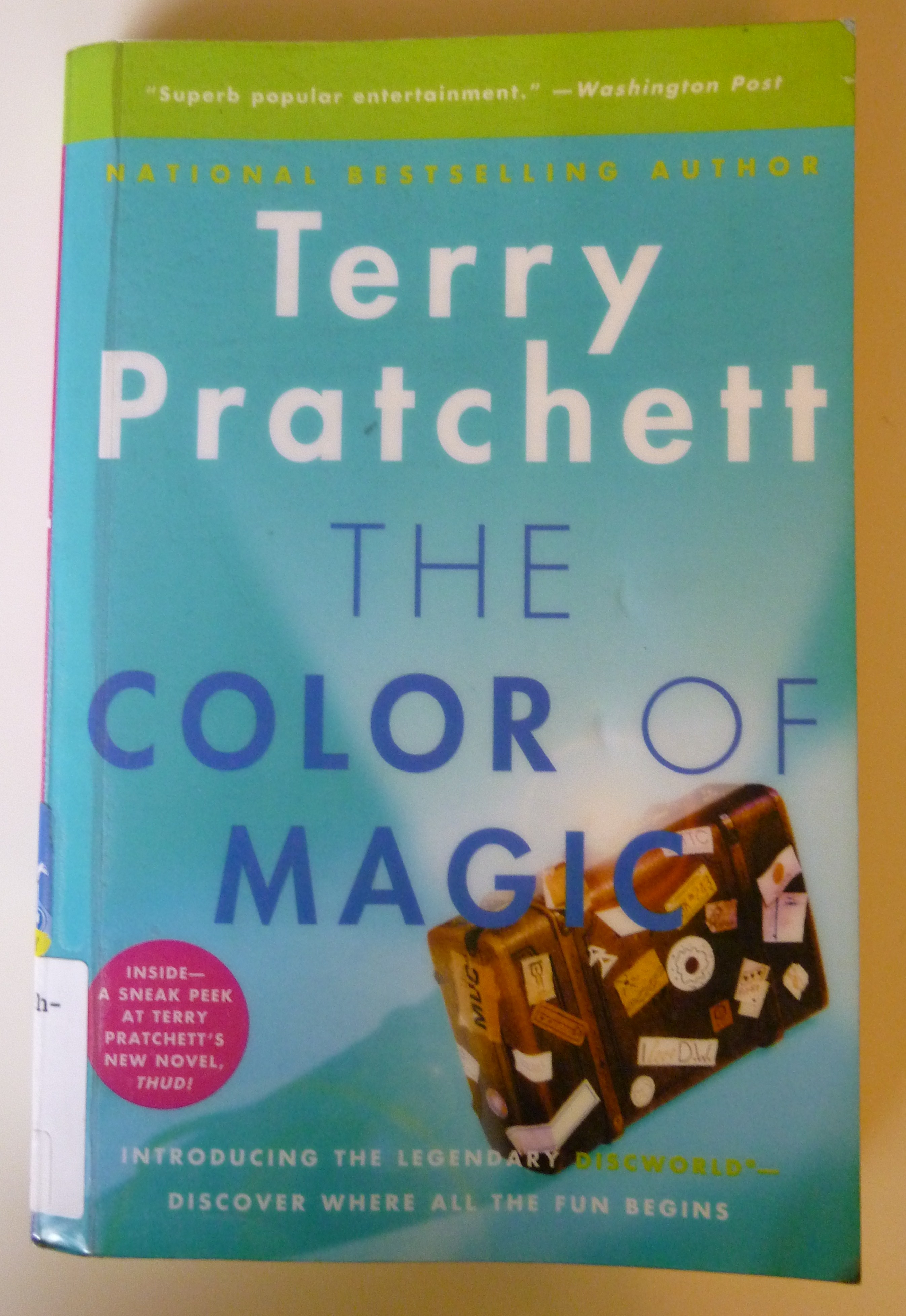
I’ve read upwards of ten books in Terry Pratchett’s Discworld series, but until recently I hadn’t actually read book one, The Colour of Magic.  It’s one of those series where you can really drop in at any point (though some books are better starting places than others).  I think there are over thirty books in the series, so if you, like me, feel a little baffled at where to begin, don’t bother–just grab something and go (though I recommend Guards! Guards! or The Truth as good starting points).  Or, of course, you could start with #1.
The Colour of Magic introduces us to Discworld, an alternate world which exists as a flat disc, riding on the back of four elephants, who are on the back of a giant turtle.  That right there may give you some idea of what we’re dealing with–a truly bizarre and wonderfully hilarious world.

The Colour of Magic begins in the ancient and cheerfully corrupt city of Ankh-Morpork, where Twoflower has come as the Disc’s first tourist, thrilled by the quaint bars and eager to meet heroes and see real Ankh-Morporkian brawls.  Rincewind the not-very-good wizard ends up roped in as his guide, and they embark on a perilous and hysterical adventure around the Disc.

It sounds almost reasonable, until I mention that Twoflower is followed everywhere by an animate trunk with hundreds of legs known as The Luggage, Death shows up every so often and is rather put out that Rincewind keeps stubbornly not dying, and at one point they encounter imaginary dragons who live inside a giant inverted mountain.  And that, of course, is only the half of it.

If you’re having a gloomy, depressing day, read a Discworld novel.  It will brighten everything.  Pratchett’s books are gritty but hilarious, have a grown-up feel but aren’t really inappropriate for young adults either.

There’s a vast cast of characters who wander in and out of the Discworld novels, and there are some subseries within the larger series (although good luck finding a comprehensive, helpful list of which books fall into which subseries), which focus on particular groups of characters.  There are the witches; the City Guard; the magicians; and let’s not forget Death.  I’m especially attached to the City Guard, led by noble but cynical Sam Vimes.

The Colour of Magic doesn’t focus particularly on any group of characters I recognize from later books, but it will definitely give you a solid introduction to the world of the Disc.

And, a random story: years ago I was on a bus, and overheard a couple of people talking about a book.  A wizard wound up in a tree, and was being visited by what seemed to be Death, but turned out to be a non-fatal disease.  The wizard objected that no one died of that disease, and he couldn’t be killed by him.  Sounds fun, right?  Of course I didn’t hear the book title, and I didn’t ask, and despite a little Googling I never could figure out what the reference was.  But now I’m reading along through The Colour of Magic and lo and behold: Rincewind lands himself in a tree, a cloaked figure appears with a scythe–but it’s not Death, it’s Scrofula.  Death was busy.  Rincewind objects, “I can’t die of scrofula!  I’ve got rights.”

Long-time mystery solved.  And almost as randomly as Discworld itself.