It Was a Dark and Stormy Night

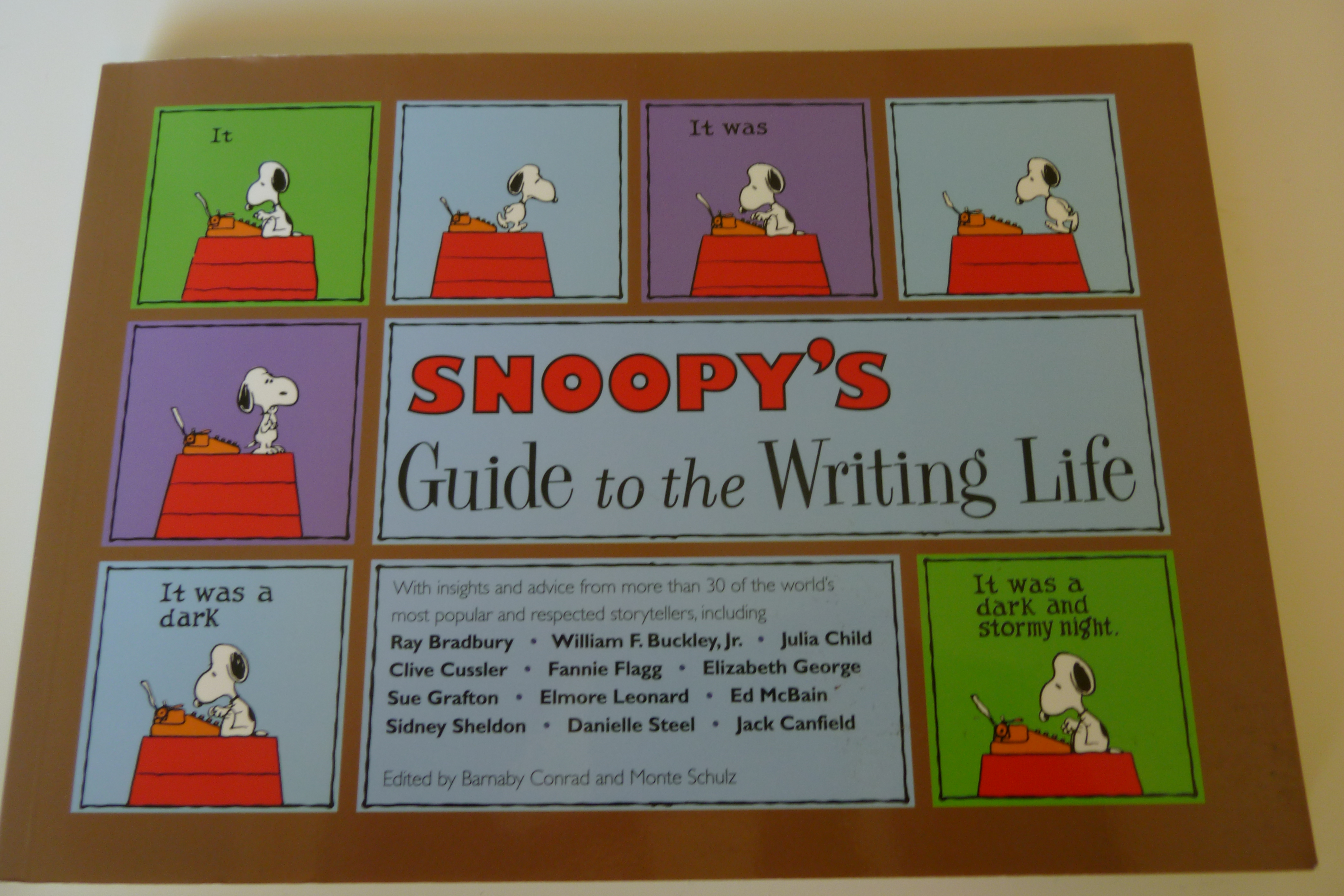
Everybody loves Peanuts, right?  And I don’t think you can love Peanuts without loving Snoopy.  Snoopy has long been one of my favorite comic strip characters, mostly because of his wonderful flights of imagination.  Enjoying writing as I do, you’d think I’d jump at Snoopy’s Guide to the Writing Life, edited by Barnaby Conrad and Monte Schulz.  So there’s a bit of mea culpa here when I admit that this was a Dusty Bookshelf Challenge book.

How long has it been on my shelf? I honestly don’t know.  It’s been sitting on a rarely-visited bookshelf for what feels like always and must have been at least a few years.

I almost never buy unread books, so how did I get it? I don’t know…somehow I got it, and I don’t remember how, so I hope it wasn’t a gift from someone who reads my blog!

Now that I’ve read it, am I keeping it? Yes, mostly because the comic strips are so fun.  More on that in a moment.

I’m counting this one for my Nonfiction Challenge too, because it’s certainly not a novel, and there’s enough text that I don’t think it has to be considered a comic strip collection either.

As Snoopy fans know, the famous beagle aspires to be a famous author.  Thus the iconic image of Snoopy sitting on top of his doghouse, typing “It was a dark and stormy night” on his typewriter.  This book brings together numerous writing-related Peanuts strips, with brief writing advice from 32 authors.

The book starts a bit slow, or maybe just takes too long to get going.  There’s a foreword from Monty Schultz (Charles Schulz’s son) and an introduction from Barnaby Conrad, both about Charles Schulz and writing.  The topic is interesting, but I think they would have done better to have one of them write, or to maybe move one essay to the end.  It’s too much on one subject, while we’re waiting to get to the main event.

But once we do get to the main event, the Peanuts strips and the writing advice, it’s a lot of fun.  I don’t think any of the writers put something down here that was life-changing for me, but they have good advice about writing and publishing, or sharing their writing adventures or the adventures of other writers they’ve known or admired.  I’m always interested in other writers’ processes and experiences.  Some of the advice ties directly into a particular Peanuts script, which is especially engaging.

The best part of the book, though, was the Peanuts comic strips.  It’s all about a beagle tapping away at a typewriter, and yet Schulz managed to get at essential truths of the writing life, and be very funny besides.  It may be an odd thing to say about an aspiring writer beagle, but Snoopy’s experiences are universal.  The struggle to begin, the difficulty of finding the right word, the well-meaning but ill-placed advice from others, the love of your own words even when you know (or suspect) they’re not very good.  Who hasn’t written something awful that nevertheless made them laugh, making it very hard to let go of?  Snoopy does a whole series of really horrid puns at one point: Edith had refused to marry him because he was too fat.  “Why don’t you go on a diet?’ a friend suggested.  ‘You can’t have your cake and Edith too.”

Some of my favorite strips are when Snoopy tries to sell his stories, and keeps getting vast numbers of dreadful rejection slips.

Dear Contributor, we have received your latest manuscript.  Why did you send it to us?  What have we ever done to hurt you?

Dear Contributor, we are returning your worthless story.

Dear Contributor, we’ve seen better writing on license plates.

In my experience, agents and editors are actually extraordinarily polite in their (form) rejections, but Schulz has still captured what it feels like!  And Snoopy’s responses are spot-on too.

Dear Editor, why do you keep sending my stories back?  You’re supposed to print them and make me rich and famous.  What is it with you?

I’m also a bit amazed by the level of the literary references in some of these strips.  Snoopy frequently aspires to be Leo Tolstoy, and there are references to Thomas Hardy, F. Scott Fitzgerald, Little Women, Moby Dick, Ben Hur…  Peanuts is wonderful proof that comic strips can be intelligent and insightful–and funny, of course!

In some ways, this book really is more of a guide to the writing life than to writing.  I don’t know that I learned much about writing, but it was good to see that even Snoopy experiences the same ups and downs of the writing life!

Peanuts website: http://www.peanuts.com/

Other reviews:
1st Writes
Perpetual Folly
The Trendsetter
Anyone else?

The Witch’s Daughter

Today’s short story is another one from my NaNo novel, told by my storytelling main character, Lyra.  You don’t have to know any background, except perhaps that her stories are heavily influenced by the Brothers Grimm, so feel free to skip on down to the story if you like.  There is a little context that may be interesting though.

The non-NaNo novel draft I’m working on is about Jasper, a wandering adventurer, and Julie, a girl he rescues who ends up traveling with him.  There’s also Tom, a talking cat.  In one chapter, they go to the castle of the Twelve Dancing Princesses, which then became the basis for my NaNo novel, telling the story from one princess’ point of view.  Lyra spends some time talking to Julie, and learns a little about her–her mother was a witch, her father taught her to read, she has a conceited orange cat and Jasper can’t read.  Lyra goes on to make up a story about Julie and Jasper to tell her sisters.  Because she doesn’t know much, it bears only slight resemblance to the story in my other novel.  But it was fun to take several of the same elements, and throw them together into a new story.

So here is Lyra’s mostly untrue story about a witch’s daughter and a wandering adventurer.

********************************

The Witch’s Daughter

I told a tale that began once upon a time not too long ago, about a girl whose father taught her to read.  The girl’s father died when she was still quite young, which left her alone with her mother.  This was doubly sad, because her mother, it turns out, was a witch, in every sense of the word.  She was far more interested in her magic and her spells than in her daughter, and the girl was mostly left to herself.  She explored the crumbly old castle they lived in, and read every one of her father’s books.

In due time, the girl grew up into a young woman, one who dreamed of escaping her mother and finding her own path through the world.  Since she had never been beyond the castle and knew no one else, she was afraid to run away alone.  She was also afraid that her mother would catch her, as a witch has many resources to hand.  And if she caught her, there were far too many horrible things she could do.  But the girl was smart, and patient, and so she waited for her opportunity to escape.

One dark night there was a terrible storm, and out of the midst of the storm there came a man on horseback who had lost his way.  He came to the castle to ask for shelter.  The witch saw that he was young and strong and there were many uses she could find for one such as him.  The girl saw that he was handsome, with hazel eyes.  The witch invited the young man in, and told him he must stay until the storm was gone. Continue reading “The Witch’s Daughter”

Quotable Mark Twain

“I have had a ‘call’ to literature of a low order, i.e. humorous…to seriously scribbling to excite the laughter of God’s creatures.”

– Mark Twain

The Girl Who Followed the Birds

For Fiction Friday this week, I have another story-within-a-story from my NaNoWriMo novel.  Within the novel, this story reveals quite a bit about how my lead character is currently feeling about her life and especially her love interest.  Outside of the novel, it is, I hope 🙂 an entertaining Brothers Grimm-esque fairy tale.

**********************************

The Girl Who Followed the Birds

This is a story about once upon a time in a mountain village.  It was a small village where there lived simple people.  They knew their mountains, they knew their business of goatherding and farming, and they knew each other.  They knew very little else.  In this village there lived a girl, who all her life had known how the rest of her life was likely to be.  Her parents raised goats and a few crops like everyone else, and she did her part to help.  Someday she would marry the boy who lived next door, and they would have their own cottage and their own goats and plot of farmland, and so would their children after them.  It wasn’t that she had to marry the boy next door, but they had lived and played and grown together all their lives; she had always expected she would marry him one day, in an abstract sort of way.  One spring morning when they were both sixteen, he offered her a cluster of blue mountain flowers and she looked into his blue eyes and the abstract became the very real and she knew that she didn’t only expect to marry him, she very much wanted to—someday.

It was a fall day when her sweetheart asked her to marry him, and he would have said that it was a perfect and beautiful day.  It was also a day when the birds were in the village. Continue reading “The Girl Who Followed the Birds”

The Lazy Girl and the Enchantress

As you know if you were reading this blog during November, I wrote a retelling of “The Twelve Dancing Princesses” for National Novel Writing Month.  My narrator, Lyra, was a storyteller, so within the novel I wrote several short stories for her to tell.  I want to share one with you today–you may recognize the beginning, as I put up an excerpt in November.  But today I’m posting the whole story.  🙂

Writing stories for Lyra was particularly interesting, because I had to think about the kind of stories she would tell.  For one thing, she has a more poetic style than I do (if that makes any sense!)  She also lives inside of a Brothers Grimm story, and has been reading that type of story her whole life.  So when I wrote stories for her, I wanted to create something that was very Brothers Grimm-influenced, but hopefully makes a bit more sense to a modern audience!

This story isn’t based on any particular fairy tale, but throws some traditional elements together–with twists.

*****************************

Once upon a time, there was a shopkeeper’s daughter who was very beautiful.  It was a sad fact that because she was beautiful, people’s automatic inclination was to do things for her.  That might not have been so bad in itself, but she had realized this tendency early on and loved to take advantage of it.

When her mother asked her to clean the house or to help with the laundry, she’d make endless excuses to get out of it, preferring to spend the time combing her hair or trying on different dresses.  When her mother did insist on her working, she was so slow about it that the good woman would eventually give up in exasperation and do the job herself.

When her father asked her to mind the shop, she would avoid helping customers if at all possible, and when she couldn’t avoid it she was as slow as you could imagine.  She asked the customers to pack up their own purchases and couldn’t be bothered even to do the counting to hand out change.  You may expect that service was slow and the customers ended up waiting around, whenever she was minding the shop.  The men, however, so enjoyed looking at her that they didn’t often complain.  Her father still knew that he was losing business because not everyone was willing to wait—and he wasn’t winning customers to his shop from the women in town.

One day the prince of that country passed through the town and his party stopped at the shop to buy fresh supplies for their journey.  It happened to be a day when the girl was (in theory) helping in the shop.  The prince saw her, and was sure that he had never seen anyone so beautiful, which may have been true.  He had been reading too many stories, and become convinced that such a beautiful face could only indicate a kind nature, a worthy spirit, and a personality that would match his own—in other words, that her beauty proved she was his soul mate, which it didn’t at all.

He proposed to her at once.  She was lazy but she wasn’t stupid, and she was quite sure that the wife of a handsome prince would have all the dresses she could ever want, and no work to do at all.  She accepted, and off they went to the royal castle. Continue reading “The Lazy Girl and the Enchantress”