A Merry Christmas, Mr. Scrooge

I think everyone has a holiday story.  That story that you have to go back to every year, or you’ll feel like you haven’t really celebrated Christmas (or Hanukkah or Kwanzaa–my experience is with Christmas, but I’m guessing it’s a universal thing).

Even though I’m such a big reader, I have to admit my main Christmas stories are movies.  It’s a Wonderful Life, White Christmas, and Holiday Inn.  And, of course, Charlie Brown’s Christmas Special.  (And as a side note to the main point of this post, thank you, Charles Schultz, for insisting on making the special your way when the network wanted you to leave out the scene when Linus recites from Luke’s Gospel.)

But there is one book.  At the risk of being almost too traditional here: A Christmas Carol by Charles Dickens.  From the classic first line, “Marley was dead” to the classic final line, “God bless us, every one” it’s such a perfect book for Christmas.

Even though I like twists on traditional stories, I don’t like people to twist things too far.  I guess at heart, I’m ultimately a sentimental traditionalist, especially when it comes to Christmas stories.  I just read Holidays on Ice by David Sedaris (a book I won’t be reviewing here because it’s not young adult), and it’s very much a collection of non-sentimental, non-traditional, non-heartwarming Christmas stories.  I enjoyed it on some level…but it also kind of made me want to run out and read A Christmas Carol.

Because on Christmas, I want to read a story about the virtues of generosity and loving thy neighbor and realizing that family is really what’s most important.  I want a story where the crotchety old man realizes that if he just extends a hand, people will be nice to him in return and welcome him into their family and everyone can live happily ever after.

Actually, I like that kind of story all year ’round.  That’s why I read young adult books.  But I especially like it around Christmas.  And around Christmas, it’s even better when you can throw in wintry, Dickensian things like brass door knockers, and bed curtains, and big turkeys, and gruel, and clanking ghosts, and little British boys who say things like “Walk-er” (which no one seems to know the meaning of).

So when I want to read a really good Christmas story, that’s mine.  What’s yours?
Finding the Way Back to Neverland

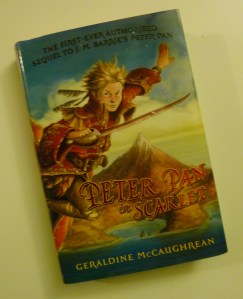
As a general rule, I’m against sequels to classic novels written by new authors, especially when the primary appeal of the original was the author’s voice.  How do you ever do that right?  I’ve only see it happen once.  Peter Pan in Scarlet by Geraldine McCaughrean is a beautiful sequel to Peter Pan.

I give a lot of the credit to her–and a lot of the credit to the way the sequel came to be.  That’s a fascinating story too.  In 1929, J. M. Barrie gave the rights to Peter Pan to the Great Ormond Street Hospital for Children, meaning that they receive all the royalty money, as well as controlling the rights.  Several years ago they held a contest inviting authors to submit a sample chapter and synopsis for a sequel.  All of this means that the people involved in the publishing had a primary interest, not in a later version, but in the original work–and you can tell.

I can’t say that Peter Pan in Scarlet feels like J. M. Barrie is telling the story, but I feel like the story is very much about the world and the characters that he created.  McCaughrean has done a very impressive job at staying true to the story J. M. Barrie gave us, and yet giving us another story that is, I think, what we all want.

Mr. Barrie was in some ways not kind to anyone who wanted to follow him with a sequel.  He left a lot of challenges behind him.  To name the chief ones–he killed off his villain, he grew up his supporting characters, and his heroine was rather annoyingly maternal all along.  So what is a sequel-writer, saddled with Wendy and knowing that readers really want to see Peter Pan and the (grown-up) Lost Boys fight (the deceased) Captain Hook, to do?

McCaughrean handles it all neatly and effectively, and with the kind of magical and whimsical solutions that are worthy of Mr. Barrie.  I don’t want to give it all away…but I can’t resist just a little.  Suppose a person wants to get back to Neverland but you can’t depend on Peter to show up at your window, how do you go about it?  Well, you’ve got to find a fairy for their dust, right?  And the best place to look…Kensington Gardens, of course.  And the way to find a fairy is to find a baby out with its nurse, and to catch the baby’s first laugh just as it turns into a fairy.  Brilliant, magical and whimsical.

Peter Pan in Scarlet opens with Wendy and the Lost Boys as grown-ups, but they’ve begun to dream about Neverland again.  They decide that something must be wrong, that perhaps Peter is in trouble.  They have to find a way to become children again so that they can return to Neverland and help him–and from there the adventures begin.  In Neverland they find that summer has turned into autumn, and something seems to be inexplicably wrong.
McCaughrean even handles Wendy well, successfully portraying her as simply a rather practical-minded child (after the grown-ups become children again), rather than a child who wasted all her time in Neverland darning socks.

After we return to Neverland and find everyone’s favorite Wonderful Boy, the adventures are “nicely crammed together,” and we have the chance to explore the greater geography of the magic lands.  Everyone’s favorite pirate captain appears too.  Again McCaughrean finds a way to stay true to the end of Mr. Barrie’s book, where the Crocodile eats Hook, and yet still bring the villain back.

Even if there was nothing else in this book to recommend it–which is obviously not the case!–there is a single line in here which would alone put it miles above Peter and the Starcatchers in my estimation.  At one point in the book, Wendy tells Peter and the Lost Boys a fairy story about a little white bird in the Kensington Gardens.  We don’t hear the story; we don’t even know what the story is supposed to be about.  But that doesn’t matter.  McCaughrean knew that a little white bird in Kensington Gardens is significant in Peter Pan lore.

Thank you, Geraldine McCaughrean, for knowing what you’re writing about, and for writing it so well.

Author’s site: http://www.geraldinemccaughrean.co.uk/

Meeting Captain Red Ballantyne

This week, I’m sharing the opening chapter of a novel I wrote set in the Caribbean during the Golden Age of piracy.  This chapter introduces you to my two main characters, Red and Tam.  I will probably share a few more of their adventures in later Fiction Fridays.  I hope you enjoy meeting them.

*******************************************

            “Are you Captain Red Ballantyne?”  I tried not to sound eager.  I failed.

             He studied me, brown eyes looking over the rim of his drink, and one corner of his mouth twisted up in a sardonic smile.  “That depends, lad,” he drawled.  “Did a woman send you, and did she look mad?”

            I had expected something less colorful.  Something like “yes.” The truth was, I already knew that he was Red Ballantyne.  That had been obvious the moment he came into the tavern.  The tavern girls knew him by name, had greeted him with enthusiasm, and several were sitting giggling at the back corner table with him.

            “Red, be nice,” the blonde on his left said, in a scolding voice that wasn’t really a reprimand.  I didn’t know her name.  The girls in there mostly ran together for me. “Don’t tease the poor boy.”

            “Who’s teasing?  A man’s got to watch his back,” he said, giving her a look entirely different from the one he’d flicked towards me.  It was the kind of look that meant he was going to forget I existed in another four seconds.

            It had taken me an hour to find a chance to sneak out of the kitchen, where I was supposed to be washing dishes.  I wasn’t willing to be forgotten that fast.  “A woman didn’t send me,” I said.  “The British Navy didn’t either.”  I figured those were the ones he really ought to worry about, so maybe I should rule out their involvement too.

            “I am an honest businessman with no personal interest in the armed forces of any country,” Red said, even more quickly than I’d spoken.  All of us, him, me, and all three girls—based on their expressions—knew that he was lying.  “I am interested in more drinks, though.”

Continue reading “Meeting Captain Red Ballantyne”

The Story That Didn’t Come Before Peter Pan

I might like Peter and the Starcatchers by Dave Barry and Ridley Pearson much better if it didn’t claim to reveal the story that came before J. M. Barrie’s Peter Pan.  As an independent adventure/fantasy story, it’s perfectly decent.  As a prequel to Peter Pan, it’s a lot of claptrap and nonsense that at no point convinces me anyone anywhere involved in the project ever so much as read J. M. Barrie’s Peter Pan.

There is a wonderful story that comes before Peter Pan.  It’s called The Little White Bird and J. M. Barrie wrote it himself in 1902.  To come along a century later and claim you’re writing a prequel without apparently doing any research is ridiculous, and insulting to Mr. Barrie.  Especially when the only research really required would be to read two books.  That’s hardly an exhaustive amount.

Mr. Barrie didn’t include a lot of details about Peter’s past life, but he did include some.  As far as I can tell, Peter and the Starcatchers ignores all of them.  The basic premise of the novel is that there is something called starstuff (strongly resembling fairy dust) loose in the world.  Peter is a member of a group of orphan boys.  The orphans, the starstuff, and a couple of factions fighting over the starstuff end up on an island somewhere.  When the starstuff gets loose, the island begins to transform into a magical place, not to mention changing Peter so he’ll never grow up.
If you’re not already spotting why most of this is an utter travesty on the original book, allow me to explain.  One–Peter was not an orphan.  It is clearly related that he ran away from home very shortly after he was born because he didn’t want to grow up to be a man–and he knew he would if he stayed because he heard his parents talking about it.  Two–Peter doesn’t grow up because he doesn’t want to.  You can take it two ways: either he forever rejected the idea of growing up the day he ran away, or he continues to reject it daily and his imagination is strong enough to make it actually happen.  Either way, it’s about Peter’s choices and his imagination.  Three–it’s pretty clear that the magical dust floating around is a byproduct of fairies, not the other way around.

These are central ideas to the Peter Pan mythology, and to ignore them from the onset creates overarching problems with the entire concept of the book.

It doesn’t get better in the details.  In Peter and the Starcatchers, Peter cuts off Hook’s left hand.  Whoops–in the original, Hook’s right hand was cut off.  Perhaps that’s nitpicking, but I’d say it demonstrates something about the amount of care taken.  If the rest of the book was true to the original I’d forgive the wrong hand, but when the rest of the book isn’t, all it does is exemplify the problems.

But you know what possibly annoys me the most?  There’s a scene in Peter and the Starcatchers where starstuff is put in a bag along with a bird, and out pops Tinker Bell.

The problem?  There is NO NEED to reveal how fairies came to be.  Because Mr. Barrie already told us that!  “When the first baby laughed for the first time, its laugh broke into a thousand pieces, and they all went skipping about, and that was the beginning of fairies.”  Now, when every baby laughs for the first time, its laugh becomes a new fairy.  Given the choice between the charming whimsy of laughter becoming fairies, and the painful practicality of smothering a bird with starstuff…well, that’s not much of a choice.  And you can’t claim to be in Mr. Barrie’s magical world and then just disregard every rule he wrote for it.

I know from looking at the bookshelf at the bookstore that there are two or three more books in the series.  I haven’t read them, so I can’t comment on them.  But after reading the first, I’d be shocked if the later ones did any better at drawing from J. M. Barrie’s books.

There is room in the world for a new prequel to Peter Pan.  There’s a gap between The Little White Bird and Peter Pan, and in that gap Peter learned to fly, went to Neverland, and met Tinker Bell and the Lost Boys.  I would love to see a well-done book that reveals that story.  But Peter and the Starcatchers is not that book.

One of Those Books About the Civil War

Across Five Aprils by Irene Hunt is one of those books.  Not a bad kind of those books.  One of those books that shows up on class reading lists and in books reports and that everyone seems to know the title of.  I wish I’d liked it better.

Even as one of those books, I somehow never actually read it in school.  I probably listened to an oral report or two, but I don’t remember them clearly (I remember endless reports on Harry Potter, but that’s another story).  Somehow, Across Five Aprils never came my way, so I decided to pick it up recently–mostly because I knew it was one of those books and I thought maybe it would be worth forming an acquaintance.

If you’re also unaquainted, Across Five Aprils covers the five Aprils of the Civil War, told from a farm in Illinois and mostly from the point of view of Jeth, too young to go to war and thrust into responsibility for the farm when his older brothers all go to fight.

I liked the book well enough, and there were were some good parts in here, especially in connection to Mr. Lincoln.  That leaves me the task of sorting out why I didn’t like it better.  Maybe it’s the hazard of covering five years in a fairly slim volume.  By necessity you have to summarize past days and weeks and months, and only occasionally dip into more detail.  I’m left with a feeling that I couldn’t get down into this book, that it was too much summary.  Even though I know there were scenes that were more detailed, I feel as though the whole thing took place on a surface level.

Another matter probably comes down to personal preference.  When I read historical fiction, I don’t like my history to get in the way of my fiction.  I’d like to learn something, but I’d rather not notice too much that I’m doing it.  Remember that this book is set on a farm–we’re not actually out engaged in the Civil War.  And yet the story stops for paragraphs and pages at a time to discuss the progress of battles and which general has been promoted and demoted and who’s advancing where.  It’s at that point that I start to feel the history is being foisted on me.

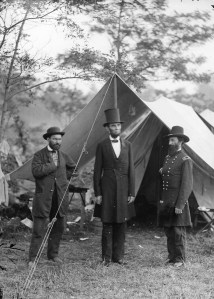
I think a fair comparison to make here would be with L. M. Montgomery’s book, Rilla of Ingleside.  It’s set during World War I, but takes place on the Canadian homefront.  Again, we’re not on the front lines, and yet we hear about every town that is taken, every time the line moves forward or back, every decisive battle–but it works.  Because the story doesn’t stop for the narration to tell us that the Germans captured a town.  Instead, the next event in the story is when one character comes flying into the kitchen to tell the other characters what the newspaper says today.

I feel arrogant saying this, when I’ve got a review from The New York Times reading “An intriguing and beautifully written book” staring up at me from the cover of Across Five Aprils, but I just don’t think the mix of fiction and history was handled all that masterfully here.  If you know a kid with an interest in the Civil War, then I do think I could recommend this book.  But you have to have that interest, because rather than fiction with a historical backdrop, this is definitely history told through fiction.