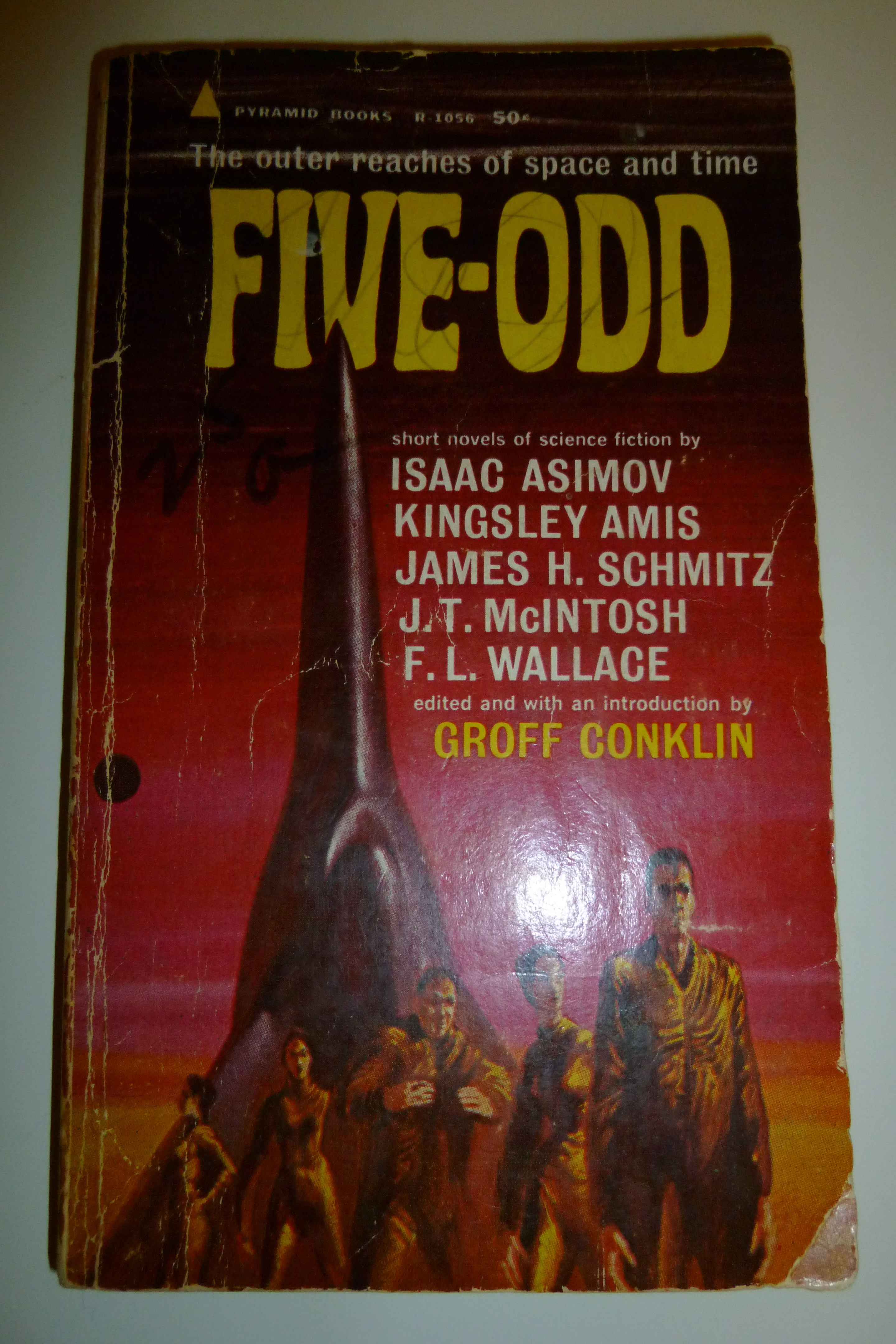
 I finished my first book of 2012 and, feeling very virtuous, I managed to make it one which applied to two of my challenges! Five-Odd, a collection of five (longish) short stories, edited by Groff Conklin, applies to both the Sci-Fi Experience and the Dusty Bookshelf Challenge.
I’ve decided Dusty Bookshelf reviews deserve a little back-story.
How long has it been on my shelf? Since August, 2011, so about four months.
I almost never buy unread books, so how did I get it? My Book Club had an all-holiday party in August (because there aren’t any major holidays in August), and I picked this up at the White Elephant gift exchange.
Now that I’ve read it, am I keeping it? I haven’t decided. I liked it–but I have high standards about what books I own. I’ll see how I feel about it when I have a little distance–say, next month.
Five-Odd is a nice mix of intriguing technology and of philosophy. It’s definitely not action-adventure sci fi. Most of the stories are about futures not so different from our present, except for some crucial advance in technology, and changes in thought because of it. Almost every story made me think about some aspect of the world and, more often, of humanity.
Isaac Asimov’s “The Dead Past” asks whether the past really is dead, while also looking at government repression and the end of privacy–but not at all the way that sentence makes it sound. The story centers around a fascinating device that will let anyone look at past moments.
“Something Strange” by Kingsley Amis felt like the weak link here to me. It’s about four people living together on a small space station, but the characters were too surreal in some ways, and then the story ended just as it felt like it was coming to the most interesting part.
J.T. McIntosh’s “Unit” addresses a question about identity. It then veers off into a story more about prejudices, piracy and collaborative intelligence, which was also interesting though I would have liked more about the idea the story started with–about people who choose to wipe away their entire past, and be entirely remade as new people with new personalities.
“Gone Fishing” by James H. Schmitz is about a conman who thinks he’s going to steal a transporter device from a befuddled scientist, only to wind up stranded on a distant planet for five years. The transporter was interesting, but more interesting was the idea of how he would cope with five years of solitude.
“Big Ancestor” by F. L. Wallace is set the farthest in the future, when humans from Earth have reached the stars, and met humans from a hundred other planets. A team of scientists from various planets goes in search of their common ancestor. There’s an excellent twist to this, and I recommend not reading Conklin’s introduction, which blatantly hints at it. There’s also an interesting passing line here, when one human mentions that most of the human races discovered space travel on their own, and then they helped the ones that didn’t. After all my years of hearing about Star Trek‘s Prime Directive, General Order Number One, to never ever ever ever interfere with less developed races, this was shocking. And yes, I know Star Trek does it all the time anyway 🙂 but it felt very different hearing it as an accepted thing!
I felt a little doubtful about reviewing this one because I wondered how easy it would be for anyone to find it. But it turns out it’s available cheap on Amazon if you do want it (and no one paid me for that link!) If you like philosophical sci fi, it’s a good read. The stories were written in the ’50s and ’60s and have that flavor. I don’t know that I’d call them sci fi classics, but they are classic sci fi…if you see the distinction there! 🙂
 Tales of the Marvelous
Diane’s right! The major appeal of the genre for me is that it examines humanity’s issues, often in a more futuristic setting. I love the depth of thought-provoking ideas in sci fi and that authors aren’t afraid to ask “what if…?” (which is probably why I’ve never really been a fan of sci fi short stories). They always leave me dissatisfied and wishing the idea had been more fleshed out
Sounds like a lot of these stories had interesting ideas that they didn’t develop fully. Sometimes sci fi isn’t really about the technology at all but the deeper issues of human existence set in a futuristic time. These stories seem to have fallen short in that regard.
Actually, I thought a lot of them got at some very interesting deeper issues. Some of those issues could have been developed further, but they at least touched on intriguing ones. Part of it may be the hazard of short stories too! There’s less time to develop ideas fully than in a novel.