Meeting a Ghost Girl Through a Twist in Time

Twist in TimeBetween Narnia, Bloody Jack, Doctor Who and Agatha Christie, I seem to listen to a lot of audiobooks with British narrators.  This is not a problem!  The trend continued, more or less by accident, when I pulled A Twist in Time by Jean Ure off the shelf at the library.

Cosy (Cosima) has her life turn upside down when her emotionally fragile mother has to go into hospital, and Cosy is sent to a foster family.  Quiet, introspective Cosy finds herself overwhelmed by the new house and new family, especially the boisterous girls Jade and Gemma.  A new school and challenges with maths [sic] doesn’t help.  Her one consolation is when she begins seeing a “ghost girl” in her room; Kathleen had the same room in the 1940s and, by reading her journal, Cosy realizes that Kathleen is seeing a “ghosty-person” too.

With lots of British slang or wording (like “maths” and “hospital” without “the” before it) this has a very strong British atmosphere that, for me, helped bring Cosy’s world to life.  I expected the book to focus mostly on the ghost girl element, so I was surprised by how much it focused on Cosy’s present-day situation–but that was vivid and meaningful so even though it might not have drawn me to pick up the book to begin with, it ended up being a powerfully engaging story.

I always enjoy stories about shy heroines who have to find their courage, and Cosy is an excellent character of that type.  She has particular nuances and complexities through her relationship with her mother, and her conflict between wanting to fit in with wild Jade and Gemma, and wanting to do well at school to keep her scholarship.  Cosy struggles with her identity and her relationships, a story told in a very moving way.  The situation with her mother is also delicately handled, revealing details slowly at the beginning of the book, and finally exploring more of that relationship through a fictional story Cosy writes.

The ghost girl has her own story, which we catch glimpses of.  Even though she wasn’t as prominent an element as I expected, she added some interest to the story as well.  There are also some subtle indications that seeing the ghost girl is doing more for Cosy than it appears on the surface.  The obvious surface help the ghost girl provides is to help Cosy with her maths–which is sending Cosy into fits of crying and frustration.

I do remember how life-and-death homework could feel at eleven years old (especially since Cosy worries about losing her scholarship) but at the same time it occasionally feels overdramatic.  However, I’m inclined to believe that maths is not really maths, and Cosy’s tears, while set off by algebra, are more about her larger situation.  From that perspective, the whole thing makes more emotional sense, and the ghost girl’s role has far more meaning.

I was impressed especially by the audiobook reading as well, done by Kim Hicks.  Though everyone sounds British, Hicks gives different accents to different characters.  It’s not taken to an exaggerated extreme, but Cosy (who’s teased about talking posh) does sound different than her working-class foster parents.  In fact, Auntie sounds remarkably like Jackie from Doctor Who, which makes a good deal of sense!

If you enjoy a bit of British flavor, a shy heroine and just a little magic (or is it science fiction?) then I definitely recommend this story.

Author’s Site: http://www.jeanure.com

Other reviews:
Tara Calaby
That was all!  Anyone else?

Buy it here: A Twist In Time

Top Ten Tuesdays: Books Requiring Tissues

toptentuesdayHosted by The Broke and the Bookish, this week’s topic is: Ten (Eight) Books That Will Make You Cry

I didn’t make it to ten on this one, because mostly I like books that make me happy…but I did manage to come up with a handful of beautifully tragic ones!

1) Les Miserables by Victor Hugo – Life is just so hard for everyone.  You’ve heard “I Dreamed a Dream,” right?  Then there’s the entire last 30 pages where I just want to weep over Jean Valjean and his wretched stubbornness about self-denial.  And, and, and…Gavroche, and Eponine, and Enjolras, and M. Mabeuf, who grows poorer and poorer and finally sells his last book.  Not quite on the level of Fantine, of course, but book-lovers will understand!

2) The Phantom of the Opera by Gaston Leroux – For most of this book, the Phantom is a straight-out monster, simple and unlikable.  Then Leroux finishes with a tragic scene of the Phantom talking about how he felt when he let Christine go…and I have to conclude that Leroux meant us to pity the Phantom after all.

3) The Hunchback of Notre Dame by Victor Hugo – You know that nice happy ending spin that Disney puts on it?  Yeah.  That doesn’t happen.

4) The House at Pooh Corner by A. A. Milne – This one is sad in a very different way.  In the last chapter, Christopher Robin comes to tell the animals that he’s going away (to school, I assume), and he won’t be able to come play with them anymore.  He tells Winnie the Pooh to go out to the Enchanted Place sometimes and remember him, and he’ll be there really.  And it’s just heart-breaking…even though everybody does have to grow up, of course.  Which brings me to the next book…

5) Peter Pan by J. M. Barrie – The end of the story gives us a brief account of the Lost Boys when they became adults.  It begins with the sentence “All the boys were grown up and done for by this time; so it is scarcely worth while saying anything more about them” and concludes with “The bearded man who doesn’t know any story to tell his children was once John.”  Christopher Robin’s growing up feels like the natural sadness of something inevitable; this feels like a very morbid view on the whole thing, which mostly makes me sad for J. M. Barrie, if this was really his feelings on what it meant to grow up.

6) The Giving Tree by Shel Silverstein – Another kids’ book with a tragic air.  Between the poor, self-sacrificing tree, to the boy who keeps taking and taking and taking and finally winds up as a sad old man with an empty life…  I’m not even sure what the message here is supposed to be, other than that life is hard and also, we’re destroying the environment.

7) The White Darkness by Geraldine McCaughrean – This one only half counts, since the book doesn’t actually make me terribly sad at any point.  But–because of this book, the sentence “I am just going outside and may be some time” puts a (mostly metaphorical) lump in my throat every time I think of it.

8) Phantom: The Story of His Life by Susan Kay – This is sort of the same as #2, but not!  It’s the story from birth to death of the Phantom of the Opera, and there are different emotional moments than Leroux provided.  Erik’s childhood is so sad (first his mother refuses to kiss him on his fifth birthday, and then his beloved dog dies…)  The part that always gets me, though?  Erik is trying so hard to be hopeful about Christine, and the only prayer he can come up with is an echo from childhood: Please, God, let her love me and I’ll be good forever.  Which is heartbreaking enough, but then he decides to go up to the Opera’s roof to pray, thinking God will hear him better from there.  And Christine and Raoul are also on the roof, and…  Well.  I’m very, very sad for him.

Are we all reaching for tissues by now?  Perhaps I should send you to some funny Discworld moments!  Or leave a comment and share about your favorite, beautiful sad books.

If Heaven Had a Telephone

First Phone Call from HeavenI don’t generally think of Mitch Albom when I think of authors I read–but when I do think about it, I’ve read and enjoyed a good bit of his writing.  So when I heard he had a new book out, I got into the (long) library hold list for The First Phone Call from Heaven.  I am happy to report that this is probably my favorite Albom book yet.

In a small Michigan town, several residents begin receiving phone calls from deceased loved ones.  All are deeply moved, and one feels compelled to share with her church community.  Soon word gets out around town, and then around the country, turning into a media frenzy.  The town becomes a pilgrim destination for believers and skeptics alike.  One town resident, Sully Harding, a widower with a young son, is convinced this must be a hoax, and sets out to investigate for the truth.

I love the plotline here, and how the story unfolds.  It’s half inspirational and half mystery.  One nice thing was knowing that Albom had written novels with fantasy/afterlife elements in them before, so it felt equally plausible that the phone calls could be real, or that they could be a hoax, so I was right along with Sully and the other characters in wondering.  I won’t give it away, but I will say that I found the conclusion to be as satisfying and feel-good as I would have expected from Albom.

There are a lot of characters, and it took me a little while to get everyone sorted in my head (Is this the one getting the calls from her mother, or the one whose sister is calling…?) The premise was strong enough to keep me engaged until I got more of the characters fixed.  It did smooth out by the second half of the book, as the ensemble cast developed more individuality, and clearer paths they were walking.

Most characters are individual portraits of grief, very moving while not being depressing.  By the time you reach the end of the book, it becomes clear that each character has been on his/her own journey through the experience.  If there’s one main character it’s Sully, but really this is an ensemble cast that ultimately has many messages about life, death and the people we love.

As seems to be usual for Albom, this is a seemingly simple book, not very long, that is ultimately quite heartwarming.

Author’s Site: http://mitchalbom.com/

Other reviews:
Pen and Paper
Blackfive
The Savvy Reader
Anyone else?

Buy it here: The First Phone Call from Heaven

Saturday Snapshot: Here I Have a Note…

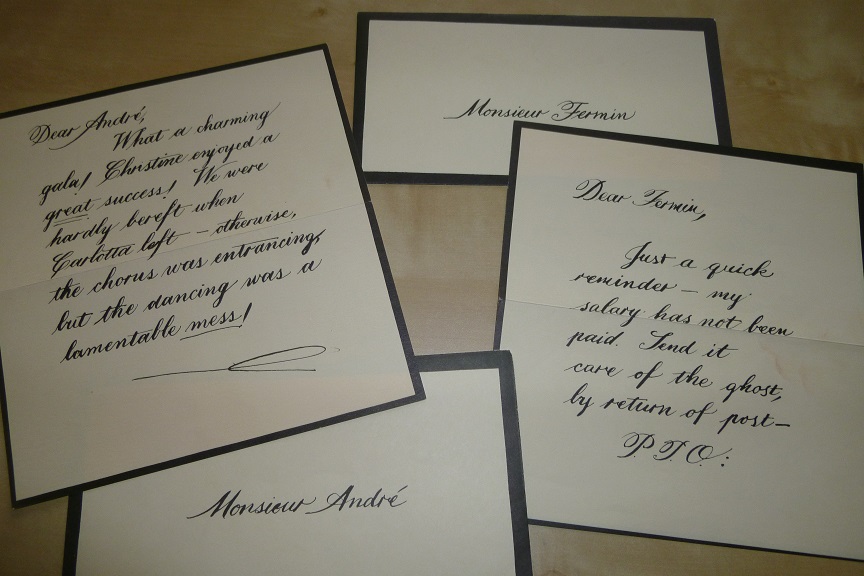
I’ve mentioned once or twice (or thereabouts!) that I’m a fan of The Phantom of the Opera.  I may have also mentioned that I’m a member of the Michael Crawford International Fan Association.  Mr. Crawford, of course, was the original Phantom in London and Broadway.  The MCIFA had a special sale recently of memorabilia…and I bought the most splendid of souvenirs!

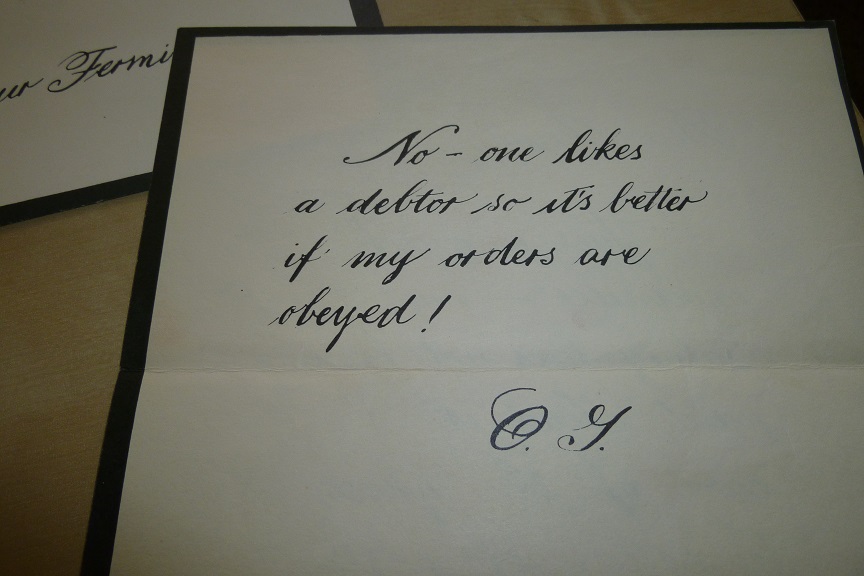
Phantom's Letters (3)This is a prop letter from the Phantom to Carlotta, actually used in the Webber production, and signed by Michael Crawford and Leigh Munro, who played Carlotta.  I couldn’t resist a signed letter…or a matching set of Andre’s and Firmin’s notes!

Phantom's Letters (1)Phantom's Letters (2)The Phantom’s letters feel far more personal than almost any other souvenir…and they’re particularly meaningful to me, because of one of my favorite moments in the play.  During the song “Prima Donna,” seven characters run about the stage, mostly waving letters and trying to placate Carlotta.  One of those characters is Meg Giry.  While others sing at the front of the stage, often (not in every production, but often) Meg slips to the back of the stage to examine all the Phantom’s letters.

It’s a tiny moment that probably 99% of the audience never notices.  I always watch for it, and it helped inspire my belief that Meg has a very special interest in the Phantom…and have I mentioned that I’m writing a novel from her point of view?

Visit West Metro Mommy for more Saturday Snapshots, and have a wonderful weekend!