Classic Review: The Ashwater Experiment

I thought I’d look back at an old review this week, and found this one on a very good YA book I ought to reread!  A fascinating premise with such good characters, I’ve read it several times and always found it engaging!

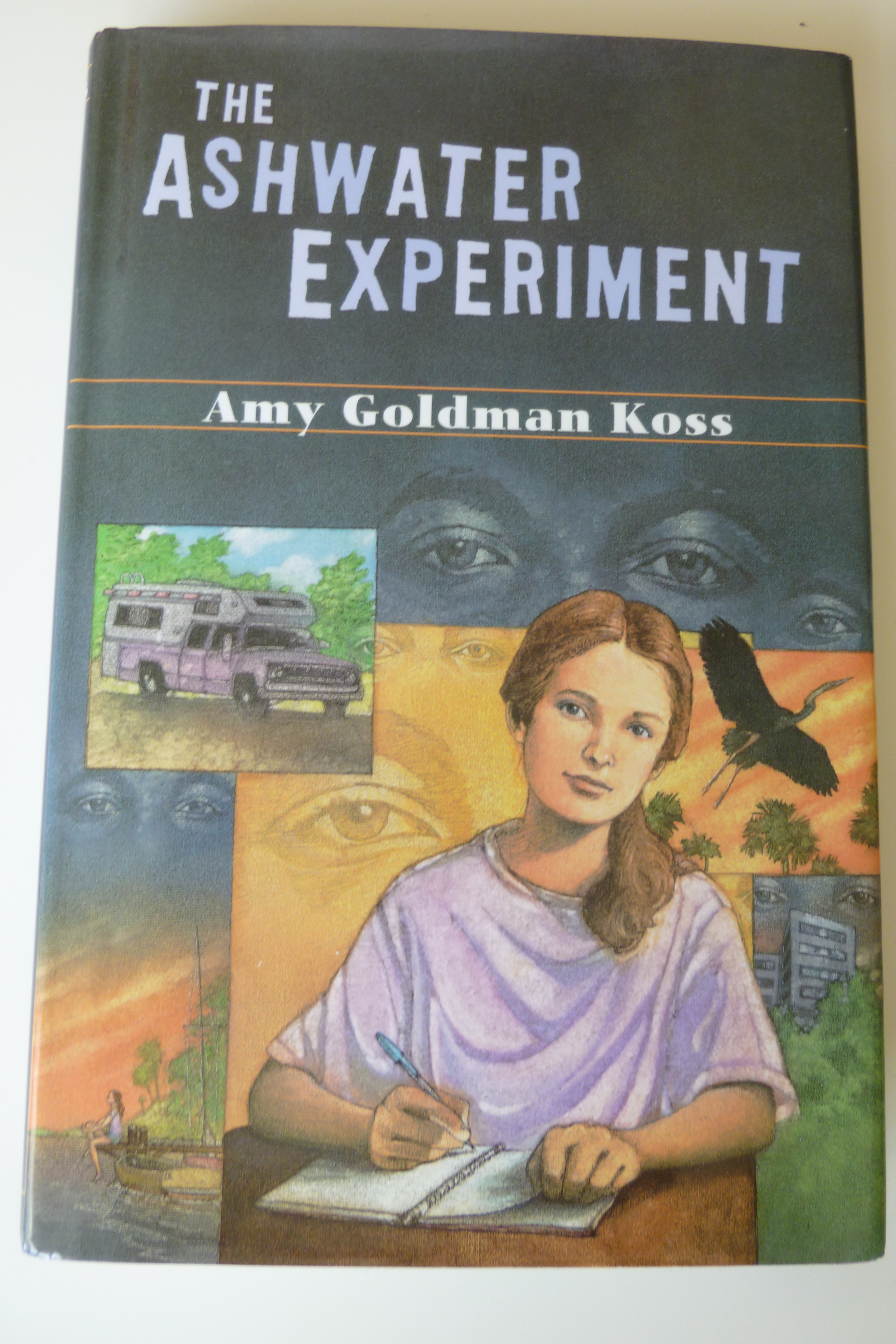
Have you ever felt that you’re not quite like anyone else around you?  I’m guessing most people have felt that way at some time or another–and that feeling is at the center of The Ashwater Experiment by Amy Goldman Koss.

Hillary wonders if she’s the only person who’s real.  You can hardly blame her for feeling disconnected from the people around her.  She and her parents wander the country in their RV, selling trinkets at craft fairs and never staying anywhere long.  By seventh grade, Hillary has been to seventeen different schools and is firmly settled in her pattern of never making ties to anyone.  So when she finds out her parents plan to stay in Ashwater for nine months–longer than they’ve ever stayed anywhere–Hillary feels trapped.  That’s when she comes up with the Watchers.

What if she’s really the center of an experiment?  Part holodeck and part Truman Show, she imagines that the world she experiences is really created just for her, with nothing existing outside of what she can see in that moment.  At first it’s easy to imagine–everywhere she goes has always seemed to have a pattern, with the same kind of people at every school.  As she stays longer in Ashwater, though, people start to seem more real than ever.

I’ve read this book before, and in the past I think it was Hillary’s imaginary (but sometimes so real-feeling) game about the Watchers that struck me.  This time, that seemed more like a sidenote.  It’s a very interesting sidenote–but the heart of the story for me on this read was Hillary’s feeling of being different, and of her gradually increasing understanding for the people around her.

When she first meets the kids at her school, she easily classifies them and easily sees them as stock characters.  As she gets to know them, she finds unexpected depth to Cassie the bookworm, Serena the society queen, and Brian the class clown.  Even the more minor characters, like Serena’s mother or Cassie’s grandmother, the nasty girl who resents Hillary and even Hillary’s own parents and grandparents, are eventually revealed to have their own problems and motives and complexities.  No one is simple.  And we all feel different sometimes–paradoxically, it’s a feeling we often have in common.

This is another one of those books that reminds me just how good and how deep a YA book can be.  It definitely is YA (or even Juvenile), appropriate for young readers and focused on young adults.  Hillary is in seventh grade, and she has seventh grader concerns: whether the girls at school like her, how well she’ll do on the math competition, whether her parents are weird.  But the larger feelings Hillary struggles with are really universal, and there’s a depth that makes this appealing–even though seventh grade was a long time ago for me.

Author’s Site: http://www.amygoldmankoss.net/
Blog Hop: Memo Re: an RIP

book-blogger-hop-finalToday’s Book Blogger Hop question is: Have you ever thought of writing a respectful, but angry letter to an author to ask them WHY they killed off one of your favorite characters in a novel?

…no.  I don’t think I ever have!  I also don’t seem to run into this too often.  I don’t think I read that kind of a book typically (there’s a reason I have never picked up Game of Thrones).

No one dies in L. M. Montgomery books except angelic children who are too pure to live to be adults (it was a trope of the time…), elderly people who have lived a full life, and, of course, parents, who are usually ushered off before or at the beginning of the story.  No one dies in Edgar Rice Burroughs books except villains and inconvenient obstacles to the love story (though I was angry with him about Clayton, rival to Tarzan, come to think of it).  And the only person who dies in retellings of the Phantom is, sometimes, the Phantom and, well…so it goes.  That’s not my preferred ending, but it was Leroux’s ending so I can’t object too much.

The Harry Potter series provided a host of tragic deaths–the only one that really got to me was…oh dear.  The twin.  I say this is the death that bothered me, and yet I can never remember if it was Fred or George.  And that’s kind of the point, it was the breaking of the pair that made me sad.  That and the line about dying with the ghost of his last laugh on his face.  Sigh.  But I get it, you know?  Fighters and mentors and serious people can die and that’s just the norm, but when the funny guy dies, then it’s seriousSerenity is a good movie example of that too.

A character death can be sad, and sometimes it can just be unrelentingly grim.  Kira-Kira, a Newbery medal winner where the heroine’s sister has a long, sad illness and then dies, was just exhausting.  But that’s the thing, I usually find books like that unpleasant or depressing, not rage-making.

I don’t know that I ever get angry with a writer about a character death.  Sometimes a character has to die.  I’ve written at least one book like that (not a published one).  I’d have trouble articulating why the hero had to die at the end of that one, but he really, really did.  So I get it, when an author kills a character, usually it’s a necessity.  Or it’s the whole focus of the book (again, Kira-Kira) which means I probably won’t like the book but, eh, tastes differ.

I get angry with writers about other things, and if I was ever going to write an angry letter it would more likely be about abusive relationships presented as romance (yeah, I’m still kind of mad at Meg Cabot).  But it probably won’t be for killing off a character!

Classic Review: Much Ado About Nothing

Today happens to be Shakespeare’s birthday (if you’re a Stratfordian, which I am) and so it seems appropriate to bring out this long ago review of my favorite Shakespearean comedy!

My love affair with the Bard goes back to high school, where I was a charter member of my school’s Shakespeare Society.  A lot of my best memories from high school involve Shakespeare (or Johnny Depp, but that’s another story!)  So I was definitely instrumental in my book club selecting a Shakespearean play last month.  Not solely responsible, but I was one of the ones who pushed.

Which is how I ended up rereading Much Ado About Nothing recently, and remembering why this is my favorite Shakespearean comedy.  It’s a great gateway play for people not very familiar with Mr. Shakespeare.

The story follows two romantic couples.  There are Claudio and Hero, whose romance takes a dark turn when Hero is falsely accused of wanton behaviour (and Claudio, the cad, believes it).  And there are Beatrice and Benedick, both known for their wit, who are continually baiting each other.  Their friends decide that they’d be perfect for each other, and set about on a plan to make each believe the other is madly in love with them.

My favorite scenes in the play are the gulling scenes, when each group of friends stages a conversation for the eavesdropping Beatrice or Benedick.  This preference may in part be because I performed in each of those scenes in my high school’s Shakespeare Festival.  But they really are brilliant comedy. Edited to add: Since originally writing this review, I saw David Tennant’s Much Ado.  His gulling scene is by far and away the funniest I’ve ever seen, though I can’t find it on YouTube, alas.  Nor is it on DVD yet, but I live in hope! </edit>

I was particularly noticing on this recent read-through how little Shakespeare gives in stage directions (though there is that one immortal stage direction in A Winter’s Tale: “Exit, pursued by a bear”).  It leaves a lot open to interpretation.  It doesn’t say that Benedick knocks over the potted tree he’s hiding behind at this point–but he can.

More significantly, many lines change completely by whether you believe the speaker is serious.  Was Don Pedro really proposing to Beatrice?  Are Benedick and Claudio really friends at the end?  You can go too far believing characters don’t mean what they’re saying, but there is room for reasonable interpretation–which makes the plays even richer.

If you’re at all interested in Shakespeare, try Much Ado About Nothing.  I recommend the Folger Shakespeare Library edition–good footnotes, and they put them on the facing page, which I find easier to read.  If you don’t feel up to reading Shakespeare, watch the Kenneth Brannagh version.  Excellent, although I can’t remember if he knocks any trees over.  I think I do recall some splashing about in a fountain though…

Blog Hop: Organization

book-blogger-hop-finalToday’s Book Blogger Hop question is: How do you organize your books for review? Does it work for you or have you had to change it?

I used to be very organized about my reviews.  I had a print calendar I used to track all my posts because I liked being able to see it visually.  When I first started, I posted three times a week (at least) and usually wrote posts two weeks ahead, so I always had a buffer of posts already scheduled.  I used the calendar to keep track of posts made and scheduled, which helped me balance the focus of reviews and vary my non-review posts.

And…then life got busy!  At some point I got through that buffer and never caught it up again.  And I dropped down to two posts a week, though I’ve been successful maintaining those.  I don’t use the calendar anymore, I just know I post Monday and Friday.  I still schedule everything–I usually do the Friday post (like this one) during the week some time, and write a review for Monday each weekend.

I never did too much organizing of books in anticipation of reviews.  I do track my books read though, in a print notebook.  If I don’t have a book in mind to review, I’ll page through that to see if I read anything recently that sparks some thoughts.

Fellow bookbloggers, do you have an organizing system for your reviews, or is it more haphazard?  Has it evolved over the life of your blog?

Book and TV Review: Father Brown

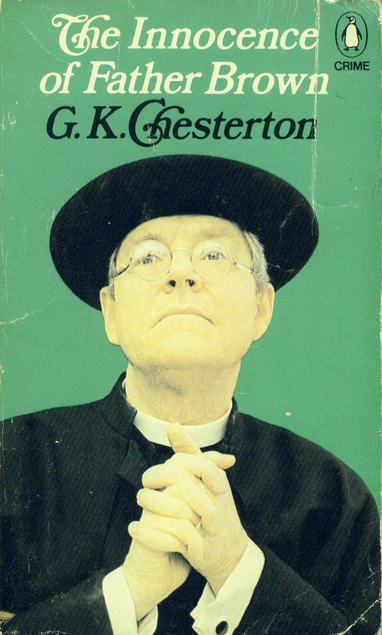
I’ve been watching the TV series Father Brown (a BBC series, available on Netflix) for many months now, and it’s quite delightful.  I thought I’d try the original stories, written by G. K. Chesterton, and got The Innocence of Father Brown. the first collection of short stories, from the library.  It was an engaging book with some clever mysteries–though not quite the Father Brown I was looking for.

Father Brown is a Catholic priest in England, with a knack for solving mysteries.  Many of the short stories in this first book feature Hercule Flambeau, first as a criminal and then reformed into a detective.  The setting is mostly London, I think in the late 1800s.  Some of the stories relate to Father Brown’s activities as a priest, though less than you might expect.  The connection is more through the insights Father Brown has gained as a priest than through plot connections.

The TV show, on the other hand, moves the setting to the Cotswolds in the 1950s, where Father Brown is pastor of St. Mary’s Church.  Here his parish work is much more integral to the stories, as usually some aspect of his priest work brings him into contact with the crime–nearly always murder.  The TV show adds in additional supporting characters: Mrs. McCarthy, parish secretary and quite proper; Lady Felicia, local aristocracy and not so proper; Sid, chauffeur to Lady Felicia; and, in later seasons, Bunty, Lady Felicia’s very modern niece.  There’s also an ongoing parade of local police chiefs, none of whom appreciate this priest interfering in the world of crime.

The short stories were interesting and engaging, but the TV show is charming and delightful–so it probably didn’t set me up that well for the short stories!  The tone just feels very different.  The Cotswold setting is a big part of the charm (though one does have to wonder about the number of murders happening in this idyllic rural village!) Continue reading “Book and TV Review: Father Brown”