Blog Hop: Reading and Re-Reading

book-blogger-hop-finalToday’s Book Blogger Hop question is: How many books have you re-read? If you have re-read books, please tell us the book’s title and why you re-read it.

I have re-read many, many books.  I’d guesstimate about a third of the books I read are rereads, which is probably somewhere around 50 re-read books a year…so I won’t try to give you a precise number or the titles!  I can try to give you the general why though.

Someone very wise (and I can’t remember who, nor is Google helping) said that you may forget a character’s name or a turn in the plot, but you remember the way a book made you feel.  This is my situation exactly–I read a lot and I read fast, which means I get to explore many, many stories, but I also forget many, many details.  I’ve sometimes re-read a book (or picked up a sequel) and realized that I’ve forgotten, say, the twist ending that showed the villain to be a hero, or which suitor the heroine chose.  You know, minor details!  But I remember how I felt.

So I re-read to revisit that feeling.  A book was relaxing or exciting or created a world I liked visiting or contained characters I loved spending time with, and I want to go revisit that.  I don’t always have the same experience, but often I do–or have a varied but similar enough experience.  As L.M. Montgomery compared it in her journal, it’s like meeting an friend again after many years, and seeing if you connect again in the same or a new way.

Beloved books I re-read, sometimes many times (I’m on my fourth–fifth? sixth? I forget–reread of Anne of Green Gables at the moment), long after I remember the major and many minor details.  But I want to re-visit the feeling, and sometimes, in the best books, I still find new things I never realized before (did you ever notice how much of Anne is actually about Marilla?  I didn’t, until now).

And then of course, in books I only re-read once or twice or at long intervals, I forget all those great swathes of things, so I can still read them to be surprised by the twist ending, or with genuine suspense about how the romance will turn out.

Re-reading books can be a surprisingly controversial question, one of those battle lines among dedicated readers.  Do you like to re-read, or would you rather keep moving on to something new?
Book Review: We Have Always Lived in the Castle

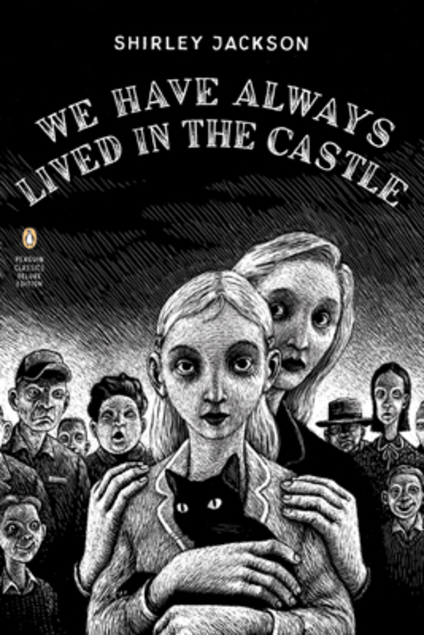
I recently read and enjoyed Holding Up the Universe.  Within that book, Libby’s favorite book was We Have Always Lived in the Castle by Shirley Jackson.  There was very little about the story mentioned, but just enough that I became intrigued enough to decide to read that book too.  And now I agree with Jack that neither he nor Libby should really be identifying with the heroine of Jackson’s book!
We Have Always Lived in the Castle is about Mary Catherine, called Merricat, who lives in a grand old house with her reclusive older sister Constance and her invalid uncle.  All the rest of their family died six years previously, from poison in the sugar bowl.  Their house and grounds are Merricat’s private kingdom, safe from the hostile stares of the villagers outside.  But Merricat’s defenses are not as secure as she believes, and inevitably things begin to change.

Apart from the murderous history, there’s very little in the plot to show what a terrifyingly creepy book this is.  Although the murderous history isn’t a bad start.  There are strong echoes of Lizzie Borden.  Constance stood trial for the murder but was acquitted.  That doesn’t stop the village children from singing a rhyme about Constance, Merricat and the sugar.  That starts the horror and the strangeness of it all. Continue reading “Book Review: We Have Always Lived in the Castle”

Blog Hop: A Question of Beliefs

book-blogger-hop-finalToday’s Book Blogger Hop question is: Would you stop reading a book if an element of the plot strongly clashed with your personal beliefs, or would you continue reading until you finished the book?

That’s a really intriguing question, and one I don’t think I can answer with a simple yes/no!  I think it depends on how an idea is being presented.  Most stories will feature some character doing something I find morally wrong, but that’s kind of the point of villains.  If the intended hero is doing something I disagree with, does the book portray it as good or bad?  I don’t expect heroes to be perfect either, and sometimes it’s important to explore good people doing bad things.  But what does the author’s intent seem to be?  And if they’re glorifying something I find morally repugnant, than I probably would stop reading.

Sometimes I quit books because of a kind of low-level discomfort with characters’ choices or attitudes.  Say the protagonist is obnoxious, or nasty to the people around them (Catcher in the Rye, a book I should have quit, comes to mind), or cheerfully engaging in extramarital affairs, or what have you, and the book portrays this as a good way to be.  I’d quit that book, but I think I probably would frame it as disliking the characters because I just find them unpleasant to spend time with, rather than precisely a moral issue.

I quit books with abusive relationships portrayed as romantic (yes, I’m still looking at you, Abandon trilogy!)  Emotional dysfunction or controlling issues will usually make me quit, but physical or sexual abuse would have me out of a book a lot faster.

I probably would have quit The Night Bookmobile, if the major issue had come sooner–the heroine commits suicide and that sort of works out for her…?  I think that points to one reason I get very upset by certain moral issues in books more than others.  If the level of violence is a little high (to a point), I don’t generally think readers are going to take that as a model.  But modeling abusive relationships as romantic or affirming suicide–that’s a message readers could internalize, and that could cause real harm to someone, especially in books for younger target audiences.

Maybe that gets to the crux of my moral issues with books.  If a book promotes something contrary to my personal beliefs, I might ride along, or quit just because I’m not enjoying it.  If a book breaks my moral code that stories should deliver healthy, positive messages (or at least, not actively harmful ones!) then I’ll be a lot more outraged.

How do your beliefs play into whether you quit a book or not?  Have you dropped some for these reasons?

Book Review: I’d Say Yes, God, If I Knew What You Wanted

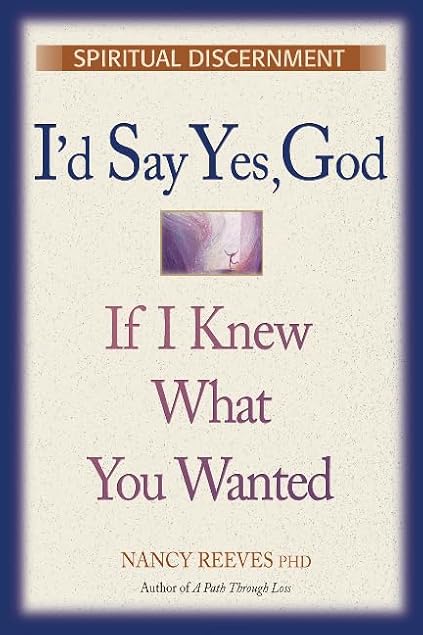
Happy Easter Monday!  I spent a lot of the last few days at my church for Triduum services (that’s Holy Thursday, Good Friday, and Easter Vigil on Holy Saturday), which at my church are very long but also very meaningful and inspiring events.  It seems appropriate to follow with a review of one of the spiritual books I’m reading this year: I’d Say Yes, God, If I Knew What You Wanted by Nancy Reeves.

I found this book in a fairly inspired way, if only through the sheer randomness of it.  I work in marketing for a hospice, so we have a spiritual care department.  Our chaplains were discarding some books from their shelves, and left them on the table in the communal kitchen.  I of course had to glance through a stack of free books…and since I have been known to frequently say, but how do I know what God wants?…I obviously couldn’t pass up on that title.

Sometimes good titles lead to disappointments, but this one proved all I might have hoped.  Everyone (religious) says we should follow God, but Reeves addresses the complicated question of knowing what that actually means in a way that really worked for me.  It’s not so much about moral choices (knowing you shouldn’t commit murder is pretty straight-forward) but rather about life choices.  Do I take the new job?  Do I stay friends with this difficult person?  How do I handle any particular challenge that comes up in life? Continue reading “Book Review: I’d Say Yes, God, If I Knew What You Wanted”

Blog Hop: Cover Judgements

book-blogger-hop-finalToday’s Book Blogger Hop question is: When you feature a book in your posts, do you include a book cover?

The short answer that readers of my blog already know is yes.  I think it’s pretty standard to include a cover with reviews, and I always do.  I usually find the cover image on LibraryThing, which is a great resource for that.  They usually feature multiple covers that a book has had, making it interesting to see the variation.  Most of the time I put up the same cover that was on the copy I read, but sometimes I choose another one that seems to capture or display the book better.

I do judge books by their covers, contrary to the old adage!  I don’t think you can often tell if a book is good or bad by the cover, but it can tell you something about the type of book it is (and whether it’s a type I’m interested in).  The first thing that catches me with a book is the title–if it intrigues me I’ll look at the cover, mostly for a sense of genre.  If there’s a dragon, or a kid with a dog, or angry-looking teenager in a leather jacket, that tells you something about what to expect.  (Although lately I’ve read some books with basically geometric covers like this one, which tells me nothing!)  After I look at the cover, I read the inside book jacket, or plot summary portion of the review–and usually not all of it.  Books generally have about two sentences of plot summation before I decide yea or nay.  So–title, cover, plot summary opening, and I’m in or not.  Mostly that works for me!

Of course, sometimes titles and covers do lead me astray.  There’s Dating Hamlet, with its silly title, comical cover, and serious, dramatic plotline.  And sometimes covers are a little too subtle.  The Girl From Everywhere‘s cover got much cooler once I actually noticed the girl’s eyes in the wave…and that took a strangely long time!

Other reviewers, do you include covers?  And for all readers, are covers important to you?