Meeting Christmas with Charlie Brown

This week, I’m looking at favorite Christmas movies.  And near the top of the list is A Charlie Brown Christmas, for many, many reasons.

The music is good, of course.  It’s often very funny–one of my favorite moments is when Lucy freaks out because she was kissed by a dog.  Snoopy’s resulting “Bleah” is perfect.  And there’s always something cute and fun about a Peanuts special.

Even more, though, it’s the most insightful twenty-five minute cartoon I have ever seen.   It somehow seems to gain wisdom every year.

It’s insightful right from the beginning.  In the first line of dialogue, Charlie Brown tells Linus something to the effect of, “I know I ought to be happy, but I don’t feel the way I’m supposed to feel.”  Linus tells him that he’s the only person who could take a wonderful season and turn it into a problem.  But the beauty and wisdom of it is–Charlie Brown isn’t the only one.

I mentioned on Friday that I get fed up with the song “It’s the Most Wonderful Time of the Year.”  The truth is, I get fed up with the concept.  Don’t get me wrong, I like Christmas.  I enjoy a lot of things about it.  But it gets overwhelming too.  There’s something in this culture that sends out a pounding message for a month: Be happy!  Be jolly!  Isn’t everything wonderful, wonderful, wonderful?  Isn’t it just the best best best day of the year?

The truth is, unless you’re seven years old, it very probably isn’t that wonderful.  I see that, and I don’t even have a reason to be sad, like people who are alone, or who lost loved ones.   Then of course there are people who don’t celebrate Christmas.  For all of them, it has to be a much more upsetting message than I find it to be.

By all means, be happy on Christmas.  But there’s nothing wrong if we’re not delirious with joy.  My deep thanks to Charles Schultz, for telling us that it’s okay to not be THAT happy.

Part of my problem with that pounding Christmas message is that often, mixed up with it more or less overtly, is the message: BUY!  Buy everything!  Storm the malls!  Spend money!  I like giving gifts, and of course I like getting them too.  But the commercialization of the holiday is downright disturbing at times.  Which gives another reason to love Schultz’s story about a scraggly little Christmas tree and an unhappy boy who stand up against the glitter and glitz of the commercially-driven holiday, taking inspiration from Chapter Two of Luke’s Gospel.

I have to admit, I hear Linus’ voice whenever I hear that passage in Luke, and I’m probably not the only one!  I think this is one of the few Christmas movies that brings the religious side into it, aside from direct Nativity stories.  It’s a beautiful moment; I’ve heard that the networks didn’t want Schultz to include it.

It’s a short film full of beautiful moments.  It’s a cute, sometimes silly movie.  It’s also full of insights, inspirations and good messages about what Christmas is all about.

2012 Reading Challenges

You did read that year correctly in the title. 🙂  I’m finishing up my 2011 Reading Challenges (details coming in about two weeks!) and have started thinking about what I want to read for 2012.

My thoughts on Reading Challenges is that they’re a good way to inspire myself to read books I want to read, but don’t get to often enough.  I’m rarely interested in something totally outside of my reading comfort zone, but I’m also not bothering to sign up for challenges related to books I read all the time anyway–like YA Fantasy!

So, here are the challenges I’ll be reading with, and telling you about, for this year.  Much thanks to A Novel Challenge for helping me find most of them!

Finishing the Series Challenge at Socrates Book Reviews

In 2011, I decided I wanted to find more series, and chose a challenge accordingly.  Then halfway through the year (a little belatedly!) I actually sat down and figured out all the series I was partway through…  So my goal for next year is to FINISH more series!  I started a bunch in 2011 that I want to read more of, plus there are others that have been hanging around neglected for much longer.  I’m going for the top level on this one, which is to complete three or more series, and hope to at least get farther on in more.

I Want More Challenge at Teatime with Marce

There are some books that I just love (and have raved about here)–but I’ve inexplicably never read anything else by that author.  You’d think one good book would be a good sign for more, right?  The idea of this challenge is to read more books by those authors.  I’m just going for the first level here, reading 2-4 books.

The Dusty Bookshelf Challenge at Books: A True Story

I have a long To-Be-Read list, but the only ones I feel pressured about are the books actually sitting on my shelves.  I rarely buy a book I’ve never read, so I don’t know where they all come from!  (Although my book club’s periodic book swaps may be a factor…)  I’m aiming for Level 2 here, Dust Bunny: 5-10 books.  My library is closed most of the week between Christmas and New Year’s (sob), so I should be able to get a strong start on this one at the beginning of the year.

Non-Fiction Non-Memoir Challenge at My Book Retreat

Sorry, the image is refusing to post for this one…  I almost never read non-fiction, which may make this seem like a strange choice (see: “not too far out of my reading comfort zone” above).  But what I’d really like to read more of, but never get to, are biographies.  I haven’t found a challenge focusing specifically on biographies, but this one should cover that, plus give me some extra incentive to tackle a few more broadly non-fiction books that have been sitting on my shelf for way too long…  Probably just going to attempt the Elementary Level, of 5 books.

The Science Fiction Experience at Stainless Steel Droppings

This challenge (experience) runs only for the first two months of the year, and has no particular rules or goals–except to read some science fiction.  I think of myself as a sci fi/fantasy fan, but the truth is that my reading is heavily skewed towards the fantasy.  This looks like a good chance to get into more of the other side.

So that’s my reading plans for the year–I hope you’ll come along for the ride.  🙂  Anyone else thinking about Challenges yet, or less formal reading plans?  If you could only achieve one reading goal in 2012, what would it be?  For me, I think I’d really like to finish the Horatio Hornblower series–so that first challenge up there is very appropriate!

Favorites Friday: Christmas Songs

I have a complicated relationship with Christmas music.  I like my Christmas music–I have several CDs I enjoy putting on this time of year.  On the other hand, there are some standards that have been so played into the ground, I can’t listen to them.  I blame the radio stations.  I have nothing personal against Andy Williams, but hearing him sing “The Most Wonderful Time of the Year” makes me want to scream.

But I do like some Christmas music, so I thought I’d highlight a few favorite songs.  Continue reading “Favorites Friday: Christmas Songs”

Hunting a Lost Prince

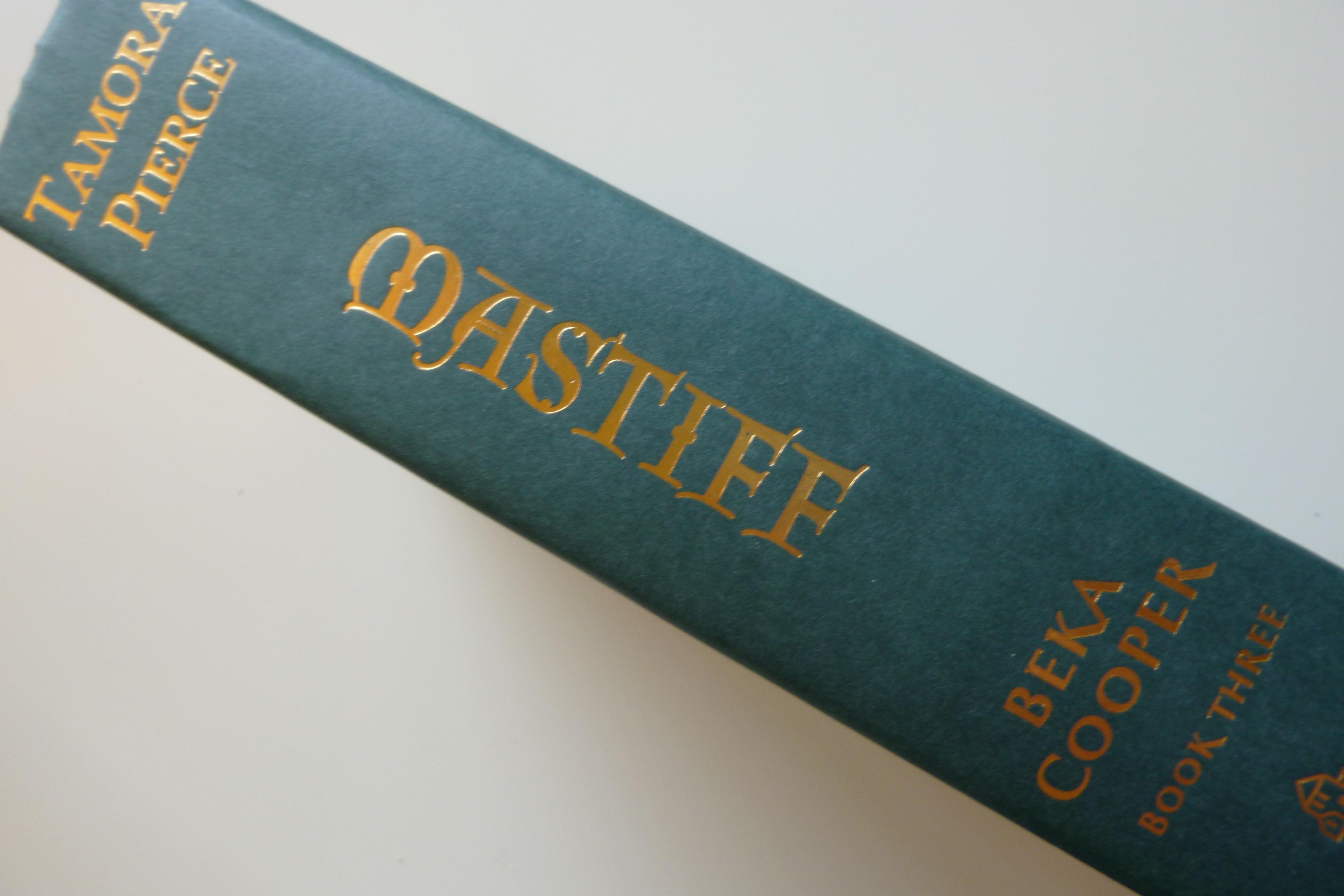
I’ve been promising a review of Mastiff, the final book in the Beka Cooper Trilogy by Tamora Pierce.  It was a good resolution to the story, an exciting adventure that tied up plenty of ends.

It begins a few years after the previous book, as Beka mourns the death of her never-before-mentioned fiance (more on him later).  It turns out she was on the verge of breaking up with him, and she’s glad of the distraction of a new Hunt–slang for a case to be solved.  In some ways this is the most focused book of the trilogy–Beka and her friends are on the trail of a kidnapped prince, and the entire book centers around this journey.

There are some strong villains in here, and I loved Beka’s friends too.  The lady knight, Sabine, had a bigger role in this book, and we had more of Pounce, Beka’s black cat.  There’s also Farmer, a new character who’s a very interesting mage.  I love it that he’s very powerful, but hides that behind a bumbling, cheerful exterior–although he really is wonderfully cheerful!

Despite a very cheery new character, this is darker than Pierce’s earlier books.  Dark things have always happened–death, slavery, violence, kidnappings.  The Beka Cooper Trilogy has always got more into the grittiness of it, though, and that’s very true here.  There’s more detail and more description of the disturbing elements.  One scene about a dead slavegirl is enough by itself to make this upper Young Adult, while Pierce’s earlier books often bounce between the Juvenile section and YA.

On the more positive side, there’s eventually some romance here, although it takes a while.  Though considering my chief problem with Bloodhound was that the romance was too fast, I won’t complain about this one!

Actually, the romance I wish there had been more of was the one with the dead fiance.  The book begins with the fiance already dead, and we only get hints about Beka’s relationship with him.  I was hoping for some kind of extended flashback, but it never came.  The hints are enough to suggest that it may have bordered on an emotionally abusive relationship, and in a strange way I think that would have been a wonderful story for Pierce to tell.  Her stories about strong women are so inspiring, and it would have been so valuable to portray one of these strong women getting emotionally mixed up and into trouble.  Beka is very capable in some ways, but she has uncertainties about relationships.  I would never believe that she’d stay with a man who hit her, but I could believe that she could be emotionally manipulated, and that would be so good for girls to see–that you can be strong and capable and still get into a bad relationship, and it doesn’t make you pathetic or worthless.

But that’s my idea, and evidently not Pierce’s vision for the book, and I can’t really criticize her for not taking the story the direction I wanted it to go.  One more serious objection I have involved a traitor in Beka’s group.  They realize someone is probably betraying them as they travel, but Beka doesn’t give much attention to that.  When the traitor’s identity finally comes out, it didn’t ring true to me.  It feels more like someone acting out of character than like a shocking reveal.

Those problems aside, it’s a great adventure with strong characters and an engaging world.  And now I can go back to looking forward to Pierce’s next book!

Author’s Site: http://tamorapierce.com

Other reviews:
YA in the Second City
Sew Skate Read
Ms. Martin Teaches Media
Yours?

The Dolphin Girl

What makes us human?  The Music of Dolphins by Karen Hesse asks this question, by looking at the world through the eyes of Mila, a human girl raised by dolphins.

Mila is picked up by the Coast Guard one day, after living in the sea for 13 years.  She’s taken to a facility where scientists help her learn language, skills, and how to live among humans.  The story centers on Mila’s growth as she learns about the human world, and on her longing for the dolphin world she knew.

My favorite part of the book is the way it’s written.  Mila tells her story herself, in a journal, and it changes dramatically as she learns.  The earliest pages are very simple, “Dick and Jane” style writing.  The font size shrinks and the words grow longer and more complex as Mila develops greater skills.  It’s a similar device as Flowers for Algernon.  Mila’s journal is punctuated by three separate passages in Mila’s head, describing her life with the dolphins.

I read this as a child and loved the change in the font and in the words.  Rereading it now, I’m more conscious of the growth in Mila’s character, from a very simplistic view of the world to a growing complexity.  She asks more questions involving “why,” has her own opinions and her own desires, and demands to be seen, not as a test subject, but as a person.

I’m sure this is a more realistic portrayal than Tarzan or The Jungle Book (fun though those are).  I don’t know enough about psychology or dolphins to be able to fully judge how accurate this is, but it feels realistic.  The ending requires a suspension of disbelief, although as a child I don’t think I realized that.  And I still find it a satisfying ending, even if I know now how completely unlikely it is.

This is a short and simply written book–Mila never approaches Shakespeare even at her most complex writing–but despite that, it gets at deep questions.  There’s a character in Pratchett’s Discworld who is described as simple but not stupid.  I think that applies here too.  It’s a simple book, but that doesn’t mean it can’t be profound.