A Conversation Before Dinner

In the writing class I took a couple months ago, we spent one class focused on dialogue.  I love dialogue.  In fact, I have a bad habit of having too much dialogue, and not enough of anything else.  So I enjoyed an excuse to write a story that was almost entirely dialogue.  I hope you’ll enjoy reading it!

********************************************

A Conversation Before Dinner

He was late to dinner again.  She sat at the table, tapping one high-heeled shoe against the carpet, smiling tightly and shaking her head when the waiter asked if she’d like a refill on her water.

Finally he rushed in, dropped a kiss on her cheek, and dropped into the opposite chair.  “Sorry, I’m sorry.  Caught at the office again, you know how it is.”

“Yes,” she said.  “I know exactly how it is.” Continue reading “A Conversation Before Dinner”

December, 1941 in Casablanca

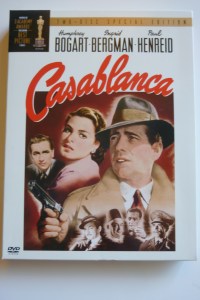
When I realized I had a post coming up on December 7th, I wanted something relating to World War II.  And then I thought–why not one of my favorite movies?  Which leads me to Casablanca.

I have no idea how many times I’ve watched Casablanca.  Once for a Spanish class, I watched it in Spanish, without subtitles, and followed it perfectly (and I’m not advanced in Spanish!)  If you’ve never seen it, put it at the top of your list–preferably in your native language.  🙂

Casablanca is set in the early days of World War II.  Refugees from Europe have fled to Casablanca, as part of the route to America…and now they wait–and wait–and wait, for the chance to move on.  The story centers on Rick Blaine (Humphrey Bogart), who runs Rick’s Cafe Americain.  Everybody comes to Rick’s–and one day Ilsa (Ingrid Bergman) walks in the door.  In a flashback, the audience learns that Rick and Ilsa had a love affair in Paris, and that Ilsa ran out on him when they fled the German invasion, which turned him into the hard-boiled cynic he is now.  Complicating matters even further, Ilsa is in Casablanca with Victor Laszlo, a resistance leader who is on the run from the Nazis–and Ilsa’s husband.  By rather questionable means, Rick is the secret possessor of two letters of transit, which could get two people safely out of Casablanca–but what will he do with them?

A mere plot description, besides being remarkably complicated (I’ve left out half of it), doesn’t do the movie justice.  It’s the characters–and the emotions of the scenes–and the incredibly brilliant dialogue that makes this movie so wonderful.

There’s a beautiful scene when the Nazi soldiers in Rick’s cafe start singing a German anthem, and Laszlo directs the band to play “La Marsiellaise,” symbol of French resistance.  The Nazis are ultimately drowned out by the singing of the crowd.  And that’s just one moment–there are probably a dozen moments that are inspiring, heart-wrenching, and moving.  I’ve never seen a movie that made me feel so strongly that every character, from Rick on down to the waiters and the gamblers, has a story behind them.

And I haven’t even mentioned my favorite character yet: Captain Louis Renault, played by Claude Rains, who in his own words is “only a poor corrupt government official,” who “blows with the wind, and right now the prevailing wind is from Vichy.”  In other words, he kowtows to the Germans.  When someone aims a gun at his heart, he responds by saying, “That is my least vulnerable spot.”  But don’t believe it!  Louis gets an enormous number of witty, clever, funny lines, and by the end of the movie we see that he has much more depth than he professes to.

A discussion on Louis leads me right into the dialogue.  I don’t think any movie is more quotable than Casablanca.  “We’ll always have Paris.”  “Here’s looking at you, kid.”  “I think this could be the beginning of a beautiful friendship.”  And that’s just Bogart.  There’s also “Round up the usual suspects” (Louis), which gets quoted by people who have no idea what they’re quoting (I’ve seen it happen).  Then there’s “Play it, Sam”–Ilsa never actually says “Play it again, Sam,” despite that line’s fame.  Those are just the particularly famous ones (see several here) but there are so many others.

“I like to think you killed a man; it’s the romantic in me.” – Louis

Rick: I came to Casablanca for the waters.
Louis: The waters?  What waters?  We’re in the desert.
Rick: I was misinformed.

Ugarte: You despise me, don’t you?
Rick: If I gave you any thought, I probably would.

The line that dates this to the first seven days of December, 1941: “If it’s December 1941 in Casablanca, what time is it in New York?  I bet they’re asleep in New York.  I bet they’re asleep all over America.” – Rick

“What if you killed all of us? From every corner of Europe, hundreds, thousands would rise up to take our places. Even Nazis can’t kill that fast.” – Laszlo

I could go on for a very long time here.  I was in a class once discussing the best quotes in Casablanca, and the teacher had to ask me to stop naming ones.  🙂

The movie came out in 1942, long before World War II was decided.  Many of the actors were European, and a number of them were refugees.  It’s not hard to imagine where the intense feeling of the movie comes from.  And they bring it to life for us, seventy years after its setting.  It’s a love story, a patriotic story, a heartbreaking story and a funny one.  Watch it.  And you may find yourself deciding to play it again.
Magicians, Neo-Druids, and an Orphan Waif

What if a magician in the sideshow had real magic?  It’s a great premise…and just the smallest part of Mairelon the Magician by Patricia C. Wrede.  It’s an excellent book, but it will do you no good to read the plot summary (at least on the copy I had), as it only addresses the first twenty pages.  Sometimes I wonder who writes these things…

So, as to the actual plot: Kim is an orphan on the streets of London, a girl who disguises herself as a boy to avoid the wrong kind of attention.  A stranger hires her to spy on Mairelon the Magician, who puts on the aforementioned sideshow.  Kim quickly realizes, however, that Mairelon is not merely an illusionist, but a real magician.  That’s as far as the book jacket will take you.  That’s barely the beginning, though.  Most importantly, Kim doesn’t find it at all shocking that he can actually do magic.  You see, Kim lives in a London where magic is real–it’s an academic, rich man’s profession, but it’s real.

The setting is actually very similar to Wrede’s Sorcery and Cecilia books, a magical version of Regency England, although her blog says they are not proven to be the same world.  I’d kind of like to think that they are.  🙂

Back to the plot, beyond what the book jacket says: Mairelon apparently sees something of value in Kim, and takes her on to be trained as his assistant for his magic show.  Kim quickly finds herself enmeshed in Mairelon’s quest to find the Saltash group, several silver objects that together can do powerful magic.  The quest takes them out of London and into the countryside where everyone you trip over is also chasing the same objects, though for various reasons.

It’s an often very funny story, a good mystery, and I enjoyed the characters.  Kim is a smart girl who knows how to watch out for herself, while watching for a chance to improve her lot.  She has a soft side too, and gets fond of Mairelon, even if she’s not likely to admit it.  Mairelon is one of those flamboyant characters who can be serious underneath it, who means well and is also enormously stubborn.  So is everyone, actually, including Kim and Hunch, Mairelon’s combination guard, wagon-driver, assistant and friend.

It’s the interplay between the three of them that I like best.  Mairelon’s tends to rush blithely ahead, carefully oblivious to Hunch and Kim’s attempts to restrain him for his own good.  The result is a lot of glowering, cursing and deliberate misdirections of the conversation.  I imagine you can surmise who’s doing what.  Hunch and Kim start out disliking each either, but develop a mutual respect–but one not likely to be admitted.

The other best part is the Sons of the New Dawn, a neo-druid group who have no idea what they’re doing, but whose leader is wildly adamant about finding his Sacred Dish, which is unfortunately the same as the Saltash Platter Mairelon wants.  They’re very funny all around.

The book winds up with a final scene featuring at least a dozen people and probably the best example of written hubbub I’ve ever seen.  I confess I have trouble balancing dialogue with three or more characters–Wrede somehow writes twelve people arguing with each other.

The end is somewhat marred in that she winds up the hubbub and then spends pages explaining everything that happened.  It’s the same device as a detective story, where the detective unmasks the killer and then neatly lays out all the steps of the crime and the investigation.  It goes on a bit, though, and feels somewhat forced.  On the other hand, she gets points for not leaving the reader wondering what on earth was going on–I’ve seen books that could desperately use a few pages of someone explaining it all.

There’s a sequel to the book, which I haven’t read yet–but if anything, the plot (if I can trust the summaries!) looks even better, so I’ll be tracking that down soon.  🙂

Author’s Site: http://pcwrede.com/index.html

Favorites Friday: Star Trek Novels

Niche appeal on this one, I know…but I’m justifying it to myself because I know I have some Star Trek fans out there.  *waves to you all*

I’m a big fan of Star Trek, especially The Original Series; the first serious novel I ever wrote was a Star Trek one, during high school.  I still think that writing Star Trek fanfiction during formative years of my writing was valuable in a lot of ways, especially writing Spock.  He has such a distinctive voice–he doesn’t talk remotely like anyone else in the story–and I think that taught me so much about stepping into a character’s voice.

I now find myself quite capable of assuming another character’s speech patterns when necessary in writing either dialogue or narration.

See that?  ^ That was Spock’s voice.  But I’m digressing–I didn’t actually mean to write about writing Star Trek, but rather about reading it–though it is in a way relevant, because the biggest turn-off for me in a Star Trek book is when the characters sound wrong.  So, here are several that got it right: Continue reading “Favorites Friday: Star Trek Novels”

NaNoWriMo Day 30 and Victory!

I passed 50,000 words on my NaNo novel today, on the last day of November.  It was 50,070 according to NaNo’s word count validator, or 50,319 if you want to believe Microsoft Word.  Either way, pretty exciting!  After my big push a few days ago, I’ve been able to keep ahead of the goal, so I actually didn’t need to write too much on this last day–which made for a more relaxed end to the month.

Of course, it’s all rather artificial too–I’m already making plans for how I’m going to write 25,000 words in December, which should take me to the actual end of my first draft.  I’ve only just reached the final section; as I’ve mentioned, this story is actually a companion piece to my other main project right now, and I just introduced my main characters from that story into this one, literally in the last two paragraphs as I passed the 50,000 word goal.  So there are still fun writing times ahead!  And after this, writing only half as much each day should be easy…right?

Well, we’ll see!  I have to actually get back to the rest of my life now.  I kept up with my job and my social life in November, but anything else creative went on the backburner (any non-NaNo blog posts you read this month?  Wrote those in October).  There are penpals to email, blog posts to write, Challenge books to read, neglected blogs to follow…

But it’s definitely been worth it for the past month.  I have so enjoyed NaNo, and barring major life circumstance changes, I’m doing this again next year!  I loved the community aspect of it the most.  It was so much fun to know there were many other people writing this month too, and to interact with them on the NaNo forums.

And I loved spending so much time on my writing.  There were ups and downs to writing this quickly.  I don’t think I know Lyra and Dastan as well as I know, say, Julie and Jasper, who I’ve spent the last year and half with.  But by this point, I do know them, and I think I can work some of the thin bits out in the revision.  I found that I wrote much less description and with far less detail when I was writing quickly–another thing to deal with in revision.  But I also found out that I actually can keep coming up with plot and scenes, and that those lightning bolt moments of realization about how a story ought to go really will come when needed, even if I don’t give them a lot of time to arrive.  I think that by the time I finish this, it will be something of reasonable quality–but it’s going to need those revisions!

I’ll see where I am with my other writing projects by November of next year, but I might decide to do something unpublishable and therefore low-pressure: like a fanfiction novel, or a sequel to one of my other books.  Something that I’d write just for the fun of writing, but that I wouldn’t normally want to spend long lengths of time on (see above: unpublishable).  That would make it perfect for the whirlwind writing month of NaNo–I wouldn’t need to spend a lot of time, and I’d come in already knowing my characters.

But that’s a plan for next October.  For now, I am so glad I finally gave NaNo a go, and thank you all for coming along for the ride!

And now Lyra and Dastan are still awaiting their remaining 25,000 words…back to the trenches!