Sleeping Beauty, Awake and Fighting

What if Sleeping Beauty didn’t turn out the way all those fairies at her christening intended?  That’s one element–and my favorite–of Spindle’s End by Robin McKinley.

There’s a line in The People the Fairies Forget when Tarry wonders what christening-gifted people would be like without the enchantments.  How does it change a person to be enchanted to be compassionate?  In my book, Sleeping Beauty is only a minor character, and is about what you’d expect her to be like if you’ve ever read Charles Perrault.

But Rosie isn’t.  Rosie is Sleeping Beauty in Spindle’s End, and is wonderfully NOT what she’s supposed to be.  She has long eyelashes and fair skin and golden hair, but she keeps the hair cut short so it doesn’t have the chance to fall into ringlets (and ends up a fuzzy, curly mass).  She hates dancing and embroidery, so it doesn’t matter that she’s enchanted to be good at them.  Her laugh may resemble a bell, but it must be a very large and unusual bell.  And most importantly, she is wonderfully, obstinately, stubbornly herself.  She’s not at all sure she even wants to be a princess, and she’s not going to just take a curse lying down.

McKinley does in Spindle’s End some of my favorite things about retold fairy tales.  We all know this story–princess cursed to prick her finger and die, fairies carry her off into the woods to keep her safe, spindles get destroyed, etc.  But she’s retold it with lots of clever, unexpected, practical twists.  What was Sleeping Beauty’s relationship with those fairies, considering they’re the only family she’s ever known?  Does she have her own plans for her life?  What’s it like to get princess-ness dropped into your lap one day?  And how do all those christening gifts turn out?

The gifts are wonderful, Rosie is wonderful, and the fairies–very practical fairies who are human-sized, don’t shed sparkles, don’t have wings, but do some impressive magic–are wonderful too.

I hate to say it, but one reservation here–I’ve never found the romance wonderful.  There is one, but it’s never felt right to me.  I’ve read this at least twice, so the most recent time I knew the romance was coming.  I really, really tried to see it coming, to anticipate it and wrap my head around it, but…while there are one or two cute moments, on the whole it just didn’t feel right.

It may be me.  It’s the kind of romance I often have trouble with.  Sometimes books like to create a friendship between a girl and an older man, which then turns into a romance when the girl grows up.  Once in a while it works for me.  Usually it doesn’t.  (On that subject, as a minor spoiler to the unwritten sequel of Red’s Girl, Red and Tamara are never going to be romantically involved.  Ever.)

But don’t let this turn you off the book.  Because honestly, I think Rosie’s relationships with her “aunts” (the two fairies) and her best friend are the more important ones than the romance, and they’re all very good.

And I love practical fairy tales.  The book opens with some lovely pages about how magic works in this country, and it’s this fantastic combination of total fantasy mixed with practical details about how people go about living their lives with this magic around them.  Magic sort of accumulates around cooking pots, for example, and fairies have to disenchant them every so often, by laying a finger on them.  Absent-minded fairies tend to have burn-scars on their fingers.  And when the evil fairy’s curse goes out, a decree is issued to lop off the tips of the spindles on all the spinning wheels.  How much more reasonable than burning every spinning wheel, and decimating the cloth industry!

My particular fairy tale retold is all about pulling out the most absurd bits of fairy tales and having more practical-minded characters try to work around them.  But I love retold fairy tales that work around those more absurd bits and make them make sense.  And I so enjoy McKinley’s rational, funny, sweet retelling of “Sleeping Beauty” that is the original story…but not quite the way Perrault told it.

Much Ado About Shakespeare

Last Saturday, along with being Holy Saturday, was Shakespeare’s birthday.  It’s one of the very few historical dates I know (other than “yesterday, December 7th, 1941, a date which will live in infamy.”  Oh, and Titus Oates’ birthday–March 17th.)  But Shakespeare’s birthday is one I memorized.  In college, I had a Shakespeare class that happened to meet on April 23rd.  I brought cookies.  🙂

My love affair with the Bard goes back to high school, where I was a charter member of my school’s Shakespeare Society.  A lot of my best memories from high school involve Shakespeare (or Johnny Depp, but that’s another story!)  So I was definitely instrumental in my book club selecting a Shakespearean play last month.  Not solely responsible, but I was one of the ones who pushed.

Which is how I ended up rereading Much Ado About Nothing recently, and remembering why this is my favorite Shakespearean comedy.  It’s a great gateway play for people not very familiar with Mr. Shakespeare.

The story follows two romantic couples.  There are Claudio and Hero, whose romance takes a dark turn when Hero is falsely accused of wanton behaviour (and Claudio, the cad, believes it).  And there are Beatrice and Benedick, both known for their wit, who are continually baiting each other.  Their friends decide that they’d be perfect for each other, and set about on a plan to make each believe the other is madly in love with them.

My favorite scenes in the play are the gulling scenes, when each group of friends stages a conversation for the eavesdropping Beatrice or Benedick.  This preference may in part be because I performed in each of those scenes in my high school’s Shakespeare Festival.  But they really are brilliant comedy.

I was particularly noticing on this recent read-through how little Shakespeare gives in stage directions (though there is that one immortal stage direction in A Winter’s Tale: “Exit, pursued by a bear”).  It leaves a lot open to interpretation.  It doesn’t say that Benedick knocks over the potted tree he’s hiding behind at this point–but he can.

More significantly, many lines change completely by whether you believe the speaker is serious.  Was Don Pedro really proposing to Beatrice?  Are Benedick and Claudio really friends at the end?  You can go too far believing characters don’t mean what they’re saying, but there is room for reasonable interpretation–which makes the plays even richer.

If you’re at all interested in Shakespeare, try Much Ado About Nothing.  I recommend the Folger Shakespeare Library edition–good footnotes, and they put them on the facing page, which I find easier to read.  If you don’t feel up to reading Shakespeare, watch the Kenneth Brannagh version.  Excellent, although I can’t remember if he knocks any trees over.  I think I do recall some splashing about in a fountain though…

Jesus as a Rock Star

I got myself into a spiritual theme this week, but I don’t really have anything that fits for Fiction Friday.  So instead of sharing some writing today, I’m going to talk about a Good Friday tradition of mine–while keeping on the story theme of this blog.  🙂

I’m sure there are endless retellings of the Passion of Christ.  It has, after all, been described as “the greatest story ever told.”  A particular favorite version of mine is Jesus Christ Superstar, the musical by Andrew Lloyd Webber.  I’ve listened to the soundtrack every Good Friday for the last several years, and last year I finally bought the DVD.  So I’ll be watching that tonight–after the Good Friday service at my church.

For those not familiar with Jesus Christ Superstar, it’s essentially the last week of Jesus’ life: the triumphal entry into Jerusalem, the betrayal by Judas, the Last Supper, the trial, the crucifixion.  Except it’s a rock opera and, at least in the 2004 DVD, it’s set more or less in the modern day.  The Roman soldiers have guns, and there’s a sort of industrial feel to the minimal sets.  I think bringing it (more or less) into the modern day makes some parts more accessible, or at least gives a new perspective on them.  Jesus as rock star.  It’s pretty cool. 

I think you already knew I love the Webber Phantom, and I love the music in JCS too.  Few melodies get stuck in my head like Webber’s.  There are powerful songs throughout the musical–Judas has some good ones, although my favorite may be “Gethsemane.”  I have a version of Michael Crawford singing that one, and after a really frustrating day, few things are more satisfying than “Gethsemane” at high volume (and Crawford holds a note in the middle for 16 seconds, which is really long if you’re trying to sing along).

This is also a good version of the story.  Not all of it is Biblical–nowhere in the Bible does Jesus tell the crowds to heal themselves, although he does keep trying to get off by himself for a while when they press around too much.  But a lot of it is very close to the Bible, enough that you can see Webber and Rice had the book open when they were writing the musical.  The confrontation between Jesus and Pilate is especially close to the Biblical version:

Pilate: Listen, King of the Jews, where is your kingdom?  Look at me, am I Jew?

Jesus: I have got no kingdom in this world, I’m through–through–through.
There may be a kingdom for me somewhere if I only knew.

Pilate: You are a King?

Jesus: It’s you that say I am.  I look for truth, and find that I get damned.

Pilate: But what is truth?  Is truth a changing law?  We both have truths–are mine the same as yours?

That’s pretty much straight out of Chapter 18 of John’s Gospel.  And where Webber takes more artistic license, I mostly like where he goes.  The story is, largely, from Judas’ point of view, and I find the more sympathetic portrayal of Judas to be fascinating.  I think the musical still leaves some debate as to why Judas betrayed Jesus.  Did he see the prophecy and knew someone had to carry it out?  (“You used me–and you knew–all the time!”)  Was he afraid of the Romans? (“I am frightened of the crowds–we are getting much too loud.  And they’ll crush us if we go too far.”)  And of course we can’t really know.  But this explores some interesting ideas.

The one part I don’t like is the portrayal of Peter.  The first time I encountered the musical, watching the movie in a religion class, it struck me that Jesus seemed so alone, surrounded by people who didn’t understand.  And I kept thinking, where’s Peter?  Peter’s my favorite of the apostles, because he usually says the wrong thing, but nearly always has his heart in the right place.  That “nearly” comes in because of the famous three denials, which is practically the only part of Jesus Christ Superstar when Peter is identifiable.  Nice job, shine a spotlight on the man’s worst moment and pay no attention to the rest.

But other than that, it’s a good retelling.   The musical walks a nice line with the miracles too.  It’s not overt, so you can take it any way you want.  The most miraculous moment is when Jesus predicts Peter’s denials–and you could interpret that by saying he just knows Peter well. 

If Webber was willing to go more miraculous, it seems to me that, if he really wanted to go back and write a sequel to a successful past musical, he should have come back to Jesus Christ Superstar (instead of writing that debacle of a sequel to Phantom).  I’d love to see a musical about the Resurrection.  The resurrection accounts in John are amazing stories too (especially at the Sea of Gallilee, when Peter–heart in the right place!–goes jumping overboard to swim ashore because he sees Jesus on the beach).

Oh well.  Until I get a musical for Easter, I’ll just go on watching Jesus Christ Superstar on Good Friday.

Illusory Seagulls?

Continuing the spiritual theme this week, I thought I’d look at a couple of novels with a spiritual element: Jonathan Livingston Seagull and Illusions: The Adventures of a Reluctant Messiah, both by Richard Bach.  They’re both good stories as stories, and have some good philosophy too.

Jonathan Livingston Seagull is about a seagull who’s obsessed with flying.  While all the other seagulls lurch around and squabble over fish, Jonathan trains and practices to become a better and better flier–perfecting speed flying, diving, and soaring up above the clouds.  When he dies, he finds himself in another place with other seagulls, who also love to fly, and goes on learning–eventually coming back to Earth to teach more seagulls to fly.  It’s a story about a bird and flying, but it’s also about rising above the world to realize your own value–and everyone’s value as a unique, special individual.

Illusions is the story of a miracle worker (literally–no tricks) who can’t stand the crowds and the fame, and heads off in a biplane to travel from town to town, giving rides: three dollars for ten minutes in the air.  The narrator is another pilot in the same line of work, and the story is about what he learns about life and the world while he flies around with the retired miracle worker.

Bach goes a bit too New Age for me at times (especially Illusions), so if you happen to read one of these, don’t assume I agree with everything!  🙂  He has a lot of good thoughts too, though, and these are some of the few books I’ve gone through with a highlighter, to note favorite lines.  They’re short books, so maybe I’ll keep it a fairly short review too, and just give you some of my favorite quotes…

Jonathan Livingston Seagull:

“How much more there is now to living…We can lift ourselves out of ignorance, we can find ourselves as creatures of excellence and intelligence and skill.  We can be free!  We can learn to fly!

“The only true law is that which leads to freedom…There is no other.”

Illusions:

“In the path of our happiness shall we find the learning for which we have chosen this lifetime.”

“The bond that links your true family is not one of blood, but of respect and joy in each other’s life.”

“Argue for your limitations, and sure enough they’re yours.”

No problem is so big that you can’t run away from it.
You are quoting Snoopy the Dog, I believe?
I quote the truth wherever I find it.

“If you will practice being fictional for a while, you will understand that fictional characters are sometimes more real than people with bodies and heartbeats.”

“Don’t be dismayed at good-byes.  A farewell is necessary before you can meet again.  And meeting again, after moments or lifetimes, is certain for those who are friends.”

Okay, not so short.  I got on a roll with Illusions.  And one more note, for the writers out there–I heard somewhere that Bach received 44 rejections trying to sell Jonathan Livingston Seagull.  It went on to be a #1 bestseller.  So don’t let rejection slips make you argue for your limitations!

The Books of Samuel, and the Story of David

Easter is coming up next Sunday, so in honor of Holy Week I thought I’d go a more spiritual direction with the book reviews this week.  I’ve been thinking about what I’ve read and enjoyed that would have a fairly broad appeal, and the story of David came to mind.

I decided several years ago to read the entire Bible.  Some parts are, um, slightly more difficult going than others.  Leviticus, for instance.  I actually sort of like the genealogies; they’re soothing, in a meditative kind of way.  But if you want an exciting story, my favorite part of the Old Testament is definitely anything involving David.  I heard David described somewhere as a great warrior and a great poet, and how can you go wrong with a hero like that?  The poet part is because many of the Psalms are attributed to David; the warrior part comes up mostly in the stories.

I think most people know “David and Goliath”–the boy who defeated the giant with his slingshot.  But that’s just one story, and there are a LOT of good ones.

It starts when Samuel, a prophet, is told by God to annoint one of the sons of Jesse as the next king of Israel.  After looking at Jesse’s crowd of sons, none are right so they have to send out to the field for the youngest and least important, who turns out to be David and the chosen one.

Later on David goes to the court of Saul, the current king, where he marries Saul’s daughter but also becomes so popular that Saul feels threatened and keeps flinging his spear at him, eventually driving him away from the court (I think that would make me leave court too!)

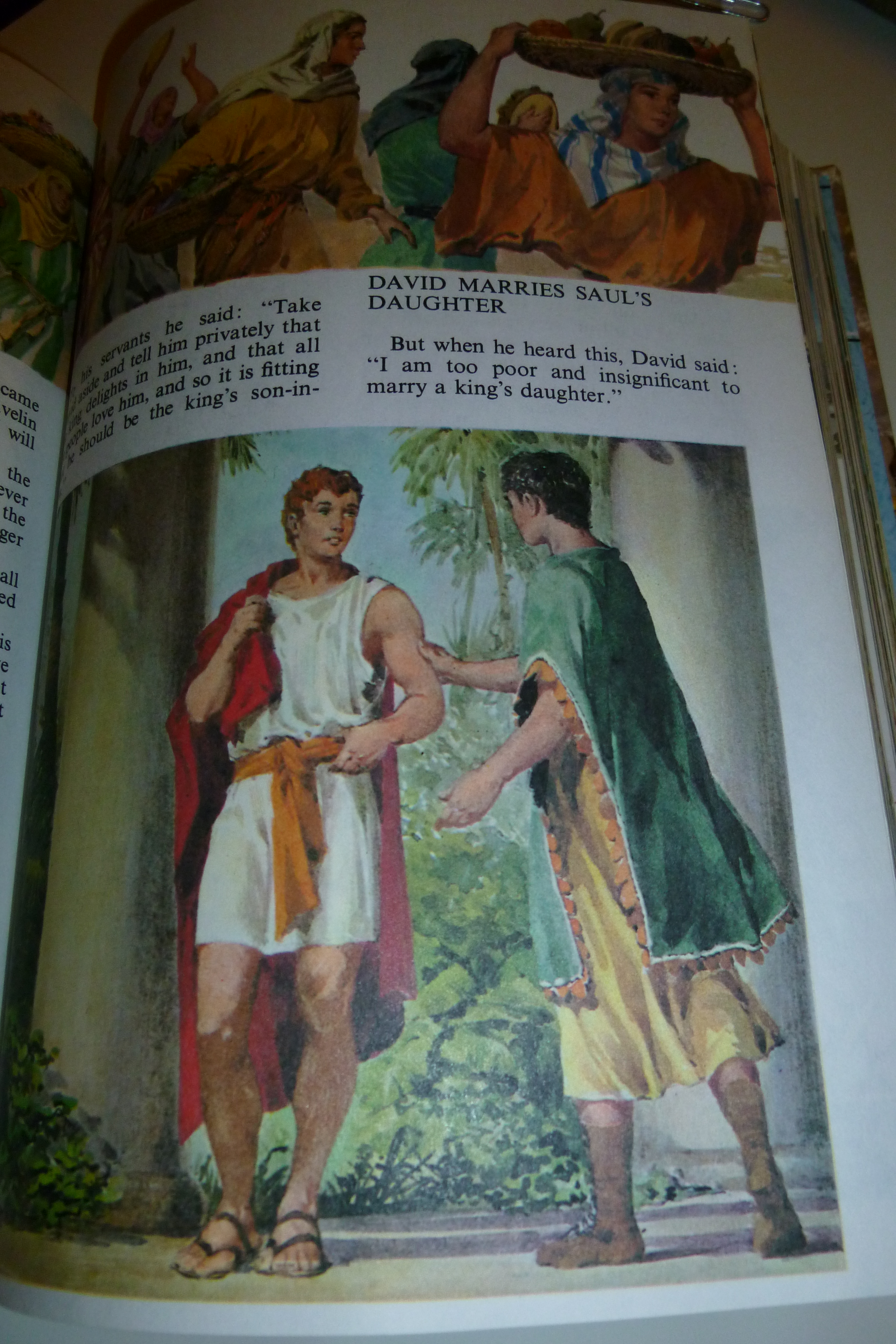
David and Jonathan, from my awesome Childrens Bible. I have read the original too...

One of my favorite threads in the David story is his friendship with Jonathan, Saul’s son.  Jonathan helps David when he begins to suspect that Saul wants to kill him.  When David flees the court, Jonathan tells him, “Go in peace, for we have sworn friendship with each other in the name of the Lord, saying, ‘The Lord is witness between you and me, and between your descendants and my descendants forever.'” (1 Samuel 20:42)  Much later in the story, after Saul and Jonathan die in battle and David is king, he asks if there are any of the house of Saul left, and ends up taking in Jonathan’s son.

David’s story is full of friendship, war, love, betrayal.  My other favorite part, after Jonathan, is about David and his son Absalom.  Absalom rebels against his father, and leads an army against him.  Despite this betrayal, David’s chief concern is to order his generals that Absalom is not to be harmed.  David’s forces win the battle, and, despite the order, one of the generals kills Absalom.  When David learns his son is dead, he has this heartbreaking lament, “O my son Absalom, my son, my son Absalom.  Would God I had died for you, O Absalom, my son, my son!” (2 Samuel 18:33)

David and Bathsheba is probably the other most famous story, after David and Goliath.  David has an affair with the wife of one of his generals, then arranges things so that the general will die in battle.  Definitely not one of David’s better moments!  But that’s one thing I love about Old Testament figures–they’re so human and imperfect!  And they still achieve great things.

As you can see from the citations above, and my title, most of David’s story is in the two books of Samuel.  The last bit is in the Book of Kings, which then goes on to talk about David’s son, Solomon.  If you’re religious (I’m Catholic myself) there’s a lot of good religious aspects to the story of David, and even if you aren’t, it’s a wonderful story.