2011 Reading Challenges – Update

It’s just past the end of March–we’re about a quarter of the way into 2011, and it seems like a good time to update on my reading challenges.  Any links will take you to my review of the book.  Some of these may get reviews later on, I just haven’t got to them yet!

I decided not to count rereads, except for the library challenge; I’ve still listed relevant rereads, because I thought people might be interested (especially for the fairy tales retold and the classics), but they’re denoted with an R rather than a number in the list.

Here’s what I’ve read so far:

Hosted by A Few More Pages.  Goal: “Series Expert,” read 12 books that are first in a series.  I don’t know exactly what defines a series, but I’ve decided a minimum of three books.

R) Sarah’s Story by Ruth Elwin Harris

R) The Lion, the Witch and the Wardrobe by C. S. Lewis (first by one numbering theory!)

1) Foundation by Isaac Asimov

2) The Children of Green Knowe by L. M. Boston

3) The Wee Free Men by Terry Pratchett

4) The Secret History of the Pink Carnation by Lauren Willig (really it’s a review of a later book in the series, but I mention this one too)

5) The Eyre Affair by Jasper Fforde


StilettoStorytime

Hosted by Stiletto Storytime.  Goal: read fifteen “classic” books (and I have it direct from the organizer that sci fi and children’s count!)

R) The Lion, the Witch and the Wardrobe by C. S. Lewis

1) Sense and Sensibility by Jane Austen

2) Foundation by Isaac Asimov

3) Trilby by George du Maurier

4) Jane Eyre by Charlotte Bronte

5) The Thin Man by Dashiell Hammett


Photobucket

Hosted by Among the Muses.  Goal: Enchanted level, read 6-9 books that are inspired in some way by fairy tales.

R) Spindle’s End by Robin McKinley (Sleeping Beauty)

R) Beauty by Robin McKinley (Beauty and the Beast)

1) Ice by Sarah Beth Durst (Cupid and Psyche / East of the Sun)

2) The Rose Bride by Nancy Holder (The White Bride and the Black Bride–it’s in Grimm)

3) Castle Waiting by Linda Medley (Sleeping Beauty)

R) The Rumpelstiltskin Problem by Vivian Vande Velde (Rumpelstiltskin)

4) Cloaked in Red by Vivian Vande Velde (Little Red Riding Hood)

5) Straw into Gold by Gary D. Schmidt (Rumpelstiltskin)
 

Hosted by Home Girl’s Book Blog. Goal: read 100 books from the library.

1) Frenchman’s Creek by Daphne du Maurier

2) Palace of Mirrors by Margaret Peterson Haddix

3) Spindle’s End by Robin McKinley

4) Looking for Marco Polo by Alan Armstrong

5) Stolen by Vivian Vande Velde

6) Enter Three Witches by Caroline B. Cooney

7) The Blue Shoe by Roderick Townley

8 ) Skating Shoes by Noel Streatfeild

9) Beauty by Robin McKinley

10) The Twisted Window by Lois Duncan

11) Ice by Sarah Beth Durst

12) Fire: Tales of Elemental Spirits by Robin McKinley and Peter Dickinson

13) Sense and Sensibility by Jane Austen

14) Golden and Grey: A Good Day for Haunting by Louise Arnold

15) The Rose Bride by Nancy Holder

16) Castle Waiting by Linda Medley

17) The Rumpelstiltskin Problem by Vivian Vande Velde

18) The Umbrella Man and other stories by Roald Dahl

19) Familiar and Haunting by Philippa Pearce

20) The Mischief of the Mistletoe by Lauren Willig

21) The Girl with the Silver Eyes by Willo Davis Roberts

22) The Children of Green Knowe by L. M. Boston

23) The Gun Seller by Hugh Laurie

24) Cloaked in Red by Vivian Vande Velde

25) Witch Week by Diana Wynne Jones

26) Little Sister by Kara Dalkey

27) The Wee Free Men by Terry Pratchett

28) Straw into Gold by Gary D. Schmidt

29) The Secret History of the Pink Carnation by Lauren Willig

30) Jane Eyre by Charlotte Bronte

31) The Heavenward Path by Kara Dalkey

Obviously I’ve been focusing a bit on the Fairy Tales Retold… 

The library one, I must admit, I viewed as almost a non-challenge, since my regular pattern of reading is to go to the library.  This could be more difficult than I thought though, going forward.  I’m fine on numbers right now, but I have somehow managed to pick up a good dozen never-read-before books in the last month or so.  I don’t know how it happened, I never buy unread books!  But I had the chance to buy some super cheap classics, and then my book club had a book swap (free books!) and now I have a whole stack of non-library books to read…so we’ll see how that turns out going farther into the year.

The First in a Series Challenge was worrying me a bit through February, which may be why I jumped farther ahead with it in March, adding 3, 4 and 5 in the last couple of weeks.  I had felt like I wasn’t getting to the point of the challenge yet, to find new series (what’s the plural?  Serieses?) to read.  But I want to read the books that follow The Wee Free Men, and I’m completely mad about The Pink Carnation series.  I’ll probably read the rest of the Foundation series too, although I originally read that one thinking more about the Classics challenge.  And I didn’t realize The Eyre Affair was part of a series until I got to the end and found the part about the author’s other books.  Undecided yet whether I’ll pick any up.

The Classics challenge is the one I think will require the most concentration–in picking up the books, I mean, not necessarily in reading them (thought that could be true too).  I find Dickens more intimidating than, say, Robin McKinley.  I’ve been on good momentum for the classics in the last month, but I don’t know how long that will last…

So far I’m really enjoying all the challenges.  It gives me a nice feeling of accomplishment when I finish a book that can go on a list.  It’s also giving me incentive to seek out certain kinds of books…and since I love retold fairy tales and have been wanting to read more classics, it’s made for good reading!
A Shy Heroine, and a Hero Named for a Vegetable

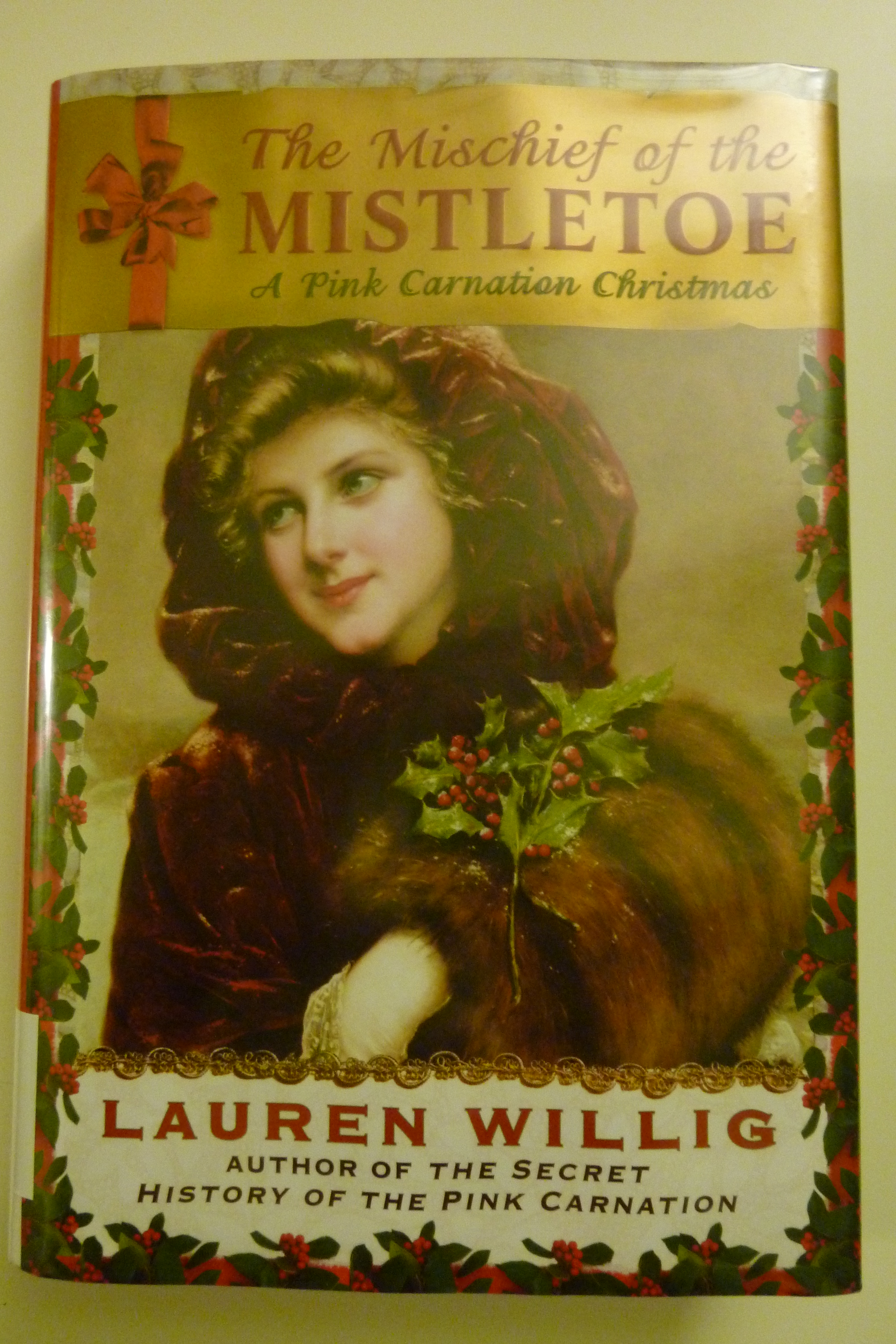
I had The Mischief of the Mistletoe by Lauren Willig on reserve at the library since before Christmas.  I added it when I saw it on a list of Christmas novels, and decided I wanted to read a good Christmas story.  Apparently other people had the same idea, and it didn’t reach me until mid-February.  But I’m so glad I didn’t decide to cancel my hold on December 26th, or even after Epiphany, when Christmas stories stopped really feeling appropriate.  For one thing, this wasn’t that strongly a Christmas story.  And more importantly, it was excellent!

The book is set in Regency England, what I can only think of as Jane Austen’s England.  Jane herself is in the book as a supporting character, as the sympathetic friend of the heroine, Arabella.  Arabella is the lead character of the book, but has clearly been a supporting character all her life.  A shy, unassuming wallflower, she’s the one at the party whose name no one can remember.  I have a soft spot for characters who think they’re unimportant.  I love watching them discover their inner depths and come into their own, and I loved watching Arabella find new strength and confidence.  Here we have the extra bonus of watching the other lead, Turnip, also discover Arabella’s value.

Reginald “Turnip” Fitzhugh…where to begin?  The name, I suppose.  I can’t tell you how much I love it that the hero has a vegetable for a nickname.  And not even a tough vegetable (I don’t know what vegetable would be tough–asparagus spears, maybe?–but I’m pretty sure turnips are not the heavyweight champions of the vegetable world).  It fits him–and he’s a wonderful character!  Endlessly well-meaning, charming and gallant, not a brilliant intellect, capable of throwing a punch when the situation calls for it, but not really all that good at derring-do and dashing exploits, frequently bumbling, very thoughtful, addicted to outlandish waistcoats.  Somehow, it works so well and is so much fun.  I love dashing heroes, but this time I really enjoyed a hero who stumbles more than he dashes–but rushes forward anyway, well-intentioned and grinning.

So you can check off the first requirement for a good book–great characters.  If you couldn’t tell already, lots of good humor too.  Occasionally this book tries a little too hard to be witty, especially in the dialogue, but most of the time it succeeds.  Third, we’re given a very sweet romance.  So, check, check, and check!

Fourth, there’s an engaging plot as well.  If it had been up to me to name this, I would have called it The Puzzle of the Pudding (to keep some nice alliteration).  Mistletoe barely features, while the plot is mostly set in motion when Arabella and Turnip discover a hidden message in the wrapping of a Christmas pudding.  This launches a series of intrigues and efforts to uncover the truth, which kept me and the characters guessing until the end about whether they were dealing with international spies and a threat to England’s security,  or with pranks among schoolgirls–or both.  Turnip staunchly believed the former, while Arabella mostly leaned towards the latter.

It turns out that this is actually Book Six, in the Pink Carnation series.  The Pink Carnation is England’s most elusive spy (in the style of the Scarlet Pimpernel).  As near as I can tell from reading plot summaries, the books are all set in the same social circles, but focus on different characters.  It’s obviously possible to start with the Mistletoe and enjoy it, since I did!  I probably missed a few things, but I don’t think it seriously impacted my reading. 

I read The Secret History of the Pink Carnation afterwards (it came much more quickly at the library) and enjoyed it as well–not quite as much, as I liked Turnip, Arabella and their romance better.  Good enough that I will definitely go on to the rest of the series though!  And if you go look up a plot description for the first book, every one I’ve read has been wildly misleading–it looks like it’s about a modern-day character doing historical research, and it is, but she’s only a very small part and most of the book is set in the past.

Since I normally review young adult books, one note I should make: this series is in the grown-up section, and while Mischief of the Mistletoe has a discreet,  Austenish feel that I think keeps it appropriate for younger readers, The Secret History of the Pink Carnation is not so discreet.  Fair warning given.

The Mischief in the Mistletoe was dedicated in part to “everyone who asked for a book about Turnip.”  I completely understand where those requests came from.  If I do a round-up of favorite characters met in 2011 at the end of the year, I expect Arabella and Turnip to be strong contenders.

Author’s Site: http://www.laurenwillig.com/index.php

When Cinderella’s Slipper Fits

After sharing my very short Cinderella story last week, I thought it would be fun to share a scene from the Cinderella portion of The People the Fairies Forget (more background here).  This scene starts at The Nightingale, an inn run by the heroine of this section, Catherine.  She’s a cousin to Jack, the hero of the Sleeping Beauty section.  Tarragon, my fairy and narrator, has been hanging out at The Nightingale recently, but hasn’t revealed his magical abilities.

Earlier in the story, Prince Roderick threw a ball, and invited every eligible woman in the country to attend (it was a large ball).  Catherine, though engaged to be married, attended the ball for the sake of the food and the dancing.  Tarry came too, for the same reasons, and while they were there they saw that the prince’s favorite dance partner had mysteriously run out on him, leaving a glass shoe behind.

A few days later, they’re hanging out at The Nightingale, when…

***********************

…we were interrupted by a sudden explosion of apples.

            Another of The Nightingale’s staff had come through the door, carrying a box of apples that had just been delivered.  He tripped on the threshold, dropped the box and sent red apples tumbling around the room.  No one looked surprised, including him.  I had already learned that his name was Richard Samuel Jones, and that this sort of event was normal for him.

            “Are you all right, Sam?” Catherine asked, bending down for an apple that had rolled near her feet.

            “I’m fine,” Sam said, rising to a crouch to gather up apples.  As he did, he remarked, “There’s all kinds of excitement going on out in the street.  Royal heralds and everything.  They’re going door to door.” Continue reading “When Cinderella’s Slipper Fits”

Netflix vs. Cable, or eBooks vs. Paper

I’ve been thinking about my television viewing.  I moved into a new apartment six months ago, and I chose not to set up cable.  There was only one currently-running show I actually cared about watching, and it didn’t seem worth the cable company’s monthly fee for a single show (which I can get on DVD by next summer anyway).

So I got Netflix instead.  When I say I don’t have cable (or even broadcast, thanks to the digital switch), that doesn’t mean I don’t watch television–I average about an hour a day, sometimes more on weekends.  But it’s mostly Netflix, sometimes something borrowed from a friend (or the, at present, two shows I really like that are currently on and which my dad puts on VHS tapes for me!)

I’ve found it feels incredibly freeing to not have cable.  No temptation to just mindlessly put the TV on.  And I’m convinced the quality of what I watch has gone up.  (And Netflix is not paying me to say this!)  It’s a difference between seeking and browsing.  With Netflix, I seek out shows and movies I really want to see.  I browse their suggestions, but usually to save things to my queue and watch later, when I decide to seek them out.  If I had cable, not Netflix, I think I’d do much more browsing through whatever was on.  And since I like to refer to television as a vast wasteland, I think I’d often end up with very mediocre shows.  A thousand channels…and nothing on.

In all of this, I see an analogy to ebooks and paper books–or more specifically, “brick and mortar” bookstores and libraries.  It’s easy to browse through stretches of physical bookshelves.  With ebooks, or online booksellers like Amazon, you have to know what you’re seeking.  There’s some browsing ability, but not to the same extent.

I’m a seeker for television, but a browser for books.  Most of what I read I find by wandering through my library’s shelves.  I’m not sure why there’s this divide in how I handle entertainment, though maybe it has to do with the quality of what I find in my browsing.  I have browsed television some in the past–I can only think of two shows I started following that I just stumbled on, and even those are probably not in my top ten of favorite TV shows.  But I’ve found many favorite books and authors by happening across them on the shelves: Juliet Marillier, Patricia C. Wrede, Gordon Korman, Helen Cresswell, Lois Duncan, even Tamora Pierce (actually, my mom browsed and found her for me, but same principle).  I just happened to pick up The White Darkness, Silver Woven in My Hair and The Squire’s Tale.

My favorite story about browsing: I’ve mentioned my character, Sam Jones.  One day I was at the library, wanting to find a new author, and on a whim decided to see if any authors named Jones looked good.  And that’s how I started reading Diana Wynne Jones.  I’ve read over twenty of her books, and she’s really top quality fantasy.

Anyway, the point: browsing books seems to work for me.  But I’ve also never really tried being a serious seeker of books.  So I’ve decided to experiment in that area: go for a month, only reading books that I specifically seek out.  Now is a good time for it, since I have a long To-Be-Read list of books I’ve seen recommended on other blogs, plus I just brought home a stack of unread books from a book swap my Book Club did.

I’m curious to see if the quality of what I read goes up if I start seeking instead of browsing.  It worked for television.  I have more doubts that it will work for books.  But…I’ll see!  And I’ll let you know.

But even if I decide I like seeking, I do hope ebooks don’t mean an end to browsing as we know it.  Because where would I be without all those books I just happened to bump into at the library?

How do you find books?  Are you a browser or a seeker?  Have you ever switched from one to the other?

Chasing After Ghost Children

I wanted to like The Children of Green Knowe by L. M. Boston.  It’s usually not a good sign when a review begins that way, is it?  You see, I saw it reviewed on a blog I follow, and it sounded intriguing.  Well…while I still respect that blogger’s opinion 🙂 I won’t be adding this to my list of favorite British children’s fantasy classics (a long list I ought to post some time!)

The book is about Tolly, a little boy who goes to live with his great-grandmother at his family’s ancestral home, a castle called Green Knowe (or Green Noah).  His great-grandmother tells him stories about his ancestors who lived in the house, especially three long-ago children, Toby, Alexander and Linnet.  Tolly quickly realizes that the children are still at Green Knowe, as ghosts.

I really like the concept, and I liked the setting.  I loved one small bit, when Tolly first meets his great-grandmother, and she’s eager to see who in the family’s past he’ll resemble–because all the faces return to her eventually.  I rather enjoyed the family stories the grandmother told.

But Tolly’s story fell pretty flat for me.  It might have helped if I had known his age sooner.  I finally figured out most of the way through that he’s six or thereabouts, when he comments that six-year-old Linnett is as big as he is.  Prior to that, he seemed sometimes older, sometimes younger, making his more childish moments disconcerting.  For that, and in a general way, it was hard to get a handle on the character.

But my bigger problem was the ghost children.  They seemed to have no depth at all.  They’re not creepy, scary ghosts; they’re not ghosts with unfinished business; they’re not ghosts who need something from the living, or even who want to do something for the living.  They’re perfect paragons who never struggle.  Gail Carson Levine, on her blog, often writes about the importance of making your characters suffer sometimes, and these characters never do.  They simply wander through the book as happy ghosts who spend all their time playing.  Their favorite game seems to be hide and seek, which doesn’t even facilitate getting to know someone.  Even when they make themselves more available, I never felt that Tolly or I could really enter a friendship with them.  I don’t think Tolly saw it, but they seemed to me to be just too self-sufficient unto themselves.  They were friendly to Tolly, but they never seemed particularly interested in him either, simply taking him for granted as a new playfellow, if they felt like playing.

And the animals.  You know that scene in the Disney Snow White when she makes friends with the entire forest?  It was like that.  The ghost children have a horse, and a deer, and a fox, and a rabbit, and a fish, and a hedgehog, and a whole flock of birds, including a peacock, and possibly one or two other animals I’m forgetting.  It was a bit much.

It may be that I came to this book too late in life.  If I had picked this up as a child, maybe I wouldn’t have seen some of the character issues, and to be honest I probably would have thought the menagerie was neat.  But I had trouble coming to this book at an older age.  My apologies if I’m pulling apart a beloved childhood favorite of anyone else–and by all means, tell me what you love about it that I managed to miss!