Journeying to Mars to Meet Tavia

Having just reviewed one of my favorite authors, L. M. Montgomery, it seems only fair to also review my other favorite author this week: Edgar Rice Burroughs.

They have some interesting differences and similarities.  The differences may be more obvious: Montgomery wrote about the small things of life in a rural village.  Burroughs wrote exciting adventures set in the jungle, or on the surface of Mars, or deep under the Earth.  But they both knew how to create a vivid world (albeit very different ones!) and how to write beautiful prose and wonderful descriptions.  Montgomery almost always has a young girl as her lead character.  Burroughs almost always has a strapping, warrior man as his hero.  But they both wrote sweet and very discreet romances–those warriors of Burroughs are also perfect gentlemen.  They also have in common that I’ve read book after book after book by them, and very, very rarely found one that wasn’t top quality.

An odd coincidence of a similarity: they were born less than a year apart.

Since I showed all my Montgomery books, why not all my Burroughs books too.
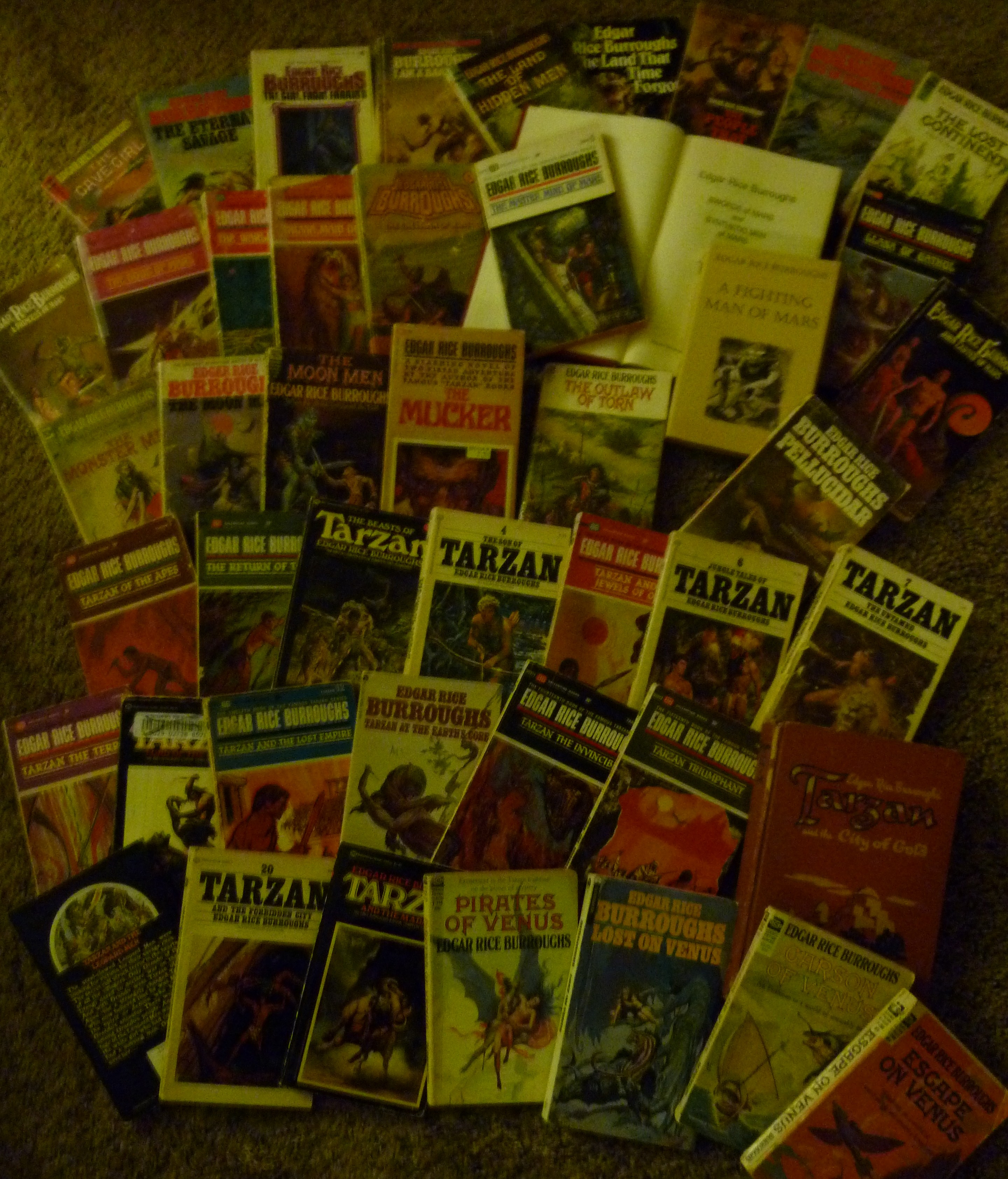
I already reviewed Burroughs’ most famous book, Tarzan of the Apes.  As you can tell from the picture above, he went on to write a lot of sequels about the lord of the jungle–over twenty.  But what I really want to write about today is his other most famous series: his Mars books.

They begin with A Princess of Mars.  John Carter is in a desert in Arizona, where he has a strange out of body experience.  He looks up at the sky, and sees the planet Mars.  He holds his arms up to the sky, and wishes–and finds himself on the plains of Mars.  In Burroughs’ world, Mars (called Barsoom by the natives) is populated by a number of warlike races, from the red Martians who look much like us, to the giant, twelve-foot-tall green Martians.  There are all kinds of other strange animals with six legs or weird stripes or bizarre abilities.  John Carter goes on to have a series of adventures full of swordplay and races against time and endless hazards and escapes, all to win the beautiful Dejah Thoris, princess of Mars.

The first three books in the eleven book series, as well as a few later ones, focus on John Carter.  My favorite, however, is A Fighting Man of Mars.  John Carter is referenced, but the action focuses on Tan Hadron, a red Martian warrior.  In some ways it’s not unlike every other Burroughs adventure: swordplay and kidnapping and a desperate quest to rescue the girl.  (Burroughs only had two plot devices, kidnapping and castaways, but he spun them into 70 adventures.)  A Fighting Man of Mars, however, is different because of Tavia.

Image taken from ERBzine.com

People who have known me on the internet for a long time will know that when I need a fake name online, a username for example, I will usually use Tavia or some variation on it.  In a way it’s a habit–I started doing that at about thirteen, and it’s easy to carry on using the same name whenever this comes up.  And it got started because Tavia is a wonderful character in a wonderful book by one of my favorite authors who, I must admit, rarely wrote a really good heroine.

But Tavia is actually capable.  She escaped on her own out of a harem (fleeing when the King first noticed her–Burroughs heroines get into dangerous situations but are never actually harmed).  She’s pretty much as good with a sword as Tan Hadron.  She’s extremely capable at almost anything that needs doing on their adventure.  Though I do think she’s pretty, her internal characteristics are emphasized much more than her external beauty.  And I find this to be one of Burroughs’ more meaningful and compelling romances.

Sure, there are more impressive heroines when you look across the range of literature.  But Tavia is a great character in her own right, and she’s the best of the ones that Burroughs gave us.  It’s the combination of all of Burroughs’ strengths of writing and excitement and world-describing, combined with a much more appealing heroine, that makes A Fighting Man of Mars my favorite Burroughs book.  It’s the seventh book in the Mars series, but don’t feel obligated to read the first six first.  They’re great books too, but it’s an independent story and Burroughs even provides a helpful overview of Martian society in the foreword.  So I think you’ll do fine if you want to jump ahead to number seven to meet Tavia.

Who Do Your Characters Know?

Have you ever noticed that an unnatural number of characters seem to be loners?  Or close to it?  It’s the standard formula–you give your main character one friend so that they won’t be totally antisocial and will have someone to bounce conversation off of, and then you ignore the rest of their social life while you pursue the plot.

But lately that second part has been bothering me.  I recently read Neverwhere by Neil Gaiman, and his main character, Richard, though a basically nice guy with a good job in a populous city, seems to have absolutely no one in his life except a coworker he’s friendly with, and a really terrifying girlfriend.  In some ways the trajectory of the book explains why Gaiman wouldn’t want to tie Richard down (I’ll leave it vague to avoid spoilers), but it put me on the thought track, and I don’t think Richard is the only character in this social situation.

 Why don’t these characters have more friends?  Why don’t they have second cousins and old college acquaintances and coworkers they’re friendly with and members of groups they attend and old friends of the family and neighbors they nod to and that best friend they bounce coversation off of?  At least, that’s the way the world works for me and the people I know.  So why don’t characters exist at the center of their own web of people?

Probably because it doesn’t make sense to clutter up a story with all those people who aren’t relevant to the plot.  But shouldn’t they exist in a subtext sort of way?  You never meet Aunt Susie and Cousin Jimmy, but the character has family photos on the wall.  We don’t need to know who’s in them, but family photos means family and it would be nice to know they exist somewhere.  Yet lately I keep running across books (and even more so in movies) where characters seem to know barely anyone.  Some characters, of course, really are loners and that’s part of the point.  But a lot just seem to be sort of vaguely unconnected.

It’s made me think about my own writing.  How many people do my characters know?  Take Jack, my goatherd.  He’s new to the area, having moved from the next country over, but he’s friendly with the servants at the castle, and he ought to know a few other shepherds and goatherds in the area–but I must admit I’m not sure I’ve made that second part clear.  He also has relatives back in his hometown, an uncle and a cousin.  His cousin, Catherine, becomes the heroine of the second part of the book.  She runs an inn and I’m pretty sure she knows most people in town.  She has a whole network of people running the inn with her, she goes to the prince’s ball with a group of friends, and when Cinderella is eventually found, Catherine knows her slightly and has heard gossip about her (unpleasant family situation).

I’m not claiming I have it down perfectly with all my characters either–far from it, I’m sure!  But it’s something I want to think about more consciously when I write characters.  Do they know a lot of people, and what kind of people?  And if they don’t–because I think the main characters of the story I’m writing now wouldn’t–why not?  And how does that change the character?

My pirate captain, Red Ballantyne, knows everyone.  Every bartender, every tavern girl, every pirate, every person he trades goods with illegally, he knows by name.  He’s also not very close to any of them.

The main character of my current in-progress novel, another fantasy loosely drawing on fairy tales, is a wandering adventurer named Jasper.  He meets new people constantly, by doing things like rescuing them from ogres.  But I think if he bumped into them six months later, he wouldn’t remember them very well.  And I don’t think he keeps in touch with hardly anyone.  But that’s who Jasper is as a character, and I eventually get into a backstory about why he doesn’t form lasting friendships with the people he meets.

Any case, it seems to me that who your characters know is a pretty good way to convey information about them.  Has anyone else seen authors who do this really well?  Or, like me, do you find that it seems to be an under-utilized tool?

Exploring the World of L. M. Montgomery

It occurred to me that I have not actually reviewed L. M. Montgomery.  She’s been woven throughout this blog, referenced here and there, but somehow I have not actually reviewed her yet.  Even though she’s among my top two favorite authors!

Maybe the problem has been that I don’t know where to begin.  I’ve read 20 novels, 199 short stories (believe me, I’m searching for a way to get my hands on a 200th one!), her autobiography, three books of letters, and her five volume journal.  If it’s in prose, I’ve read it.  And now, where to start?

My L. M. Montgomery collection. I have...a few of her books.

I suppose I could take the obvious route.  Anne of Green Gables was her first novel, and the one I name when people look blank after I say L. M. Montgomery is my favorite author.  It’s a good place to start reading if you’re not familiar with her books.  Anne is a red-headed orphan who is adopted by Matthew and Marilla Cuthbert by mistake–their friend was supposed to bring them a boy from the orphanage, who could help Matthew on the farm.  The story follows how Anne found her place in Green Gables.  Anne is precocious, whimsical, imaginative, deeply in love with nature, and, though always well-meaning, apt to get into scrapes.  Once she dyes her hair green–another time she breaks her leg after walking on a roof on a dare.  Anne is a wonderful character and her adventures are funny and endearing.

That’s a good place to begin.  But I don’t want to stop there.  Because there’s also Emily, a dreamy writer, and Pat, who fiercely loves her home, and Valancy, who only starts to live her life when she thinks she’s dying.  And beautiful, tragic Kilmeny; Marigold with her imaginary and magical friend; capable and confident Jane.

I don’t know why Anne of Green Gables is Montgomery’s most famous book, because she wrote so many others that were at least as good.  The great gift of Montgomery is her ability to create appealing characters and place them in a beautiful world.  With very few exceptions, her books are all set in small towns in Prince Edward Island.  She herself grew up in Cavendish, a small town in PEI, and her books very much harken back nostalgically to the Cavendish she remembers in her childhood–a close-knit community where everyone knew everyone, and the chief social events were quilting circles, lectures and small dances–and weddings and funerals, of course.

Her books are also filled with nature.  Like Anne, Montgomery had a passionate love for the beauties of nature.  Pine trees, flowers, a range of hills against the sunset–from her journal you learn first-hand how deeply these affected her, and that carries into her books.  I once read a book that combined quotes from Montgomery about nature, with pictures that were meant to correspond.  I was amazed to find that none of the pictures were as beautiful as what she was describing.  She felt beauty so intensely–she was able to see it and then convey it in words, where someone else wouldn’t have seen the same thing at all.  A picture may be worth a thousand words, but not when the words were written by L. M. Montgomery.  She has a very unique writing style, which I obviously love–it may not appeal to everyone though, which is why I sometimes recommend starting with her short stories to see if it’s a style that works for you.  The Road to Yesterday or Chronicles of Avonlea are good collections.

Don’t get the impression, though, that her books are long treatises on nature.  The beautiful surroundings are the backdrop to human adventures.  They’re funny, exciting, romantic, sometimes tragic.  She had a gift for drawing out the emotions in events small and large–from the pettiness of carping relatives to the deep betrayal of a disloyal suitor to the fun of a picnic in the woods to the humor of an awkward dinner party.

There are some books I feel I’d love to live inside, and L. M. Montgomery’s certainly sit high on the list.  After reading her journals, I think she felt the same way.  Her life was not always happy, and the sunny world of her writing was sometimes an escape.  Fortunately, she’s made that world available to the rest of us too.

The Monster and the Prince

Sometimes, the muse is fickle.  Sometimes a story starts out beautifully, and then completely stalls out.  So this is fair warning that today’s Fiction Friday is from a story that never got finished.  It went beautifully for about four chapters, and then I ran into some major issues, and went on to a different project.  I may come back to this one, but for now it’s incomplete.  I know the full plotline so if anyone’s really curious I can tell you about it, but it hasn’t been written yet.

But I thought the first chapter was pretty entertaining, and I hope you might find it that way too, even without the rest of the story to follow.

This is in the same world as The People the Fairies Forget, but a different time and a different country.  Fun bit of trivia: the countries in this world all have names inspired by fairy tale writers (or retellers).  This story is mostly set in Gaicaveene, which is named for Gail Carson Levine, and Rokinlay, named for Robin McKinley.

***************************************

            She looked up at the castle and shivered.  It was cold and there was a wind blowing—but it wasn’t that kind of shiver.  And it wasn’t, from appearance, the kind of castle that should make a person shiver.  It was a shiver that should be prompted by looming parapets of crumbling stone, moss grown walls and birds of prey winging beneath a full moon.  It wasn’t a shiver that one would expect from gleaming white towers, rooftops shining golden beneath an afternoon sun, and pennants waving gaily in the wind.

            She pulled her silk scarf more tightly across her face and told herself to stop being excessively imaginative.  It was a bad habit.

Continue reading “The Monster and the Prince”

Songs About Pursuing Your Dreams

Since the subject of pursuing your dreams came up yesterday, I thought I’d do a follow-up post, about two of my favorite songs.  They haven’t come up before because, well, they’re not books!  But since they’re both about dreams, they’re appropriate to the theme.  They could even be a response to one of the questions essay writers answered for Living the Life of My Dreams.

What is your favorite audio material, and what do you enjoy most about it?

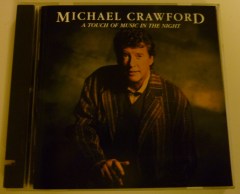
Michael Crawford is my favorite singer; he’s best known as the original Phantom of the Opera, but I have his other CDs as well and they’re amazing.  He’s a wonderfully talented singer who puts so much emotion into songs, and can hold notes for ridiculous lengths of time.  My favorite song is “A Piece of Sky,” which is all about following your dreams.  In essence, it’s about realizing that from your window you can only see a piece of sky, stepping outside and seeing that the world is so much bigger:

What’s wrong with wanting more?
If you can fly, then soar.
With all there is, why settle for
Just a piece of sky?

I can’t find a clip online anywhere of Crawford singing this one.  You can listen to Barbra Streisand sing it (although, with all due respect to Streisand, I like Crawford’s version better) or you can find it hiding as the second half of “Papa, Can You Hear Me,” on his concert CD and available on iTunes.  Or you can do what I did, and buy his CD, A Touch of Music in the Night, which has the best version.  Just for a sample, here’s another of Crawford’s songs.  And I swear I’m not being compensated for recommending his music! 🙂

My other favorite song about following dreams may be from an odd source…Newsies is a live-action Disney movie about a newsboy strike.  There’s one song, “Santa Fe,” that’s sung by the lead character (a very young Christian Bale!) and is all about his dream to go to Santa Fe.  Santa Fe becomes symbolic about pursuing a new life:

When I dream, on my own, I’m alone but I ain’t lonely,
For a dream o’ nights the only time of day,
When the city’s finally sleeping, and my thoughts begin to stray,
And I’m on the train that’s bound for Santa Fe.

And I’m free, like the wind, like I’m gonna live forever.
It’s a feeling time can never take away.
All I need’s a few more dollars, and I’m out of here to stay.
Dreams come true–yes they do–in Santa Fe.

I hope you all get the chance to see how big the sky is–and to find your Santa Fe.