Stories About Pursuing Your Dreams

Something a bit different today.  A big theme that tends to come up in my writing is pursuing your dreams.  I like that in books I read too, and today’s book is all about that.  Living the Life of My Dreams, compiled by Caryn Fitzgerald, shares stories from 30 people who have pursued their dreams.  It’s a bit different, in that it’s not young adult, or even fiction.  It’s thirty essays from real people sharing about their lives.

It’s not my normal genre, but it’s showing up here because I was slightly involved in the creation of it.  As is mentioned a few times around here, in my day job I work for UniversalGiving.  My boss, Pamela Hawley, is one of the people who contributed an essay to the book, and I was involved in putting that together.  I’ve also been coordinating with Caryn about the launch of the book.  She asked if we knew any bloggers who would review it.  Well, it so happens, if you need a book review blogger…

So yes, I’m probably a little biased when it comes to Pamela’s essay!  But I’m less biased about everyone else.  Caryn sent me an advance copy of the book, and I’ve been reading through the essays.  It’s very interesting in that you can see the many different writing styles and voices that went into this, since each essay was contributed by a different person.  Some follow a set of questions Caryn provided, others are reflections.

There are many very different stories, but most follow a path of not liking the life they were in, making changes, and finding a new, more rewarding direction.  There are a lot of entrepreneurs, and a lot of writers (which I guess makes sense, when you’re asking people to write an essay!)  I love seeing the many different ways people find greater fulfillment–traveling, writing, starting a craft business, helping others, spreading a cause…  I think the two main messages I take from this book is that you can always change your life, and that there’s no one path to happiness.

This is presently published as an ebook, and you can find it online here–it comes out today.  If you enjoy stories about pursuing dreams, it’s a good read.

Spinning Stories from Straw

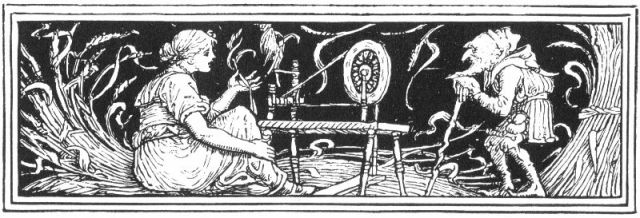
I think Vivian Vande Velde and I have similar feelings about fairy tales–wonderful stories, except for all those parts that don’t make sense.  She explores all those weird bits of “Rumpelstiltskin” in The Rumpelstiltskin Problem, and to very funny effect.

This book excellently shows the versatility of fairy tales.  This is a book of six short stories, all retellings of “Rumpelstiltskin,” and all very different.  Sometimes Rumpelstiltskin is well-meaning–sometimes the villian–once even a woman.  We meet a host of different miller’s daughters, clever and stupid and greedy.  Some kings are nice and some are cruel.  Some stories have magic, some don’t.  But all the stories follow the basic premise of “Rumpelstiltskin,” and all are funny.

I think my favorite part of the book is actually the introduction, when Velde discusses the inspiration behind the book–and analyzes all those parts of “Rumpelstiltskin” that don’t really add up.  Why does the miller tell the king his daughter can spin straw into gold when she can’t?  Why does Rumpelstiltskin want a baby?  Why does the miller’s daughter want to marry the king, after he kept threatening to cut her head off?  Why did Rumpelstiltskin agree to the name-guessing contest when, according to their original agreement, he’s already won, and has nothing more to gain?

I love fairy tales.  But they often don’t make sense, and I enjoyed Vivian Vande Velde’s discussion, and then retelling, of one I haven’t thought as much about.

I do believe that classic fairy tales, especially the best known ones, must have something in them that makes us keep telling them.  Some core truth, or spark of an idea that appeals.  What do you think it is for “Rumpelstiltskin”?  In a way it’s a “deal with the devil” story, so perhaps it’s that story of being pushed to desperation, making a questionable deal, and then the forces of good still triumphing in the end.  Well, assuming you consider the miller’s daughter and the king to be on the good side.

And that depends how you interpret the story–or which of Vivian Vande Velde’s retellings you’re reading.

Author’s Site: http://www.vivianvandevelde.com/

Hanging Out with Some Favorite Characters

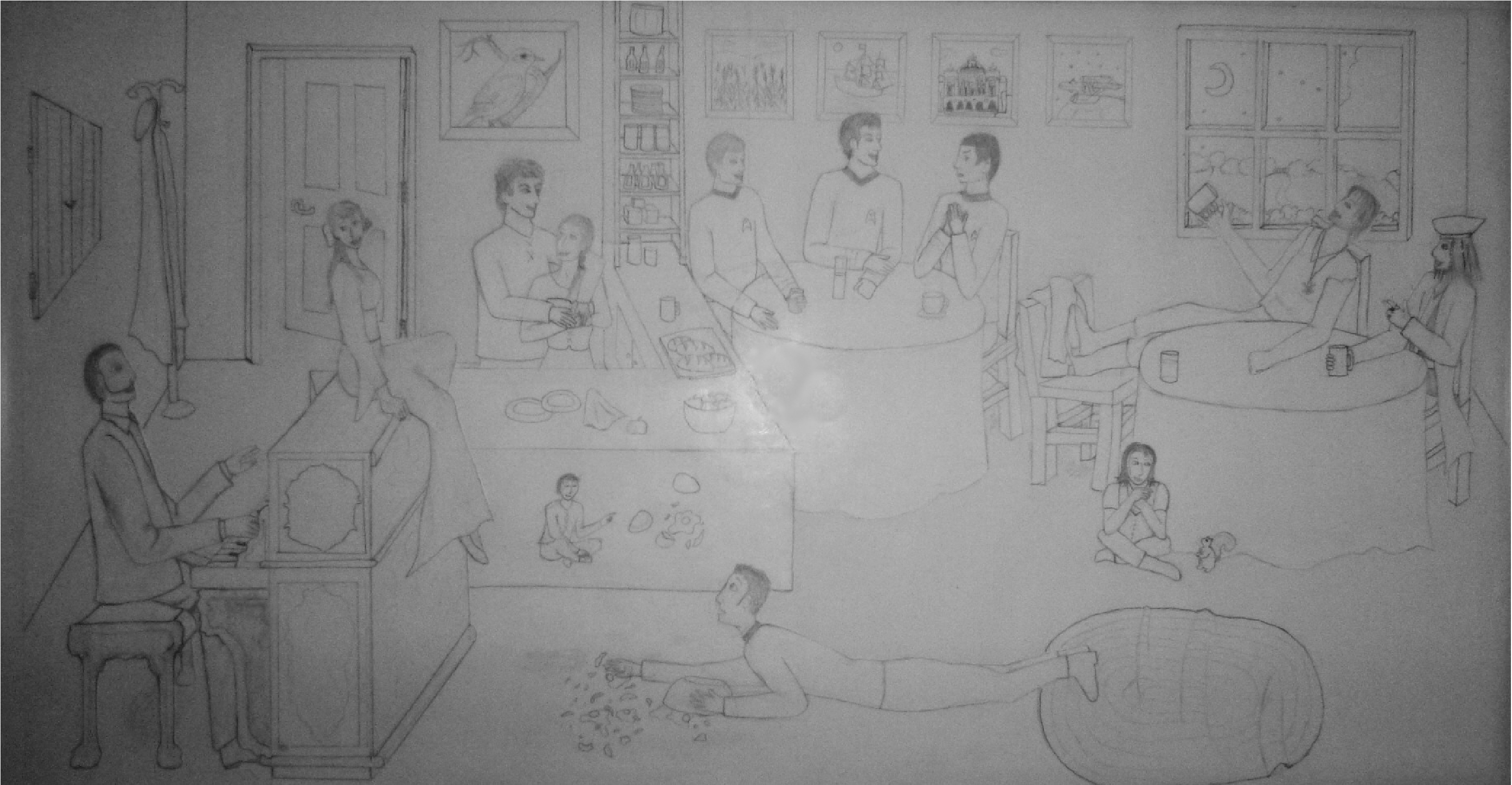
In keeping with this week’s focus on picture books, I thought I’d share a drawing for Fiction Friday.  I never claimed to be a great artist, but every so often–usually when I’m having writer’s block–I’ll turn my hand towards drawing instead of writing for a little while.  I still think in terms of stories, so most of the time my drawings will still end up being of characters or some kind of story in themselves.

One of my favorite and by far most complicated drawings is a scene I did of the main characters from each of my major stories hanging out together.  If you click, you can see it larger.


The setting is The Nightingale, an inn which features in The People the Fairies Forget.

Starting from the far left, we have Erik, the Phantom of the Opera, playing the piano.  With him is Meg Giry, who has a small role in Leroux’s Phantom, a larger role in Webber’s, and a lead role in my Phantom story.

Behind the counter are Catherine and Anthony, major characters in the later part of The People the Fairies Forget.  Catherine gets into trouble when Cinderella’s shoe fits her.  When not dealing with problems like that, they run The Nightingale

Floating in midair in front of the counter is my fairy, Tarragon.  Tarry is magically repairing the eggs which were broken by Sam Jones, who tripped and fell across the floor.  Jones could be from any of these stories; he has at least a cameo in all of them, and is apt to trip in all of them too.

Sitting at the back table are Dr. McCoy, Captain Kirk, and Mr. Spock, who beamed down from the Enterprise.

At the other table we have Captain Red Ballantyne with his feet up on an adjoining chair, deep in conversation with Captain Jack Sparrow.  Tamara, who comes from the same story as Red, is sitting by the table chatting with Rodney the squirrel, who Jack met in my Pirates of the Caribbean story.  Red’s Girl isn’t a fantasy, but if I’m going to stretch things to bring all of these people together, I decided Tam could talk to Rodney.

If you’re curious about the little details, the pictures on the back wall are, from left, a nightingale, a cornfield, a sailing ship, the Paris Opera House, and the Starship Enterprise.

I find that when I spend a lot of time writing about characters, they stay in my head in a way that no other characters do.  So in a way, it makes perfect sense to think about them spending time together.  And it’s fun to imagine how they would interact.

If you could bring characters from any fictional source together to hang out for the evening, who would you choose?

Quotable Gail Carson Levine

“There’s nothing wrong with reading a book you love over and over.  When you do, the words get inside you, become a part of you, in a way that words in a book you’ve read only once can’t.”

–Gail Carson Levine, in Writing Magic

Gail Carson Levine is the author of a number of fantasy books for children and young adults, best known for Ella Enchanted.  You can follow her blog at: http://gailcarsonlevine.blogspot.com/

Breaking Out of the Story with the Three Pigs

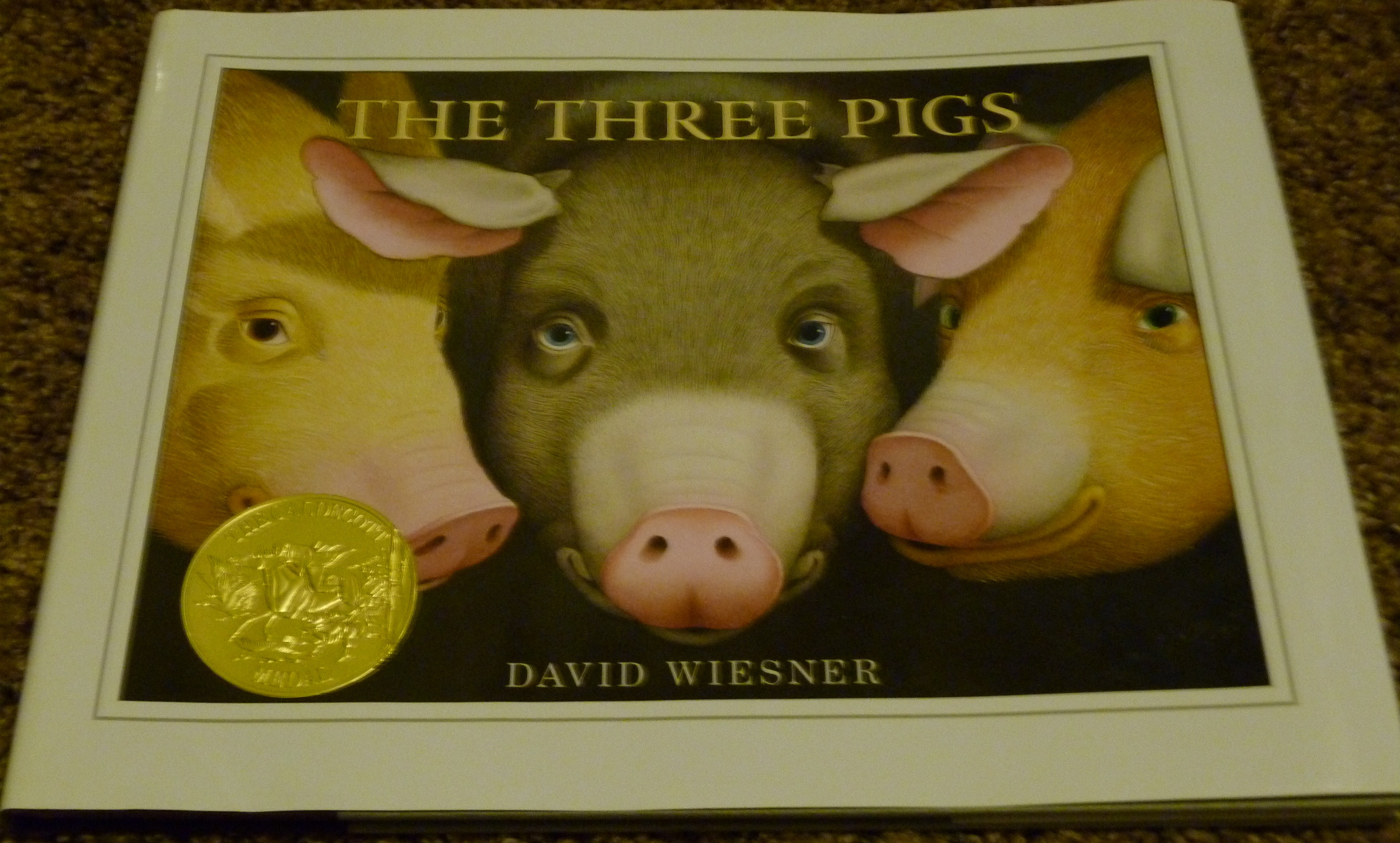
For my second post on picture books this week, I want to talk about The Three Pigs, written and illustrated by David Wiesner.  Unlike the Grandpa and Uncle Wainey books, this wasn’t a beloved childhood story for me–but that’s because it wasn’t written until I was already a teenager.  I somehow managed to stumble on it later in life, and I’m glad I did.  I’m pretty sure this would have been a beloved childhood story if I had been born twelve years later.

The story begins like the story always does, with the wolf coming to blow down the houses of the three pigs one by one.  But this time, the wolf blows the first pig right out of the story and into the margins.  He runs to get his brothers, and they escape from the wolf and go on an adventure out beyond their original storybook.  The pigs fold up one of the pages to make a paper airplane, and fly off into other stories.

I love the concept of characters coming out of the original story.  I love the absolute shattering of the fourth wall that entails.  I love the three-dimensional feeling of the book–the art makes you feel as though you can reach into it, or as though the pigs can lean out to look at you.

The art itself is beautiful.  I’ve read several books by Weisner, and he’s an incredible illustrator.  It really feels like there are works of art on every page.  He also does something very clever here where the art style changes as the pigs go in and out of different stories.  They go into a pen-and-ink drawn story at one point, and change to fit that art style.

I love retellings of traditional stories, and this is one of the most innovative and imaginative ones I’ve found.

Author’s site: http://www.hmhbooks.com/wiesner/index.html