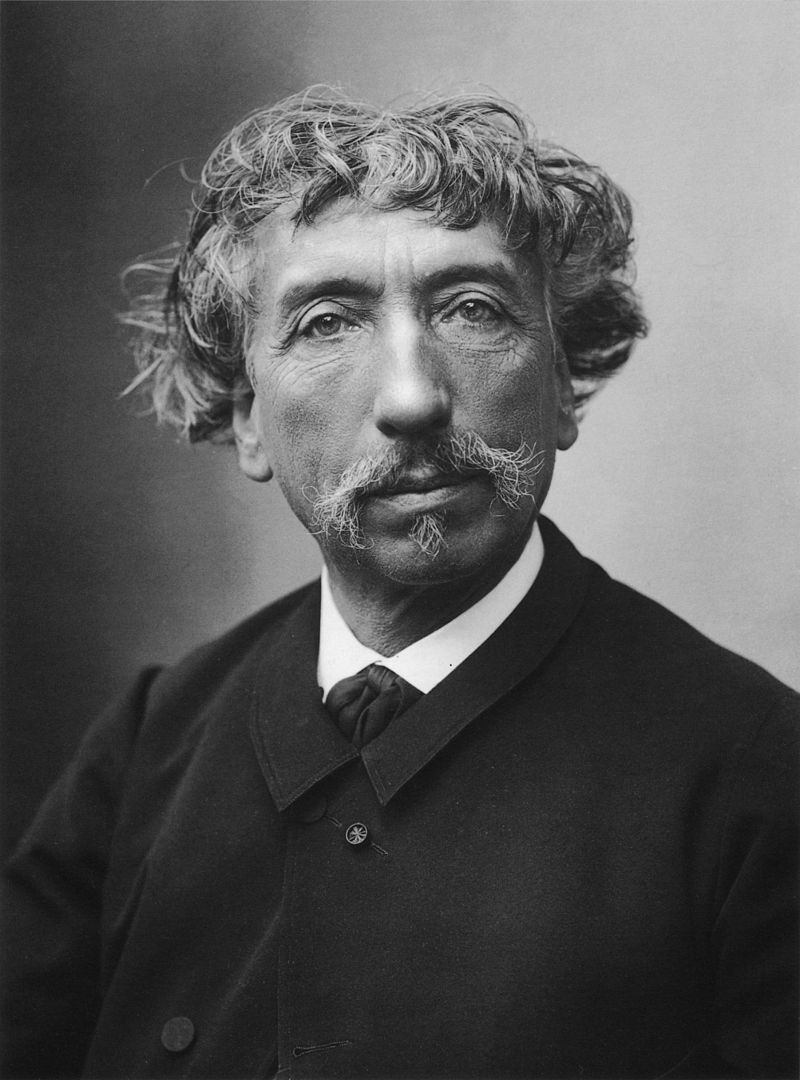
 Charles Garnier plays a funny role in my Phantom novel–a character who is and isn’t there. I wanted him in it as a kind of shadow, a part of the Opera he built, almost literally. Erik reads his book on the construction of the Opera–Meg sees his portrait in two places in the Opera–Erik references him with respect–and of course, the building is called the Opera Garnier throughout my trilogy, an actual choice since it could have been the Opera de Paris (or the Palais Garnier, or the Salle des Capucines) and still been correct usage. But I wanted that Garnier acknowledgment.
Garnier is nearly the only historical figure in my novel. The only other one is Degas, and he’s only referenced very slightly by comparison (although the Phantom does have one of his paintings on his wall!)
Somewhere I picked up a kind of fondness for Garnier, maybe from Susan Kay’s novel where he’s a more prominent character, or from visiting the Opera Garnier itself. Or maybe because of one story I heard about Garnier that I just love. While the Opera was under construction, Empress Eugenie, the wife of Napoleon III, was not wild about Garnier’s design. She asked him what style the architecture was and, being a clever man, Garnier responded, “The Napoleon III style, of course!”
So he’s in here, a little, for those reasons–but also for what I can say about the Phantom through him. And that mostly comes out in one very brief flashback. Garnier may be in the rest of the trilogy just for the sake of this moment, because I love the image of Charles Garnier and the Phantom of the Opera sitting on the edge of the stage the night before the Opera opens, drinking champagne to their masterpiece. And I will trust that the ghost of Garnier won’t mind me giving a little credit to the fictional Phantom!
Here’s my favorite bit of the flashback, as the Phantom reflects on their relationship and his role.
****************
Finally, looking at the champagne bubbles and not at Garnier’s shadowed face, he had said, “Please don’t tell them about me.”
“Of course not.”
That was all. No more than that. It was enough, because unspoken between the words and filling the empty auditorium was the tacit understanding that had always existed between them. There had never been anyone else who understood their mutual obsession for this building, no one else who loved it as they did. He had liked to think of it as similar to two men in love with the same woman, each uniquely able to understand the feelings of the other.
Of course, when that situation actually came about, it had been utterly different. So much for metaphor.
Garnier had a career, a family, a public face, and had gone on to design other buildings, explore other landscapes. Erik was the shadow he left behind to watch over his masterpiece.

 I was recently feeling that there wasn’t enough science in my life (I don’t know, it was a feeling) so I did what I usually do when I want more of a topic–I found a book about it. Specifically, I went to the library and looked up “astronomy” in the Dewey Decimal system and went over to that shelf to see what I could find. And so I stumbled onto How I Killed Pluto and Why It Had It Coming by Mike Brown–and it was excellent.
 Time again for the Friday Face-Off meme, created by


 Tales of the Marvelous