The Silver Chair

Silver ChairNext in line on my adventure through the Chronicles of Narnia on audiobook is The Silver Chair by C. S. Lewis, read by Jeremy Northam.  This one feels like a more direct sequel to The Voyage of the Dawn Treader, following most closely on those events and characters.

The Silver Chair begins in our world, at the very dreadful school, Experiment House.  Eustace Clarence Scrubb (much improved and no longer deserving his name) attends here, along with Jill Pole.  Fleeing from a pack of bullies, the two children find an open door in the school wall—and go through into Aslan’s Country.  Despite some mishaps, Aslan sends them to Narnia, charged with finding the missing Prince Rillian.  In Narnia, they learn that Rillian is the son of the aged King Caspian.  They set off into Giant Country in search of Rillian, guided by Puddleglum the Marshwiggle.

This is reminiscent of The Voyage of the Dawn Treader, as a journey story, but it has a much tighter focus on the quest.  Even when not immediately apparent, the various adventures (like being taken captive first by giants, and then by subterranean “earth men”) all lead towards the rescue of Prince Rillian.

Eustace and Jill are satisfying lead characters, not as noble as the Pevensies perhaps but good-hearted on the whole.  I enjoy characters who are good people trying to do the right thing, but who still descend to bickering and complaints when trudging through a snowstorm.  It’s very human, without making the characters unlikable.

My favorite character may be the non-human one, Puddleglum the Marshwiggle.  His name fits him perfectly, as he’s hopelessly doleful and apt to predict the worst.  Even though he seems like a wet blanket Eeyore at first, he comes through as courageous, sensible and dedicated.

My favorite scene is well along in the book, so spoilers beware!  After they find Rillian, there’s a confrontation with the witch who has been holding him captive.  It’s a wonderful, tense scene with an enemy who doesn’t swing a sword but uses words instead.  She uses magic, too, but the fascinating part is her mind-twisting arguments that the world above must not really exist.

This isn’t a new favorite of mine in the series (that’s still a toss-up between The Magician’s Nephew and The Voyage of the Dawn Treader).  It is a solid installment with a compelling plot and likable (but not too likable!) characters, and some nice creepy moments from truly dangerous villains.

Only the last book in the series left, the appropriately named The Last Battle.  Coming up soon (with a very exciting reader, by the way…)

Author’s Site: https://www.cslewis.com/

Other reviews:
The Bookworm Chronicles
Living on Literary Lane
The Day Dreaming, Candy Eating Red-Headed Bookworm
Anyone else?

Buy it here: The Silver Chair

Cursed by Frogginess

FroggedFew things are more disappointing than a premise I love in a book that just didn’t work for me.  It’s very rare that you get a second chance at that original brilliant premise.  I was disappointed by The Frog Princess by E.D. Baker, even though I loved the idea of the princess turning into a frog when she kisses the enchanted prince–so I was thrilled to hear about Frogged by Vivian Vande Velde, a story about a princess turning into a frog, from an author I’ve greatly enjoyed in the past.

Frogged is about Princess Imogene, twelve-almost-thirteen, and worried that she’s not a very good princess.  When she meets a talking frog, she tries to help by kissing him, and ends up trading places–he’s restored to being a boy, and she becomes a frog.  Since he quite rudely refuses to help, Imogene sets off herself in search of the witch who cast the spell.  Along the way, she meets new enemies, secures unexpected allies, becomes a star attraction in a terrible theatre company, and learns something about herself and the people around her.

This is not the same story as The Frog Princess, although the parallels are inescapable.  Happily, I liked this one much better.  It’s a simple story and the target age is young (perhaps 8-10), and there isn’t a huge amount of depth or complexity…but the voice was strong, there was a nice amount of humor, and the story was reliably entertaining.

An ordinary, possibly clumsy, not-stereotypical-beautiful princess has becomes something of a stereotype itself (I can think of five others without even trying), but Imogene has her own unique points.  I like that she very much feels 12-almost-13, and most of her problems are chalked up to being a difficult age more than anything else.  Some “ordinary princesses” are almost overpowering in their identity as “ordinary,” and become unusual by swinging so far that direction.

I also particularly liked an arc of learning Imogene goes through about changing how she sees others.  She’s always good-hearted, but she comes to realize that some people she thinks she understands have unexpected depths (for good and ill), and also that people don’t always perceive her the way she expects.

My favorite character apart from Imogene is the witch, who is gloriously untroubled by anyone else’s problems.  She’s not a wicked witch, exactly, and feels quite comfortable in her own mind that her actions have been reasonable (and she makes a convincing case).  She’s also not a Glinda-type, who wants the heroine to solve her problems herself so that she can learn the true lesson.  She’s simply practical, unsentimental and takes it for granted that everyone should take responsibility for handling their own lives.  She might drive me crazy in real life, but she’s remarkably refreshing in this kind of story.

Actually, a lot of the twists on traditional fairy tales are refreshing in here.  But I do tend to like that kind of thing. 🙂

Author’s Site: http://www.vivianvandevelde.com/

Other reviews:
Charlotte’s Library
Ms. Tami Reads
Kid Lit Geek
Anyone else?

Buy it here: Frogged

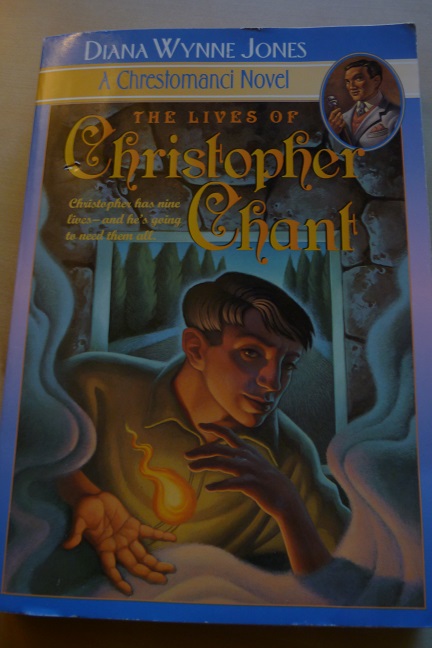
The Lives (and Deaths) of Christopher Chant

Lives of Christopher ChantOne reread project I didn’t get to in 2013 was Diana Wynne Jones’ Chrestomanci series.  I’ve read them all but out of order and at widely-spaced intervals so (not unlike The Great Khan Adventure) I decided I’d like to put them all together in chronological order.  I got started with the earliest, The Lives of Christopher Chant.

Christopher’s life could be rather bleak, with his wealthy, absentee parents and string of unfriendly governesses.  But Christopher has a secret—when he goes to bed, he can step out of his body, go around a corner, and enter The Place Between.  From there he visits the Almost Anywheres, a series of worlds very unlike his own, and each other.  When Christopher’s Uncle Ralph learns about his traveling, and especially his ability to bring solid objects back with him, Uncle Ralph gets Christopher involved in a series of experiments–with, naturally, disastrous consequences.  Eventually we learn that Christopher is a nine-lived enchanter, which proves very fortunate, as his adventures in other worlds keep losing him lives.

I think this book helps satisfy an itch I’ve had ever since reading The Magician’s Nephew, with its wonderful and utterly under-utilized Wood Between the Worlds.  The Place Between is very different in tone but very similar in function, and Christopher (and the reader) gets to visit far more worlds than Diggory and Polly did.  I’d still like more of that, but it was delightful anyway.

Christopher is a compelling boy hero who’s likeable but flawed as well.  He learns and grows as the book goes on, in the best way of complex characters, coming to realizations about how he treats people and where his strengths lie.

Among the supporting characters, the stars are the Goddess and Throgmorten.  The Goddess, otherwise known as the Living Asheth, is a girl Christopher meets in another world.  She and Christopher are on a nice parallel journey of finding out what they want in life, and how to make it happen for themselves, instead of being pushed around by circumstances.  Throgmorten is an Asheth Temple cat, fantastically valuable and fantastically bad-tempered in a highly entertaining way.

The book abounds with other magicians, good and bad and often incredibly strange.  Diana Wynne Jones has a wonderful ability for whimsy and humor in her magical stories, which is on full display here.  All that whimsy and humor is woven around a clever and complex magical system and universe structure.  Much is explored and, equally, it feels clear there’s much more still left…which is nice, when there’s several more books in the series!

This book functions as a kind of prequel, with most of the later books featuring an adult Christopher.  I read the books so spread out before that I’m sure there are lots of connecting lines I haven’t drawn, which I look forward to as I continue through the books…

Author’s Site: http://www.dianawynnejones.com/

Other reviews:
Books and Chocolate
Eyrie.org
Family Reads
Reading the End
Anyone else?

Buy it here: The Lives of Christopher Chant

Voyaging Aboard the Dawn Treader

The-Voyage-of-the-Dawn-Treader-943021I made a quick jump from Prince Caspian to The Voyage of the Dawn Treader, Book 3 (or 5) in the Narnia series by C. S. Lewis.  I remembered this one fondly, and happily found my memory correct–this was absolutely excellent, from “There was a boy named Eustace Clarence Scrubb and he almost deserved it” all the way to the end.

This is the third (and last) book focused primarily on the Pevensie children, though in this case it’s only the younger ones, Edmund and Lucy.  They and their cousin Eustace are swept through a picture to find themselves on The Dawn Treader, King Caspian’s ship sailing into the far and mysterious East.  A few years have passed since their last trip to Narnia, and Caspian is ruling over a peaceful country.  He’s set out in search of seven lords who were friends of his father, and disappeared into the East years before.  Their journey takes them through a series of islands and adventures, searching for the lords–and, perhaps, Aslan’s Country.

Journey-focused stories can be engaging or aimless, and this is one of the good ones.  Interesting adventures are frequent, and though each island has little connection to each other, the ongoing quest keeps the story moving forward.  There are wonderful adventures, from Eustace’s transformation into a dragon to the hilarious Dufflepuds to the terrifying, darkness-enshrouded Island Where Dreams (nightmares) Come True.

The adventures are good and the characters are excellent.  Lucy and Edmund uphold the Pevensie banner just fine without Peter and Susan, and Caspian is splendid and noble while still able to be young at times too.  And there’s the boy named Eustace Clarence Scrubb…  For all that I like the plucky, capable Pevensies, I also enjoy a character who does not handle magical adventure well.  S/he among you who would not be upset by a lack of indoor plumbing, throw the first stone at Eustace.  And while too much of Eustace would have been, well, too much, Lewis begins his redemption process early, and so he grows throughout the book.

(A sidenote–you may recall my issues with The Magicians by Lev Grossman, mentioned in an earlier Narnia review.  Try to imagine traveling through Narnia with six Eustaces who never learn anything.  That’s kind of how The Magicians felt to me.)

Perhaps the best character of all, though?  Talking mouse Reepicheep, the bravest and noblest of them all, despite his diminutive size.  We met him in Prince Caspian, but we get much more of him here.  Reepicheep is fearless, unswervingly devoted to honor, and fierce as a lion.  Reepicheep is hugely comical even while being genuinely noble, an impressive blend.

All in all, an excellent installment in the series, and the first rival to The Magician’s Nephew for status as favorite.  Next up, The Silver Chair, which I also remember particularly fondly, so I’m looking forward to it!

Author’s Site: https://www.cslewis.com/

Other reviews:
The Bookworm Chronicles
Bookwraiths
Living on Literary Lane
Anyone else?

Buy it here: The Voyage of the Dawn Treader

Dancing with the Wintersmith

Terry Pratchett is one of those authors I read on a fairly regular basis, and always have a good time with!  Most recently, I read Wintersmith, the third book in the Tiffany Aching subseries of Discworld.

Tiffany is a 13-year-old apprentice witch of considerable promise (and modesty).  She attends a Dark Morris dance, welcoming winter, and can’t resist jumping in–which brings her to the attention of the Wintersmith, the spirit of winter, who finds himself suddenly enamored of this human girl.  Dealing with the chaos and destruction caused by the Wintersmith’s attempts at wooing requires all of Tiffany’s strength and ability, as well as help from senior witches Granny Weatherwax and Nanny Ogg, from the fighting, drinking and swearing Wee Free Men, and from bookish and good-hearted Roland, who is not Tiffany’s young man.

I think I enjoy the Tiffany subseries so much because, like the City Guard subseries, they give me a sane main character (Tiffany and Vimes), surrounded by wildly eccentric characters.  Tiffany is a wonderful heroine who has been growing into her abilities (and perhaps more importantly, her identity) throughout the series.  I mentioned above she has promise and modesty, but it’s really more complicated than that.  Tiffany always does what’s needed, and doesn’t see anything remarkable in that–even if it’s rescuing her brother from the Queen of the Fairies, or confronting the Spirit of Winter.  I love a character who is flawed enough to not always do the right thing, but to always try to do what’s needed.

The other witches are wonderfully eccentric and unique, from Miss Treason who deliberately made herself a legend, to Annagramma, a somewhat New Age witch who thinks it’s all about rituals and beads.  Then of course there’s Granny Weatherwax–witches don’t have a leader, and Granny is the leader they don’t have–and Nanny Ogg, warm and cheerful and practical about all things, like using a Cornucopia of Plenty to stock the larder.

The Wee Free Men, also called the Feegles, are at their usual wild state of hilarity, endlessly cheerful and enthused, shouting and rushing about and eager to do whatever is needed to help “the big wee hag.” I love it when they attempt to sing “Row Your Boat” while crossing the River Styx, “at every possible speed and tempo and with no regard at all for the tune,” annoying Death not a little.

The funniest feature of this book may be Horace, a very lively Lancre Blue Cheese.  He’s adopted by the Feegles, given his own bit of tartan, and does his best to hum along with the singing.

Roland also gets some nice scenes in this book.  He’s not Tiffany’s young man (in rather the way Granny is not the leader of the witches) and he has to step up to be the Hero in the story, even though he’s only ever used an imaginary sword, and learned swordplay from a book.  He has some truly awful aunts and I am hoping for more of his story in the next book…

If I have one criticism of this book, it’s the first chapter.  Chronologically, it covers events which should slot in between Chapter Twelve (of Thirteen), and I frankly don’t know why Pratchett decided to start there.  It made me thoroughly confused, and wondering if I’d missed a book in the series.  So–if you begin this and don’t know what’s happening, keep reading.

Anything else…have I said much on the plot?  The plot is good, perfectly engaging and exciting in spots–but it’s more important as a vehicle for the wonderful characters and high hilarity Pratchett is so good at!

My recommendation: don’t start the series here…but do start the series. 🙂

Author’s Site: http://terrypratchettbooks.com/

Other reviews:
Tethyan Books
Science Fiction and Fantasy Book Reviews
Feeling Fictional
Anyone else?

Buy it here: Wintersmith