The Gift of The Giver Series

When I found out that Lois Lowry had released a fourth and final book in her Giver series, I had it on reserve at the library within five minutes.  Apparently everyone felt the same way, as I was about #25 in line.  That actually worked out perfectly, because it gave me time to reread the first three books!  Which also seemed to be in high demand…so perhaps other people felt the same on that too.  Today I want to talk about those three–and then discuss Son in its own review next week.
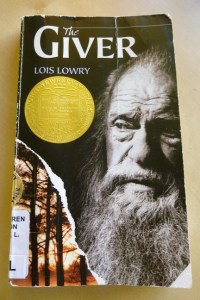
Lowry Giver The most famous, I believe, is the first book, The Giver.  I remember a teacher read it to us in sixth grade, which is the same age Jonas is in the book (probably not a coincidence).  Until I picked it up again, I would have guessed that I had reread it more recently–but I don’t think so anymore, because it felt so different reading it as an adult.

Jonas lives in a very carefully regulated community, where a council of elders decide how each person’s life will be lived.  Everyone is assigned a career at age twelve.  Later on they’re assigned a spouse, and then given children.  When Jonas turns twelve, he is assigned the mysterious role of Receiver, the keeper of the community’s memories from a time before.  As he gradually receives memories from the old Receiver, now called the Giver, Jonas begins to question the world around him.

As far as I can remember when I was twelve, I didn’t find this book disturbing until most of the way through, when I found out what it really means to be “released” from the community.  Reading it as an adult, I was disturbed by page one, when a plane flies over the community unexpectedly and everyone, children and adults alike, stop in their tracks, paralyzed by uncertainty and fear in the face of anything different.  There is something really wrong with this society.

The more you read and the more you find out, the worse it gets.  Lowry has created an incredibly chilling book that is deceptive in its simplicity.  The language is simple, the book is short (I read it in a day) and it’s very much about a child–but it is so powerful.  Part of the chilling nature is Jonas’ easy acceptance of the world as it’s been presented to him.  I think when I was twelve I accepted it right along with him.  As an adult, I’m horrified immediately, while the narrator goes along without seeing a problem for most of the book.

This is not a flashy dystopia–no one’s bleeding, no one’s starving or forced to fight to the death in an arena.  The community is designed to prevent pain.  But it is nevertheless a terrifying vision of a future with no independence, where the individual is completely subjugated to the “good” of the community, and the goal of eliminating pain has eliminated all positive emotions too.
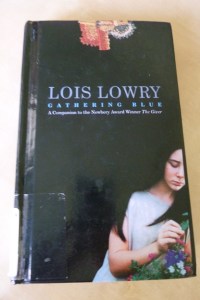
Lowry Gathering BlueNow how do you follow that book?  Book two is Gathering Blue, which does not really seem to have any connection to The Giver (more on that in a bit).  This is set in a different future community.  Kira’s community is not neat and ordered like Jonas’.  Her village lives a subsistence life with no room for warmer emotions in the fight merely to survive.  Anyone who can’t contribute is killed.  Kira, born with one bad foot, was saved in childhood by her caring mother.  Now that her mother has died, Kira saves her own life through her talent for embroidery; the village elders choose her to repair the Robe that records the history of their world.

Kira’s people are as much dehumanized as Jonas’, albeit in a different way, and the governing body has no more concern for people.  It’s fascinating to watch more and more be revealed about her community.  Kira is a particularly good character, and there are good mysteries to unravel in her world.  I remember the first time I read this, I was so frustrated by where it ended!
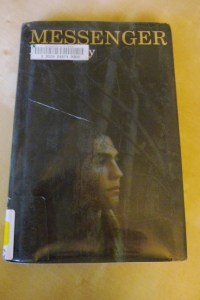
Lowry MessengerSo it’s a good thing there’s book three, Messenger, which ties the first two books together and gives us answers to their inconclusive endings–if not a final ending yet.  This book focuses on Matty, a young friend of Kira’s.  He’s living in a new village, a warm and welcoming place founded by outcasts from other, harsher communities.  But something is changing.  A mysterious figure known as the Trademaster has been inviting people to trade away parts of themselves–honor, kindness, strength–for whatever they most want, and the attitude of the whole community is hardening.

This is the first directly fantastical book.  There are fantasy elements in the first two, but they don’t feel like fantasy.  Jonas’ receiving of memories feels like a kind of hypnosis, and Kira’s embroidery abilities seem like they could be magic, or could be only inspiration.  This book features the Trademaster and his abilities, as well as a sentient, hostile forest, and a special ability Matty is learning to use.  Kira and Jonas both return, so we find out more about the next few years of their lives, and about their clearly magical abilities too.

We again see a theme of dehumanizing.  Jonas’ people lost their humanity trying to escape their pain.  Kira’s people are ground down by poverty and self-interest.  Matty’s people are sacrificing the best of themselves in the interest of greed.

Messenger is in some ways the weakest book, with its primary value bridging the two stronger ones.  I don’t feel like Matty is as effective a character as Jonas and Kira, and while Trademaster is terrifying, he’s also flashier–and we lose the subtle horror of the first two books that was so much more chilling.

However–I also think Messenger gets some criticism because it’s been perceived as the final book of the series.  It does part of that job, tying some things up, but it doesn’t give a strong finish.  Seeing it only as a bridge book leading to book four, I think it lives up to that role very well.

And book four, Son, gave me that stronger finish I was looking for.  But that will be the next review…

Author’s Site: http://loislowry.com/

Other reviews:
Annette’s Book Spot
Stephanie Early Green
Becky’s Book Reviews
Anyone else?

Buy it here:
The Giver
Gathering Blue
Messenger

A Journey Back to Middle Earth

Hobbit 1I saw The Hobbit this weekend, and it was so much fun to go back to Middle Earth.  The movie is excellent on so many levels, from the characters to the action to the vistas…and to the return to Middle Earth.  Also–Martin Freeman!

This is a prequel that is self-aware of its own sequel, but that works.  The movie begins, I believe, the same morning as The Fellowship of the Rings.  Bilbo is writing his memoirs and nephew Frodo is eagerly anticipating the arrival of Gandalf the wizard for Bilbo’s party.  And then we flash back sixty years…to watch an unchanged Gandalf select a much younger Bilbo for an adventure–along with thirteen dwarves who invade Bilbo’s home in a very funny fashion.  Bilbo reluctantly embarks on “an unexpected journey,” and soon finds himself engulfed in a quest to fight a dragon to reclaim the dwarf homeland, fighting orcs and trolls and even stranger creatures along the way.  Meanwhile, Gandalf and others are worried about the rise of darker powers in a pretty obvious foreshadowing–but no matter, it gives it a nice all-tied-together feeling.

Let’s start with Bilbo.  To reiterate–Martin Freeman!  This actually makes the long wait for Sherlock feel worth it.  Freeman is playing the character he plays best, the ordinary chap who just wants a peaceful life (and perhaps a hot cup of tea), only to find himself thrust into chaos far beyond his scope.  He has to rise to meet it, and discovers he has a zest for adventure in the process.  Such is Arthur Dent, Dr. Watson, and most definitely Bilbo Baggins.  Starting from a scene where he firmly tells Gandalf that no adventures are wanted here, they’re inconvenient and make one late for dinner, Bilbo grows into a hero almost in spite of himself.  At the risk of a slight spoiler, I will say that he eventually shows courage in battle–but I think I was more impressed by a scene afterwards when he shows that he understands what they’re fighting for, believes in the rightness of the cause, and is willing to persevere to make it happen.  That’s more indicative of character growth than hitting an orc with a sword.

The other biggest character in the movie is Gandalf the Grey Wizard, wise and yet at times very humanly unsure too.  Ian McKellan is excellent, conveying all sorts of depth of emotion with just a twinkle of the eye or a curl of the lip somewhere behind that enormous beard.

It’s a movie of beards, by the way, since we spend most of it in the company of dwarves with some fantastic beards.  Thorin, the dwarf king, is the most serious and complex of the group, the leader of the quest and the somewhat Aragorn-like figure of the movie: rough and sometimes terse, but good-hearted and a brave leader.  The rest of the dwarves shine largely as comic relief, but provide the occasional dramatic insight too.

One of the most striking characters of all is Gollum.  I doubt he was in the movie for more than fifteen minutes, but they are among the most memorable fifteen minutes.  He’s completely mad, big-eyed and sad one moment, snarling the next, and just so excellently done all the time.

There are also cameos by other old friends–Frodo was mentioned above, and we also see Elrond, Galadrial and Sarumon.  I confess I was rather hoping for Legolas (I don’t care what the purists say about his not being in the book), but IMDB tells me he won’t be along until the third movie.  I was also watching for Benedict Cumberbatch, never saw him except in the credits, and figured out after I got home that he was the Necromancer–who I think was only seen in silhouette for about five seconds.  Next movie, I hope for more.

But on the subject of old friends–it is so much fun to come back to this world, to see some of the same faces, to recognize the same creative style.  I am by no means a major Lord of the Rings fan, and it’s been years since I watched the movies.  Yet there’s something so nostalgic about The Hobbit.  This may be enhanced by the fact that we’ve come back to what is, in a way, a simpler time in Middle Earth.  Sauron is just starting to rise, Smaug is a comparatively small villain, and the movie is more light-hearted, at least in spots.

There are certainly epic sword fights and large-scale battles with hideous monsters, and moments that are just so deliciously Tolkienesque.  I don’t really know how else to describe it, because I think he set the definition.  He set the standards that so many others are emulating and going back to the original just brings it to some kind of pinnacle of fantasy.

But there are also funny parts, particularly the beginning as the dwarves run rough-shod over Bilbo’s home, and most especially a scene involving a trio of gourmet if stupid trolls who want Dwarf for dinner.

There are also incredible views.  If Lord of the Rings has led you to expect scenes of footsore travelers traipsing across mountain paths with breathtaking vistas behind them…you will not be disappointed.  The setting is really remarkable throughout, from the sweeping views to the beautiful Rivendell set amidst waterfalls, to the truly horrible troll kingdom, to the cozy homeyness of the Shire.  It’s all so vivid, so beautifully realized…and I saw it in simple old 2D.

I’d be remiss if I didn’t reflect on the fact that this is a long movie.  And it’s part one of three.  It reminds me of Harry Potter 7, Part 1, in that it feels like someone set about to include every detail they could.  The Hobbit is not a slow movie, but it is a movie that takes its time.  It will not be rushed, it will not leave anything out, and if there is an element of backstory or a moment of foreshadowing to be told, it will tell it.  No need to hurry, just relax and enjoy the scenery.  It’s almost a little cosy, if I can use that word to describe a movie involving orcs and swords and falling off of mountains.

I have to admit I’m not quite sure how there are going to be two more movies after this, but I’m content to sit back and see where the journey takes us.  I look forward to continuing to visit Middle Earth, because it’s an amazing place where so many fantastic things can happen.  I mean, there are dwarves, and elves, and a city built amongst waterfalls, and stone giants!  It’s just–wow!

Also–Martin Freeman! 🙂

Movie site: http://www.thehobbit.com

Godmothers and Fairy Tales and Tradition

I’ve been reading my way through Mercedes Lackey’s 500 Kingdom series, and I keep meaning to review each book…but I reviews piled up and I haven’t got to them.  So I thought maybe I’d better review the series on a whole.  It may be best looking at them all together anyway, because I have definite feelings–mixed.

The series has been rather hit and miss for me, both in that some books are better than others and that some aspects of books have been better handled than others.  The biggest advantage of this series is a blissfully brilliant concept–in the 500 Kingdoms (take that literally) life is constantly influenced by the Tradition, a vague, overarching, not-quite-intelligent magical force which tries to push people and events onto…well, traditional paths.  Therefore life tends to conform to familiar fairy tales, for good or for ill.  The Godmothers are a network of powerful magical women, who work through and around the Tradition, trying to create happy endings.

I love that concept.  I love all the playing with traditional fairy tales, and I love the clever ways they get retold.  I love the ways people find to manipulate the Tradition, and the sometimes silly things that have to be done to keep the Tradition happy.

Things get more mixed with the characters–from book to book, some have been strong while others have never felt fully realized.  Likewise, I have mixed feelings on the plots–some are good, but several have felt distinctly scattered.  But perhaps I’d better look at this book by book. Continue reading “Godmothers and Fairy Tales and Tradition”

The Fairy Tale Behind the Ballet

The holidays are creeping up on us!  I always like thinking about favorite books and movies to help put me in the spirit.  This year, I was fortunate to find a new (to me at least) book with a Christmas theme: Nutcracker by E. T. A. Hoffman, illustrated by Maurice Sendak.
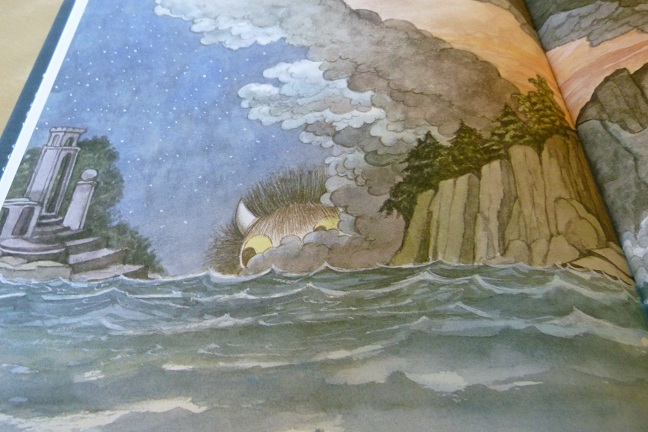
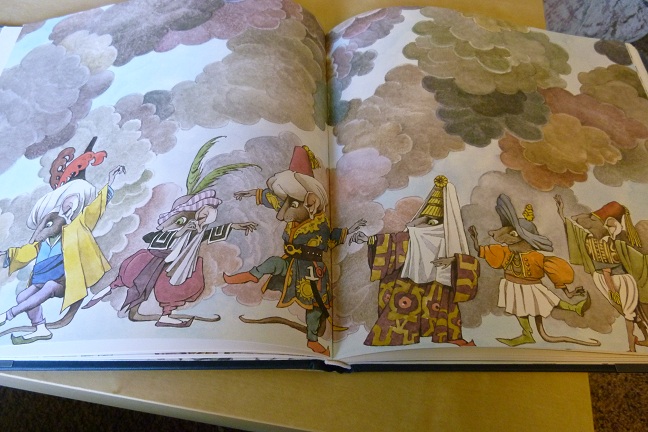
You may be familiar with the Nutcracker ballet–and this is not quite that.  The ballet is based on the story, and you can certainly see the same outlines.  But as often happens when stories are translated from one medium to another, things changed along the way!  The plot is a bit different and, in this particular edition, so is the atmosphere created by Sendak’s illustrations.

Like the ballet, the story begins with Christmas Eve, as Marie (or in the ballet, Clara) and her brother Fritz open their Christmas presents.  Marie’s favorite is the wooden Nutcracker.  That night, after everyone else has gone to sleep, Marie is in the parlor with the toys.  She witnesses a fight between the toy soldiers led by Nutcracker, and the fearsome, seven-headed Mouse King–or did she just dream it?  Here the story diverges from the ballet.  Marie is injured in the fight (or did she just put her arm through a glass cabinet?) and while she’s sick in bed, Godfather Drosselmeier tells her a fairy tale story of how the Nutcracker was cursed, and the roots of his enmity with the mice.

This is a lovely Christmas tale, with much the same charm and feel as the Brothers Grimm (though maybe less grim than their darkest!)  The book is really a novella, including the long story-within-a-story in the middle.  The odd story about the cursed princess who can only be cured when a magic nut is cracked is great fun, and Marie has her share of adventure too.

The illustrations are obviously a big part of this book, and there are some beautiful ones.  Don’t expect the tinsel and glitter of most productions of the ballet, but Sendak brings the characters to life with his own unique style–and with particularly elaborate costume details.  There are many full-page spreads, including a series of pages in a row when Marie and Nutcracker travel to the magic country.  There’s even what looks like a “Wild Thing” peering around a rock in one of those pictures!

My favorite thing about the book may be the charming narrative voice.  J. M. Barrie has won my heart forever by being the most charming of narrators, and so when I say Hoffman reminded me of Barrie in some moments, it’s a high compliment.  He has the same trick of addressing the reader that I enjoy so much, and there’s also some great tongue-in-cheek humor.

The edition I have was just released last October, and it’s physically a beautiful book.  It’s a large hardback, and seems designed to make a wonderful holiday gift!

Other reviews:
Rhapsody in Books Weblog
Minding Spot
A Patchwork of Books
Anyone else?

Disclosure: I received a free copy of this book from the publisher in exchange for an honest review.

Rise of the Anthropomorphic Manifestations…er, Guardians

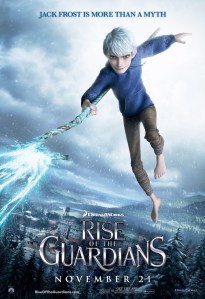
When I went to see the adorable Wreck-It Ralph a couple of weeks ago, I saw ads for another animated movie, Rise of the Guardians.  Pretty much all I knew was that it was about Santa Claus and Jack Frost and the like, and there was a monster to fight…but this put it close enough to fairy tales to pique my interest, and so I went to see it this past weekend.  And it was excellent!

The movie focuses on the great mythical figures of childhood–I’m not sure quite what to call them, and “anthropomorphic manifestations” is too long, so let’s call them fables for convenience.  The main fables are Santa Claus, the Easter Bunny, the Tooth Fairy, and the Sandman–and Jack Frost, our lead character.  The first four are Guardians, protecting children through the centuries.  Now childhood is threatened by Pitch Black, the Bogeyman, and the Guardians are seeking Jack Frost’s help to fight back.

Jack has his own worries to think about–no humans can see him, no children believe in him and he doesn’t know what his purpose is meant to be–but he’s pretty sure he doesn’t want to be a Guardian.  Irresponsible and free-spirited, he doesn’t see himself as Guardian material, yet finds himself pulled into the fight against Pitch.

It’s a good plot that keeps moving at a quick pace, and the movie is enormous fun.  I love the way they play with the portrayal of the fables.  These aren’t the simple, saccharine characters who show up on Hallmark cards.  Santa (Alec Baldwin) seems to resemble a Russian mob boss who runs the North Pole with the help of tiny, hilariously-inept elves and a lot of Yetis.  The Easter Bunny (Hugh Jackman) is Australian, wields a boomerang with deadly effect, and uses magic rabbit holes to get around.  The Sandman is a tiny gold man with clouds of sand around him all the time, who doesn’t speak but flashes symbols above his head.  The Tooth Fairy (Isla Fisher) is a hyperactive cross between a humming bird and a human who is a little too interested in everyone’s teeth, and is surrounded by a crowd of tiny, hummingbird fairies.  And Jack Frost (Chris Pine) is an outwardly-tough prankster with a good heart, who is in fact deeply lonely.  Pitch (Jude Law) is suitably frightening, although I must admit a sneaking sympathy with him too.

The characters are engaging, both fun and appealing, and the humor is great–and this movie is SO beautiful.  It’s not the kind of beautiful animation you see in Brave, with all those landscapes (and Merida’s amazing hair!), but the animated medium lets them do incredible things with the magic.  It’s more like some of the scenes from Fantasia, with lights and shapes and beautiful patterns.  Jack leaves lacy flowers of frost behind him everywhere he touches, and there’s a wonderful opening scene as he leaps around a frozen lake leaving patterns in his wake.  The Sandman sends dreams as golden streamers of light soaring through the air to each sleeping child.  And Pitch’s nightmares are horrifying black stallions that stream shadows behind them.  It’s all so vivid, and so magical.

I have one criticism–the holidays are very much simplified down, and the movie exists in a world where Easter simply won’t happen if there aren’t any eggs, and Christmas is irrevocably and entirely ruined if Santa doesn’t come.  I don’t appreciate that message…but I’m also somewhat resigned to it in this kind of story.  Movies almost always equate Christmas with Santa, and I guess I’ll have to watch The Nativity Story if I want something else–or A Charlie Brown Christmas.

Aside from that, this actually has a quite nice message, about the wonders and joys of childhood and their importance.  The story takes a J.M. Barrie-esque twist, as it turns out that the Guardians need the belief of children to give them strength.  I like that balance, of the children needing the Guardians but also the Guardians needing the children.  And even if Santa isn’t really the deepest part of Christmas, this is a fairly deep Santa–somewhere inside the Russian mob boss, that is.

Technically, this is set around Easter, but it feels very much like a Christmas movie.  After all, two major characters are Santa Claus and Jack Frost, and most of the settings feature snow.  It has a Christmas movie atmosphere too.  As the cliche phrase puts it, it would be “fun for the whole family.”  I know it made me smile all the way through!

Movie site: http://www.riseoftheguardians.com/