The Graveyard Book Read-Along, Week Two

This month, I’m participating in a read-along of Neil Gaiman’s The Graveyard Book, as part of R.I.P.  We’re looking at a few chapters a week, with no specific questions for each post.  This week’s discussion is on chapters 4-6.  See my first post here.

I want to start by saying I’ve really enjoyed reading everyone else’s thoughts on the book; it’s definitely made me think about new aspects of the story, or consider some angle I hadn’t thought of.

For instance, I’ve seen some comparisons to Tim Burton–and I can completely see that!  There’s a very Burtonesque aspect to the depiction of the ghosts and the supernatural beings, who come across in some ways as more “alive” and engaging than the living characters.  That’s the entire focus of Corpse-Bride, and we see it here too.  Bod’s friends and loved ones are all dead or supernatural.  In this section of the book particularly, we see Bod venture out among living people–who are far less friendly and much more threatening.

This line of thought has also led me to very much want an animated movie (or maybe miniseries, it’s so episodic) of the book–screenplay by Neil Gaiman and directed by Tim Burton.  Obviously that would mean Johnny Depp as the voice of Silas, Helena Bonham Carter as the voice of the Lady on the Grey, and possibly Christopher Lee as the voice of the man Jack.  So if it ever happens, remember–you saw it predicted here!

Anyway, on to this section of the book…

I think Chapter 4 is one of my favorite chapters.  Bod meets the ghost of Liza, who was drowned and burned (both) as a witch and buried without a marker.  He decides that he wants to buy her a headstone, and ventures out of the graveyard to find a place that sells them.  I love Liza, who is so up and down and friendly and spooky all together.  I love that Bod wants to get her a headstone just because it’s right for her to have one.  It would be so easy to make her really nice or a perfectly innocent victim.  Then it would still be admirable, but somehow I think it would make his action less.  It would become an act of charity, or simpler in some way.  As-is, I think he’s doing it just because it’s right.

Chapter 5 is about “the dance Macabray,” the rare night when the dead and the living gather in the old town and dance together.  I love the eeriness of that concept, and I love the descriptions of the unearthly music and the magical dance.  I do have to say that as someone who normally pronounces macabre as “ma-cob,” the constant use of “Macabray” made me wince…but I looked it up and apparently there are multiple correct pronunciations.  Maybe it’s a British/American thing.

After Chapter 5, we have a brief interlude that shows us the man Jack again, though it doesn’t tell us much except that he’s still after Bod.  He’s a convocation, and even though the speaker is talking about philanthropic work, the mere fact of the man Jack’s presence makes me deeply suspicious about this group.  And I am reminded of a group in The Sandman Chronicles.  There was a kind of murderers convention, especially for really twisted murderers.  That was aroundwhen I stopped reading those graphic novels, so it’s just as well we don’t get more specifics here about the man Jack’s group…

Chapter 6 sees Bod attempting again to venture out of the graveyard, this time to go to school.  There are some fantastic things in here–I mean, he uses graveyard powers to fight bullies!  Love that!  Though I do think Silas could have been a little more proud of him, even if it was a bit stupid.

As touched on above, Bod meets far more frightening people among the living than he does in the graveyard, and I love that inversion of expectations.  It’s also interesting that Bod doesn’t decide to hide among the ghosts–he still feels drawn towards the living.  There’s a lovely bit (which of course I can’t find right now!) when Silas talks about how, for the living, there are always possibilities, always the potential for growth and change and making an impact on the world.

That’s my philosophical thought for this section. 🙂  I believe the next (final) section will be tying up some of the background threads from the beginning of the book, and I’m looking forward to seeing it all come together.

And, of course, to seeing everyone else’s thoughts on this part of the book!

The Graveyard Book Read-Along, Week One

This month, I’m participating in a read-along of Neil Gaiman’s The Graveyard Book, as part of R.I.P.  We’re looking at a few chapters a week, with no specific questions for each post.  This week, a discussion on the first three chapters.

I’ve read The Graveyard Book before, but it’s been a few years and some of the details have gone fuzzy.  I do remember the shadowy feel of the book, and that I enjoyed it!  So I’m looking forward to digging into in greater depth.  (I suspect there’s a pun somewhere in that “digging in” phrase…but we’ll just move along…)

For those not familiar with the book, it tells the story of Bod, a living orphan who is being raised by a community of ghosts.  The first chapter describes how this situation came about, and the next two share a couple of Bod’s childhood adventures.

The first thing that struck me on picking this up again was the pictures.  The first few pages of each chapter are illustrated with wonderful black and white drawings that set the shadowy tone of the book so well.

Gaiman makes a very interesting choice by starting us out in the point of view of a murderer, the man Jack who killed Bod’s family.  What’s particularly remarkable is that he manages such a deft balance of starting us in an unbelievably horrible situation–but I don’t feel inclined to slam the book and walk away.  It is horrible, and it’s certainly dark and creepy (just the phrase “the man Jack” is so creepy), but it never quite becomes grotesque or too twisted.  And if you’ve read the Sandman graphic novels, you know Gaiman is capable of going there!  As it is, this sets up a wonderful darkness without scaring squeamish me off of the book.

I also love that it’s the living man who’s frightening–the ghosts are quite homey and pleasant.  They have a close community in the graveyard, with each ghost living in his or her respective crypt, all going about much the same community relations that they had in life.  And why not?

In Chapter Two, Bod makes a human friend, a little girl named Scarlett whose mother thought it made sense to bring her to play in a graveyard (a nature reserve, technically).  The two of them venture into a dark depth of the graveyard and encounter very strange and sinister creatures.  I enjoyed some of the contrast between Bod and Scarlett, but wish Gaiman had done more with that.  Ultimately they both end up not being afraid of what appears to be a monster–and I totally get that Bod is used to the strange and the supernatural, but I don’t understand why Scarlett, as a normal little girl, calms down remarkably quickly.  Perhaps I’m just meant to take her as being special too.

My favorite thing about Scarlett, though, is probably that she thinks Bod is an imaginary friend.  What a wonderfully fuzzy margin between reality and imagination!

In Chapter Three, Bod gets a new tutor, Miss Lupescu (whose name makes her secret fairly obvious), and ends up captured by ghouls.  The best thing about the ghouls is their names.  They all receive new names when they become ghouls, names which properly reflect the high esteem ghouls hold themselves in: names like “the famous writer Victor Hugo” or “the Bishop of Bath and Wells” or “the 33rd President of the United States.”  And they’re never shortened.

So far, the book is quite episodic, with each chapter almost a self-contained short story.  I do seem to recall, however, that threads begun in one place will come back in another, and it’s going to be fun to watch that weaving.  And the short story nature makes this good for a read-along!

Austen and Bronte and Magicians

My next book for the R. I. P. Challenge is The Magicians and Mrs. Quent by Galen Beckett, which mostly comes into the category in the book’s second part.  I became interested because this was described as a blending of Austen and Bronte, in a fantasy world–and that’s exactly what it is!
The book is divided into three sections.  Book One is told by three narrators in rotating chapters.  We meet Ivy first, a young woman fascinated by magick [sic].  Her beloved father was a magician who has gone out of his mind; Ivy comes to realize that magick may relate to the cause, and also that he left her a riddle to solve, relating to vital work she must do.  Rafferdy is another narrator, a bored and cynical nobleman interested only in amusement and determined to do no harm by having no meaningful effect on the world at all.  Our third narrator is Eldyn, who is striving to create a better life for himself and his sister, but in the process falls into the power of a ruthless highwayman and revolutionary.

The personal stories of all three characters roll out against a backdrop of brewing revolution and a growing magical threat, which Ivy in particular must find a way to combat.

Book One has us very much in Austenland.  Book Two takes a dramatic shift towards Bronte, when Ivy accepts a position as governess at Heathcrest Hall, a gloomy manor out on the moors.  There’s a not too subtle resemblance in the premise to Jane Eyre, and Heathcrest Hall is presided over by Mr. Quent, who bears a not too subtle resemblance to Mr. Rochester.  Book Two is strictly about Ivy, and told by her in first person.  The book takes on a gothic feel, out on the misty moor where strange magick is afoot.

Book Three takes us back to the setting and narrative structure of Book One, as all the characters’ plotlines come to a head.

This book started slow for me, but I ended up really enjoying it.  In the first section, I was mostly only drawn into Ivy’s chapters.  Rafferdy and Eldyn are interesting, but they weren’t engaging me that much. The book picked up in the second section, when the plot gets more focused, and we get much more magick.  (And I have no idea why it’s spelled with a K, but it is.)

The book is set in Invarel, which is a very obvious parallel to England.  All the names are changed, but there are frequently details that are clear analogs; for instance, the brewing revolution centers around an obvious Bonny Prince Charlie equivalent.  There is the difference, of course, of the presence of magical forces, which exist in a few different varieties.  There are magicians who can work certain complex spells.  There are illusionists, who mostly work their marvels in theatres.  And there are witches, who have an affinity for the Wyrdwood, an ancient forest spread throughout the country and which, legends say, will fight back against its enemies.

All the magick is intriguing, although in a way what grabbed me the most was scientific (sort of).  The other biggest difference between Invarel and England is that Invarel’s planet is in a solar system which operates very differently from ours.  The crucial result is that they don’t have days and nights of set length.  People have to constantly check their almanacs to see how long the day will be–maybe four hours of daylight, maybe twenty-eight.  I was fascinated by the concept, and by all the details about how society can function under those circumstances.  I kind of wish there had been more of that!  I’ve seen at least one reviewer complain that it didn’t make sense and that’s probably true–but that didn’t worry me.  It was just so interesting!

The world of The Magicians and Mrs. Quent is an intriguing one, and I was also drawn into the characters.  As mentioned, it started slow for me, but Rafferdy eventually gains some depth and Eldyn’s plotline gets more intense.  I enjoyed Ivy from the beginning; her family circumstances and her character are both reminiscent of Elizabeth Bennet.  She’s a capable, intelligent, well-read young woman who is nevertheless constrained by her position in society.

I was essentially playing “spot the Austen character” all through Book One.  Ivy’s parents and two younger sisters all seem drawn from the Bennet household, and you can also find Lady Catherine de Burgh, Mr. Collins, and even Mr. Palmer from Sense and Sensibility.  There may be more–I’ve only read three Austen books.

I suspect this book is more fun if you’re familiar with both Pride and Prejudice and Jane Eyre, although I don’t think it’s essential.  It draws from them for the characters, and the circumstances those characters find themselves in (Ivy especially), but the plot goes in a different direction from either book.  If you don’t have the background knowledge, you could probably just take this as-is and be interested.

The style of the writing is also drawn from Austen and Bronte, although rarely in a heavy-handed way.  You can see it right in the first sentence: “It was generally held knowledge among the people who lived on Whitward Street that the eldest of the three Miss Lockwells had a peculiar habit of reading while walking.”  A few times I thought Beckett was trying too hard to make the dialogue sound Austenish and it came out stilted, but most of the time it’s a nice flavor in a very readable book.  Except, that is, when Beckett picked up Austen’s teeth-gnashing habit of skipping lightly past romantic declarations without any dialogue!  I always want to know what they said, not just the narrative fact that they said it!  Sigh.  On the plus side, near the very end of the book we get a little more Bronte-style adorable romantic teasing dialogue, so I was somewhat mollified.

All in all, I’d say, be warned that this may take some effort at the beginning, but it really is worth continuing.  I recommend this if you like fantasy, and highly recommend it if you like Austen and Bronte.  I know I’ll be going on to read the next two books!  This one gives us resolution, but there are still mysteries to be explored.  I may also be rereading Jane Eyre soon…

Author’s Site: http://wyrdwood.net

Other reviews:
Fyrefly’s Book Blog
Kid Lit Geek
Stewartry
Things Mean a Lot
Stella Matutina
Anyone else?

Classic Review: The Little White Bird

A quick update today, to say that I just got back from my trip to London and Paris.  I scheduled posts ahead, but if you noticed a distinct silence in the comments, that was why.  The trip was amazing 🙂 and you will be hearing (and seeing) more about it soon!  While I’m getting back on top of things, I have another classic review today, very relevant to my recent trip.

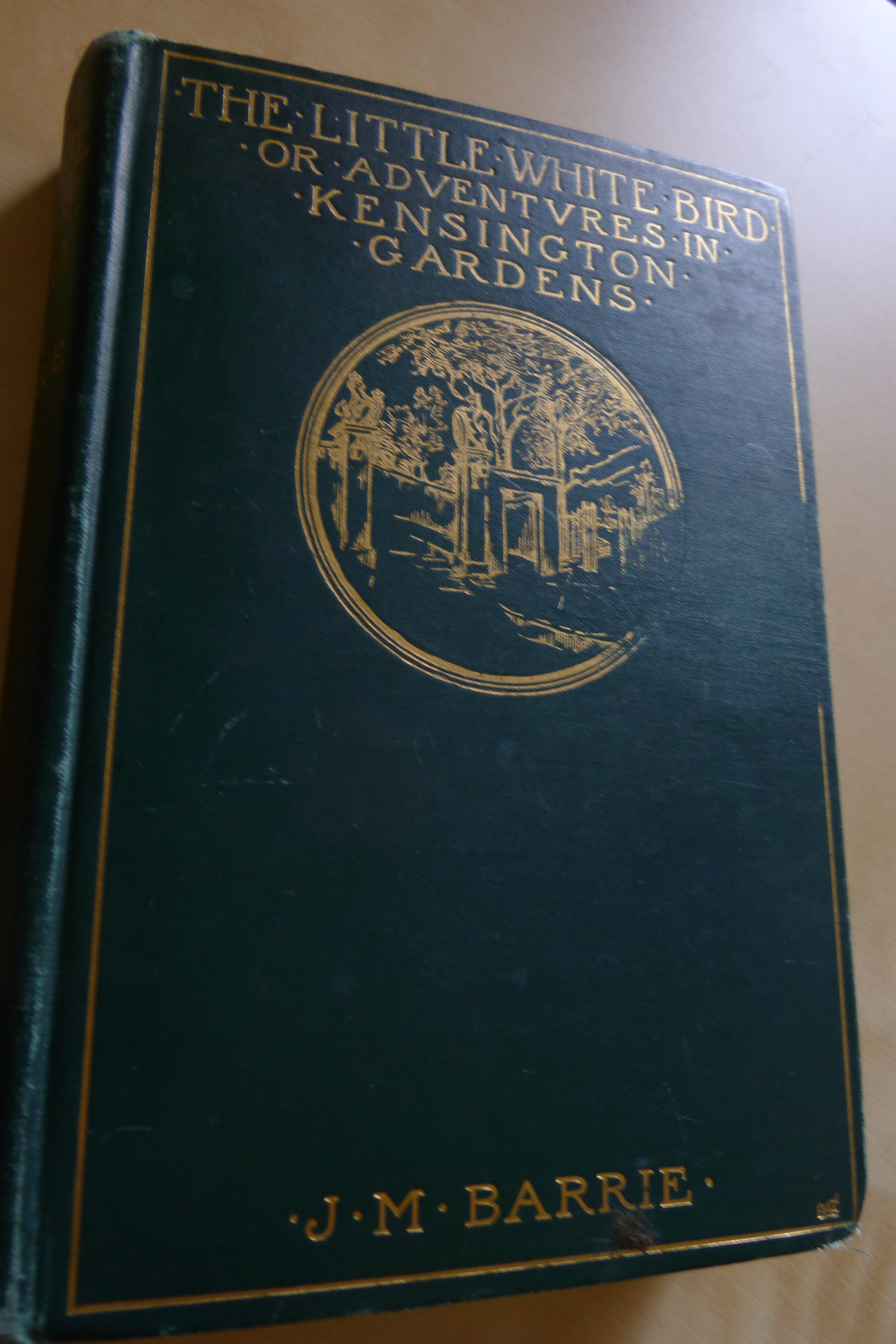
My hotel in London was near Kensington Gardens for a variety of reasons.  It really was a practical choice.  But I also stayed in that part of town because of J. M. Barrie.  The author of Peter Pan, he lived near Kensington Gardens, where he met the Davies boys, the real life inspirations for Peter.  He wrote another book inspired by the Davies, featuring Peter in a cameo.  It’s really that book, The Little White Bird, that’s given me my fascination with Kensington Gardens.

*********************************

It really all began in the The Little White Bird.  It’s very possibly my favorite J. M. Barrie book, even over and above Peter Pan.

The Little White Bird; or Adventures in Kensington Gardens is a tale about a man who befriends a little boy, and has adventures with him in London and Kensington Gardens.  If you’re not already suspecting the autobiographical nature of this novel, the little boy’s name is David.  Historically, J. M. Barrie befriended the Davies brothers in Kensington Gardens.  Not too subtle!  He also has a dog named Porthos, as did Mr. Barrie.  The man in the story is left unnamed.  He’s referred to as Captain W–.  I somehow picked up the habit of calling him the kindly old gentleman.

A review in The Times said of the book when it was first published, “The peculiar quality of The Little White Bird…is it’s J.-M.-Barrie-ness…whimsical, sentimental, profound, ridiculous Barrie-ness…Mr. Barrie has given us the best of himself, and we can think of no higher praise.”

I couldn’t put it better.  The Barrie-ness is often the best part of Mr. Barrie’s books.  The charm, the whimsy, the flights of fancy, the sweet sadness…the book is funny and tragic, absurd and heartbreaking, and sometimes all at the same time.  The tragedy, for the kindly old gentleman at least, is that David doesn’t really belong to him, and will one day grow up and leave him.

And there we come to the Peter Pan connection.  Besides thematic connections, there are also four chapters in the middle of the book that are about Peter.  They’re almost oddly unrelated to the rest, other than by geography, but I think they’re meant to be stories that the kindly old gentleman tells David.  In Peter Pan, Peter tells Wendy, “I want always to be a little boy and to have fun.  So I ran away to Kensington Gardens and lived a long, long time with the fairies.”  And this is that story.

We read about Peter’s running away from home, find out why he doesn’t grow up, see him meet the fairies, and also meet a girl he knew long before there was Wendy.  This is before Peter went to Neverland (although an island features) and the Lost Boys and Tinkerbell are yet to come on the scene, but there are other wonderful magical creatures and adventures.  The four chapters about Peter, along with one chapter giving a Grand Tour of the gardens, have been excerpted and published as Peter Pan in Kensington Gardens, with lovely illustrations by Arthur Rackham.

The Baby’s Walk

The Grand Tour (and map) is especially wonderful, because if you’re ever in London, I highly recommend spending an afternoon in Kensington Gardens with The Little White Bird in one hand.  It’s what I’ve done, and I spent a couple of hours going, “Oh, there’s Mabel Gray’s gate!  And the Round Pond!  And that must be the Baby Walk!  And this is probably the weeping beech where Peter sat!”  Even a century later, I was able to find almost everything J. M. Barrie described.  And it’s a little easier to get to Kensington Gardens than to figure out which star is the second one to the right.

One more note on The Little White Bird–George Davies, who was the chief inspiration for David, took a copy of the book with him to the trenches in World War I.  I think that’s one of the saddest and sweetest things I ever heard.

Even in much less dire reading circumstances, it’s a lovely and enjoyable book–and, of course, magical too.

Classic Review: Ella Enchanted

I’ve reviewed a lot of retold fairy tales on this blog.  One of the first was Ella Enchanted, and I still think it’s one of the best!

***********************************

Cinderella, in her traditional form, is a character who drives me absolutely up the wall.  Come on, woman—I know you lived in a pre-feminist culture, but don’t you have any backbone at all?  Your life’s awful—so do something about it!  And the fairy godmother—where was she all these years while Ella was being mistreated?  The fairy only shows up when the girl wants to go to a party?  (Because obviously that’s something of paramount importance.)

But, like all great fairy tales, Cinderella does have that spark of eternal appeal.  Who can’t relate to the dream of being lifted out of your ordinary or even unpleasant life, because that one person (the prince, the book editor, the boss for the dream job, the head of the club…fill in your own relevant personality) sees you and says, yes, you’re special above all others.  That’s the core of Cinderella.  But Cinderella herself is irritating.

So when you can take that eternal spark and improve on the character and the plausibility—well, as I said when discussing Wildwood Dancing, then you’ve got something.  And Ella Enchanted by Gail Carson Levine is one of the best retellings of Cinderella I’ve ever read.

Ella is cursed at her christening—if anyone gives her a command (from “eat this cake” to “go jump off a roof”) she has to obey it.  And with that one brilliant stroke, Levine has a heroine who, like the traditional Cinderella, does everything her wicked stepfamily tells her to do—but who also has a mind of her own.  No one could accuse Levine’s Ella of lacking backbone.  She obeys, but I don’t think I’d describe her as obedient.  She can think for herself and, as much as she can around the limits of her curse, takes control of her own life.

There’s a good plot, with ogres and adventures and a kind of quest in Ella’s search for a way to overcome her curse, but I think what mostly stands out in my mind are the characters.  Ella, of course.  And her fairy godmothers (both of them), her more-than-usually complex wicked stepfamily, her absentee father, and, of course, Prince Charmont—because what’s a Cinderella story without a true love, right?

Ella Enchanted probably belongs in the juvenile category, rather than young adult.  But, kind of like the original Cinderella, it has a wide appeal, even if you’re not really the target age group.

I unfortunately can’t quite just ignore the movie here.  There is one, but let’s all just pretend that there isn’t.  Don’t see it.  Really.  I did, and I think I spent most of it twitching and saying, “No, no, no, that’s wrong.”  Besides getting the details wrong, it got the spirit wrong, and while I can sometimes forgive a movie for changing the facts a little, it’s much harder to forgive a movie for maiming of the spirit of a story.

Because what Ella Enchanted really is is a very practical, plausible (once you accept the existence of magic) retelling of Cinderella.  The movie isn’t.  But the book is, and it’s well-worth the read.

Author’s site: http://www.gailcarsonlevine.com/