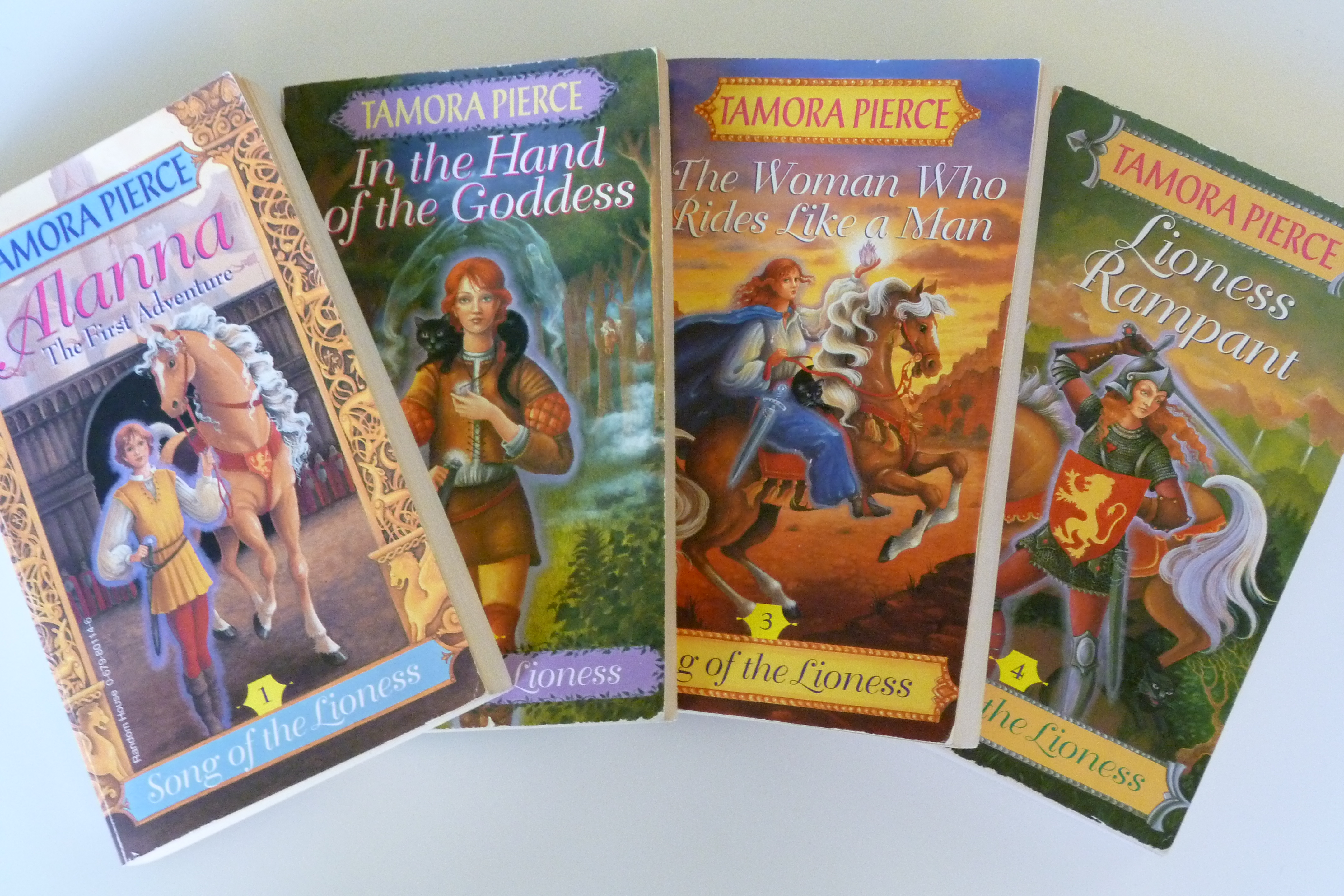
The Stories That Change Our Lives – Inspiration from Tamora Pierce

Today I have a post up on my company’s blog, PhilanthroPost, about how inspiring I found Tamora Pierce’s books when I was growing up.  I’d very much appreciate it if you’d drop past the blog to read it, and maybe leave a comment or a like!  Here’s the beginning of the post:

***************

“Girls are 50% of the population. We deserve to represent 50% of the heroes.”
– Tamora Pierce

Sometimes the people who inspire us never existed.  And sometimes it’s the people who created those fictional characters who furnish the inspiration.

Tamora Pierce is an author of young adult fantasy novels, and at the risk of sounding like I’m exaggerating, I can tell you that she changed my life.  Tamora Pierce writes books about strong women, or “sheroes.”

When Pierce was starting out in writing, there was (and to some extent, still is) a belief that books about boys were more marketable.  The theory goes that young adult girls will read stories about male heroes, but young adult boys won’t read about female leads—write about a boy and you have twice the market, meaning there weren’t as many stories about heroic girls, and not as many role-models for girls to read about.

But almost thirty years ago, Pierce wrote Song of the Lioness

Read the rest of the story on PhilanthroPost!

A Sci Fi Retelling of Cinderella

First, a bit of business–the first post for the Going Postal group read goes up a week from tomorrow.  I contacted everyone who let me know they were interested, but there’s still plenty of time to join in–so let me know if you’d like to!  Now, on to the review…

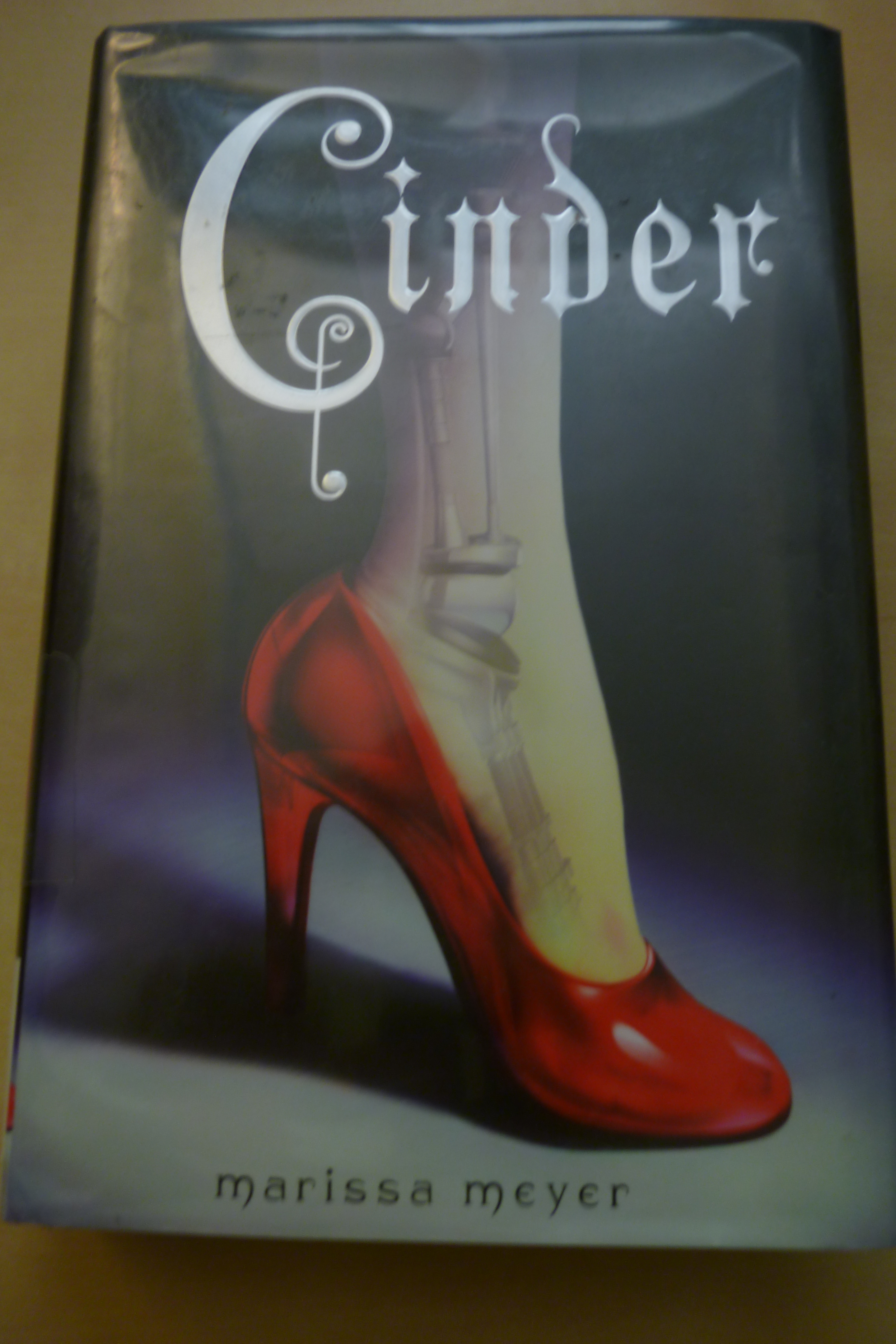
I put Cinder by Marissa Meyer on hold at the library at the beginning of the Once Upon a Time Challenge–in mid-March.  It’s only fair to say that my library usually runs through hold lists pretty quickly…but in this case, the book finally got to me in mid-June.  I managed to read it about five days before the OUaT Challenge ended!

So was it worth the wait?  Yes–because I was very curious about it.

As you may have guessed or known, Cinder is a retelling of Cinderella, though I was surprised by how loose a retelling it actually was.  Set a vague distance into the future, Cinder is a cyborg, mostly human but with a mechanical hand and leg, and circuitry in her brain.  While she is downtrodden by her (adoptive, not step) family, and there is a prince and a ball, the book mostly focuses on the search for a cure for a pandemic sweeping the globe, as well as rising tension with Lunars, the human moon-dwellers who have developed mental powers to manipulate others.

I quite liked Cinder.  She’s a strong Cinderella who’s plotting escape from her family and doesn’t actually care that much about the ball–she has bigger problems to think about.  I loved the cyborg-ness too, and wanted more of that element.  What was there was fun, from the low-tech (storing things in a compartment in her calf) to the high-tech (she can mentally connect to the internet, and her body warns her when she’s overheating).

Prince Kai was a nice guy, though a bit bland.  He served his role in the story perfectly well, and had a little more complexity in his uncertainties about how to fulfill his position as prince (and soon to be emperor), but he didn’t strike me all that much either.  In a bit of a reversal of that, my one biggest issue with the book was that I wasn’t sure why he was so struck by Cinder.  He starts singling her out almost as soon as he meets her–and I do appreciate that they meet and start developing a relationship well before the ball.  It’s just that I’m not sure what prompted him to pursue that relationship.  I mean, I like Cinder–but I’m really not sure why the prince, who has every girl in the country to pick from, decided he liked this particular one.  I’m all in favor of the idea that he saw something special in her, only I don’t feel like the book ever made clear what exactly it was, or even if there was something–I’m just assuming there must have been.

So it wasn’t a heart-stopping romance, at least not for me, but I am curious to see where it goes.  This book is the beginning of a series, and there are a lot of threads still to be explored.  There are some good tensions in Cinder and Kai’s relationship, like the political marriage he’s being manuevered into with the Lunar Queen, and the small fact that Cinder is trying to hide being a cyborg from him.  Cyborgs are looked down on as somehow less than human, in what I’m sure is intended to be a reimagining of the social structure of Cinderella’s original setting.

I would be remiss if I didn’t also mention Iko.  She (it?) is Cinder’s friend and somewhat fairy godmother-like figure, and she’s a robot.  She’s a robot who is also a hopeless romantic, quite forward, and often funny.  She wants Cinder to go to the ball more than Cinder does, and she’s really rather adorable at times.  The most moving moment in the book for me involved Iko’s personality chip–and that’s all I’m going to say, to avoid any spoilers!

So, to sum–fascinating concept, good characters (especially Cinder and Iko), okay romance, pretty good plot though at times it stretched on a bit, and one late-in-the-book twist was really obvious (maybe that was just me–but I don’t think so).  I liked the book–I didn’t love it–but I am adding it to my list of series, and plan to read the next one when it comes out!

Author’s Site: http://www.marissameyer.com/

Other reviews:
Stella Matutina
At Home with Books
Book Journey
Andrea’s Book Nook
Book Nut
I saw this on a LOT of blogs before it finally got to me…did I miss yours?

Through a Maze, into the Past

Some books seem to make the rounds of all the blogs I follow.  That’s what brought me to The Freedom Maze by Delia Sherman.  So many bloggers loved it, I couldn’t resist giving it a read.  And I did enjoy it, largely for reasons that other people mentioned too…and I had a few reservations.  More on those in a bit!

The book is about Sophie Fairchild Martineau, thirteen years old and living in the American South during the 1950s, just as the Civil Rights movement is starting to take shape.  She’s bookish and awkward and doesn’t know how to be the proper, refined Southern lady her mother wants her to be.  Her mother has never forgotten that their family used to be wealthy plantation owners, before the Civil War.  Sophie is sent to spend the summer with her grandmother and aunt on what’s left of the family land, and wanders into the Maze, a labyrinth of hedges and paths.  She meets a strange Creature, and makes a wish…only to find herself back in 1860, where her Fairchild ancestors assume that this tanned, unkempt child must be a slave.

There’s a lot to love in this book, starting with Sophie.  I already loved her by the bottom of Page One.  She reminds me of Sym from The White Darkness, so obviously a thoughtful, lovely girl who’s being told by the people around her that there’s something wrong with her.  I love that Sophie likes to read–and she and I seem to have read all the same books!  It’s so much fun to have a heroine who has read Edith Nesbit and Edward Eager, and knows how this sort of adventure is supposed to go.  She knows the rules about wishes and magic creatures and native guides…but then nothing goes the way she expects.

I was so interested in Sophie and her family dynamics and life in the 1950s that I was almost disappointed when she went into the past.  But the family dynamics and the life in the 1860s turned out to be very interesting too.  The handling of the master/slave situation was fascinating.  The Fairchilds (with the exception of a very nasty daughter) are not cruel people, but they are slaveowners.  Through a combination of obliviousness, delegation of discipline, and a conviction of how the world is meant to be, they fully believe in their own goodness.  And in a way they are “good masters”–but that doesn’t mean the slaves are happy.  Neither are they desperately miserable in the day-to-day.  Sherman walks a narrow line to avoid falling into stereotypes in either direction, while vividly portraying the culture of the white society, and the community of the slaves.

Sophie is mistaken for the daughter of one of the men in the family, who’s currently living in New Orleans.  She has the Fairchild nose and tan skin from being in the sun, and so must be the offspring of a white master and his African slave–which makes her a slave too.  This was one of the most intriguing and disturbing aspects of the story.  I’ve certainly been familiar with the concept before, but I don’t think I had ever seen it brought to life.  Everyone, white and black alike, believes that Sophie is related by blood to the white family, but she’s still classed and treated as a slave.

Sophie meets many wonderful people, particularly among the other slaves, and somehow those characters are growing on me more as I get farther out from the book.  Strange!  The book takes on the feel of historical fiction the longer Sophie spends in the past, and I liked learning more about life in the time, though to some extent this was a more academic than emotional interest.

As interesting as it all was, it also began to feel somewhat purposeless.  It’s suggested, very clearly, that Sophie has been sent into the past for a reason, to do something.  I had to wait most of the book for any hint of what that might be, and at times I felt as though I was waiting for the main story to get going.  Sophie does ultimately end up helping another character in an important way, but the character wasn’t previously significant, and I didn’t have much reason to care.  If that was the whole point of it all…I could appreciate it from a humanitarian standpoint, but it didn’t have much emotional resonance for me.

The other point, I’m sure, was for Sophie to grow, to find a new view on the world, and to find the strength to seize her own freedom.  And I love that in theory…but in practice that aspect felt a bit rushed.

This book does many wonderful things–the way it does them doesn’t always feel quite as wonderful as they might have been.  But don’t let that dissuade you!  It is an enjoyable, fascinating book.  It takes what feels like a very familiar setting, finds new angles, and is thoroughly thought-provoking!

Author’s Site: http://deliasherman.com

Other Reviews:
Stainless Steel Droppings
Charlotte’s Library
Stella Matutina
Anyone else?
Lords and Ladies and Witches and Elves

I just read my first book for my Summer in Discworld challenge: Lords and Ladies, part of the Witches subseries.  I seem to be reading Pratchett’s Witches books backwards.  I read Maskerade first, ages ago.  Lords and Ladies comes immediately before it, and there are at least two other earlier ones.  But no matter–Discworld is fun in any order (but be warned, spoilers ahead for earlier books).  I wound up here because it’s June, and I wanted to read Pratchett’s Midsummer Night’s Dream retelling for the Once Upon a Time Challenge.
It’s a very loose retelling.  There are fairies and royalty and a group of rustics who are trying (without much success) to put on a play.  Beyond that, there’s not much resemblance to the Bard’s story.  Pratchett’s story focuses on three witches–Granny Weatherwax, Nanny Ogg and Magrat Garlick.  They’ve just returned from a trip abroad (a previous book), and Magrat is due to marry King Verence (which she’s almost sure she wants to do).  Meanwhile, there are mysterious crop circles popping up in fields, on heads of hair and in bowls of porridge; there are strange stirrings between the multiverses; and an ancient force is trying to break through from another world.  Unfortunately, as Granny and Nanny know, elves are not nearly as nice as people want to believe…

The plot here is mostly just a vehicle for the characters–and they’re wonderful characters.  Granny Weatherwax is a stiff old crone, in the most literal sense, terrifying for her sheer willpower more than for her magic, and fiercely protective of her kingdom and people.  Nanny Ogg is ever cheerful, ever comfortable and good-natured, utterly incapable of being embarrassed no matter the circumstances and at home everywhere…but you somehow get the impression you don’t want to cross her either.  Magrat is sweet and plain and lacking self-confidence–at least until she gets some inspiration from history.

There are a host of good supporting characters as well.  Verence was originally trained to be a Fool and somehow wound up king (also a previous book), and is very sure that he can learn all he needs to about running a kingdom, handling people and getting married by reading the right books.  The group of rustics don’t stand out individually (especially since they’re all known as Weaver the thatcher or Carpenter the baker or Baker the butcher, and so on), but they’re funny in their jumble–and they’re the closest connection to the Shakespearean play.  The Wizards from Ankh Morpork’s Unseen University come to town for the wedding, and I liked them better than I have in any previous books–they’re finally starting to emerge as individuals to me.  My favorite, though, is the Librarian, who loves books and happens to be an orangutan (a spell gone very wrong).

And the elves, well…they are actually genuinely frightening.  It’s not at all a horror book, and I wouldn’t exactly say any parts are scary–but the concept of the elves, these smiling, beguiling people who see humans as animals, and wreak havoc and inflict pain for the fun of it…it’s quite a frightening concept.

I do have a few small criticisms.  The book takes a good fifteen pages to get going properly.  Pratchett likes to do philosophical prologues, and this book went through a whole series of scenes like that before we got to the witches (though Death had a good scene in this first section).  The point of view jumps about wildly, which sort of bothers me but only in an academic way.  It didn’t actually interfere with my reading, it was just something I noticed every so often and my literary instincts got upset.  More difficult was his lack of speech tags in some places, so I had to go back and count lines to figure out who was talking.

But those are small criticisms.  I enjoyed the book: there was some beautiful writing, excellet character development, good tension and, of course, humor.  I wouldn’t classify it as a favorite Discworld volume, but I liked getting to know the Witches better, and I expect to continue reading their stories–though I haven’t decided whether to go back to the beginning, or keep going backwards!

Author’s Site: http://terrypratchettbooks.com/

Other reviews:
SF Reviews
The Wertzone
The Incurable Bluestocking
Anyone else?

Fairy Tale Round-Up: Beauty and the Beast

One of my favorite fairy tales is “Beauty and the Beast.”  If you read the original by Jeanne Marie Leprince de Beaumont, it has as many weirdnesses as any other fairy tale.  But it also has a heroine with more spirit than most (and who likes to read!) and a romance with at least the potential for more depth.

The story is pretty consistent, about a girl who goes to live with a Beast to save her father’s life.  She sees past the Beast’s forbidding exterior to fall in love with him, breaking the spell and turning him into a handsome prince.  And usually there are roses in it somewhere!  In the original, the Beast is kind of scary and manipulative, not to mention far too attached to his flowers.  But the retellings are some of my very favorite stories…

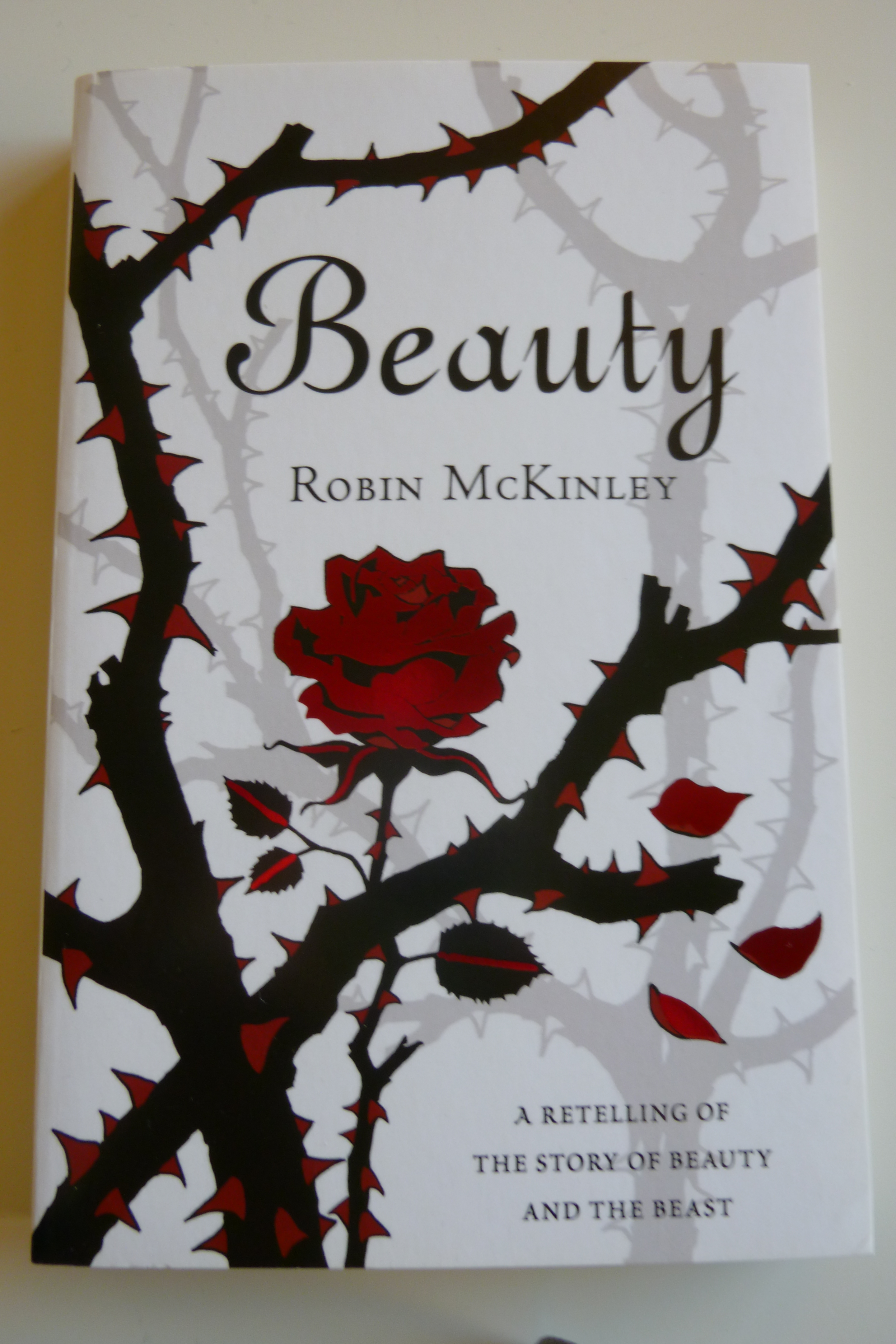
Beauty by Robin McKinley was probably one of the first fairy tale retellings I ever read.  It’s a beautiful book that’s as much about Beauty, her family and her own growth as it is about her romance with the Beast–which is still quite sweet.  The non-magical world feels very real, and even the enchanted castle, while appropriately magical, has a somewhat homey feel.  It’s a cosy book, sweet and lightly humorous.

McKinley returned to the story for Rose Daughter, another (unrelated) retelling.  This version is gorgeously written, and far more surreal.  If Beauty is all pastels and greens and browns, Rose Daughter is all vivid scarlets and purples and strange shadows.  The Beast’s castle is truly another world, where rules of magic supercede little things like the rules of physics.  I didn’t like the romance quite so well and there was a lot about roses, but it’s still an absolutely lovely book.

I’m not as fond of La Belle et La Bête, Jean Cocteau’s 1946 movie version.  It has a very surreal feeling too, but to some extent that kept me at a distance from the story.  The characters felt too much like archetypes and some parts were unexplained–and I don’t think it was a problem of the French dialogue.  The sets and effects are wonderful and it’s a landmark in fairy tale films, but it’s more interesting as an academic view than as simple entertainment.

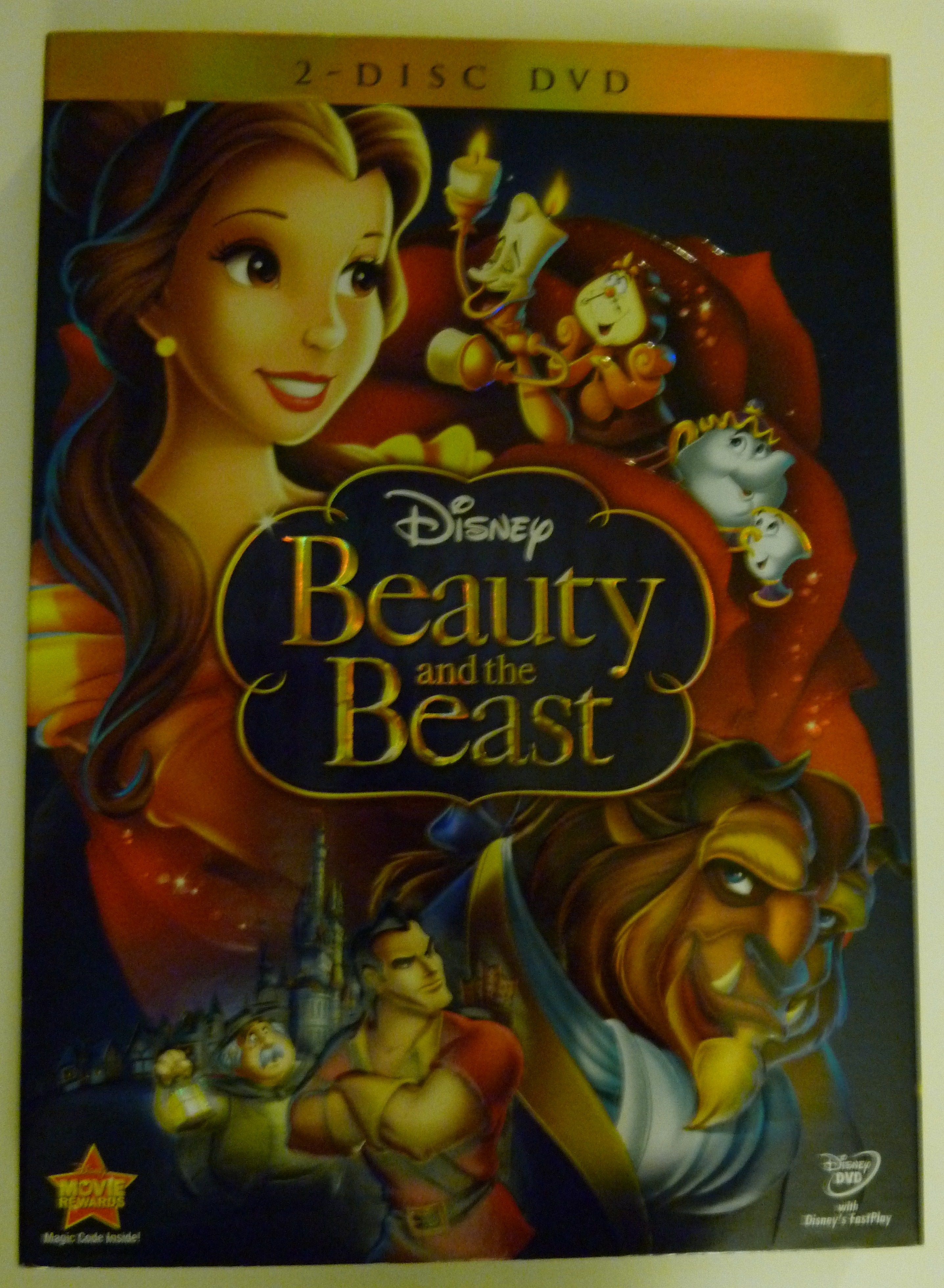
I do love the much lighter Disney Beauty and the Beast.  It has gorgeous scenery, excellent songs, and wonderful characters.  Belle, the Beast and the assortment of talking objects are all delightful characters, and the plot is much improved by the introduction of Gaston as a convincing villain.  This may be my favorite Disney cartoon (though there’s some stiff competition out there!)

Heart’s Blood by Juliet Marillier is a much looser, more mature retelling.  Caitrin comes to the castle to work as a scribe, fleeing her abusive family and an unwanted suitor.  She meets Anluan, crippled in body and even more so in spirit, and learns about his family curse that populates the fortress with ghosts.  It’s “Beauty and the Beast” only in the broad strokes, but there is an enchanted mirror and a curse to overcome–even though it’s really more about finding strength within than it is about meeting requirements to break a spell.

I’d love to find more good “Beauty and the Beast” retellings!  Any suggestions?