Spinning Stories from Straw

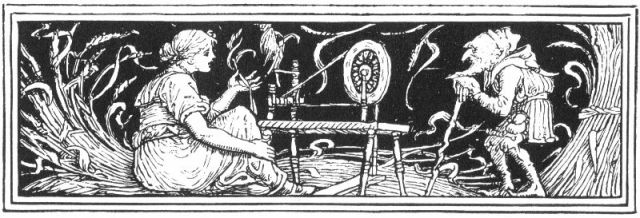
I think Vivian Vande Velde and I have similar feelings about fairy tales–wonderful stories, except for all those parts that don’t make sense.  She explores all those weird bits of “Rumpelstiltskin” in The Rumpelstiltskin Problem, and to very funny effect.

This book excellently shows the versatility of fairy tales.  This is a book of six short stories, all retellings of “Rumpelstiltskin,” and all very different.  Sometimes Rumpelstiltskin is well-meaning–sometimes the villian–once even a woman.  We meet a host of different miller’s daughters, clever and stupid and greedy.  Some kings are nice and some are cruel.  Some stories have magic, some don’t.  But all the stories follow the basic premise of “Rumpelstiltskin,” and all are funny.

I think my favorite part of the book is actually the introduction, when Velde discusses the inspiration behind the book–and analyzes all those parts of “Rumpelstiltskin” that don’t really add up.  Why does the miller tell the king his daughter can spin straw into gold when she can’t?  Why does Rumpelstiltskin want a baby?  Why does the miller’s daughter want to marry the king, after he kept threatening to cut her head off?  Why did Rumpelstiltskin agree to the name-guessing contest when, according to their original agreement, he’s already won, and has nothing more to gain?

I love fairy tales.  But they often don’t make sense, and I enjoyed Vivian Vande Velde’s discussion, and then retelling, of one I haven’t thought as much about.

I do believe that classic fairy tales, especially the best known ones, must have something in them that makes us keep telling them.  Some core truth, or spark of an idea that appeals.  What do you think it is for “Rumpelstiltskin”?  In a way it’s a “deal with the devil” story, so perhaps it’s that story of being pushed to desperation, making a questionable deal, and then the forces of good still triumphing in the end.  Well, assuming you consider the miller’s daughter and the king to be on the good side.

And that depends how you interpret the story–or which of Vivian Vande Velde’s retellings you’re reading.

Author’s Site: http://www.vivianvandevelde.com/
The View from the Ground

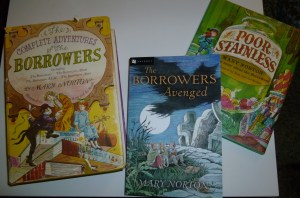
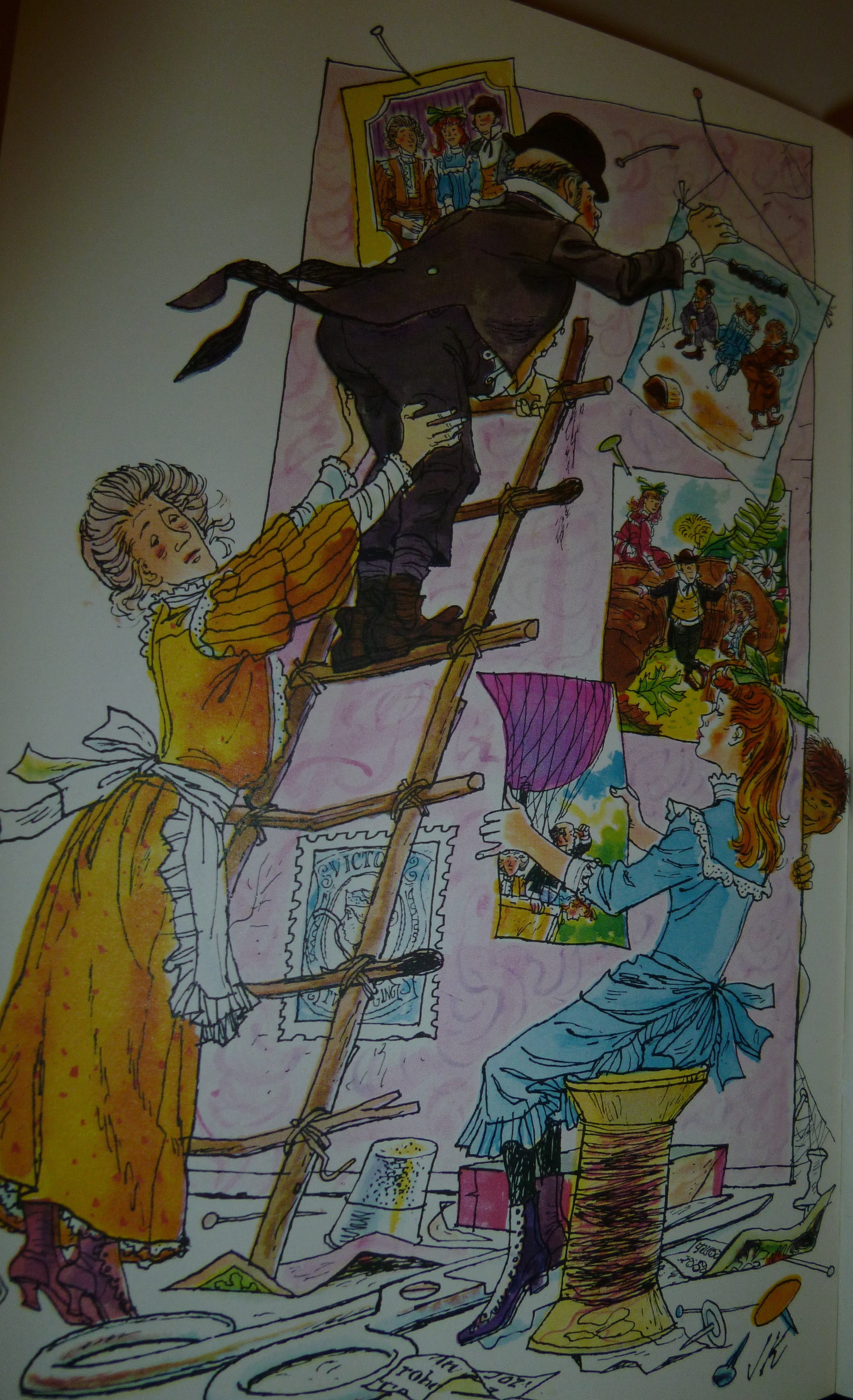
Have you ever lost your keys?  Or a safety pin or a paperclip or maybe a spoon or a roll of thread?  Maybe they were borrowed.  Not by a houseguest–at least, not a human one.  The Borrowers series by Mary Norton tells the story of tiny people who live among us, hidden from sight.  Only a few inches tall, they live inside walls and under floorboards, and survive by “borrowing” odds and ends from the human world.

One of my favorite parts of the whole idea is the details on how the Borrowers live.  The stories are set in England, I think in the early 1900s (though it’s a bit vague) and despite being so much smaller than everyone else, the Borrowers have clothes and rooms and furniture that is all quite proper to the time.  Except, of course, that the walls of the rooms are made of stacked books, the table was originally a pill box, and the chest of drawers is made out of match boxes.  I love the ways ordinary objects are cleverly and creatively repurposed.  And it’s fun to imagine the adventures of a family who can (and do) live inside of a boot in one book, and float down a stream in a tea kettle in another.

The Borrowers series focuses on Arrietty, who I think is about fourteen (although I’ve been paging through the first few chapters and can’t actually find an age!) and her parents, Pod and Homily.  It’s the greatest crisis in the world for a Borrower to be seen by a human–but Arrietty has a fascination with humans, which leads to any amount of trouble.

There are five books in the series (plus a very short prequel named Poor Stainless), starting with The Borrowers.  They’re all good, but I think they get better from the second one on.  It’s in the second one that they leave their home in the old manor house and go out into the wider world for adventures–as mentioned, living in a boot for a while, and ending up in a tea kettle floating down a stream, among others.  Norton keeps the suspense up through the Borrowers’ need to evade humans who want to capture and exploit them, and through the ongoing hazards of surviving in the world when you’re much smaller than everyone else.

One aspect to the book that’s interesting and I think unusual, is that it’s actually a family having an adventure.  In most children’s fantasy, the child in the story has the adventure–think of Dorothy, Alice, Jane and Michael, Wendy or any of the children in Edith Nesbit’s books.  The parents are dead, or oblivious to any magic goings-on, or can be conveniently left behind for the length of the adventure.  In The Borrowers, however, we see a family unit of father, mother and daughter launch into the world.  It’s slightly more Arrietty’s story than anyone else’s, but Pod and Homily are the next two lead characters.

One note if you pick this up and find the first few pages slow going–there is a frame story to this, something about humans who saw the Borrowers telling the story to others.  I can tell you intimate details about the Borrowers’ adventures, but I’m extremely hazy on the frame story because I’ve never actually read it.  I probably should someday, but it’s never seemed as interesting, and at some point (probably by the time I’d read the first book or two) I discovered that it’s very easy to just flip ahead a few pages until I found the first chapter that was from Arrietty’s point of view.  So I could be missing a few details of the story, but I’ve never felt their loss if I am.

As it is, the books are a wonderful adventure with excellent characters and a completely different perspective on the world, from the vantage point of a few inches off the ground.

Bear and Psyche, Sort Of

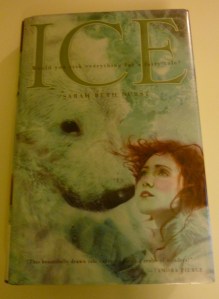
As you might know, one of my reading challenges for the year is to read novels that are fairy tales retold–because I really need to read more than I already do!  🙂  But, that goal is what led me to Ice by Sarah Beth Durst.

Cassie lives in the Arctic, at a research station with her scientist father.  Her mother, she believes, died when she was young.  Her grandmother, however, tells a fairy tale about Cassie’s mother–she was the daughter of the North Wind, and was promised to marry the Polar Bear King.  But she fell in love with a human, Cassie’s father, and bartered with the King–he could marry her daughter instead.  And when the North Wind found out that his daughter married a human, in his fury he blew her away to the castle of the trolls.

Such is the swiftly-established backstory, which probably could have been a novel (or at least Part One of a novel) in its own right.  But Ice really starts when Cassie is eighteen, and past believing in fairy tales–until the Polar Bear King actually shows up and wants to marry her.

As you might guess, the Polar Bear King is in fact a magical polar bear.  He asks her to call him Bear, and can conveniently change shape to a human on occasion–although there are complications.  Durst created a very interesting magical framework for her tale, which I enjoyed.  The unfolding romance was sweet as well, and when some of those complications separate Cassie and Bear, Cassie’s quest to find him is an exciting one.  It’s also implausible in certain ways I don’t want to get into to avoid spoilers, but if you suspend disbelief, it’s a good read.

Ice has a very strong fairy tale feel, complete with the fairy tale backstory and a castle of the trolls located “east of the sun and west of the moon.”  But it wasn’t actually immediately apparent which fairy tale this was.  A video interview with the author describes it as “Beauty and the Beast,” and from the initial premise I went into it expecting that.  Maybe I shouldn’t argue with the author, but I have to say, the farther I read the more I think it’s actually “Cupid and Psyche.”  Granted, Cupid is not usually a polar bear, but that complication involving Bear’s human shape was that Cassie couldn’t see what he looked like–which is straight out of “Cupid and Psyche.”  It also wouldn’t shock me to find out there’s a minor tale somewhere in Grimm’s that this follows even more closely.  It just has that archetypal fairy tale feel to it, and I imagine some of the elements have come up in a lot of different places.

I did have a few reservations about the book.  One of the biggest involves Cassie’s mother.  It’s not giving too much away to reveal that she does come back from the castle of the trolls–it happens fairly early on in the book.  Not knowing her mother was a huge motivation for Cassie at the beginning of the book, but then when her mother actually comes back, I didn’t feel like that was adequately developed.  It’s fair enough to say that meeting your mother for the first time at eighteen does not necessarily lead to immediate closeness, but I didn’t feel like Durst properly explored any relationship between the two of them, even if it was going to be an awkward or strained relationship.

Second, I had some trouble with the points where magic and reality met.  I believed in the research station.  I believed (in a fantasy book way, I mean) in Bear’s castle and in his magic.  But sometimes the two intersected, and I had a lot more trouble believing in a scene where a scientist doing research in the Arctic says, “yes, my wife was held captive by the trolls for many years.”  I don’t think it was just magic and the modern day intersecting–I’ve read urban fantasy that I really enjoyed.  I think it was that characters who showed no sign of believing in magic suddenly started talking about it as an accepted fact, and that was a little hard to buy.

However–it was still a good book.  And when I was getting down to the last few chapters, I even stayed up late to finish reading and see how it would turn out.

Author’s site: http://sarahbethdurst.com/contact.htm (check out the best ever FAQ section!)

Beauty (Maybe) and Her Beast

Beauty and the Beast has always been one of my favorite fairy tales–probably because the retellings are so good.  If you go back to the original story, it’s almost as flawed as any other traditional fairy tale.  But the retellings…are SO good.  Beauty by Robin McKinley is a particular favorite of mine.

The basic story is familiar, if you’ve read the original or even if you’ve seen the Disney movie.  From the Disney movie you’ll recognize the part about the terrifying Beast living in the castle in the woods.  A lost traveler spends the night and, upon offending the Beast, agrees to bring back his daughter, Beauty, to stay at the castle.  From the original story you’ll recognize the part about Beauty’s father being a rich merchant who lost his fortune, forcing them to move out to the country.  And Beauty had two sisters as well, and it was Beauty’s request for a rose when her father began his ill-fated journey that, in a way, put everything else in motion.

I think I read Beauty before I read the original fairy tale, so when I did read the original, I kept thinking, “oh, now I see where McKinley got that detail or this part from!”  But, like any great fairy tale retelling, McKinley has taken the slender original story and embroidered and expanded upon it, bringing the characters to life and explaining the bits that never quite made sense.

Beauty’s father and two sisters are very real characters, and the tragedy of going to the Beast’s castle is as much about leaving them as it is about going to an unknown fate with a monstrous Beast.  How a rich merchant family makes their way in a country village is a detailed and developed part of the story.

Beauty and the Beast are my favorite characters though.  Beauty, like the original and the Disney version, loves to read.  She’s also ugly, or at least considers herself so (not something from either version).  I LOVE that element.  If you read enough fairy tales, breathlessly beautiful heroines get very old.  They’re all very much the same, sweet-tempered and beautiful and sickeningly good.  So I love McKinley’s scrawny, mouse-haired, stubborn-minded Beauty–a name she picked up as a child and has been too embarrassed to request dropped.  The Beast is charming, sometimes unsure of himself, and really rather sweet.  I thought the romance was very cute.

My other favorite part is probably the castle itself.  It’s enchanted, of course, but there’s a wonderful practical side to the magic.  Beauty has a couple of enchanted breezes (sort of) attending to her, and in personality they’re quite fussy and straight-forward and focused on common sense.  And I’m so very, very amused by enchanted candles that light themselves–and sometimes have to admonish each other, “Hsst–wake up, you” when one of them doesn’t light.

Robin McKinley wrote another retelling of Beauty and the Beast called Rose-Daughter which, despite following the same basic plotline, is quite different (a lot more roses, for one thing).  It’s very good also, but much more surreal.  The magic, and even the non-magical characters, like the two sisters, feel less real-world to me–not unrealistic, exactly, but not so realistic either.  I recommend it too, but personally I prefer the more grounded Beauty.

But by all means, read both.  Or either.  Or pretty much anything else by Robin McKinley, because I can’t honestly say I’ve met a book by her I didn’t like.  Beauty may be my favorite, though.

Author’s Site: http://www.robinmckinley.com/

Through the Wardrobe

Narnia has been coming up a lot for me lately.  I went to see The Voyage of the Dawn Treader…my book club book pick was inspired by Narnia…the series was referenced on a blog I follow…  I decided the universe was telling me something (and that book club book especially made me want to go back to the original) and I decided to re-read The Lion, the Witch and the Wardrobe by C. S. Lewis.

I say “re-read” because I know I read it before, but I honestly couldn’t tell you how long ago it was.  Years and years, although the story is so familiar that in some ways it doesn’t feel that long.  For those who somehow don’t know the story (side-note–I once overheard a woman tell a librarian she’d never heard of the series, so it’s possible), it’s the story of four children who go through a wardrobe and find themselves in the magical country of Narnia.  There they meet the great lion Aslan and fight an epic battle against the White Witch.

It’s a wonderful story on many levels.  It’s a lovely children’s fantasy with dashing heroes, not too much blood, magical creatures like Mr. Tumnus and Mr. and Mrs Badger, and several stern admonitions that it’s very foolish to shut oneself inside of a wardrobe (I honestly think Lewis was worried about this, he repeats it so many times).  On a more symbolic level, there’s a clear Christ story enacted.  But it works on both levels, for however you want to take it.  I’ve always thought that was the mark of the best kind of book–a good story and a good message where neither one gets in the way of the other.

I enjoyed Lewis’ style very much.  Things happen so quickly.  Lucy, the first child into Narnia, gets there by page six.  As the adventures continue, they go on at a tumblingly-quick rate.  There’s even a point where Lewis writes, of an unpleasant night journey by sledge, “This lasted longer than I could describe even if I wrote pages and pages about it.”  Thankfully, he doesn’t bother, concluding, “But I will skip on to the time when the snow had stopped and the morning had come and they were racing along in the daylight.”

C. S. Lewis and J. R. R. Tolkien were in the same writing group.  I’ve heard that Tolkien spent years and years on The Lord of the Rings, and Lewis wrote The Lion, the Witch and the Wardrobe in a matter of weeks (something that I’ve also heard annoyed Tolkien no end).  I have to say, it shows for both of them.  Different viewpoints on writing could consider that a plus or a minus to either one, but my preference would have to be with Lewis.

Lewis begins the book with a lovely dedication to his goddaughter, the real-life Lucy.  In somewhat contradiction to the story that he wrote the book in a few weeks, he says that he wrote it for her but she grew up faster than it did and she’s now too old for it, “but some day you will be old enough to start reading fairy tales again.”  Lewis clearly understood about the cross-age appeal of the best children’s stories.  We may go through an age where we think we’re too grown-up for “kids books,” but eventually we get old enough to realize we can come back to them.

St. Paul wrote, “When I became a man, I put childish ways behind me” (1 Corinthians 13:11).  C. S. Lewis added, “Including the fear of being thought childish.”  We don’t have to “think like a child or reason like a child” (paraphrasing Corinthians) to appreciate a story written for children.  We can enjoy it with new eyes, new understanding, and hopefully some of the old magic too.