Ordinary–But Charming

I’ve read several books about ordinary princesses.  The danger is that ordinary can sometimes be only half a step from boring, and when you set out to make your heroine ordinary, you sometimes end up with a heroine who is so very ordinary that she’s not at all interesting or distinctive.  But, on the other hand, sometimes it works.  There’s nothing at all boring about Amy in The Ordinary Princess by M. M. Kaye.

I have to love a book that begins “Long and long ago, when Oberon was king of the fairies, there reigned over the fair country of Phantasmorania a monarch who had six beautiful daughters.”

Amy is born seventh, and is cursed–or blessed?–at her christening by a fairy to be ordinary.  Unlike her blonde-haired, blue-eyed and breathtakingly beautiful sisters, Amy has mousy brown-hair and a turned-up nose, is not the least bit graceful, and is, well, ordinary.  But she knows how to climb down the wisteria vine growing by her window and go off into the forest to climb trees and make friends with squirrels, and she has a wonderful practical bent.  Of one of her sisters’ suitors, she thinks, “He may be very good-looking, but I’m quite sure he has never giggled one good giggle in his life!”

When Amy’s turn comes to get married, the royal family is at an utter loss to find an interested prince, so they decide the solution is to bring in a dragon.  That will of course tempt some prince to come kill it, and then he’ll have to marry the princess.  Not wanting a dragon to lay waste to the country, Amy decides to run away.

She goes on to have quite ordinary adventures, in the forest and later as a kitchen maid at another castle, where she falls in love with a man-of-all-work.  They’re ordinary adventures in the most charming way.  The writing is very good, and Amy is a sweet and endearing heroine.  She somehow seems utterly unlike a lot of the brown-haired, tom-boyish, clumsy “ordinary princesses” that populate other books of this sort, even though point by point she has a lot in common with them.  Maybe it’s simply better writing.

I love practical, pragmatic, humorous stories loosely inspired by fairy tales, and this one’s a favorite.

A Magical Lady Knight

I’m going to try–I really am–not to wax too enthusiastic today.  But it’s hard when I’m talking about a favorite series–when it would actually not be inaccurate to use phrases like “changed my life” and “favorite character ever.”

Am I talking about some great inspirational work?  Well…not a traditional one.  I’m talking about the Song of the Lioness Quartet by Tamora Pierce.

The first book is Alanna: The First Adventure.  Alanna is a girl who wants to become a knight, except that girls aren’t allowed to become knights.  So she disguises herself as a boy and sets out to become one anyway.  Alanna is an incredible character.  When I was younger, I basically wanted to be her when I grew up.  She’s stubborn, determined, and incredibly brave, but also human–she makes mistakes, she has struggles, and she’s not always sure of herself.  She was my favorite character when I was a kid, out of any book I’d read.

The series has a host of memorable characters, with new ones arriving in later books as well.  A couple of favorites include Prince Jonathan, every girl’s dream of a handsome and charming prince, and George Cooper, the roguish and equally charming King of Thieves.

They all live in a world of swordplay and tournaments that is nevertheless grounded and believable–swing a sword around too long and you’ll have sore muscles.  They also live in a world of magic.  Alanna possesses the Gift, which she can use for various spells, some practical and some dramatic.  There is also an entire pantheon of gods who occasionally step into mortal affairs.

The books are funny, exciting, engaging…amazing.

And they changed my life.  I’m a firm believer that a girl can do anything a boy can do, that women have the same rights as men, and that we all ought to be equal, whether in pay rates or in who cleans the house.  I’m sure a lot of that belief comes from my parents, especially my mom, but I think reading about Alanna at a young age helped.

I also met one of my best friends because of Tamora Pierce.  We were freshmen in high school, and were both shy book-lovers.  We were in a class together, but hadn’t talked.  She was reading a Tamora Pierce book, and so was I.  I can’t remember now who talked first, but we’ve later admitted that we each noticed the other one’s book, and each took out our own book before class started in the hopes that the other one would notice and use it as an excuse to start a conversation.  She’s still one of my best friends; we’re both eagerly awaiting Tamora Pierce’s next book, promised for this February.

You may also be recalling right now that in Fiction Friday, I’ve featured some of my writing about a girl who disguised herself as a boy so that she could become a pirate.  It’s not a coincidence that my character’s name is Tamara.

Song of the Lioness is my favorite quartet by Tamora Pierce.  She’s written other books set in the same world, and many characters, Alanna included, turn up in those books.  I recommend those as well.

Much as I still love her, I don’t think I want to be Alanna anymore.  Now, I think that when I grow up, I want to be Tamora Pierce.  I don’t know anything about her personal life, but I’d like to be her from a writing perspective, at least.  🙂

Author’s Site: http://www.tamora-pierce.com/

My Tamora Pierce Collection

A Magical Retelling of Cinderella

When I reviewed Ella Enchanted, I said it was “one of the best retellings of Cinderella I’d ever read.”  There was actually a very specific reason I didn’t just say it was the best retelling.  That reason is Silver Woven in My Hair by Shirley Rousseau Murphy.

I read this originally from the library when I was…maybe nine?  I don’t really remember.  Young.  I read it several times, and then it somehow disappeared off the shelf.  But miraculously, I remembered the title.  I usually don’t.  I usually remember something like, there was a bit in there where the girl is watching the royal family come back from the island and she sees the goatherd, and then she invites him into the kitchen at the inn to have dinner and it makes her stepfamily mad but he just laughs so it’s all right…oh and then they had a picnic later on in the book, and there was that really good part about the owner of the sword.

And that’s not going to help anyone find the story they’re looking for.  But fortunately I remembered the title, and by the time I was in high school the wonderful world of online booksellers existed and I was able to buy Silver Woven in My Hair for my very own, and I spent an entire afternoon rereading the whole book.  It was lovely.

It’s one of the best retellings of Cinderella I’ve ever read.  It’s a story about Thursey, and her terrible stepfamily.  The royal family was coming back from that island because they were there while the queen and the prince recovered from being captured in a war.  Thursey’s father went to the war and never came back, so this Cinderella actually has a reason to stay where she is–even though she knows he’s probably never coming back, she can’t bring herself to leave, just in case.

Thursey doesn’t have a sparkly fairy godmother, but she does have friends who want to help her go to the ball at the palace.  There’s Anwin the monk, and there’s Gillie the goatherd, who’s funny and charming–and pretty far from a sparkly fairy godmother.  🙂

One part of the story I love is that Thursey is a Cinderella who loves Cinderella stories.  Her family runs an inn, and she collects stories from the travelers who pass through–all the different Cinderella stories from different cultures, Cendrillon and Aschenputtel and Catkin and so on.  Even though Thursey’s life isn’t very good, she never stops dreaming.  The ball is one aspect of the story, but Thursey’s dreams have a lot more substance than dancing a single night at a ball.

The characters, from Thursey to Gillie to the nasty stepfamily, are well-drawn and life-like.  The story is very grounded in reality, in a practical world where dishes have to be washed and goats have to be fed and there’s none of the impossible and imcomprehensible leaps that the original fairy tales often make.  Yet there’s also something whimsical about the tale.  For some reason the word “gossamer” keeps coming to mind, and I think it has to do with the writing style.  Murphy has kept some of the poetry of the old tales, while giving us characters and a plot that are more tangible.

Silver Woven in My Hair isn’t exactly a fantasy…or it could be.  Murphy leaves it up to the reader to decide whether some elements are really magic or not, and I’m not entirely sure what I think.

But even if you decide it’s not a fantasy, it’s definitely a magical story.  And a marvelous tale.

A Multiplicity of Jacks, and One Tom

I really, really wanted to love The Secret History of Tom Trueheart by Ian Beck.  But I didn’t.  My feelings were much more mixed.

I really do love the premise.  Tom has six older brothers named Jack, who all go on adventures in the Land of Stories.  How fun is that?  First, the idea that you can walk through a gate and enter a magical land where fairy tales happen to you, and that there’s a family where they have this tradition of going off on adventures…love it!  And I love the idea of gently poking fun at the way fairy tale heroes (non-princes, at least) are always named Jack.

Tom is the youngest (making him the seventh son–very fairy tale proper, that) and the smallest, and he’s convinced that he’s the least brave.  He’s the only one who hasn’t gone off on adventures, but when all his older brothers mysteriously disappear, then it’s up to him to find out what happened.  I’m not going to try to claim that that’s terribly original, but it’s from the children’s section, and I like stories about characters who don’t think they’re brave and have to find qualities in themselves they didn’t know they had in order to save the day.

So far we’re doing great.  But.  (And you knew this was coming.)  But…we have to read what happened to go wrong with each Jack.  And we have to read what happens when Tom ultimately helps them.  Don’t forget, the Jacks are in the Land of Story to embark on fairy tales.  So what this ultimately turns into is a lot of retelling of fairy tales.

We get the first half early on in the story: Jack gets halfway into Sleeping Beauty’s castle (or whatever) and gets into some kind of trouble.  The book goes on, Tom has his adventure, we come back later, and Tom helps Jack rescue the princess.  (Sorry if that was a spoiler, but I doubt it surprised anyone).  The trouble is, nothing all that original happens to the fairy tale itself.  Tom is thrown into it, but it’s not really that different.

Tom’s story is original, when we’re following him, but when we’ve also got six Jacks to get through, I felt like I spent way too much of the book just reading stories I already knew.  This might have been better with about half as many Jacks, and only half as many fairy tales.

That points directly to my other problem: while I love that idea of six characters named Jack, they do run together.  Beck tried to distinguish them, by giving them all a nickname like Jacques or Jackson or Jake, but I was still getting them mixed up.  I’m not very good with character names though, so that might just be me.

Like I said, I have mixed feelings on this book.  I love the premise.  However, I’d only recommend reading it if you’re also in the mood to reread the Brothers Grimm or Charles Perrault, because that’s more or less what you end up doing, in between Tom’s adventure.

I recently found out there are two sequels, and since the premise is so good, I just might investigate them.

Author’s site: http://tomtrueheart.com/

Getting Your Ears on Straight

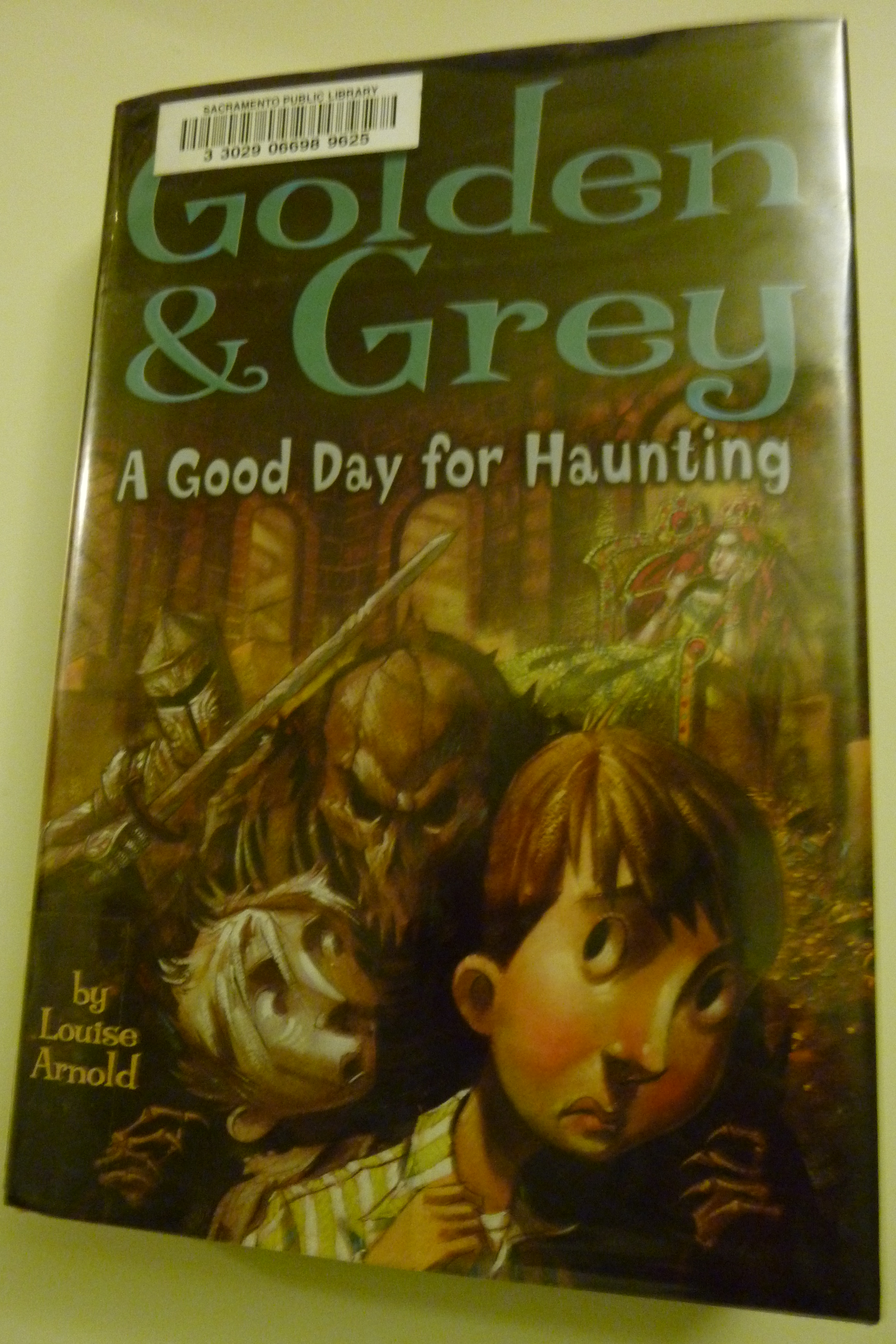
I’ve been having a bad run lately of books with bland characters.  Even some books I’ve enjoyed have had flat, not very memorable characters.  Golden and Grey by Louise Arnold, however, has been a glorious exception to the rule.

It may just be that Grey Arthur can’t get his ears to line up.  It really may be as simple as that.  But I think that’s just part of it.

Let me back up a little.  I don’t usually like to spend large swathes of time explaining plots, but this one has a particularly complicated premise, so here goes.  Golden and Grey is the story of Tom Golden and Grey Arthur, the story of the world we know, and the world of ghosts.  Ghosts are not what you think they are.  They aren’t the spirits of humans who have died; they’re simply another kind of people who exists side by side with humans, only back when people got very scientific and logical and realized that ghosts didn’t fit their scientific and logical rules, they decided it was easier not to see ghosts–and they haven’t ever since.

Grey Arthur is a young-seeming ghost who has been trying for 300 years to figure out what he is.  He tried to be a Poltergeist, but he kept feeling bad and returning the socks he stole, so that didn’t work out very well.  When he tried to be a Sadness Summoner, his attempts at depressing poems kept turning out to have happy endings…and so on like that.

Tom Golden is a perfectly ordinary and normal human boy, who nevertheless has found himself labeled Freak Boy and picked on by bullies at his new school.

When Tom Golden and Grey Arthur both mutter “Life isn’t fair” at the same moment, a connection is formed and Grey Arthur has a revelation.  His role is to be Tom’s Invisible Friend: pulling “Kick Me” signs off of Tom’s back, putting Tom’s forgotten lunch into his locker for him, and sitting with him in the cafeteria so he won’t be alone, even if Tom doesn’t know he’s there.  And then an accident occurs and Tom becomes able to see ghosts…and things really become crazy.

This is a delightful book on so many levels.  The ghost world is elaborate and varied.  Every kind of ghost from legend seems to be represented here, from funny to scary, each neatly labeled and categorized as a type, from Headless to Faintly Real to Screamer to Thesper (you don’t want to meet a Screamer, but a Thesper would be all right).

I think it’s a good element that Tom is normal but still a social outcast–because isn’t life just that irrational and inexplicable and unfair sometimes?  If he had a weird habit or a shadowy past it would be easy to explain but not as real somehow.  He becomes much more relatable by being normal.

The plot is a good one, with twists and turns that I didn’t even get into here.

And as I started out by saying, there are excellent characters in this story.  They’re memorable, fun, and vivid.  It’s even more impressive that they’re vivid, when you consider that a lot of them are invisible.  There’s cheery Grey Arthur with his mismatched ears and his host of ghostly friends; Tom and his parents (who are just quirky enough to be interesting but stay normal); and a handful of human characters at school.  I can bring most of their names to mind, which doesn’t sound impressive, but I’m bad at remembering names, so it actually does say a lot.

There are at least three books in the series, of which I’ve read the first two (and I plan to pick up the third!)  Arnold keeps up the quality and the interest in the second by introducing a new group of very amusing characters, as well as a new threat.

Whole-hearted recommendation for these books.  Funny, entertaining, well-worth the read.

Author’s site: http://greyarthur.com/

UPDATE: I recently read the third book (and added its cover picture), and was glad to see the high quality maintained.  Arnold continues with the characters she introduced in the second book, and raises the stakes for the conflict to keep things exciting.  And of course I LOVED some very funny references to Grey Arthur’s mismatched ears.