Visiting Madrid with Bloody Jack

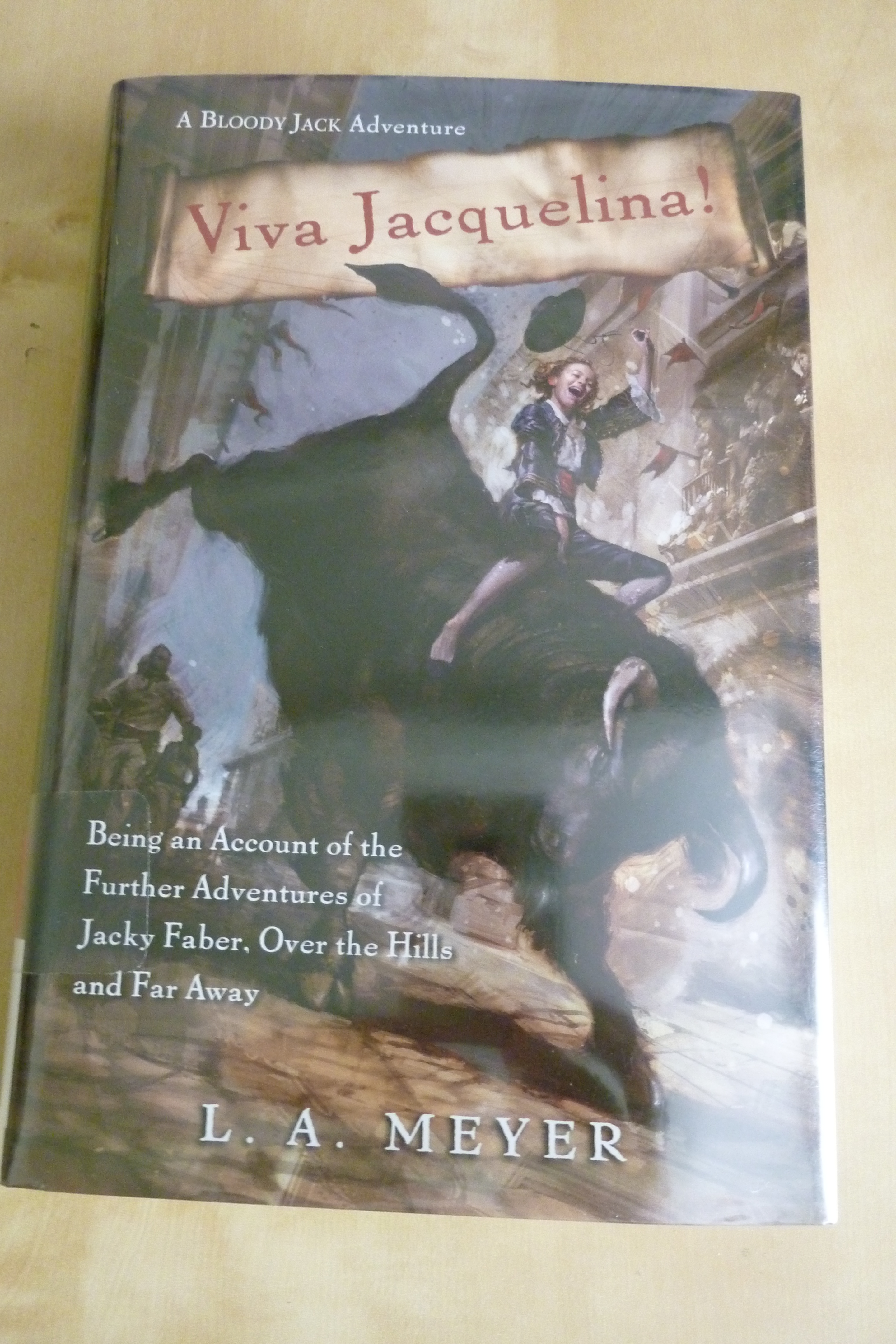
Every fall I look forward to the latest installment of the adventures of Bloody Jack.  This year, it was Viva Jacquelina!, L. A. Meyer’s tenth book about the irrepressible Jacky Faber.

Jacky has, in her various adventures, been a British Navy sailor, a merchant captain, a pirate, a member of the British intelligence, and sometimes even a fine lady.  As you might guess, this installment takes Jacky to Spain.  It begins on the battlefields of the Napoleonic wars, before Jacky is sent on a spy mission to Madrid.  Separated from her friends, she finds work at an artist’s studio, learning painting, posing as a model, and flirting with the local boys.  Jacky’s adventures go on to involve bull-riding, the Spanish Inquisition, and a band of gypsies.  In other words, it’s the usual Jacky Faber fare.

Jacky is still the charming, undaunted, ever-cheerful and ever-resourceful girl we’ve met in nine previous books.  She’s grown more confident but no more cautious or sensible.  The adventures come fast and furious here, which is good and bad.  The book keeps moving along at a quick clip and there’s never a dull moment–but sometimes I did wish it would slow down and give us more depth and more detail.

It strikes me that we’ve entered an interesting place with these later books in the series–they’re still enormous fun, I still love the characters, and I still can’t resist reading on to find out what happens next.  At the same time, the books are starting to lose the depth and the originality of the early ones in the series.  In some ways this book reminded me a bit of the second one, Under the Blue Tattoo, in that Jacky spends some months settling (relatively) quietly into a town and a household.  But this book racketed along at a much faster pace than the second book, and we never delved as deep into the characters or developed a plot that was as complex.

Jacky is also beginning to seriously grate on my nerves when it comes to her constant flirtations.  In the span of this one (relatively slim) book, she gets into pretty serious sparking with five men–all while her heart belongs to her one true love Jaimy, of course.  Jacky’s always been a bit free with her affections, but I feel like in this book she went farther faster and with greater numbers, and never seems to grasp that any of these men might take her seriously.  When her attitude starts to become, “ho-hum, another one swearing undying love,” it gets just a little annoying.

But I do still love Jacky–only I’m starting to feel like her best friend, Amy Trevelyne, who is frequently apt to sigh and wish Jacky would learn some restraint.  On the other hand, it is kind of fun that Jacky turns on its head the cliche of the roving man with a girl in every port.

All in all, I’d say this book isn’t up to the brilliance of the earliest ones in the series…but it’s still a very enjoyable read.  I wouldn’t suggest starting the series here, but if you haven’t read Bloody Jack, I do recommend picking it up!  This is a wonderful series to explore.

Author’s Site: http://www.jackyfaber.com

Other reviews:
Fyrefly’s Book Blog
In Bed with Books
Bookyurt
Anyone else?

Sailing Back to Treasure Island

I think we all know that pirates are kind of an interest for me.  So naturally I was intrigued by the prospect of a sequel to one of the great classic pirate stories, Robert Louis Stevenson’s Treasure Island.  Often I have big objections to sequels to classics, but this particular classic falls into a nice middle area, where I’m interested, but I’m not so attached that I hold it too sacred for a new author to attempt a story.

Silver: Return to Treasure Island by Andrew Motion is told by a different Jim Hawkins, the son of the original.  This Jim is eighteen years old and thoroughly sick of his father’s stories about his glory days on Treasure Island.  Nevertheless, he can’t resist following when he’s approached by Natty, the daughter of Long John Silver.  Natty’s dying father has prepared a new expedition to Treasure Island.  Jim steals his father’s map, and he and Natty set off, hoping to find a cache of silver that the last expedition left behind.

What they find are ghosts of the past–the nephew of a man the original Jim Hawkins killed; three pirates marooned by the last party, now inflicting barbarities on a group of castaways; and always the looming memories of the first Jim Hawkins and of Long John Silver.

This story stands largely on its own, with almost the entire cast consisting of new characters, and an entirely new plot.  The events of the previous book are obviously essential, though, so I wouldn’t read this without any knowledge of the original.  That said, I think even a small knowledge would be enough, such as a familiarity with a retelling (and while we’re on that subject, Muppet Treasure Island is my favorite version!)

The writing is excellent here.  There’s a formality to it that harkens back to the original book, without going too far and sounding stiff to a modern audience.  There are wonderful descriptions, particularly of nature, which is described not only in terms of appearance but very much in mood, sometimes being almost anthropomorphized.

Jim (the younger) is a thoughtful character, who explores his own feelings and motivations, and makes interesting observations on other characters as well.  Natty is a wilder character and harder to read, but there are glimpses that make her engaging and demonstrate her complexity.

We only get a little of Jim the older, and of Long John Silver, but something interesting happens with them.  I feel I have to give a little context here–in almost every adaptation I’ve seen, there’s a complicated relationship between Jim and Long John, a love-hate situation where Long John plays almost a fatherly role.  In the original, Jim pretty much sees Long John as a devious pirate and it’s all much simpler (and less interesting).  Here, Jim describes the relationship as the book tells it–but Long John seems to remember it as the more complex relationship that we see in adaptations.  It’s an interesting balance.

The adventures in the book are tense and exciting.  There are stretches that are quieter, but the action is good when it comes.  This gets pretty dark in spots, but never quite goes too far.  It’s obvious there are very horrible things happening on Treasure Island, and there isn’t much doubt about what–but we never got it in such detail as to be too awful.  It does edge up very close to a disturbing area though, so reader beware!  There are also some hints at the very beginning of something quite odd in Natty and Long John’s relationship, but that’s never elaborated on–which to be honest, I thought was just as well!

I did think the book mis-stepped in other places by not elaborating, as Motion mostly avoids the thornier issues.  Long John Silver is married to “a colored woman,” I think based on a reference in the original book, which means Natty is mixed race.  In 1802, she would have faced enormous prejudice because of that; here, it’s skated right past.  When Jim finds out, he remarks once that it doesn’t change how much he’s drawn to her, and that’s all.  While that’s certainly admirable of him (by modern standards), it feels anachronistic.  History’s attitudes may disturb a modern reader, but this reaction in a young white man of the early 1800s makes Jim almost impossibly progressive.

The situation is similar when slavery comes up (and it plays a significant part in the plot).  All the good characters are apparently abolitionists, with no need to even discuss the question–even though this is five years before England ended the slave trade, and 30 years before slavery was outlawed in the British Empire.  Of course I don’t think the immorality of slavery is a complicated question, but it should have been a complicated one for characters living in 1802, and I think Motion oversimplified.

I won’t say that the simplification spoiled my reading of the book by any means–but I think this was a good book that had the potential to delve a little deeper, and in a way that would have been more realistic.

This is definitely worth the read if you like historical fiction about pirates and buried treasure, and especially if you enjoy the original.  Which I also recommend–along with Muppet Treasure Island. 🙂

Disclosure: I received a copy of this book for free from the publishers in exchange for an honest review.

Other reviews:
Minding Spot
A Bookworm’s World
Man of La Book
The Literateur
Anyone else?

In the Footsteps of Sherlock Holmes

I brought a great stack of British books with me when I went to London, many of which I hope to share with you.  I thought I’d start off with Sherlock Holmes, which kills several birds with one stone.  It’s a good book for the R.I.P. Challenge, and also lets me share a little about my trip!

First, the book review.  I’ve read a lot of Sherlock Holmes stories and novels in the past, and to be honest, when I look at titles I’m not always sure which ones I’ve read!  But I was almost sure The Valley of Fear was a new-to-me book (and it was), so I brought that one with me to London.  It turned out to be an interesting mix of a novel.

It opens, as most Holmes stories do, with Holmes and Watson invited to look into a strange case.  A man is found dead in his home out in the country–complicating the situation, his home is an old fortress, complete with moat.  The drawbridge was up, so how did the murderer get in, and where did he go?  There are a few strange details about the crime scene and the other people in the house.  The murdered man seems to have had something dark in his past, but the only clue is a vague reference to “the Valley of Fear.”

So it’s essentially standard Holmes fare, and a good mystery with a clever resolution.  Holmes is in fine form, it’s always nice to visit with him and Watson, and all in all it’s a good Holmes story.  The biggest point of interest for me is that Moriarty is referenced here.  I had always previously thought that he was only in the single short story (and, of course, many adaptations).  There’s more about him here, which explains a lot.

The funny thing about this book is that it’s in two parts.  Part One I described above–Part Two is a flashback into one character’s past in the Valley of Fear.  I feel like I can see here Doyle’s desire to get away from Holmes, because he’s essentially given us a non-Holmes novella in the middle of a Holmes novel.  It’s interesting enough, but not as good as the section with Holmes.

It suffers also from a rather peculiar problem which is hard to discuss without spoilers.  Doing my best…there’s a twist near the end which changes almost everything that came before it.  The problem is, in order to give the impression which leads to the shocking twist, for most of the book we’re dealing with very unlikable characters.  It might have been better as a short story, when we wouldn’t have to spend quite as much time with unpleasant people.

Even so, if you’re a Holmes fan, this is definitely worth reading for the mystery in the first half, and the insight into Moriarty.  And it was a great choice for my trip, because I was in a Holmes mood.  You see, one of the places I visited was 221B Baker Street.

I had heard it was a tourist trap, but it was better than reported–at least, part of it.  As I think about it, the museum actually has a fair bit in common with The Valley of Fear.  It opens splendid and very Holmesian, and then diminishes as you go.

221B Baker Street, of course, is the home of Holmes and Watson.  It’s very vertical–you get to visit three small floors.  The first level has the parlor and Holmes’ bedroom, and this level is absolutely superb.  Every detail you could want is there, with Irene Adler’s photo on the mantel, Holmes’ tobacco in a slipper, and Watson’s medical bag on a chair.  In Holmes’ room there’s an open book on beekeeping, which he took up after he retired from detective work–it’s those little details that really impressed me.

The next floor is sort of Watson’s room and Mrs. Hudson’s room (although I never had the impression before that the landlady lived in the same apartment…)  This level is a mix of period things and Holmes memorabilia.  Both are interesting, but they do sit a little oddly together.

The third floor is fairly dreadful.  It’s all done up with mannequins meant to be characters from different stories, and for whatever reason they made choices towards the macabre and the grotesque.  It’s all rather creepy–and I was there at ten in the morning.  I shudder to think what it’s like in the dark.

But like The Valley of Fear, the museum is all worth it for the beginning.  The parlor makes you feel like you’ve stepped into the stories.

Stay tuned this Saturday for more pictures from 221B Baker Street.  I’m anticipating a Holmes-themed Saturday Snapshot!

Other reviews:
Lucy’s Bookshelf
The Literary Omnivore
The Flying Inn
Anyone else?

Through a Maze, into the Past

Some books seem to make the rounds of all the blogs I follow.  That’s what brought me to The Freedom Maze by Delia Sherman.  So many bloggers loved it, I couldn’t resist giving it a read.  And I did enjoy it, largely for reasons that other people mentioned too…and I had a few reservations.  More on those in a bit!
The book is about Sophie Fairchild Martineau, thirteen years old and living in the American South during the 1950s, just as the Civil Rights movement is starting to take shape.  She’s bookish and awkward and doesn’t know how to be the proper, refined Southern lady her mother wants her to be.  Her mother has never forgotten that their family used to be wealthy plantation owners, before the Civil War.  Sophie is sent to spend the summer with her grandmother and aunt on what’s left of the family land, and wanders into the Maze, a labyrinth of hedges and paths.  She meets a strange Creature, and makes a wish…only to find herself back in 1860, where her Fairchild ancestors assume that this tanned, unkempt child must be a slave.

There’s a lot to love in this book, starting with Sophie.  I already loved her by the bottom of Page One.  She reminds me of Sym from The White Darkness, so obviously a thoughtful, lovely girl who’s being told by the people around her that there’s something wrong with her.  I love that Sophie likes to read–and she and I seem to have read all the same books!  It’s so much fun to have a heroine who has read Edith Nesbit and Edward Eager, and knows how this sort of adventure is supposed to go.  She knows the rules about wishes and magic creatures and native guides…but then nothing goes the way she expects.

I was so interested in Sophie and her family dynamics and life in the 1950s that I was almost disappointed when she went into the past.  But the family dynamics and the life in the 1860s turned out to be very interesting too.  The handling of the master/slave situation was fascinating.  The Fairchilds (with the exception of a very nasty daughter) are not cruel people, but they are slaveowners.  Through a combination of obliviousness, delegation of discipline, and a conviction of how the world is meant to be, they fully believe in their own goodness.  And in a way they are “good masters”–but that doesn’t mean the slaves are happy.  Neither are they desperately miserable in the day-to-day.  Sherman walks a narrow line to avoid falling into stereotypes in either direction, while vividly portraying the culture of the white society, and the community of the slaves.

Sophie is mistaken for the daughter of one of the men in the family, who’s currently living in New Orleans.  She has the Fairchild nose and tan skin from being in the sun, and so must be the offspring of a white master and his African slave–which makes her a slave too.  This was one of the most intriguing and disturbing aspects of the story.  I’ve certainly been familiar with the concept before, but I don’t think I had ever seen it brought to life.  Everyone, white and black alike, believes that Sophie is related by blood to the white family, but she’s still classed and treated as a slave.

Sophie meets many wonderful people, particularly among the other slaves, and somehow those characters are growing on me more as I get farther out from the book.  Strange!  The book takes on the feel of historical fiction the longer Sophie spends in the past, and I liked learning more about life in the time, though to some extent this was a more academic than emotional interest.

As interesting as it all was, it also began to feel somewhat purposeless.  It’s suggested, very clearly, that Sophie has been sent into the past for a reason, to do something.  I had to wait most of the book for any hint of what that might be, and at times I felt as though I was waiting for the main story to get going.  Sophie does ultimately end up helping another character in an important way, but the character wasn’t previously significant, and I didn’t have much reason to care.  If that was the whole point of it all…I could appreciate it from a humanitarian standpoint, but it didn’t have much emotional resonance for me.

The other point, I’m sure, was for Sophie to grow, to find a new view on the world, and to find the strength to seize her own freedom.  And I love that in theory…but in practice that aspect felt a bit rushed.

This book does many wonderful things–the way it does them doesn’t always feel quite as wonderful as they might have been.  But don’t let that dissuade you!  It is an enjoyable, fascinating book.  It takes what feels like a very familiar setting, finds new angles, and is thoroughly thought-provoking!

Author’s Site: http://deliasherman.com

Other Reviews:
Stainless Steel Droppings
Charlotte’s Library
Stella Matutina
Anyone else?

Pirates!

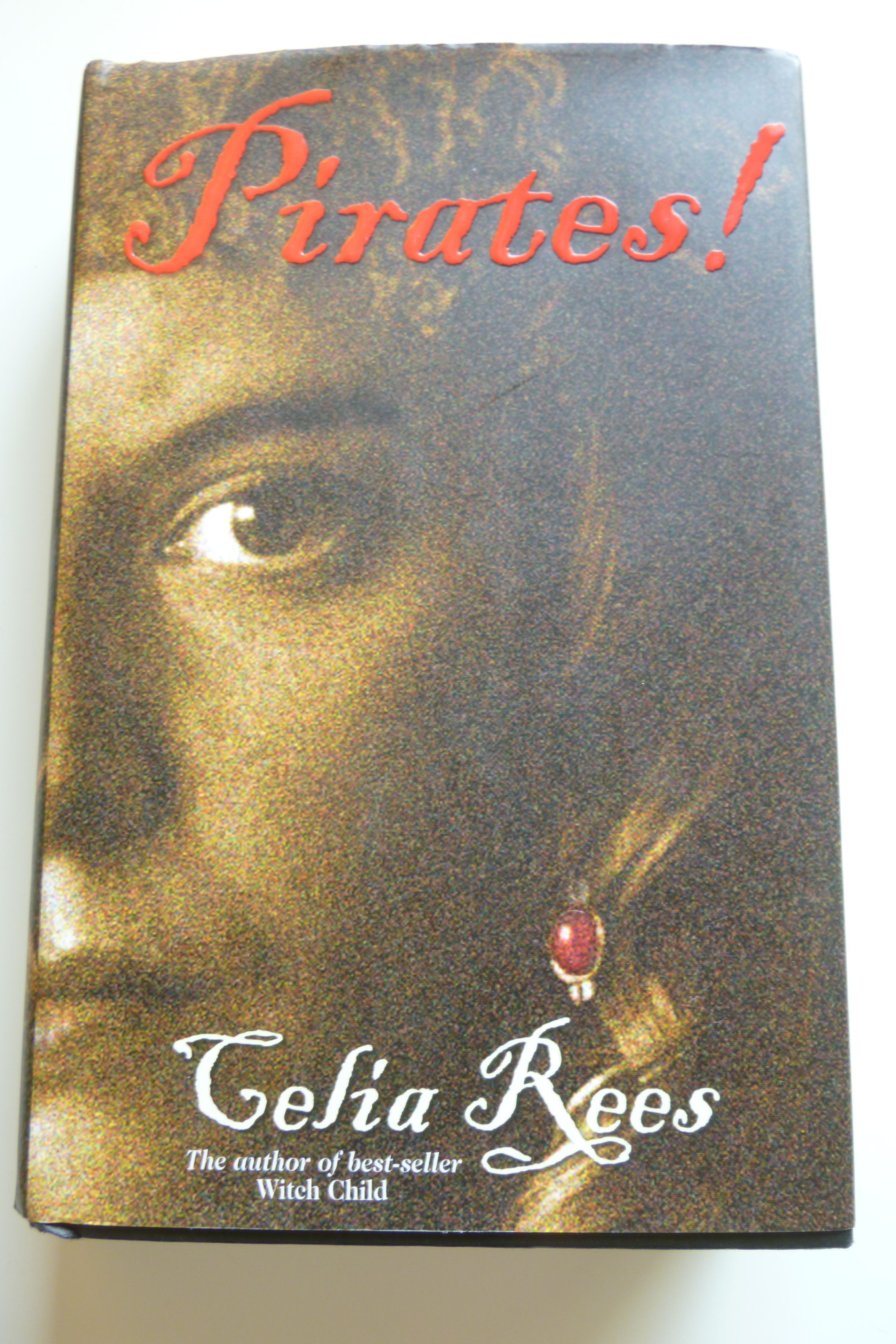
Rarely can my interest in a book be so perfectly expressed by its title as in the case of Pirates! by Celia Rees.  I mean, why was I interested?  Pirates!  It’s all rather self-evident.

But this is also a Dusty Bookshelf book, so despite the pirates(!) it took me some time to get to it somehow.  Backstory:

How did I get it?  Bookswap with my book club.  I’d been seeing it at bookstores and the library for ages but somehow never got to it, so when it wandered past me available for free, I thought…pirates!  And took it home.

How long was it on the shelf?  Since February 2011…I read it in April, so 14 months.  Ouch.

Am I keeping it?  No…I enjoyed it, and I enjoy the title way too much, but I didn’t quite love it enough to keep it.

What, you ask, is the book about?  Besides pirates, of course.  It’s about Nancy, the tom-boyish daughter of a wealthy English merchant, who after her father’s death finds herself packed off to the family plantation in Jamaica.  There she bonds with Minerva, a slave who becomes like a sister to her.  The two girls flee into the wilderness when Nancy realizes she’s being forced towards a marriage with the terrifyingly cruel Bartholome, another merchant and plantation owner.  Nancy and Minerva find a friendly band of pirates and join the crew, though Nancy is still dreaming about her childhood sweetheart–who just happens to have joined the British Navy.

It’s a fun story and an exciting premise, and I loved reading a novel about female pirates in the Caribbean during the Golden Age of Piracy.  I mean, I wrote a novel with that premise–it’s kind of an area of interest for me!  I may be too familiar with it, though, because I kept feeling sort of like I’d already read this.  I’m reasonably sure I haven’t actually read it, but I can think of several books with similar elements.

There were some things a bit more unusual.  I liked the bond between Nancy and Minerva.  I liked the twin focus on both piracy and slavery.  I’ve read books about one or the other, but rarely seen them together, even though they were both going on in the same time and place, and even in the same shipping lanes.  I studied Jamaican history for a class in college and was fascinated by the Maroons, a group of escaped slaves and other society outcasts who lived inland in Jamaica.  I was also shocked that I’d done a lot of research on piracy (same time and place!) and never heard about them.  Somehow the stories don’t usually overlap–but they did here, as Nancy and Minerva got in with both groups, and I enjoyed seeing that.

I loved the references to historical pirates.  None of them showed up, even in cameos, but they were talked about, including Anne Bonney and Mary Read, the only two real life female pirates from the Golden Age.  This is actually set a few years after most of the greats had died, in the last year or two of the Golden Age (so that’s about 1724).

This was mostly historical fiction, not fantasy.  Bartholome has an uncanny ability to track Nancy after she runs away, and Nancy has some oddly prescient dreams about him, but I wouldn’t really define this as fantasy.  It’s more a suggestion that some of the native folklore has a little bit of truth in it.

This was an enjoyable book, good characters and an excellent setting…and I really don’t know why I liked it without loving it.  But at least now I know more about that tantalizing title–Pirates!

Author’s Site: http://www.celiarees.com/

Other reviews:
Curvy Writer
Em’s Bookshelf
Mommy Brain
Anyone else?