100 Years Ago at the South Pole

Scott and Party at the Pole, Jan 17, 1912

On January 17, 1912, Captain Scott and his team of explorers reached the South Pole, 100 years ago today.  They weren’t the first ones there–Roald Amundsen’s Norwegian team beat them there by a month.  Scott also found that getting there was the easier part.  All five of the men who reached the Pole died trying to get back again.

So why am I telling you this depressing story?  I suppose because I don’t actually find it depressing.  Tragic, yes; depressing, no.  They did fail–but that’s usually not how the story is told.  They died martyrs to the adventure and heroes of history, proving the length of man’s endurance and determination, pushing out the frontier and chasing the impossible dream.

Also, Titus Oates, one of Scott’s men, has a major role in one of my favorite books, The White Darkness by Geraldine McCaughrean.  I freely admit that most of my impression of Scott and his journey came from her book.

So in honor of the anniversary, here’s to impossible dreams (hopefully with better planning!) and I’m re-posting my review of The White Darkness.  It was only the third book review I ever posted here, so most of you probably weren’t here to read it the first time anyway.  🙂

**********************

“I have been in love with Titus Oates for quite a while now—which is ridiculous, since he’s been dead for ninety years.  But look at it this way.  In ninety years, I’ll be dead, too, and the age difference won’t matter.”

This is one of my all-time favorite opening lines of a book (right up there with “All children, except one, grow up”).  I read this in a bookstore and knew immediately that I had to read The White Darkness by Geraldine McCaughrean. Continue reading “100 Years Ago at the South Pole”

A Servant’s Magic

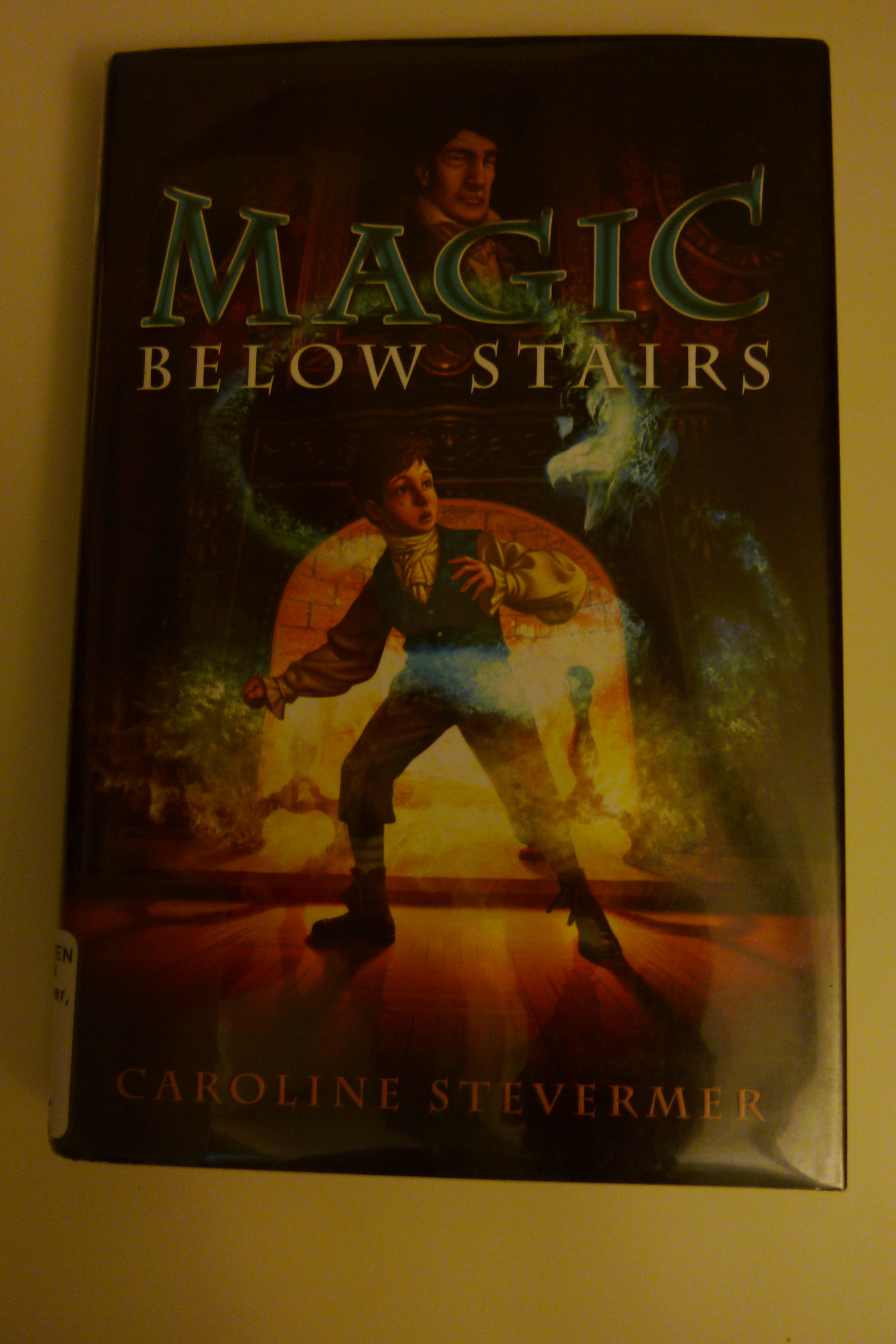
I love the Sorcery and Cecilia series by Patricia C. Wrede and Caroline Stevermer, so I was excited to stumble across a companion book recently.  Magic Below Stairs by Caroline Stevermer revisits the world of the series from a new point of view.  You don’t need to have read the rest of the series to enjoy this one, though I think it would add more meaning to some parts.

The series is about two women, Kate and Cecilia, who marry a couple of magicians, Thomas and James (respectively!)  They’re aristocracy of some sort; Magic Below Stairs comes from the other side of the social strata, and focuses on Frederick.  He notices strange happenings at the orphanage where he lives, and discovers that their cause is Billie Bly, a house brownie.  Billie Bly has attached himself to Frederick, and when Frederick is chosen to join Kate and Thomas’ household as a new servant, Billy Bly comes too–which Thomas does not appreciate at all.  Meanwhile, there’s also a nasty curse lying in wait.

This actually felt oddly like a Diana Wynne Jones book.  You have the earnest young boy, the absent-minded magician, and a looming threat.  And it’s all set in a grand English manor.

Stevermer’s website tells me this is set in Victorian Britain.  I’m not good at all at keeping straight different eras of British history (unless you give me an actual event to measure by–the Battle of Trafalgar, say, or the life of Shakespeare), so I just knew this was set somewhere back in the past when manor houses had entire staffs of servants hard at work below stairs.  Part of the fun of this book is seeing the world from that perspective.  This is especially true because this isn’t a book about the oppressed lower classes, which you do see sometimes.  The servants here actually seem a fairly contented lot who are fond of Thomas and Kate.

Saying that this reminded me of Diana Wynne Jones is a high compliment, of course.  🙂  This is a fairly short book without a huge amount of depth, but it’s a fun read with good characters and some nice humor at times.  And if you try it and enjoy it, you should definitely go on to the longer and more complicated Sorcery and Cecilia books!

Author’s Site: http://members.authorsguild.net/carolinestev/

Romance and Religion in the Middle Ages

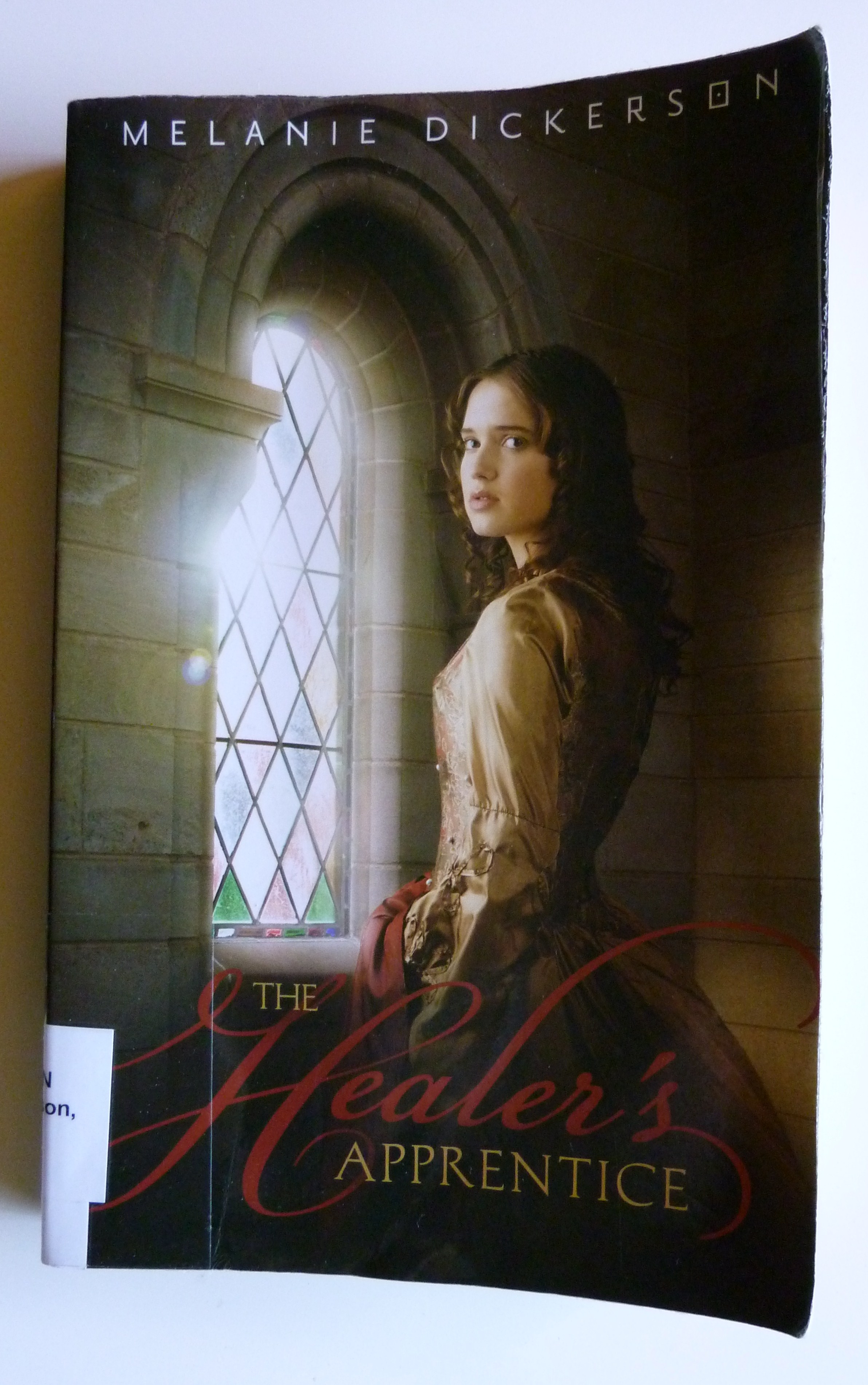
In my ongoing quest to find fairy tale retellings, I recently found The Healer’s Apprentice by Melanie Dickerson.  I’m actually not sure how, because it’s only very loosely Cinderella, and equally loosely Sleeping Beauty.  But it was a good read regardless.

The healer’s apprentice is Rose, who became an apprentice to dodge the arranged marriage her mother wants for her.  The setting is Germany, somewhere in the Middle Ages.  There’s a little bit of fairy tale in it, but it reminds me much more of Karen Cushman‘s books, which so vividly bring history to life (another review, perhaps).  Rose finds herself torn between the two sons of the local baron, Wilhelm and Rupert.  Meanwhile, she’s also trying to figure out if a healer is really what she wants to be.  In the background, there’s a story about an evil magician stalking Wilhelm’s betrothed.

There’s a little bit of a Mary Sue situation here, where every man seems to be intensely interested in Rose.  But a couple potential interests turn out otherwise, and Rose goes through enough ups and downs in her romances that it’s not too painful a Mary Sue.  Besides, I can deal with it better when the heroine is actually a decent person with some admirable character traits (unlike, say, Twilight).

Rose and especially Wilhelm struggle a lot with trying to do the right thing.  Part of this is centered around their religious faith, which I found very interesting.  You (or at least, I) don’t often see religious characters in fiction, especially not in something that has even a mild fairy tale element to it.  I thought Dickerson handled it very well, in that their religious convictions seem plausible for their time period, without feeling archaic either.  Some of the morality tales and religious beliefs of past centuries don’t sit well with modern concepts, but there was a good balance here.

On the whole I enjoyed the book–better than Sleeping Helena, not as good as Spindle’s End (although a more satisfying romance)–and all in all a good read.

Author’s Site: http://melaniedickerson.com/

The Red Badge of…Well, Something

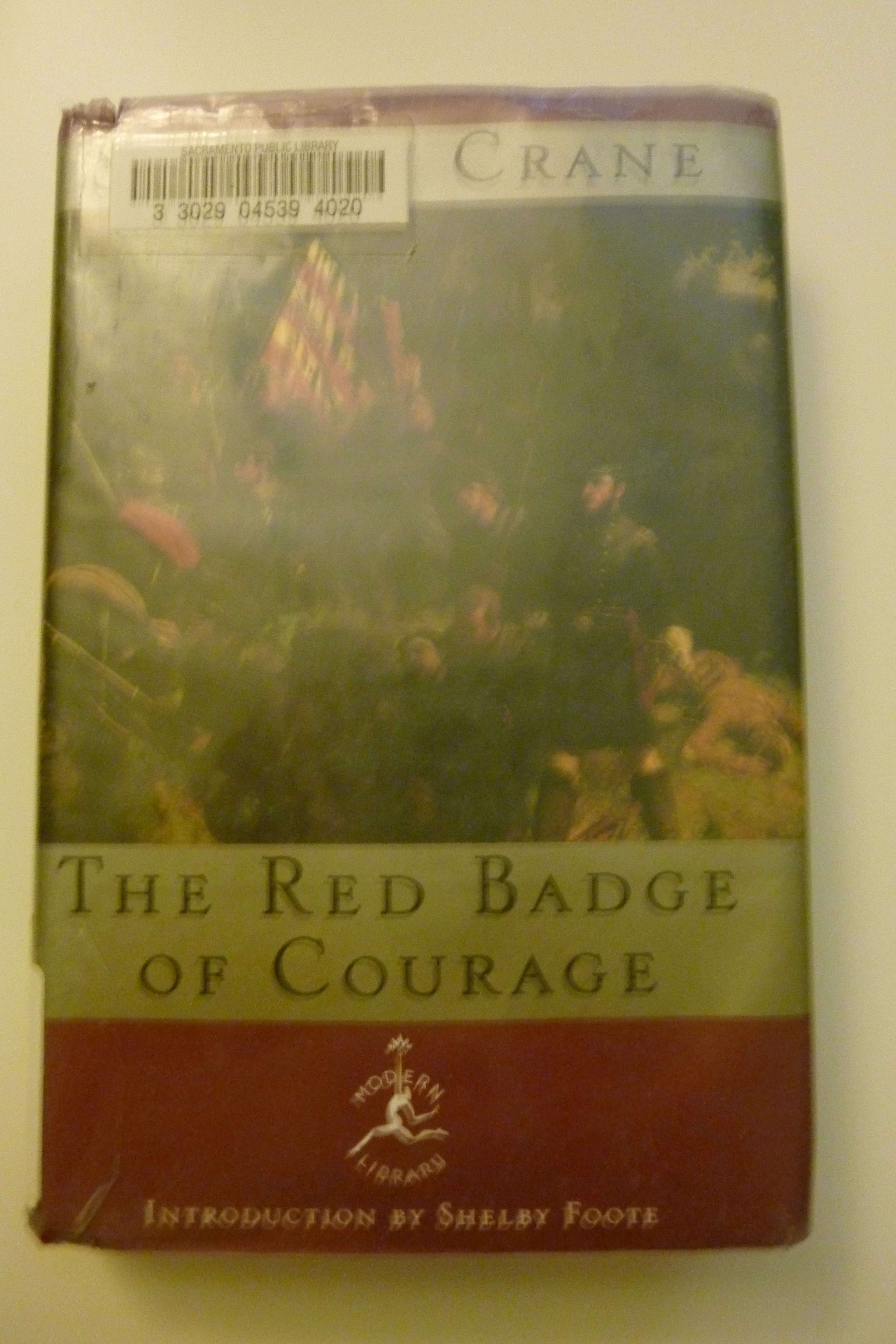
One of the most interesting parts about finally reading books I’ve always heard about is seeing how my vague impressions have differed from the actuality of the book.  Take The Red Badge of Courage by Stephen Crane.  Not at all what I was expecting when I finally read it this week.

My impression was always that it was about a boy in the Civil War, who deserted during his first battle, then returned, fought bravely in a second battle, and felt that he had earned his “red badge of courage.”

As it turns out, the hero’s not that young.  I think this mis-impression was the fault of whatever kid did an oral presentation on this book years ago, during elementary school.  And to be fair, the hero, Henry Fleming, is referred to 99.5% of the time as “the youth.”  If you’re twelve, I can see how you’d conclude that a youth is probably also twelve.  But, while his age is never really given, he and the other soldiers seem to accept him simply as another one of themselves, definitely not a drummer boy or otherwise marked out as significantly younger than the average.  Even in the Civil War, that has to mean he’s at least sixteen, and probably eighteen.

Second, this cowardice to bravery business is so much more complicated than I always thought.  The youth does run during his first battle, but so does many soldiers.  He does return, and fight in a subsequent battle, and this time he’s marked out for bravery.  But it didn’t feel like a nice, noble character growth.  In the first battle, he’s overcome by the sheer animal instinct of fear.  In the second battle, he’s swept away by the no more admirable quality of hate.  In both cases, it feels more like a kind of madness than any kind of nobler instinct.

I’m not sure if this was Crane’s point.  If his intent was to paint the reality of war, to demonstrate that it isn’t noble and courage is a very iffy thing, I think that’s what he illustrated.  Yet somehow he never quite brought it to the point that I could feel completely sure that’s what he was trying to do.  Maybe the title is the most telling part.  The youth gets his “red badge of courage.”  But the red badge turns out to be a wound, and the youth gets his when he tries to ask another fleeing soldier what’s going on, and the man whacks him one with his rifle.  There’s nothing courageous about it.

My favorite part of the book was early on, before the first battle.  The youth is really troubled about whether he’ll run when he’s put to the test.  He thrashes it out, and wonders, and worries–and looks around him and thinks that no one else feels this way.  That’s what I found most interesting.  It’s the idea of these hidden fears and worries that we’re desperate not to tell anyone, and that we think only we have because no one else expresses them…but maybe it’s just that everyone else is equally desperate not to tell about theirs.

My least favorite aspect of the book was the youth himself.  I liked him well enough in the beginning, but after the first battle I found his behavior totally repugnant–and I don’t mean the running.  I guess I don’t have the battle instinct.  I know that cowardice in the face of danger is practically the highest crime for a military man, and I certainly don’t find it admirable–but I found it easy to forgive him for getting scared and running in the complete chaos of a Civil War battle.

After the battle, though–the youth falls in with a group of wounded men, who are all trudging (as much as they can) back towards the camp.  Although he himself is unhurt at this point, the youth seems to demonstrate almost no instinct to help them.  He helps one friend in a very minimal way, but actually abandons another man.  This troubles him a little later on, but more because he’s afraid someone else will find out than because he feels any actual guilt.  I guess I can let go of the glorious battle ideal easily, but have much more trouble letting go of the ideal of comrades in arms and no man left behind.

When the youth is injured himself, a friend (who thinks he was wounded in battle) takes care of him, bandaging up the wound and giving the youth his own blanket.  The youth expresses no gratitude, very little acknowledgement even, and is in fact quite rude and contemptuous to the friend later on.  Besides which, he just begins to come off as very arrogant and unfeeling on the whole.

Maybe some of this goes back to Crane’s point about war not being glorious, and about soldiers not being saints.  But I’d rather have likable characters.

An interesting book, and I’m glad to have my own opinion on it now…but I don’t know that I’d push it on a kid if they asked for a recommendation for a book report.

An American Girl for an American Holiday

Happy Fourth of July!  I’ve been hunting my shelves for a good book to review that’s appropriate to the day.  I usually celebrate with movies–either 1776 or Mr. Smith Goes to Washington.  But I do have one favorite book series set around the Revolutionary War.

I loved American Girl when I was a kid.  I subscribed to the magazine for many years, and read several of the book series.  My favorite was always Felicity.  One of the best Christmas gifts I ever got was a Felicity doll, with her wardrobe of clothes and her four-poster bed, from rather indulgent grandparents.  🙂

Felicity lives in Williamsburg, Pennsylvania, at a time when tensions are beginning to rise between the British and the colonists.  Felicity loves adventure and has trouble being a proper young lady–which is probably what makes her beloved of young girl readers.  The main focus of her story is usually on school or family or friends, but the political situation furnishes a backdrop, and sometimes becomes part of the story.  At one point, Felicity is separated from her best friend, Elisabeth, because Felicity’s family is pro-revolution, while Elisabeth’s father is a Loyalist.  At another point, Felicity’s father’s apprentice considers running away to join the revolutionary army.

The books strike a balance, bringing in history without making it feel dragged in, and without distracting too much from Felicity’s adventures as a girl living her ordinary life in the 1770s.  Not every book achieves such a good balance!

The most appealing part of the Felicity stories, for me, was Penny.  Penny is a horse who Felicity tames and learns to ride, rescuing her from a cruel master.  This was directly responsible for my going through the horse phase that probably every little girl has at some point!

These are sweet books, and a lot of fun–and quite short!  Rereading them many years later, I find it takes about twenty minutes to read one book.  But Felicity and her world are nice to visit–however briefly!