The Two Princesses of Bamarre

Two Princesses of BamarreMy (unintentional) theme for Once Upon a Time this year seems to be rereads of long-ago books I’ve largely forgotten…and today is another one, The Two Princesses of Bamarre by Gail Carson Levine.  Levine wrote the particularly excellent Ella Enchanted (review), and also has a wonderful blog with writing advice.

The two princesses of this title are Addie, who is afraid of everything, and Meryl, who dreams of adventure.  When Meryl falls fatally ill, Addie has to find her courage to set out adventuring in search of a cure.  Fighting ogres, spectres and a quite alarming dragon, and with some help from a very nice magician named Rhys, Addie learns more about her kingdom, and about herself.

The plot is somewhat episodic, and on the whole a pretty straight-forward quest.  The strengths of the book are more in the characters and the depiction of magic.  Bamarre is largely over-run by different magical threats, and there are some very interesting ways that magic is created.  Spectres might be the creepiest, as they can appear in anyone’s form.  Dragons are creepy in their own way, though, at least the one Addie meets–she genuinely loves her victims, keeping them around for company, and mourns them once they’re dead…but all the time considers it inevitable that at some point she’ll become angry and kill them.  Very odd!

Magicians are quite odd too, as they’re “born” when lightning strikes marble.  They seem to be mostly human though (and can even intermarry), except they have a tendency to float.  One of my favorite details may be when Rhys admits that he has trouble keeping his feet firmly planted, so he usually hovers a hairsbreadth above the ground.

Addie’s physical journey is pretty straight-forward (and occasionally a bit implausible) but her internal journey is more profound.  I think Levine portrays very nicely her growth and finding of her own strength, without losing who she was.

This was a fun and pretty quick reread.  If you haven’t read Ella Enchanted, read it–not because there’s any connection to this book but just because I think it’s Levine’s best.  But if you’ve already read Ella (seeing the movie does not count) and liked it, then Two Princesses is another good one as well.

Author’s site: http://gailcarsonlevine.com/

Other reviews:
Leaf’s Reviews
Escaping Reality (One Book at a Time)
Brightdreamer’s Book Reviews
The Book Vortex
Anyone else?

Buy it here: The Two Princesses of Bamarre

The Fantastic Mr. Fox, Written and Read by Roald Dahl

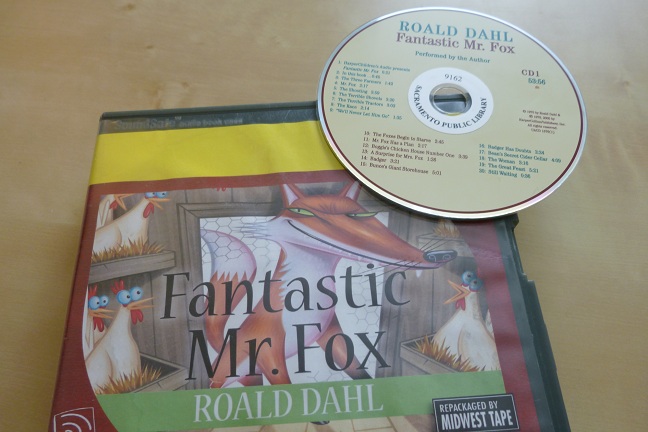
Fantastic Mr. FoxLast week, I found myself with a long drive coming up and no audiobooks on hand!  So I dropped by my library and impulsively picked up The Fantastic Mr. Fox, without realizing that it was actually read by Roald Dahl himself.  I’m calling a talking fox appropriate for Once Upon a Time too.  I had a good time listening–but also came to the conclusion that I’m just too old for this story.

I had seen the movie already (and by the way, great choice of casting with George Clooney as the voice of Mr. Fox) and found the book to be more or less the same storyline.  Boggis, Bunce and Bean are poultry farmers, and rather an unpleasant bunch.  Mr. Fox routinely steals from the three of them to feed his family, until Boggis, Bunce and Bean strike back, first with guns and then trying to dig or starve the Fox family out of their hole.

It’s an enjoyable, exciting story, with lots of Dahl’s flair for language and rhyme.  There are tense moments and humorous moments and a few gross moments, of the kind aimed at kids.  All in all, it is fun.  And I might have quite liked it if I had read it when I was younger and more willing to take matters at face-value.

But.  The trouble is, I can’t get behind Mr. Fox as a hero.  Because he is stealing from Boggis, Bunce and Bean.  Dahl tells us that they’re terrible people, but I don’t see much actual evidence of that.  Yes, they’re rather rude, unhygenic, and ruthless in hunting down the Fox family…but you can’t steal from someone just because they’re rude and don’t bathe often enough.  This isn’t Robin Hood stealing from the oppressive Sheriff of Nottingham.

Even the villains’ ruthlessness towards the foxes is an uncertain indicator, because it’s not quite clear what they understand about the foxes’ intelligence and level of civilization.  Using lethal force to defend property is going too far, but that’s when applied to humans.  Shepherds and farmers have defended crops and livestock from predators since time immemorial.  As an animal lover, I’d rather they let the animals live, but I can’t say they’re evil if they take extreme measures.

So while I’m supposed to be cheering on crafty Mr. Fox, I never could quite avoid seeing Boggis, Bunce and Bean as honest (if unpleasant) businessmen taking necessary steps to defend their livelihoods from a persistent and unrepentant thief.

The situation is made worse because at one point Badger asks Mr. Fox if the stealing bothers him.  Mr. Fox jumps on something of a soapbox about how he’s only trying to keep his family from starving (because they’re under seige at this point) and after all, Boggis, Bunce and Bean want to kill him and he doesn’t want to do any such thing to them, so stealing is comparatively minor.  Which is all well and good except he’s ignoring the larger cause and effect.  He didn’t start stealing because they were hunting him.  They started hunting him because he was stealing.

I should note that I do like the occasional roguish hero–Captain Jack Sparrow is one of my all-time favorite characters.  But Mr. Fox does not have the charm of a Captain Jack, or the noble ideals of a Robin Hood, and at the end of the day…he was just not that fantastic.

But the audiobook only took an hour of my life (while driving), and it was well worth the time just to satisfy my curiosity about the book.  And I did enjoy listening–even if it had some issues!

The best part, though, was that the book was read by Roald Dahl.  And somehow, he just sounded the way I would expect Roald Dahl to sound. 🙂

Author’s Site: http://www.roalddahl.com/

Other reviews:
Tor.com
Reading to Know
Strange and Random Happenstance
Anyone else?

Buy it here: Fantastic Mr. Fox (CD)

Welcome to the Land of Oz

Welcome to OzI’ve lately been slowly rereading the Oz series by L. Frank Baum.  This is at least my third or fourth time through, over the span of…maybe 18 years.  Everyone knows the first one: The Wonderful Wizard of Oz.  It’s less well-known that there are another thirteen books in the series–and even more if you count the non-Baum ones, which I don’t.

Fourteen would be a bit many to tackle in one review 🙂 but I’ve been discovering that it’s surprisingly easy to divide the series into sections, mostly trilogies.  So today let’s look at the first three–I’d like to call them the “Welcome to Oz” Trilogy.  Though new characters are introduced throughout, these first few introduce the principle players, not to mention the setting, which is frequently a character in itself.

***********

The Wonderful Wizard of Oz bears some resemblance to the movie…and some differences.  Kansas farmgirl Dorothy is picked up by a tornado and carried away to the magical land of Oz with her little dog Toto.  There, her house lands on a wicked witch, she acquires a pair of magic slippers (silver, not ruby), and sets off through Oz with a Scarecrow, a Tin Woodman, and a Cowardly Lion.  Eventually she meets the Wonderful Wizard, kills the Wicked Witch of the West, and goes home by slipper power.

That all sounds like the same plot as the movie…but the difference is focus.  While the movie ties neatly together with both Glinda and the Wicked Witch appearing early on, and the Witch providing an ongoing threat, they come in later on in the book.  Dorothy spends more time simply wandering about on adventures, without the drive and the urgency of the movie.  Growing up, I actually never liked this book–and I think the problem was that I was comparing it to the movie.  This most recent read-through, I was finally able to look at it more separately, and it is a rather charming (if unfocused) fairy story.

We’re introduced to a lot that’s fun here, and the characters are delightful.  At the same time, there were some things that Baum hadn’t quite figured out yet.  For instance, he all but directly says that the emeralds in the Emerald City are illusion, and that the Wizard didn’t really give Dorothy’s companions their various rewards, but just humbugged it.  This takes a turn in later books–in the later volumes, the Emerald City really is covered by gem stones, and the brain, heart and courage bestowed by the Wizard really are magical.  While I like the message that Dorothy’s friends had all they needed all along…I do also like the more magical version of events.  Though at least Baum maintained the magic in this book to the extent that the story didn’t all become a dream sequence at the end!

The ramblingness of the book is the most serious problem, and while this is good, I don’t actually think it’s one of the strongest volumes–strangely, when it’s the best-known!

***********

In the second book, The Marvelous Land of Oz introduces new characters.  Dorothy isn’t in the story at all, and the hero instead is Tip, a boy being raised by Mombi, an evil witch.  Tip runs away with Jack Pumpkinhead, a stick-man with a Jack O’Lantern head, which Tip made and Mombi brought to life.  Their adventures eventually lead them to an alliance with the Scarecrow and the Tin Woodman against an army of girls who have conquered the Emerald City.

Between the threat of Mombi and the possibility of war, this is one of the more exciting installments.  The characters are also particularly entertaining, the ones mentioned above as well as a giant, highly-educationed Woggle-Bug, a strange flying contraption called the Gump, and a return appearance by Glinda the Good Witch.  The army of beautiful girls armed with knitting needles (really) sets off my feminist instincts a bit, but they’re counterbalanced by Glinda’s far more capable female army.  The ending of the book is bizarre to say the least–I won’t give it away, but I’ll say that sometimes you have to just go along with Baum and not ask too many questions…

***********

Ozma of Oz is Book Three, and one of my favorites of the series.  Despite the title, which refers to the new Queen of Oz, this is largely a Dorothy book.  She gets lost at sea and washes ashore in a magical country near Oz, swiftly reuniting with old Oz friends who are on a journey to the Nome King to rescue the Royal Family of Ev.

This one is full of images and moments that have stuck with me all out of proportion to their importance–though maybe I should just say it has memorable moments.  There’s a wonderful bit early on when Dorothy finds trees laden with lunch boxes and dinner pails.  She picks ripe ones, opens them up and finds entire meals growing inside.  It’s not an important scene, and yet it’s so delightful and whimsical.  It encapsulates the magical things that can happen in Baum’s world.

Later on, Dorothy encounters Princess Langwidere, who has a collection of different heads and interchanges them at whim, the way people normally change hats or jewelry.  It’s weird and wonderful and just a bit creepy!

When the party from Oz reaches the Nome King’s cavern, he explains that he’s turned the Royal Family of Ev into knick-knacks, and invites each rescuer to search among his collection and try to choose the correct ones–at the peril of being turned into knick-knacks themselves.  That story element of having to choose the right enchanted object from a collection has definitely threaded itself into my mind, and is directly responsible for a chapter in my novel–though my heroine had to select the right enchanted fish.

***********

Baum’s books are whimsical and magical and full of funny, fascinating characters.  There are very few rules and anything is possible.  The first one has some flaws, but on the whole these first three in the series are excellent.  They’re rarely highly dramatic or very deep, but they’re entertaining and bright.  These are wonderful pieces of classic fantasy I highly recommend.

Other reviews:
Story Carnivores
Sarah Reads Too Much
Booksessed
Dark Chest of Wonders
Anyone else?

Buy it here:
The Wonderful Wizard of Oz
The Marvelous Land of Oz
Ozma Of Oz

…or the movie version 🙂

Climbing Notre Dame with Quasimodo

HunchbackOne of my top places to see in Paris last September was Notre Dame Cathedral–for the architecture and because I like big old churches and because it’s an icon.  But also very much because of The Hunchback of Notre Dame.  I’ve never actually read Victor Hugo’s novel (though I have put it on my list since visiting the cathedral) so when I say that Hunchback influenced my Parisian sight-seeing…I mostly mean the Disney movie.

I can’t remember being particularly attached to this one as a kid, but in recent years it’s been emerging as one of my favorite Disney cartoons.  That makes sense, because this is not at all a typical Disney cartoon, and has a much more adult feel.  I love typical Disney and I don’t mean to criticize it in the review that follows, but I do feel this one is on a different level.

I’d really like to know how the first person looked at the book and said, hey, let’s make a cartoon!  Instead of a star-crossed princess and her prince, we have Quasimodo, the hunchbacked bellringer of Notre Dame.  His only friends are three gargoyles (two of whom are named Victor and Hugo–love that) and though he dreams of entering the world he’s watched, this has always been forbidden by his master, the stern magistrate Frollo.  Quasi finds a little daring, the beautiful and bewitching gypsy Esmeralda comes on the scene, and everything changes.

I love Quasi and his growth as a character, as he overcomes his fears and realizes his own value.  Sure, it’s not quite the complexity of Susan Kay’s Phantom, but there’s still a depth here that goes beyond perfect-princess-meets-perfect-prince.  Likewise Esmeralda is a strong, intelligent character, very aware of larger societal issues of class and prejudice.  I even like the prince figure, the handsome Phoebus, who I find more likable than, say, Raoul from Phantom.  Phoebus has his own depth, as a soldier who struggles with a new position and orders he doesn’t like–and he has a sense of humor.  Disney heroes who have funny scenes with horses to seem to work well with me…  And how do you go wrong when he says to his horse, “Achilles–heel.”

Frollo is also a villain with fascinating depth, and he’s a very mature villain for a Disney movie.  His interest in Esmeralda is on a totally different level than Jafar’s decision to marry Jasmine in Aladdin.  I really don’t know how the scene “Hellfire” got into a Disney cartoon.  Frollo is singing about lust and temptation and damnation, while there are flames and demons and hooded figures chanting “mea culpa.”  It’s fantastic and wonderful, but–in a Disney movie?  Really?

I love the songs, especially “Out There” which is one of my favorite songs ever.  It’s just so beautiful and heartfelt, and is one of the main reasons I felt I had to spend time in Paris “strolling by the Seine.”  The only time I got out my iPod while walking around was to listen to “Out There,” sitting on a wall next to the Seine.  I also love “God Help the Outcasts”–again, there’s a depth to it, and to Esmeralda’s character.  From the opening lines, “I don’t know if you can hear me, or if you’re even there–or if you would listen to a gypsy’s prayer,” she’s having a complex religious experience.  It’s deep, it’s emotional, leading up to the end, “please help my people, the poor and downtrod–I thought we all were children of God.”

My only significant reservation on the movie is the last two minutes.  After such a beautifully nuanced movie, it tied up with more of a simple Disney happy ending.  Quasi gives his blessing to Esmeralda and Phoebus, and then is embraced by the crowd.  And…I don’t buy either idea.  He may accept how Esmeralda feels about Phoebus, but I’d find it much more believable if he was less pleased about it.  A little wistfulness, maybe?  And after all the times that crowd has made an about-face, I wouldn’t trust it to stay welcoming for the span of five minutes.

I’m not sure what ending I want.  I don’t want Quasi to die, or even to retreat back into his belltowers (because then what was the point of the character growth?)  But after all the rest of the movie, I feel like they could have managed a more subtle, less conventional ending.  Maybe he retreats to the towers but it’s implied he’ll come out again in the future?  A little wistfulness on the romance question but also make it clear that Esmeralda and Phoebus will be his friends into the future, opening up the possibility that he could venture out farther someday?  There had to be some kind of bittersweet or lightly hopeful ending they could have managed.

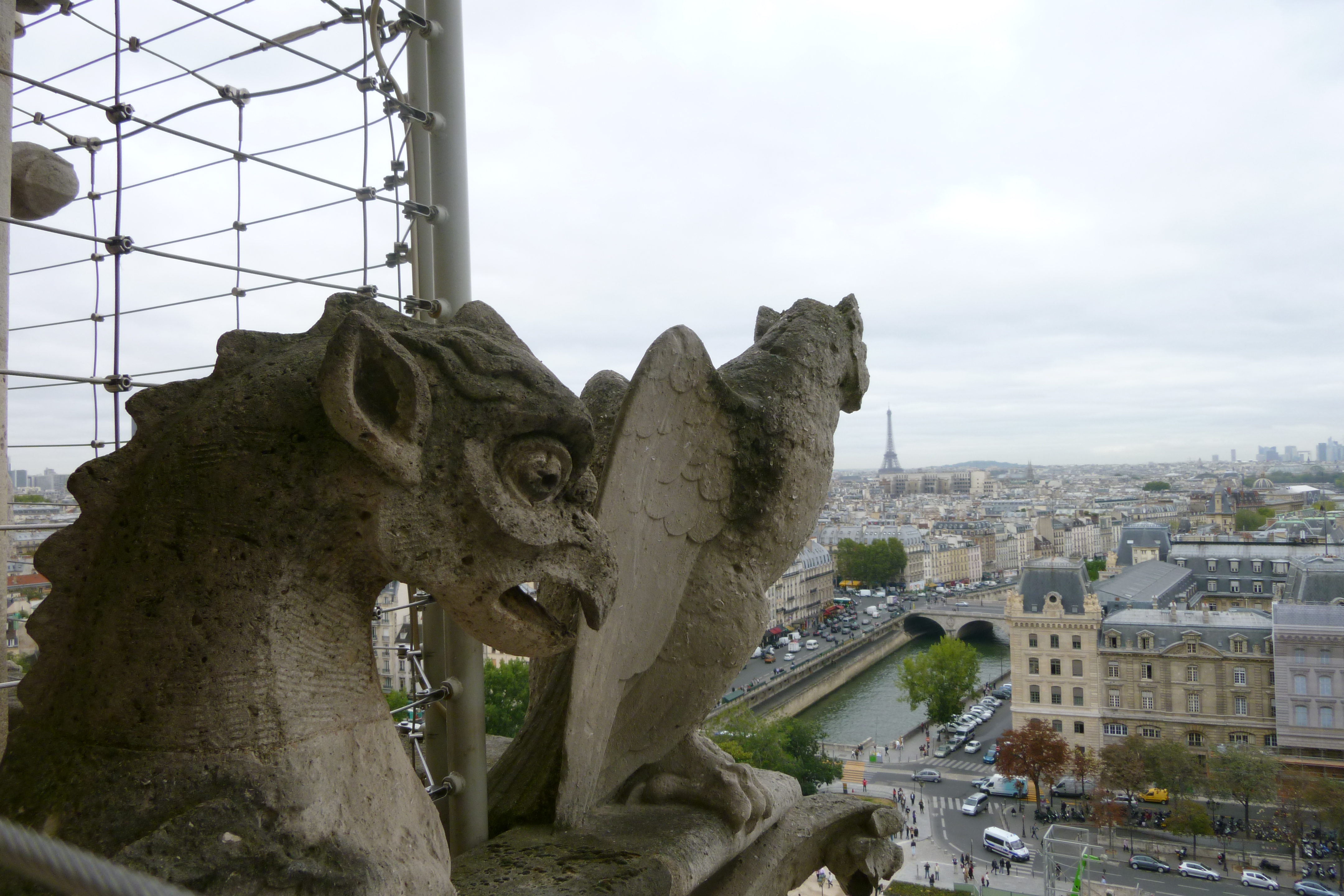
I still love the movie–and I loved watching it shortly after visiting Notre Dame.  Someone animating this really knew what Notre Dame looked like, and when I watched it again I kept reacting to things I recognized.  If you go to Notre Dame, you can easily go into the church, which is very beautiful.  I recommend also going around the corner to the left and getting in line to visit the belltowers.  There are a lot of stairs (a LOT of stairs), but it’s worth it to see the gargoyles and the view.  You don’t really get to see Quasi’s bells (just one) or the space where he lives in the cartoon, but it’s still neat–and you can see the whole of Paris below.

I’m planning a Notre Dame Saturday Snapshot for this weekend, so come by for more pictures then!

The Fairy Tale Behind the Ballet

The holidays are creeping up on us!  I always like thinking about favorite books and movies to help put me in the spirit.  This year, I was fortunate to find a new (to me at least) book with a Christmas theme: Nutcracker by E. T. A. Hoffman, illustrated by Maurice Sendak.
You may be familiar with the Nutcracker ballet–and this is not quite that.  The ballet is based on the story, and you can certainly see the same outlines.  But as often happens when stories are translated from one medium to another, things changed along the way!  The plot is a bit different and, in this particular edition, so is the atmosphere created by Sendak’s illustrations.

Like the ballet, the story begins with Christmas Eve, as Marie (or in the ballet, Clara) and her brother Fritz open their Christmas presents.  Marie’s favorite is the wooden Nutcracker.  That night, after everyone else has gone to sleep, Marie is in the parlor with the toys.  She witnesses a fight between the toy soldiers led by Nutcracker, and the fearsome, seven-headed Mouse King–or did she just dream it?  Here the story diverges from the ballet.  Marie is injured in the fight (or did she just put her arm through a glass cabinet?) and while she’s sick in bed, Godfather Drosselmeier tells her a fairy tale story of how the Nutcracker was cursed, and the roots of his enmity with the mice.

This is a lovely Christmas tale, with much the same charm and feel as the Brothers Grimm (though maybe less grim than their darkest!)  The book is really a novella, including the long story-within-a-story in the middle.  The odd story about the cursed princess who can only be cured when a magic nut is cracked is great fun, and Marie has her share of adventure too.

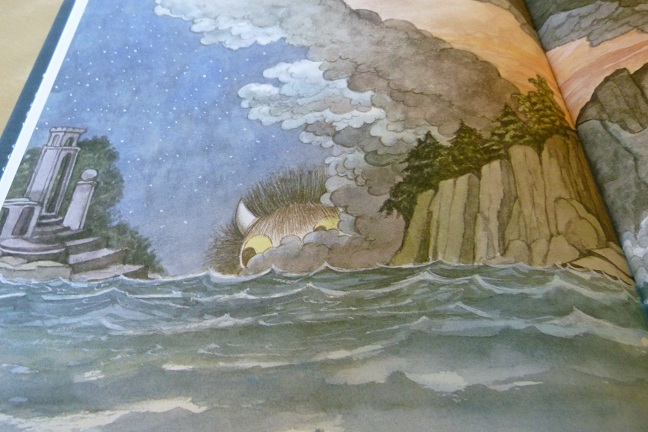
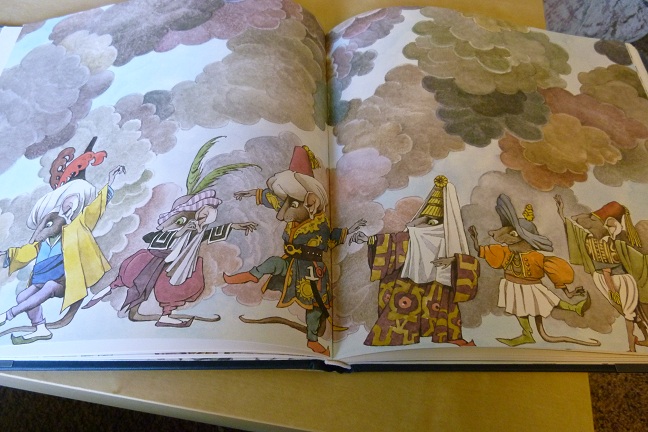
The illustrations are obviously a big part of this book, and there are some beautiful ones.  Don’t expect the tinsel and glitter of most productions of the ballet, but Sendak brings the characters to life with his own unique style–and with particularly elaborate costume details.  There are many full-page spreads, including a series of pages in a row when Marie and Nutcracker travel to the magic country.  There’s even what looks like a “Wild Thing” peering around a rock in one of those pictures!

My favorite thing about the book may be the charming narrative voice.  J. M. Barrie has won my heart forever by being the most charming of narrators, and so when I say Hoffman reminded me of Barrie in some moments, it’s a high compliment.  He has the same trick of addressing the reader that I enjoy so much, and there’s also some great tongue-in-cheek humor.

The edition I have was just released last October, and it’s physically a beautiful book.  It’s a large hardback, and seems designed to make a wonderful holiday gift!

Other reviews:
Rhapsody in Books Weblog
Minding Spot
A Patchwork of Books
Anyone else?

Disclosure: I received a free copy of this book from the publisher in exchange for an honest review.