Twelve Princesses, Plus One

What if the twelve dancing princesses had another sister?  That’s the premise of The Thirteenth Princess by Diane Zahler, retelling the fairy tale of the twelve dancing princesses from the point of view of their youngest sister, Zita.

This story starts out by tackling the question of why the king and queen opted to have quite so many children.  The king desperately wanted a son (as kings usually do, in medieval-type kingdoms), but instead, daughter after daughter was born.  Finally, the queen died giving birth to the thirteenth princess, Zita.  The king blames her for the death of his wife, and the end of his hopes to have a son, and banishes her to live in the kitchens as a servant.  As she gets older, she finds ways to secretly spend time with her sisters, and when they became mysteriously ill (and their dancing slippers keep mysteriously wearing out), Zita and her friends have to investigate to save the princesses.

I have mixed feelings about this one.  It’s a cute story about a spunky girl, and it is nice to see a girl with close ties to the princesses rescue them, instead of a strange man coming in to save the day, as happens in the original. There’s some good description, especially about the damp, moldy castle–because when you think about it, a castle built over a lake probably would be moldy!

Somehow this just didn’t quite grab me, though.  I don’t think it’s only that I’ve read so many versions of the fairy tale.  There really are some issues here.  For one, while the essential concept of the youngest, semi-banished princess is interesting, it also felt contrived.  It’s hard to imagine a king actually doing this, or having his court go along without batting an eye.  The king has twelve daughters who live like, well, princesses, and one who’s banished to the kitchen.  It almost feels like a story about child neglect, with a parent who targets just one child, while a lot of good people watch this happening and don’t do anything–everyone in the castle knows what’s going on, and no one does anything.  I don’t think Zahler was trying to write social commentary, but the situation creates a strange undertone to the story.  Zita isn’t being abused, but she’s still in a dramatically different situation than her sisters, while right alongside them.  It is, at the very least, incredibly socially awkward, to an extent that I don’t feel like Zahler really dealt with.

Zita’s separation from her sisters and status as a servant are essential to the plot, but I wish Zahler had found a different way to set that up.  Create a question about her parentage (though that could be dicey in a Juvenile book), or say that her identity had to be hidden, or something…

The focus on Zita’s story also means that we spend less time on the twelve older princesses.  I’ve already seen authors with longer, more-focused books stumble over dealing with a cast of twelve princesses.  They’re often under-developed as characters, but this book is one of the worst for that.  Arguably, they were never meant to be developed, since the book is about Zita, but it’s about Zita’s relationship with her sisters, and the major conflict of the plot is how to save them…so for the book to work, we have to care about them.  Other than in a vague, general way, I don’t.  They’re perfectly nice girls, but I don’t care about them as individuals.

Zahler doesn’t help matters by giving all the princesses A names–Aurelia and Alanna and…I can’t remember any of the others.  I’m on shaky ground criticizing that decision, since when I wrote a retelling, I gave my princesses A names too (but mine all have nicknames and are rarely called by their identical-sounding A names).  The only princess who’s developed at all is Aurelia, the oldest.  The others occasionally get a comment in the narration to say that one likes to read or another is the prettiest or whatever, but none of that really goes anywhere.  I only remember there was one named Alanna because of Tamora Pierce, and I don’t remember anything about that particular princess anyway.

On the other hand, Zita is a pretty good character, marked by strong loyalty to her sisters, and she’s in an interesting place trying to figure out her role and her relationship to her family.  I don’t feel like that was explored quite as much as I’d like, but there was at least some good character development there.  Her friends are Breckin the stable boy and Babette, a witch they meet out in the woods.  They’re both reasonably good characters, if somewhat straight-forward in their friendship for Zita and their desire to help the princesses.

I think that might be the key to my reservations about this book.  There are themes and characters that could have been more complex, and weren’t.  What IS there is good, fun, interesting…but the book feels like it could have been more.  I’m sure there are those who would tell me that this is a kids’ book, so how complex does it need to be…but I’ve ranted before about how deep kids’ books can be.  This book is set up to be about parental neglect, sibling rivalry, discrimination (against magic-doers), thwarted love, and class divisions…but most of that isn’t really dealt with.

It’s a fun little story, and if you want a light, quick read, it’s a good one.  But don’t expect it to be more, and if you only have time for one novel about the Twelve Dancing Princesses, there are others I’d recommend instead.

Author’s Site: http://www.dianezahler.com/

Other reviews:
The Bookwyrm’s Hoard
Debz Bookshelf
Eva’s Book Addiction
Anyone else?

Off to Neverland, with Fairies

Long-time readers know that Peter Pan is one of my favorite books.  You might also know that I often have trouble with new writers telling stories about beloved characters.  So Gail Carson Levine’s Fairies series is a slightly dicey situation, with one of my favorite authors writing based on one of my favorite books.  If it had gone bad, it all would have been immensely sad.

So it’s a good thing that it’s a good series!  It’s very much a kids book, but it’s a sweet read.  I just read the last book as part of my challenge to complete more series.  This one is basically a stand-alone, so you could choose to start here if you like.  I started this series so long ago (2006!) that I don’t even remember my thoughts when I began, if I was worried about whether it would work.  But I remember I liked the first two books, and I can talk about why I think they do work.

As you might have already surmised, the series is not so much about Peter as it is about Tinkerbell, and a host of other fairies who live in Neverland.  Shifting the focus makes it easier for a new author to step in.  Barrie only gave us a few hints and glimmers (or should I say flashing lights?) about fairies, so Levine can build up a more complex world without contradicting what came before.  In the first two books, Peter Pan himself is just referenced, and he’s only a supporting character in this third one.

The first two books introduce us to Levine’s Tinkerbell, an emotional but well-meaning fairy who loves to tinker with metal objects.  It’s not the image people usually have of elegant Tinkerbell–but it’s exactly what Barrie said about her, and explains her name.  We also meet other fairies, like Rani, who loves water, and Vidia, a nasty fairy who loves to fly fast.

Knowing the characters would certainly provide more context for book number three, Fairies and the Quest for Never Land, but you could start here because the book really focuses on Gwendolyn, a descendent of Wendy, whose female ancestors have been flying off to Neverland with Peter ever since.  Gwendolyn can’t wait for her turn, especially when Wendy’s “kiss” (the acorn a confused Peter gave her) gives her tantalizing visions of the island.  Peter does eventually arrive, and when she gets to Neverland Gwendolyn rushes off to look for fairies.

That’s both the strength and the weakness of the book.  Gwendolyn gets to meet all the fairies, and their guardian, Mother Dove.  It’s lovely to find out about society in Fairy Haven, and to watch Gwendolyn learn what her own talent is as she struggles to be accepted by the fairies, and then to help them when a terrifying dragon is accidentally released.  It’s a sweet story, exciting in spots, rather cute throughout.

My trouble, actually, is Peter.  As long as he wasn’t in it at all (or just in a passing reference), I didn’t miss him–so the first two books were fine in that way.  But when he’s in it a bit, suddenly it bothers me that Gwendolyn seems to have no interest in him at all.  Likewise, Peter has very little interest in Gwendolyn (and keeps calling her Wendy).  Peter’s arrogance and forgetfulness are very well-established so I don’t fault the character portrayal.  But the magic of Peter appearing at the window to take someone to Neverland…well, part of it is a Cinderella story, that the special person sees you and chooses you and says that you’re special too.  Peter didn’t seem to think Gwendolyn was special at all.  I guess that’s all right, since what she really wanted was for Tink to think she’s special…but I think Peter’s special so it bothered me!

But that was mostly a side issue, a kind of absence of something that I thought should be there.  What actually was there was good.  It’s not Barrie’s Neverland–it’s a bit homier and a bit more practical.  But it’s not painfully not Barrie’s Neverland either.  And to be fair, the cover says it’s about “Disney Fairies,” so I suppose it doesn’t have to be based on Barrie at all, when it’s really coming from another source material.  With that in mind, Levine has actually written something that’s impressively accurate to Barrie, when she probably didn’t need to be at all.

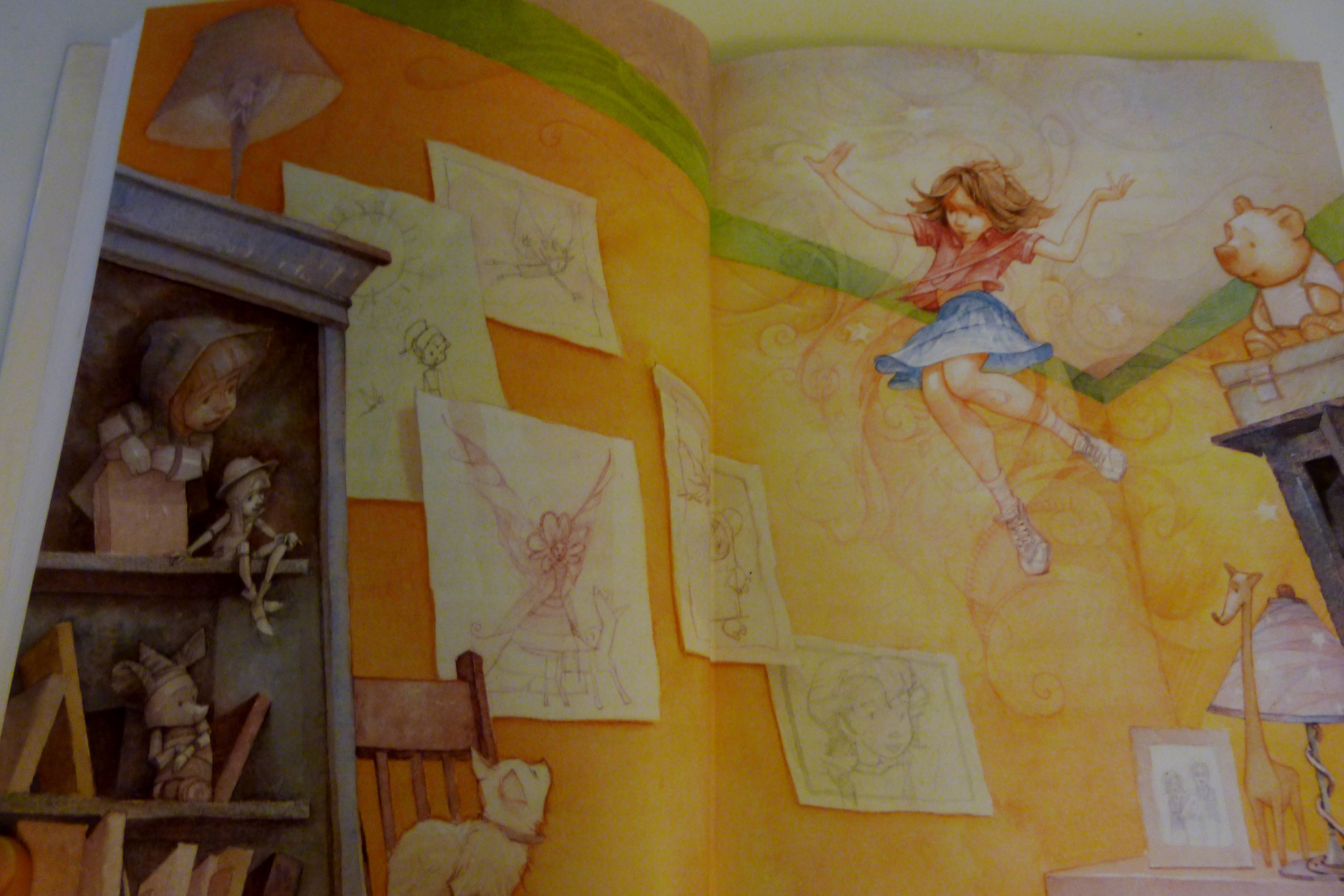
I would be remiss if I didn’t comment on the illustrations.  David Christiana did the illustrations for the entire series and they are absolutely beautiful.  There are many full-page illustrations (or two-page, and even one fold-out!) and they add a wonderful dimension to the story.  I like the book, but it’s actually the illustrations that are making me tempted to buy it!

This isn’t one of my favorite Levine books, but it is a fun look at Neverland from a different angle (even if sometimes a little TOO much that angle!)  This is a simple, sweet, fast read–I’m glad I finished the series, because it was a lovely book and when I did finally read it, it only took me a day!

Author’s Site: http://gailcarsonlevine.com/

Other reviews:
Reading All Year Long
Shannon Messenger
Confessions of a Book Habitue
Yours?

Talking to Animals, Fighting Monsters

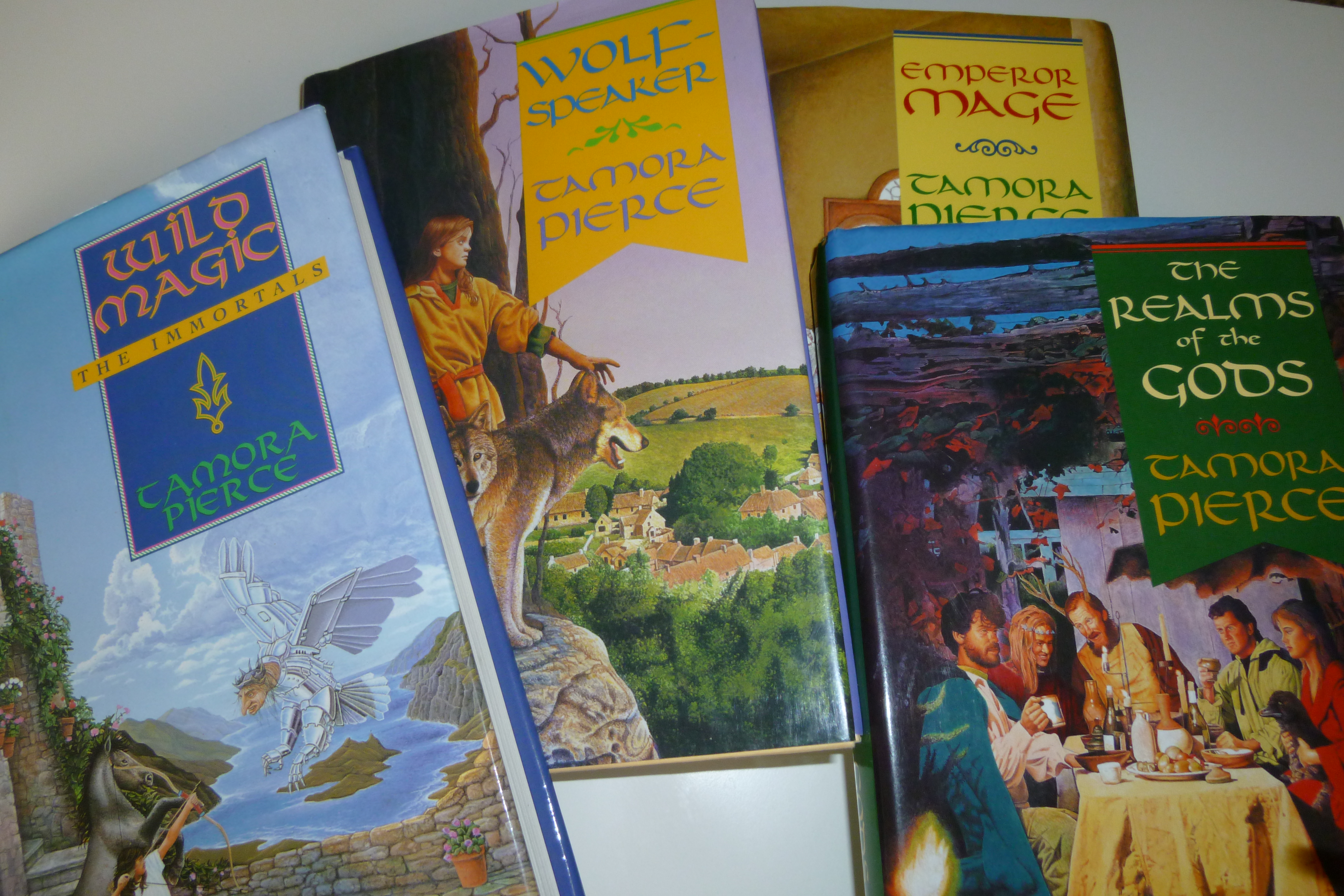
It’s not one of my reading challenges, but I have a personal goal this year to re-read Tamora Pierce’s Tortall books.  I’ve been reading her new books as they come out, but it had been years since I read the older ones.  I re-read the Song of the Lioness quartet in January, and it really is just unutterably wonderful.  In February, I re-read The Immortals quartet–and that’s my subject today.

The Immortals quartet is always referred to in my mind as the Daine books.  The main character is Veralidaine Sarrasri, an orphaned girl who discovers that her “knack with animals” is actually powerful magic.  She comes to Tortall (the setting of Song of the Lioness); she finds a job caring for horses for the Queen’s Riders, and finds a mentor in the magician Numair Salmalin, who helps her learn to use the wild magic that lets her talk to animals.  Meanwhile, the realm is threatened by strange magical creatures, who were locked in the Divine Realm 400 years before and are now escaping.  These are the immortals–they can in fact be killed, but will live forever if they aren’t killed.  Many of the creatures are in league with Emperor Ozorne of Carthak, who seeks war against Tortall.  Daine and her friends, human, animal, and even immortal, have to unite to defend against the threat.

The quartet opens almost ten years after the end of Song of the Lioness.  Many of the major characters from the first quartet come back in supporting roles here, and I LOVE seeing Alanna, George, Jonathan, Thayet and all the rest back again, and finding out what they’ve made of their lives.  The new characters are good too.  Numair is great fun and often quite funny–at one point he’s turned to stone, breaks free of the spell, and asks the spellcaster to do it again so he can try to break out again.

Daine is a lovely heroine as well.  She grows a lot, both as a person and in her magic.  Her magic develops, finding new abilities in every book.  At first she can only talk to animals; then she learns to inhabit their minds, then to change shape herself.  She also starts out very friendless, hesitant to trust anyone, absorbed only in her own life, and grows into relationships and a position of importance in the world.  She also grows in her understanding of the immortals, realizing over time that they’re more than just monsters.  She does find a place among very important people very quickly, which feels a little contrived–but only a little.  It’s mostly justified by circumstance, and also by what I know of the characters.  Queen Thayet’s friendliness to a strange girl from another country has more to do with Thayet than with Daine.

Other than Daine and Numair, the other characters that stand out the most to me are the animals and the immortals.  Daine has at least one animal sidekick in every book.  In the first it’s her horse, Cloud, who feels she has to take care of Daine and keep her from doing anything foolish.  By the second book, Daine has adopted Kitten, a baby dragon.  There’s also a wolf pack in that one, and a squirrel I just love.  In the third book there’s a tiny monkey, and the fourth book introduces the darkings, inkblot-like creatures who are surprisingly adorable.  And there’s Rikash, a Stormwing–half human, half metal bird–who brings Daine to see that even Stormwings, one of the most vile of the immortals, are more than just monsters.

These are in many ways more fantastical books than Song of the Lioness.  There’s certainly magic in the first quartet, but it feels different.  Magic is more like a tool, one Alanna uses or that her enemies use against her, or it comes up as part of rituals.  For Daine, magic is a way of life.  She’s constantly using her magic one way or another, her closest friend is a magician, and she’s always fighting magical creatures.  It creates a different feel; in some ways it may make Daine a little harder to relate to, although it’s certainly a lot of fun to read about.

I love this quartet, although I will acknowledge it’s not quite on a level with Song of the Lioness.  A few times there were point of view switches that bothered me, especially in the beginning of the first book, and sometimes the characterization seemed just a touch off–people weren’t saying things I thought they ought be saying.  Those are relatively minor, though, and I mention them only because I know this was written after Song of the Lioness, and it makes me wonder if that quartet has issues too, only I’m so swept along by the characters and the plot that I don’t notice them!

A bigger issue in The Immortals is the romance.  I don’t like it.  I’m sorry to people who are fans of it, but I just don’t.  I don’t want to give spoilers but…I will say Daine ends up with a character who is in all four books, but their relationship is very different in the first two books.  In the third there are a few hints of something, but everything could very easily and reasonably be interpreted according to the earlier basis of their relationship.  And then in book four there’s suddenly a romance.  And I just don’t like it.  It’s a particular kind of romantic story arc that almost never works for me.

But don’t be put off by that.  Because whatever the minor issues of the books are, they’re still wonderful to read.  I won’t say they changed my life, but they’re certainly another great example of a strong female lead in fantasy, and there’s a good message about everyone having strength and value.

Author’s Site: http://www.tamora-pierce.com/

Other reviews:
My Advice to Avoid Being Laughed Off the Page (includes spoilers)
Kathy Takes on Books
The Sleepless Reader
Tell me about yours!

Caught Between a Great Brain and a Money-Loving Heart

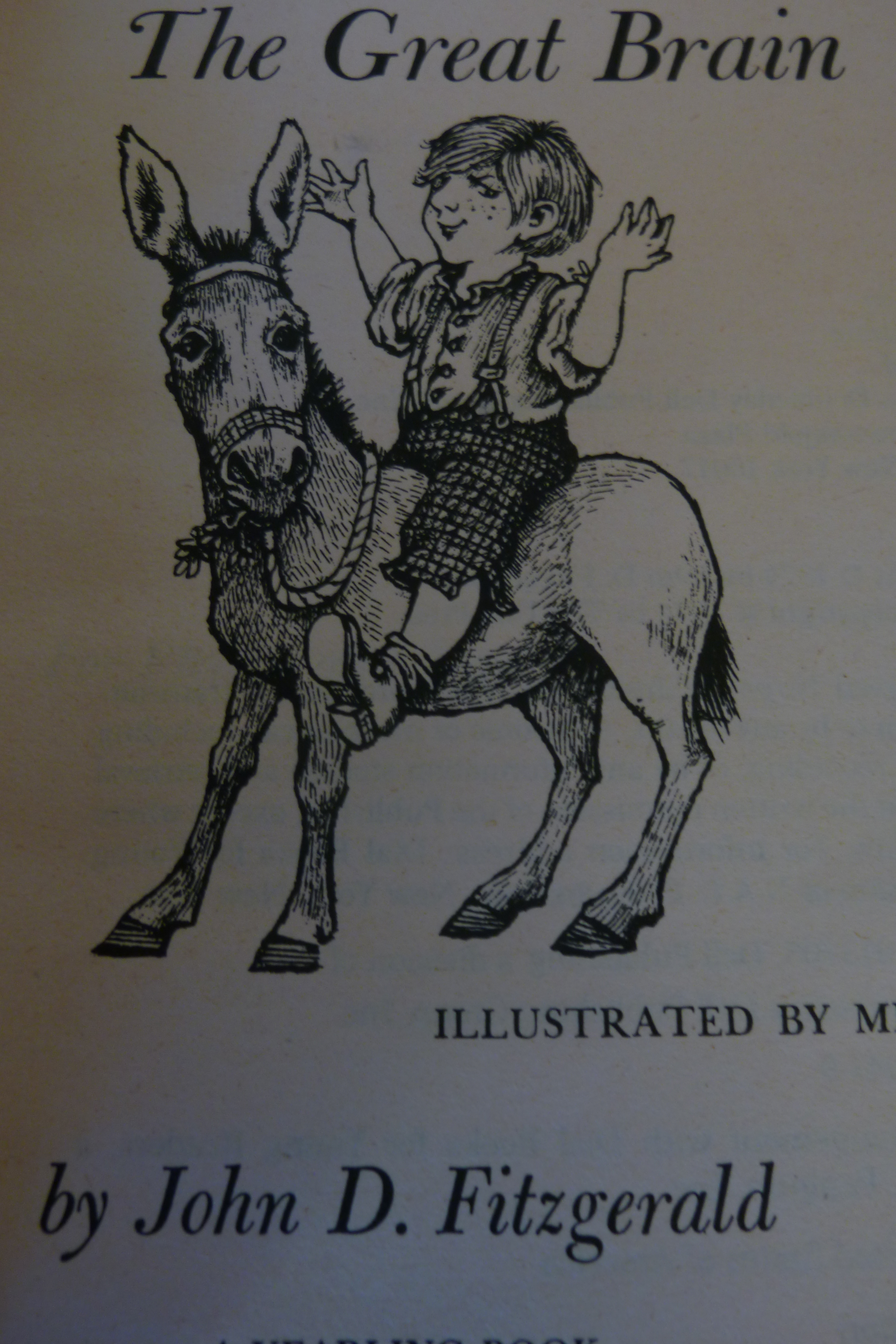
On the subject of funny kids books about boys, another favorite besides Gordon Korman is The Great Brain series by John D. Fitzgerald.  Based loosely on Fitzgerald’s childhood, the books are set in a small town in Utah in the 1890s.  The Great Brain of the title is John’s older brother Tom, who has a brilliant intellect and a “money-loving heart.”

There are seven books in the series, each a string of vignettes.  John narrates in first-person about the adventures of his brother Tom, who always has a scheme going to swindle someone–including John, who never seems to learn that it’s impossible to win a wager against Tom.

Tom is very clever, and it’s always fun to see what scheme he’ll come up with next.  I’ve never been a big reader of mysteries but I like figuring things out, and guessing at what plot Tom is devising, or how he’ll solve some problem, always makes for good puzzles.  Tom is a great character in that he never becomes TOO unlikable.  He’s immensely proud of his Great Brain, and he loves to get money out of people.  He doesn’t cheat, though–he finds ways to trick them, usually exploiting their own gullibility or greed.  He also uses his Great Brain to help people, sometimes saving lives or dramatically changing lives for the better.  He usually gets something for it too…but that’s always the question, of whether he’s acting from compassion or from greed!  Usually I get the sense it’s a little of both.  He’s also not above being humbled at times when greed or pride leads him into a serious mistake.

John is a good character, sweet-natured and modest.  He often refers to his “little brain” in comparison to his brother’s Great Brain.  John is rather eclipsed by Tom, but that aspect of the books seems to work–it’s John’s story about his brother, so it makes sense that he’s giving Tom the center stage.  John’s obvious admiration and love for his brother (no matter how many times Tom swindles him!) also goes a long way to setting Tom up as a likable character.

The stories are mostly light and funny.  They’re not the hilarity of Gordon Korman, but they are very entertaining.  There are some serious ones mixed in too.  Sometimes the situations kids get into have real peril, as when two boys get lost in a network of caves, or when one boy loses his leg to an infection and contemplates killing himself.  The Great Brain series is another example of how deep children’s books can be, addressing very serious issues and subject matter, while being child-appropriate.

And fun, of course.  Even though the stories are sometimes serious and Tom is out to swindle others to satisfy his money-loving heart, these still come across as sweet stories about family, set in a small town in a quieter time.  Well-worth the read.

Other reviews:
The Five Borough Book Review
Books 4 Your Kids
There must be more…tell me about yours?

Chaos and Disorder at Summer Camp

I’m a big believer in re-reading books, and I don’t think there’s any book I’ve read more times than I Want To Go Home by Gordon Korman.  My guess is I’ve read it fifteen times–I lost count at twelve.  Most of those times were also before the age of twelve, but I’ve reread it in recent years too, and even after all those times, it still makes me laugh.

I’ve reviewed some of Korman’s other books, about the deep metaphor of a garbage bag and a hilarious series about a boys school.  This one is another of his best.  This is a story about a summer camp for boys, held on Algonkian Island.  The story centers on Rudy Miller, who hates camp.  He’s a loner, perpetually bored, and has no interest in participating in the many sports played at camp.  His only interest is escaping–which, when you’re on an island, requires considerable planning.  Rudy does become friends with Mike Webster, a comparatively normal boy who doesn’t enjoy camp either.  Rudy has a dry wit, and is creative and intelligent–mostly using those skills to think up wild schemes for escape, dragging Mike along with him.

As per his usual setup, Korman surrounds a relatively normal lead (meaning Mike, not Rudy) with crazy characters.  To name just a few, there’s Mr. Warden, the bow-legged camp director who firmly believes that all boys love camp and never quite registers that Rudy may be a problem.  There’s Chip, the counsellor for Rudy and Mike’s cabin; he’s constantly driven up the wall by Rudy, and has a tendency to fall into the lake.  There’s Harold Greene, Rudy’s nemesis and a twit (Rudy’s dubbing).

Rudy and Mike wind up in a whole series of adventures, involving stolen boats, a pillow fight that destroys a cabin, the startling discovery that Rudy is brilliant at any and all sports, and a good dozen escape attempts.  Before the summer is over, Rudy comes very close to destroying Algonkian Island.

It’s a great book.  Simple, short, and the target age group is probably about ten years old.  But it’s very, very fun even if you’re much older than that.  If you want a quick read that will make you laugh, give it a go.  I have–fifteen times.

Author’s Site: http://gordonkorman.com/

Other reviews:
Lucky Book Deals
Amie Kaufman
SirTheory’s Treatise on Life

Yours?  And by the way–just a brief scan of reviews suggests I’m not the only one who has read this one again and again!