Picturing the Twelve Dancing Princesses

Have you ever stumbled on something and wondered why you didn’t know about it twenty years ago?  That’s how I feel about Kinuko Craft.  She did the cover for Wildwood Dancing, and since seeing that, a friend and I have both become a little obsessed with her art.  And apparently she’s been doing covers and illustrations for years!  How did I not discover this sooner?

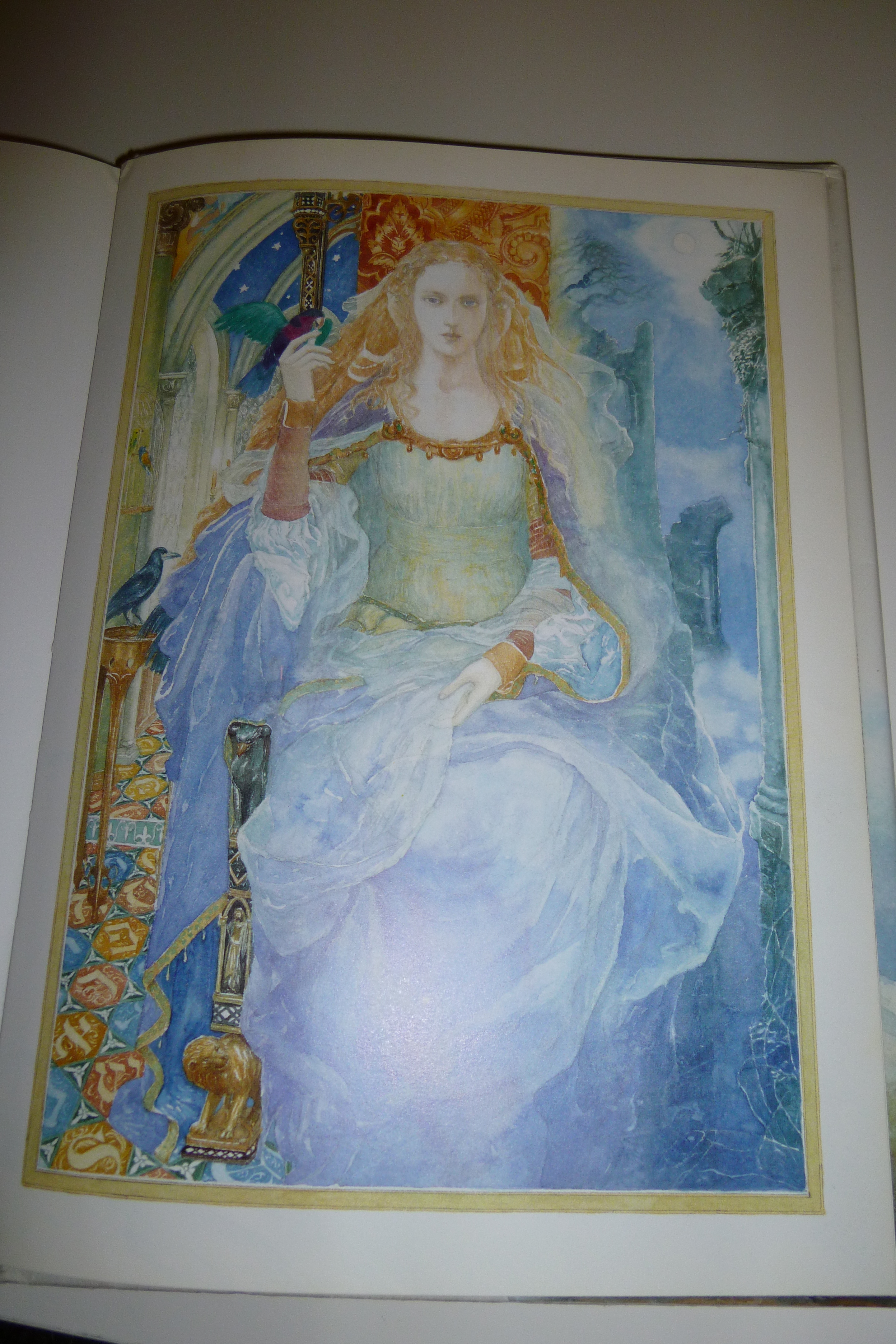
Most recently, I tracked down a beautiful picture book, The Twelve Dancing Princesses by Marianna Meyer and illustrated by Kinuko Craft.  I’ve talked about the dancing princesses a lot in various other retellings, and this one doesn’t offer a lot that’s new in the story itself.  A slight twist on a few elements, but mostly a straight-forward retelling.  But the pictures are lovely.  Apparently this is just my week for talking about illustrations!

Almost every alternate page is a full-page illustration, with illustrated sidebars on the text pages.  The detail and intricacy of the art is wonderful.  Some pictures are relatively simple, such as a man working in a field (although even that has an entire sweeping landscape behind him).  Others are a swirl of faces and dresses, showing all twelve princesses.  One dark picture shows the mysterious castle on the far side of the magic lake; another is riot of color in a flower garden.

The hero is drawn a little cherubic for my taste, but the princesses and their dresses are beautiful.  I think my two favorite pictures are when the hero is approaching the castle, showing the stretch of mountains and water before him, and a picture showing dozens of couples dancing in a vast hall lit by chandeliers.

But why take my word on what they look like?  Better to just put up a few pictures!


Illustrator’s Site: http://www.kycraft.com/
To Sleep, Perchance to Dream

There’s an old legend that Merlin never died–that he’s imprisoned beneath a stone somewhere on the moor, sleeping through the centuries.  And while he sleeps, what might he dream?

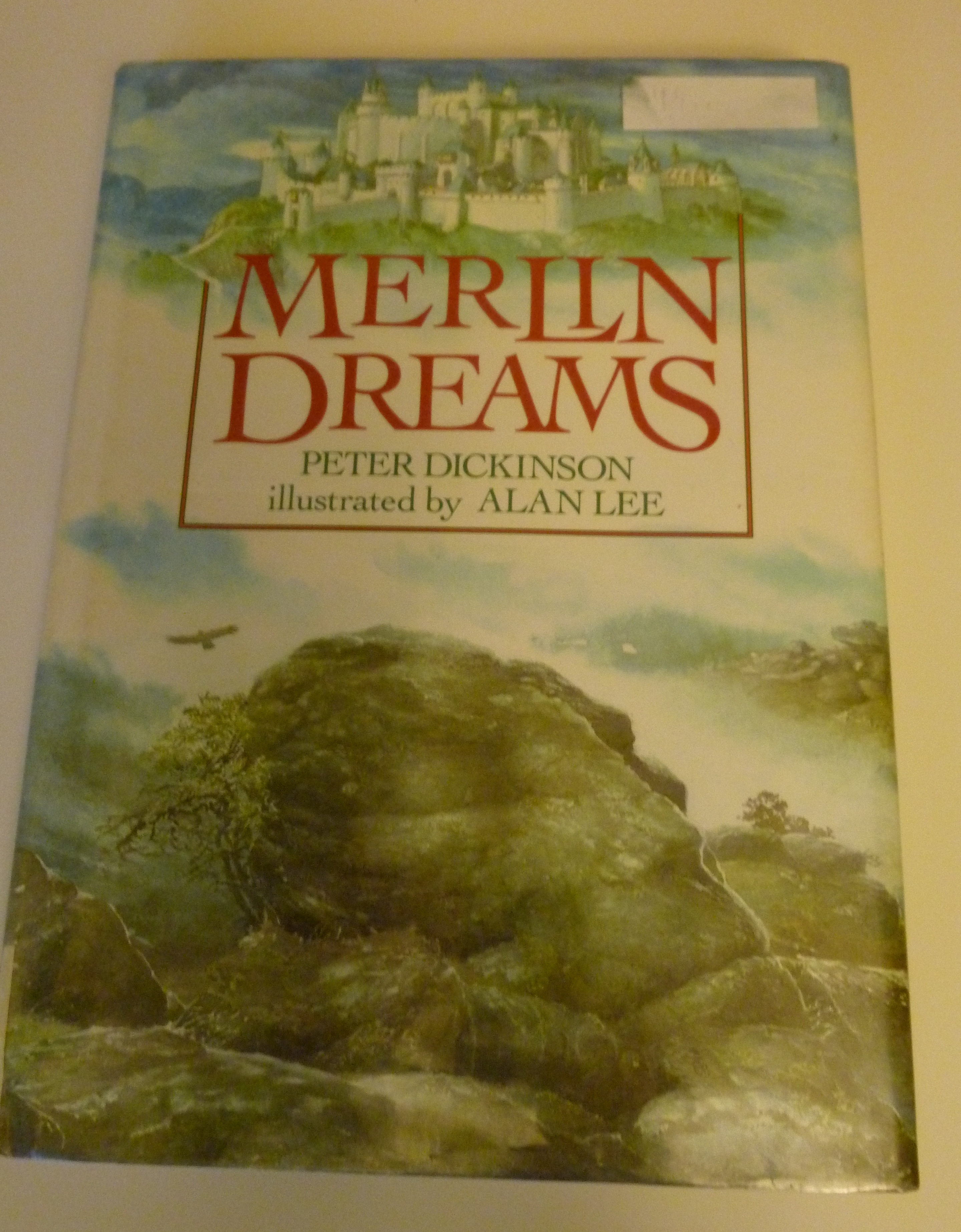
This is the frame-story for Peter Dickinson’s wonderful book, Merlin Dreams.  He tells eight stories, eight dreams of Merlin beneath his stone.  Between each story Merlin half-wakes, remembers his life or senses what goes on above him, then drifts back into sleep…and has another dream.

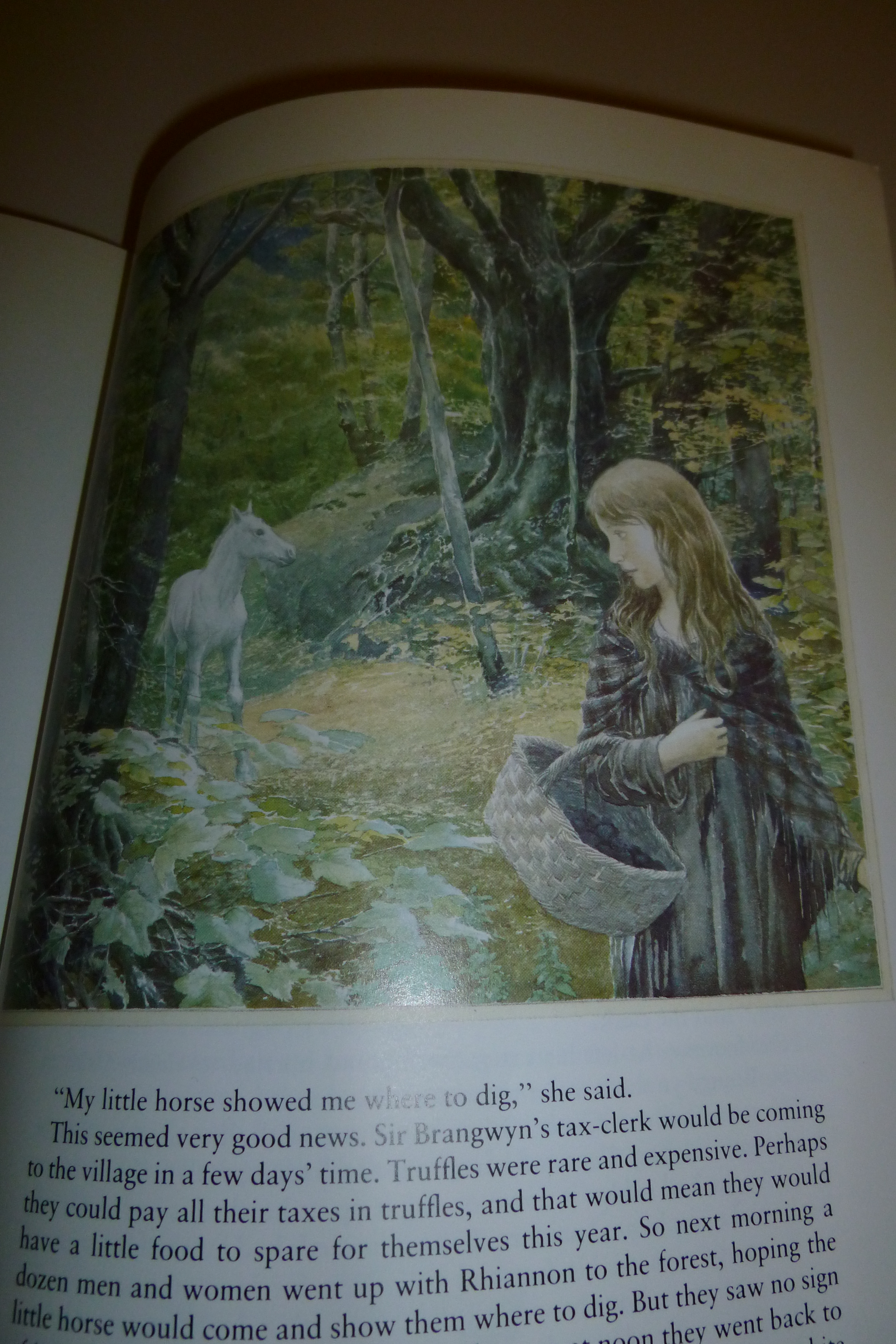
I’m fascinated by the frame story, and the short stories are excellent too.  Several have a vaguely Arthurian flare, although I don’t think any retell an actual legend.  But there are dashing (and not so dashing) knights, brave damsels and many unexpected heroes.  There’s a king, fallen from honor and strength who needs a little girl to show him the way back.  Another little girl befriends a unicorn in the woods, only to be threatened by men who want to exploit the opportunity to hunt a unicorn.  Two stories feature tricksters who put on shows for country folk they hold in contempt, only to be undone by their own tricks.  There’s a young prince who fights a dragon, and another, particularly ugly young man, who fights a sorceress.  And woven throughout, Merlin remembers his own life, and strange fragments of other scenes and stories.

There’s a wonderful magical, mystical quality to the stories.  Often all is not as it seems, and the magic holds plenty of surprises.  Even though I don’t think these are traditional stories, many have that enchanting feel to them.

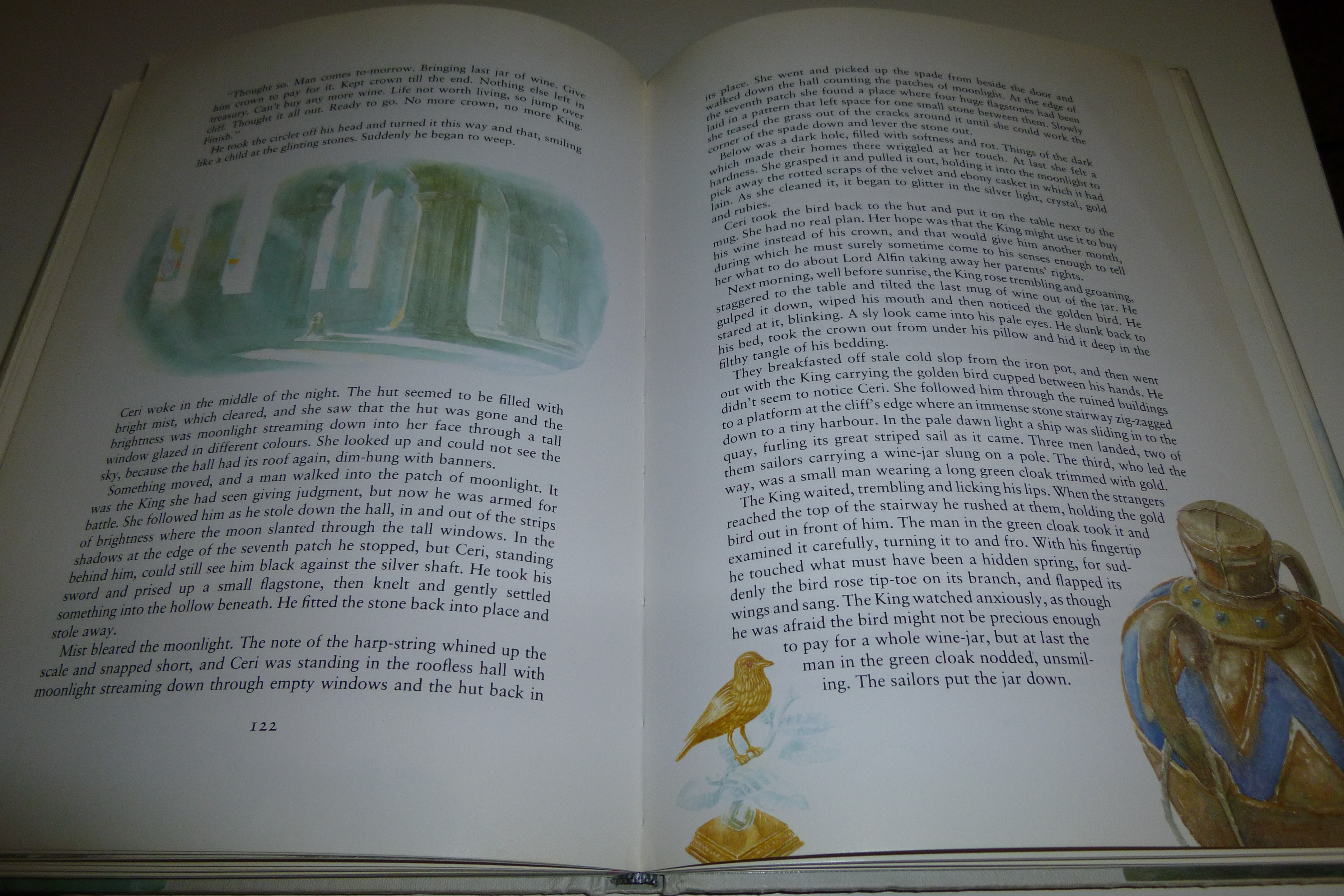
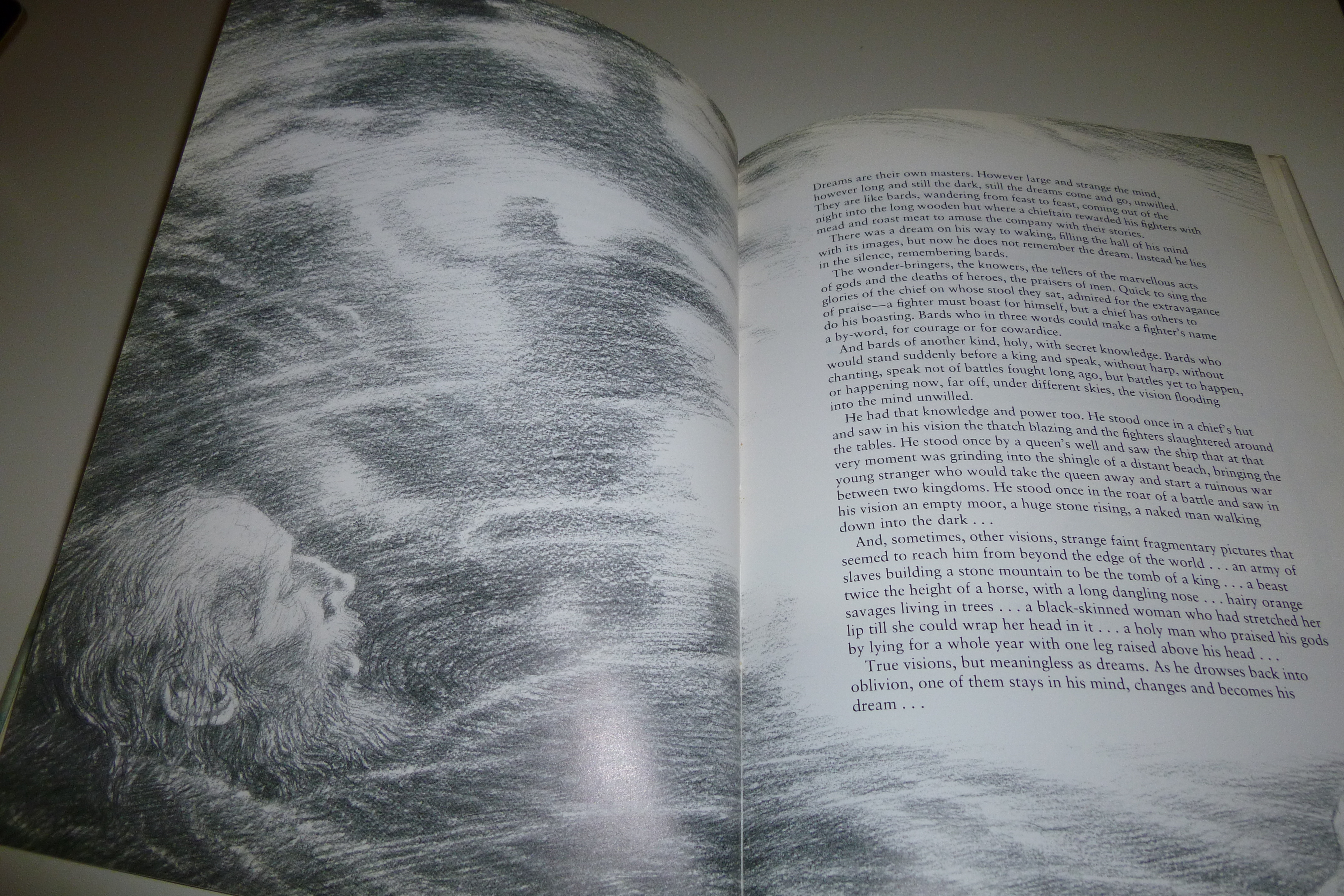
Part of it’s very much the writing.  Part of it is the illustrations too.  I honestly don’t know if there are multiple versions of this book, but if there are, make sure you get a copy with Alan Lee’s illustrations.  There are many throughout the book, some dark and shadowed, some vivid and bright.  They bring the stories to life in a new way, and many are just beautiful.

This is generally put in the kids section, and I think the short stories are definitely good for kids.  A word of warning that some of Merlin’s reflections are pretty dark.  And as beautiful as most of Alan Lee’s illustrations are, some could be disturbing for a smaller child.

There’s no Table of Contents to the book, which can be a little inconvenient at times.  But I think it fits too.  After all, it’s not just a neat line of stories.  It’s a series of dreams, and if you could line them up and list them out and easily jump to one or another, I think that would lose some of the flowing, magical quality of the book.

I can’t resist a few more pictures!  You can click on them to see them larger.


Author’s Site: http://www.peterdickinson.com/

Sleeping Beauty’s Sister, Questing Through Fairy Tales

I decided to give E. D. Baker another chance.  She wrote the highly disappointing Frog Princess–but I was so intrigued by the premise of The Wide-Awake Princess, I decided to try it anyway.

The story is about Sleeping Beauty’s younger sister, Annie.  She’s immune to magic (in fact, she nullifies it around her), so when the entire castle falls asleep, she stays awake.  She goes in search of princes to kiss her sister, picking up a handsome guard for a traveling companion.

To give Baker due credit, she’s really good at ideas.  I mean, the princess kisses the frog and turns into a frog–that’s brilliant.  The chancy part is what she does with the ideas.  Fortunately, this book was packed with clever ideas, and the follow-through was an improvement on The Frog Princess.

While out looking for princes, Annie encounters elements from half a dozen other fairy tales–Hansel and Gretel, Snow White and Rose Red, Rapunzel, the Princess and the Pea, even the Frog Prince.  They’re all a little bit tweaked, mostly in clever ways, and the fast flow of them all keeps the book interesting.

My main reservation towards the book was a lack of depth.  The major characters had some development but were not very complex, and they didn’t seem to feel anything very deeply.  As an example–all the royals, including Annie’s family, are magically enhanced from christening gifts.  Since Annie nullifies magic, they all become less beautiful, less graceful and so on while around her (again–brilliant idea).  As a result, Annie is forbidden to touch her family, and they never hug or kiss her.  In Susan Kay’s Phantom, the Phantom has the exact same problem, that his mother refuses to kiss him.  For him, it’s a deeply scarring situation, causing him real pain as a child, and on into adulthood.  Annie, on the other hand, seems to be a little wistful on the subject.  (Really–her mother never touches her–that should be painful!)

To some extent it’s apples and oranges–Phantom is high drama, this is a children’s comedy.  But characters in comedies can still feel things.  And children’s books can have depth–the end of The House at Pooh Corner has real pathos, and Abel’s Island is about a character’s existential crisis.

Then there was the treatment of life-threatening situations.  Characters choose to plunge into danger without much motivation.  And while in dangerous situations, Annie is never afraid.  She’s uncomfortable, irritated, occasionally worried, but not afraid.  It got to the point where I was rooting for her to get scared some time, just to prove that she’s human.  I love feisty heroines, but even Alanna (a lady knight dubbed the Lioness) gets scared sometimes.  I don’t care how light your story is meant to be, your characters still have to be believable according to human nature.

But the ideas were really good.  The plot was fine.  Annie, despite not having much depth, is a fun character, and her love interest is a good guy.

In the end, it’s a fun story.  Just don’t expect it to be more than that.

Author’s site: http://www.edbakerbooks.com/

Under the Sea

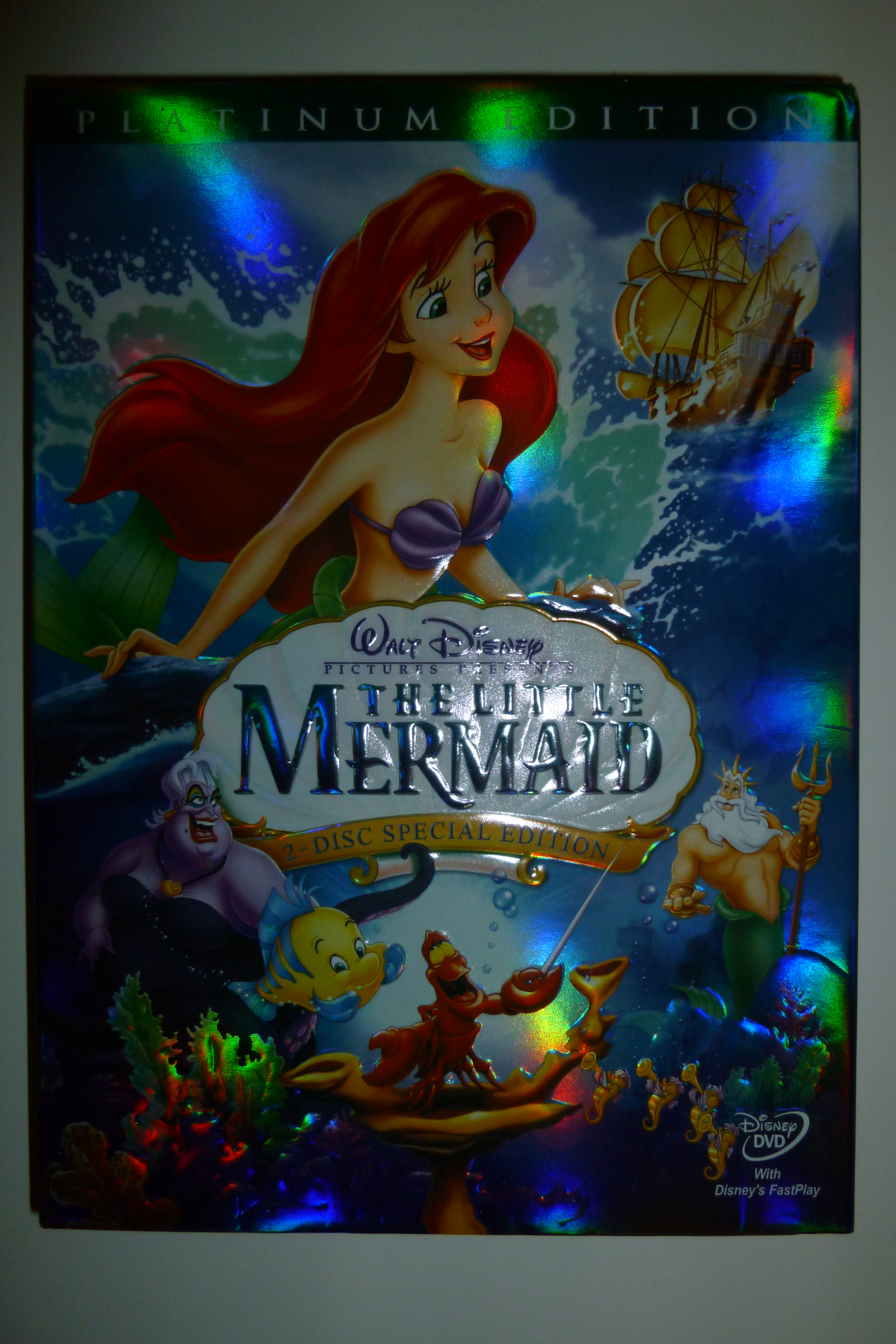
As you may have noticed, I’ve been revisiting some favorite kids’ movies lately–most recently, I went under the sea for The Little Mermaid.  Definitely one of Disney’s best!

The plot is straight-forward enough: Ariel, a mermaid princess, sells her voice to Ursula, the Sea Witch, in exchange for legs so that she can try to win the human prince she’s fallen in love with.

There could be a horrid problem here where Prince Eric clearly is only interested in her face (since she can’t talk to him!) but I actually think the movie did a pretty good job developing their relationship–you know, as much as you can in very brief time, and without any mutual dialogue.  Still, I felt like it worked.

However, I discovered that for my adult self, Ariel and Eric are of limited significance.  I like Ariel’s independent thinking, and Eric is a slightly more impressive Disney prince than most that came before him.  But…the movie’s really all about Sebastian.  The irritable, anxious, well-meaning though crusty crab sidekick totally stole the show for me.  He’s a composer too!  Did you ever notice that Sebastian gets two major songs (both nominated for Academy Awards), while Ariel only has one (plus a reprise)?  Not to mention–Sebastian’s just really funny.  Flounder and Scuttle were great too–how is that the animal sidekicks quite often end up being the best parts of animated movies?

Chef Louis is also wonderful, and clearly made a big impression on me as a kid, considering I was surprised by how little he’s actually in the movie when I watched it again.  And as a kid, I didn’t even know that he’s voiced by the same actor who played Odo in Star Trek: Deep Space 9.  My dad saw Rene Auberjonois at a Star Trek convention once, and he sang “Les Poissons” for the audience.

Aside from Sebastian and company, there were a couple of things that struck me here.  The first is one I’m sure my child-self would have understood.  I was fascinated by Ariel’s hair.  It was the way it floated when she was underwater.  All flowy and floaty and…yeah, having a girly moment, obviously.

The second thing that struck me was a very grown-up observation.  It’s nice and all that the prince got married, but at the end of the movie, the big news in the kingdom shouldn’t be the wedding, or even that she’s a former mermaid.  You know what the real news is?  Good grief, fish are intelligent!

The discovery that fish are on an intelligence-level with humans would have major ramifications.  I mean, what does this do to the fishing industry?  (Sidenote: if you look at the scene with Chef Louis from Sebastian’s point of view, and with the premise that fish are intelligent, it becomes something out of a heavy-duty slasher film.  Body parts everywhere!)  Considering Eric’s kingdom is on the coast, he could have a major economic slump on his hands if they have to give up fishing.  Though on the other hand, they have an entirely new trading partner in Triton’s kingdom, so maybe it would work out.  Plus you could expect all the marine sciences to develop at an astronomical rate.

You know I love picking fairy tales apart…but I love this movie too.  Good romantic leads, Ursula’s a fantastic villain (the tentacles–how cool are the tentacles?), great music, and of course…a funny and irritated crab!

An Outrageous Tale from Roald Dahl

The books transported her into new worlds and introduced her to amazing people who lived exciting lives.  She went on olden-day sailing ships with Joseph Conrad.  She went to Africa with Ernest Hemingway and to India with Rudyard Kipling.  She traveled all over the world while sitting in her little room in an English village.

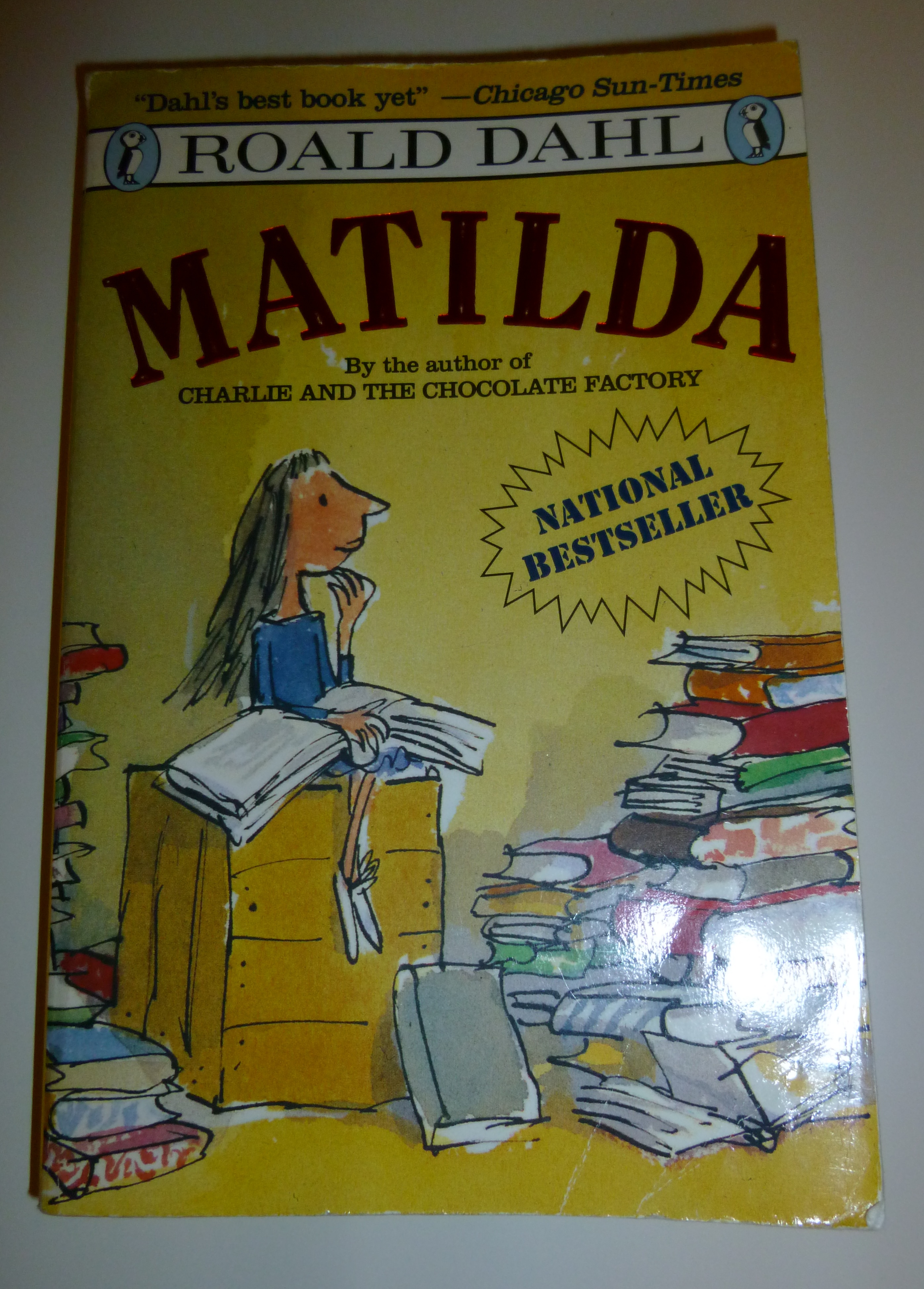
And while sitting in an apartment in California, I traveled to an English village with Roald Dahl.  The quote above is from Matilda, Dahl’s wonderful story of a very brilliant little girl.  Matilda loves books, teaching herself to read at the age of three, despite her horrid, neglectful parents who care only about television.  Matilda first shows her spirit through pranks on her parents (retaliation for their treatment of her) but really comes into her own when she goes to school.  Matilda discovers the extent of her own powers as she faces down the terrifying headmistress Miss Trunchbull, to defend her beloved teacher, Miss Honey.

Matilda must be one of those books everyone’s read, right?  If not, get thee to a library!  🙂  It’s a delightful book with Dahl’s full ability to spin out a fun and wild tale.  Everything is taken to an extreme: Matilda reads Dickens at the age of four, and Miss Trunchbull swings little girls around by their pig tails.  But that’s the comic fun of it.  Matilda’s incredible abilities make her entertaining, while her sweetness and unawareness of her brilliance make her a lovable character.  And if Miss Trunchbull was an inch more realistic, this would be a terrible book.

The handling of Miss Trunchbull, and to a lesser extent Matilda’s parents, was particularly interesting to me last time I re-read Matilda.  Maybe it’s because I just read another book about a neglectful and abusive parent–but that one was a serious treatment of the subject, and very much a drama.  Matilda is, of course, a children’s comedy.

Matilda’s parents are portrayed as being dreadful and nasty, but they don’t cause any real harm.  They don’t starve Matilda–they just make her eat TV dinners all the time.  Matilda’s mother leaves her home alone while she’s out playing bingo, when Matilda is only four.  Instead of getting hurt or kidnapped, Matilda cheerfully trundles off to the library.

At school, Miss Trunchbull never hits any children–she just picks them up by their ears, or forces them to eat monster-size chocolate cakes.  She does shut children into a cabinet, but we never see that, we only hear about it.  There’s a discussion at one point on how Miss Trunchbull can get away with everything.  Matilda explains it, “Your story would sound too ridiculous to be believed.  And that is the Trunchbull’s great secret…Never do anything by halves if you want to get away with it.  Be outrageous.  Go the whole hog.  Make sure everything you do is so crazy it’s completely unbelievable.”

I think that’s Dahl’s great secret too.  You can write about dreadful things–this is, really, a story about child abuse–but be outrageous and it becomes funny instead of disturbing.  It couldn’t really happen, it has no grounding in reality, and so it’s not upsetting.  The only time Miss Trunchbull’s actions approach reality is in her treatment of Miss Honey–and that’s what finally comes back to get her.

Whatever Dahl’s secret is, it works, and he’s given us a fun and funny story with entertaining and memorable characters.