A Servant’s Magic

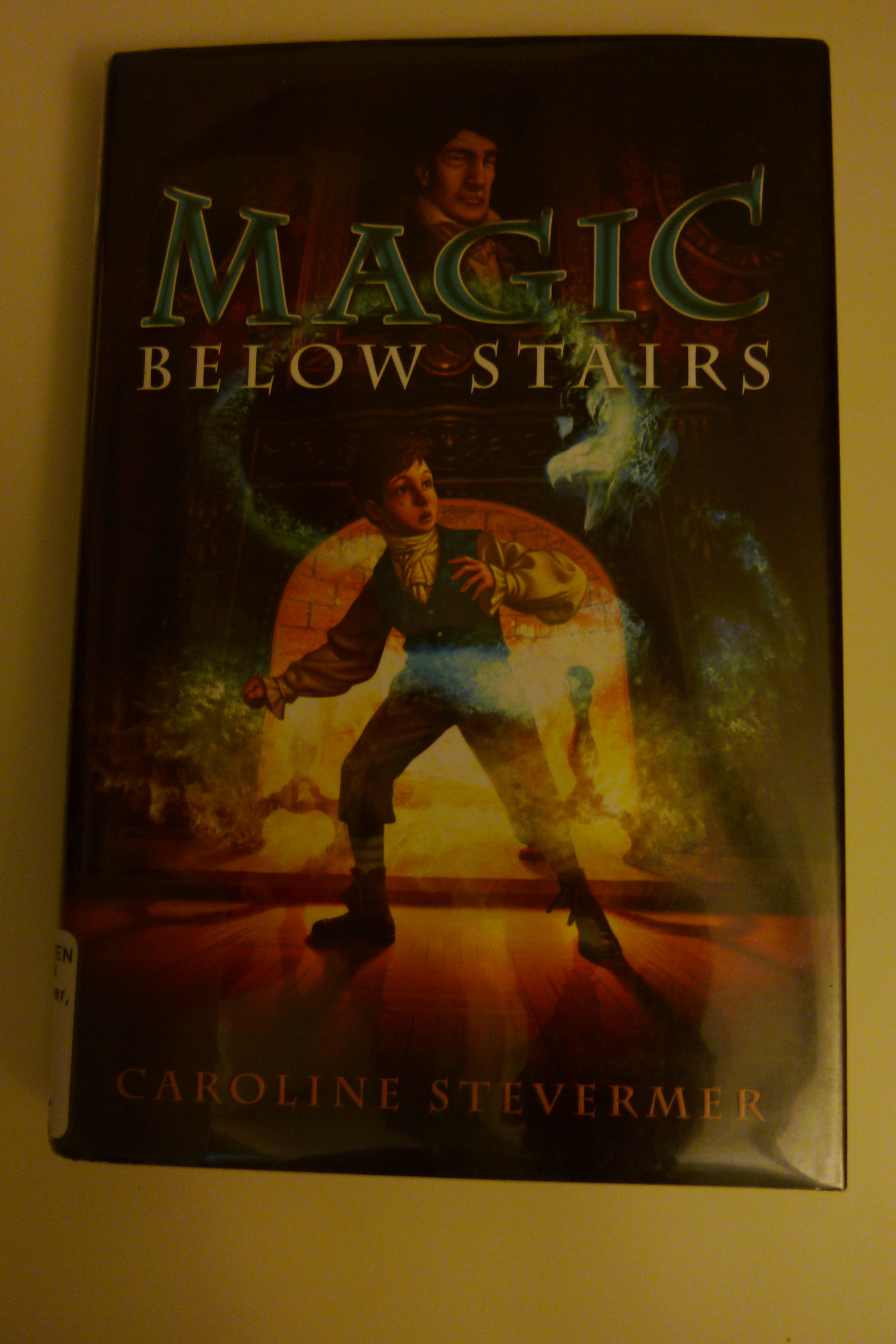
I love the Sorcery and Cecilia series by Patricia C. Wrede and Caroline Stevermer, so I was excited to stumble across a companion book recently.  Magic Below Stairs by Caroline Stevermer revisits the world of the series from a new point of view.  You don’t need to have read the rest of the series to enjoy this one, though I think it would add more meaning to some parts.

The series is about two women, Kate and Cecilia, who marry a couple of magicians, Thomas and James (respectively!)  They’re aristocracy of some sort; Magic Below Stairs comes from the other side of the social strata, and focuses on Frederick.  He notices strange happenings at the orphanage where he lives, and discovers that their cause is Billie Bly, a house brownie.  Billie Bly has attached himself to Frederick, and when Frederick is chosen to join Kate and Thomas’ household as a new servant, Billy Bly comes too–which Thomas does not appreciate at all.  Meanwhile, there’s also a nasty curse lying in wait.

This actually felt oddly like a Diana Wynne Jones book.  You have the earnest young boy, the absent-minded magician, and a looming threat.  And it’s all set in a grand English manor.

Stevermer’s website tells me this is set in Victorian Britain.  I’m not good at all at keeping straight different eras of British history (unless you give me an actual event to measure by–the Battle of Trafalgar, say, or the life of Shakespeare), so I just knew this was set somewhere back in the past when manor houses had entire staffs of servants hard at work below stairs.  Part of the fun of this book is seeing the world from that perspective.  This is especially true because this isn’t a book about the oppressed lower classes, which you do see sometimes.  The servants here actually seem a fairly contented lot who are fond of Thomas and Kate.

Saying that this reminded me of Diana Wynne Jones is a high compliment, of course.  🙂  This is a fairly short book without a huge amount of depth, but it’s a fun read with good characters and some nice humor at times.  And if you try it and enjoy it, you should definitely go on to the longer and more complicated Sorcery and Cecilia books!

Author’s Site: http://members.authorsguild.net/carolinestev/

The Secret Lives of Characters

The Great Good Thing by Roderick Townley has one of the best premises I’ve ever encountered.  Princess Sylvie lives inside a book (also called The Great Good Thing).  She and her family and friends act out their story whenever a Reader opens the book.  When the book is closed, they go on about their lives behind the scenes.  Everything begins to change for them when Sylvie breaks the rules to help a special Reader and her family.

I love this concept.  I love reading about what it’s like to be a character in a book.  I love when Sylvie rests her head on a large adjective, or goes swimming in the pool on page 36, or hides in the Acknowledgements page.  I think anyone who has ever felt a connection to a character in a book will enjoy the idea of a magic world between the book covers, where the characters live lives in and around the text we read.

The actual plot…is pretty good.  This is one of those books that leaves me thinking about how I’d take that premise and do something very different…but it is very enjoyable for all that.  I do like where it went–it’s just that with a premise like that, there are so many wonderful places to go!

One thing I’d do differently, and which I think is not just my preferences but an actual lapse in the book, relates to romance.  As it stands, there is none; that’s just not what the book is about.  But we catch glimpses of Sylvie’s story (the book within the book–let’s call it the Story for clarity).  There’s enough to tell us that at the end of the Story (and this really isn’t a spoiler), Sylvie rescues the Keeper of the Cave, who turns into a prince.  The Story being what it is, a kind of fairy tale, the natural order would be for Sylvie to get together with the prince–at least, in the Story.  But we don’t see that at all in the book we’re actually reading.  All the other characters hang out together while the book is closed, like actors who are off-stage, but we don’t see the prince (or even the Keeper of the Cave) at all.  One of Sylvie’s motivators is lack of a close companion, so I can see how a romance wouldn’t fit–but rather like showing a gun that never goes off, why have a prince at all if you’re not having a romance?

I recently found out there are two more books in this series, which I plan to read now, so maybe one of them will head in a romantic direction.  And even if they don’t, it’s still a fun story with interesting characters, and a good message about the power of a story and the importance of preserving it–and, of course, a fascinating premise!

Author’s Site: http://www.rodericktownley.com/

The Power of a Library

First, a question unrelated to this book review: I’m taking a trip to Washington D.C. next month, and usually when I go on vacation I like to read a book set in the place I’m visiting.  So I was wondering–any suggestions for books taking place in Washington D. C.?  Preferably something I can find at my library…

Which leads me to today’s book review!  It may be that I have a soft spot for Jerry Spinelli’s The Library Card because I’m so fond of libraries myself.  The book is a set of four long short stories (not quite novellas, so what do you call them?)  They’re only connected thematically, and by the presence of a mysterious blue card.  Each owner of the card sees it somehow as The Library Card, and in different ways it ends up changing their lives.

Mongoose and Weasel (not their real names) are on their way to being juvenile delinquents when Mongoose finds the library card.  It brings him to the library, which opens a whole new world of information to him.  This story is especially good because of the character development.  What’s happening to Mongoose is positive, but it’s also pulling him away from Weasel.  We see some of that from Weasel’s point of view, and can feel his pain at losing his friend.  I actually end up feeling sympathy for the kid who’s really trying to lead his friend down a bad path (though not malevolently).

Sonseray is another character who prompts unexpected sympathy.  On the surface of it, he’s a complete screw-up, apt to pick fights and get into trouble.  But the reader also gets to see how much he misses his mother, who died.  The library card leads him to a book that helps him connect with her memory.

I felt less sympathy for Nanette.  The library card helps her become friends with April, but I couldn’t feel the basis of their friendship the way I could with Weasel and Mongoose.  Weasel wasn’t deliberately a jerk, but I couldn’t really see Nanette’s redeeming qualities.  This story was all right, but my least favorite.

My favorite story was Brenda’s.  She’s so obsessed with television that she has a deep emotional crisis when her parents make her turn off the TV for a week.  This one is funny, and makes a very good point.  The library card helps her realize that she has been so busy living the lives of her TV characters, she’s stopped living her own life.

The stories are sweet, funny, sometimes sad.  And they all have a good message about the power of a book to change a life.

Author’s Site: http://www.jerryspinelli.com/

Stranded with a Talking Mouse

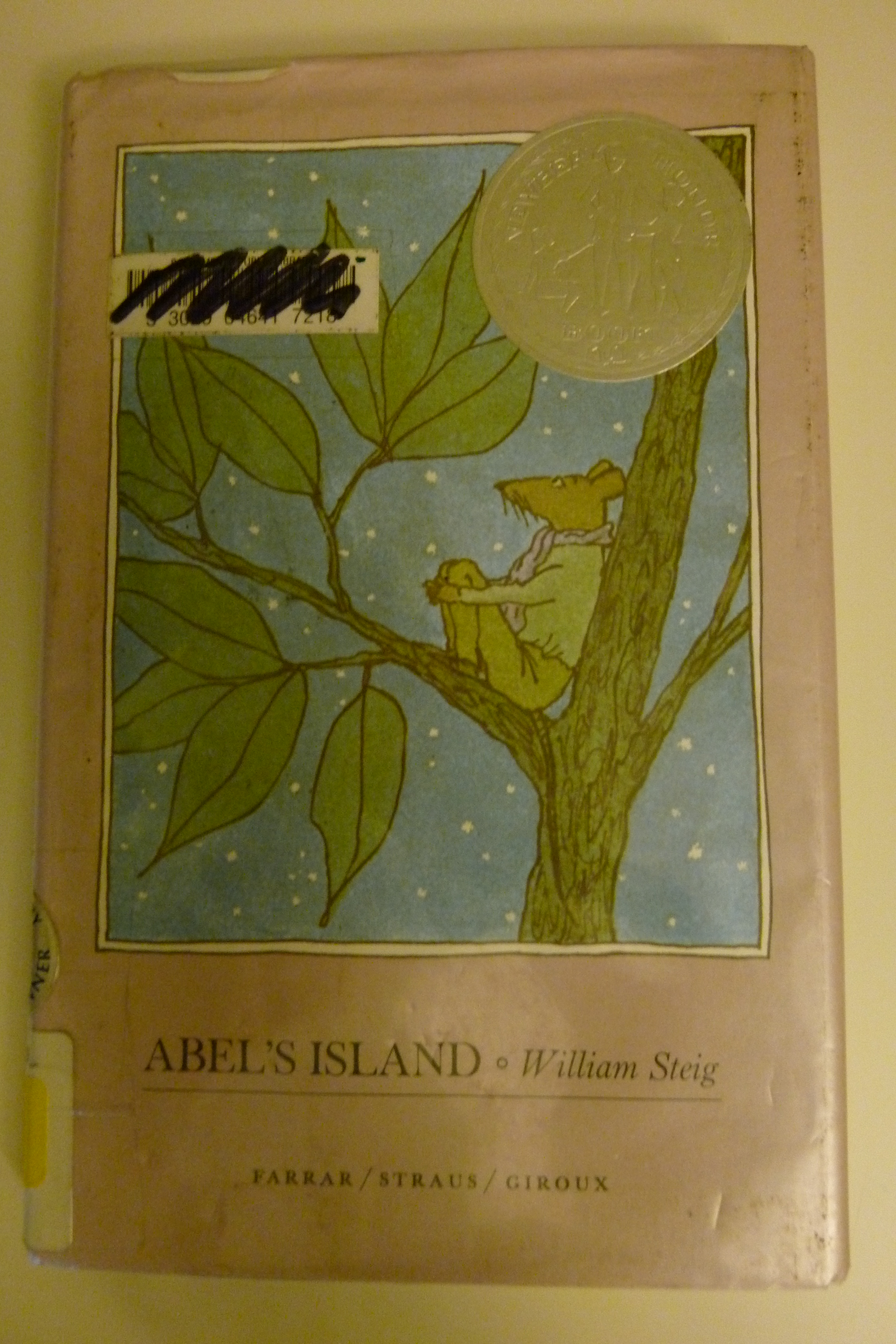
It’s funny the books that stay with you.  I remember around about third grade (maybe, I don’t remember that part for sure) we had to do a certain number of book reports during the school year, maybe per month.  I don’t remember if I found that challenging, but I doubt it.  🙂  I also don’t remember any of the books I did for this, except one: Abel’s Island by William Steig.  For whatever reason, that one stuck.

Although I don’t think it was until I reread it last week that I made the connection–William Steig!  The one who did a bunch of picture books!  You know, Doctor De Soto and Sylvester and the Magic Pebble (and he also has the happy good fortune of being alphabetically near James Stevenson, my favorite picture book author).  Yet another advantage of revisiting childhood favorites.

By all means check out the picture books, but for now, back to Abel’s Island.  Abel is a mouse, who lives in a fairly modern society with other mice.  They have clothes and towns and jobs–although Abel doesn’t have a job himself, because his mother has money.  Abel and his wife Amanda go out for a picnic in the woods one day.  When a storm comes up, Abel is literally blown away.  He’s carried down a stream and ends up on a small island in the middle of the river.  And there he stays, unable to signal help or to build a craft which will survive the river’s current and carry him to the opposite shore.

Abel has to figure out how to survive on the island, taking care of his physical needs and, even more so, struggling to deal with his intellectual and social needs.  I suppose it’s a bit of a Robinson Crusoe story, but a lot shorter and more interesting!

I’m trying to remember what I liked best about the book when I was a kid, and it may have been the survival aspect.  Now, it’s Abel’s internal growth.  His time on the island strips away all the clutter and the defenses that society normally gives us, and forces him to really look at himself in raw honesty.  He realizes how pointless his life has been, struggles with how he’s been living, and ultimately comes to a new realization about his calling.

Pretty deep stuff for a kids book, right?  😉  It’s handled fairly lightly, but the themes really are deep and universal.  Yet another example that makes me want to throw things when people say, “oh well, I didn’t expect much depth from it–it’s a kids book.”  A talking mouse can have an existential crisis too, and do it in a way that will make it a perfectly appropriate book for a third-grader.

I won’t swear that Abel’s Island is really vastly better than all those other books I read that I can’t remember anymore.  But it’s definitely a good one, and one worth remembering.

The Quintessential Diana Wynne Jones Book

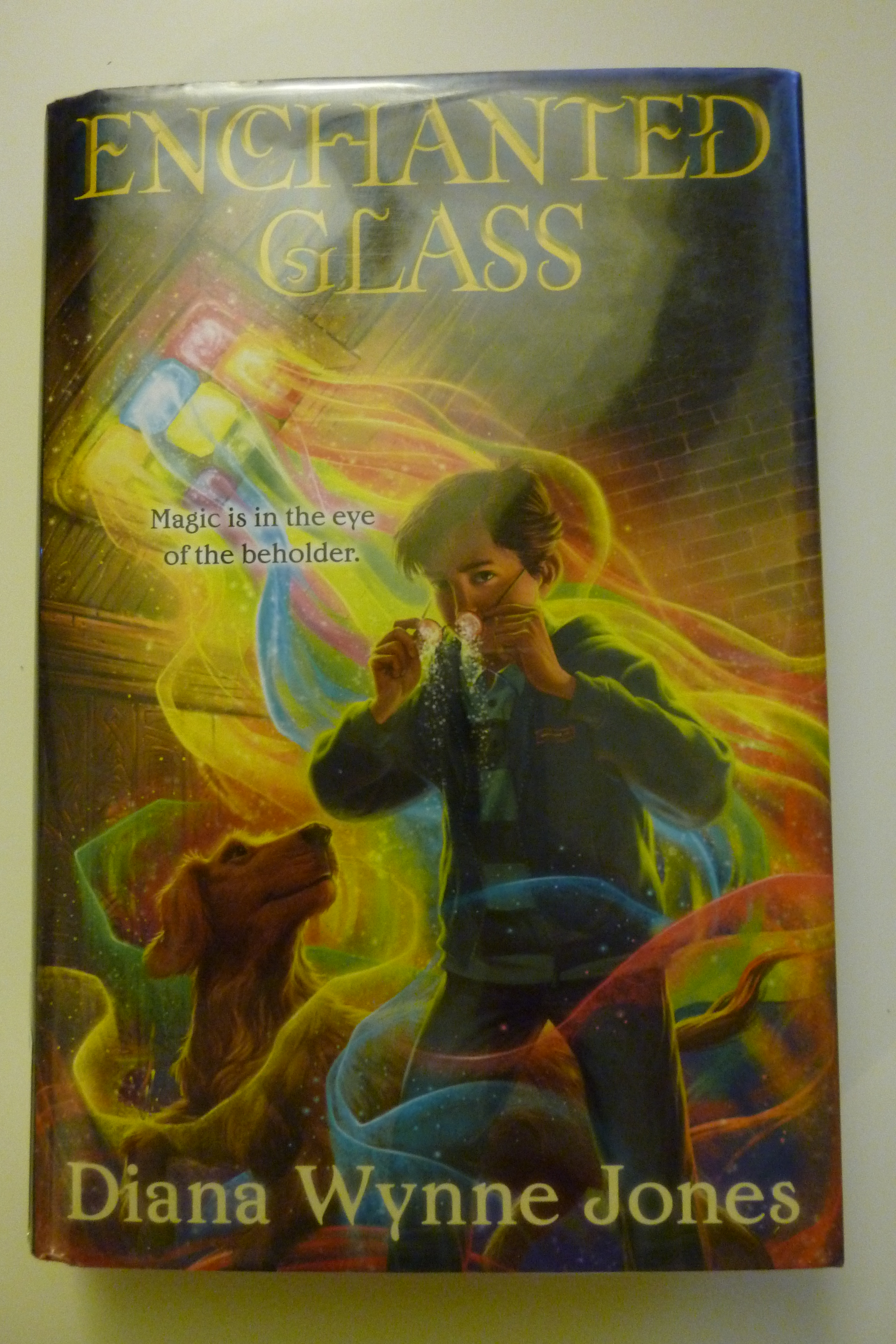
I loved reading Enchanted Glass by Diana Wynne Jones.  It was a delightful book, especially in its Diana Wynne Jones-ness.  I’ve been trying to think how to explain it.  It’s original, and new, and independent of her other books.  But so many elements I expect from her were here.

There was the earnest young boy, presently displaced, possessed of powerful magic.  There was a well-meaning though absent-minded man, also possessed of powerful magic, who holds a position of responsibility in the magical world.  There was a full cast of quirky supporting characters.  Many characters were somehow paired with others (I don’t mean romantically–in a more thematic sense).  There’s a mysterious magical threat, involving another world.  And it’s all set in an English village amidst rolling hills.

It’s like the quintessential Diana Wynne Jones book.  It all comes together to create a charming and, for fans, familiar atmosphere, while being a new book.  It makes it all rather poignant to know it was the last one published during her lifetime.

The story centers around Aidan, the earnest young boy, and Andrew, the well-meaning, absent-minded man.  Aidan is an orphan, fleeing from mysterious, magical Stalkers.  He ends up at Andrew’s big old house in the country, where Andrew is trying to figure out how to take over the magical reins from his recently-deceased grandfather.  They have adventures with magic, the Stalkers, a village fair, and an enemy neighbor with his own magic.  Also, there’s a giant, a werewolf, bizarrely large vegetables, and colored glass windows they’re sure have magic somehow.

The book is lovely–though not totally without flaws.  The point of view jumps haphazardly between Andrew and Aidan, which mixed me up occasionally.  It doesn’t help that their names have similar letters in them, making them run together sometimes so I lost track of who was thinking.

I also had a little trouble with the state of magic in this world.  Most of the characters seem to accept magic as perfectly natural–one character even mentions it when convincing Andrew to hire her as a secretary, and refers to it much the way she might refer to ability with typing.  However, I think most of the characters accept magic because they live in a particular place where magic is strong, as there are some hints that most of the rest of the world doesn’t believe in magic.  The complicated part is that Andrew has managed to forget most of what his grandfather taught him about magic.  When there’s a host of characters who think magic is ordinary, coupled with a main character who accepts magic but can’t remember much about it, I don’t know whether to view magic as ordinary or mysterious.

But both these problems, the magic and the point of view, seem to improve as the book goes on, and neither is serious enough at any point to spoil the book.  Definitely a high recommendation here.

Author’s site: http://www.dianawynnejones.com and http://www.leemac.freeserve.co.uk/