Today, a Warning

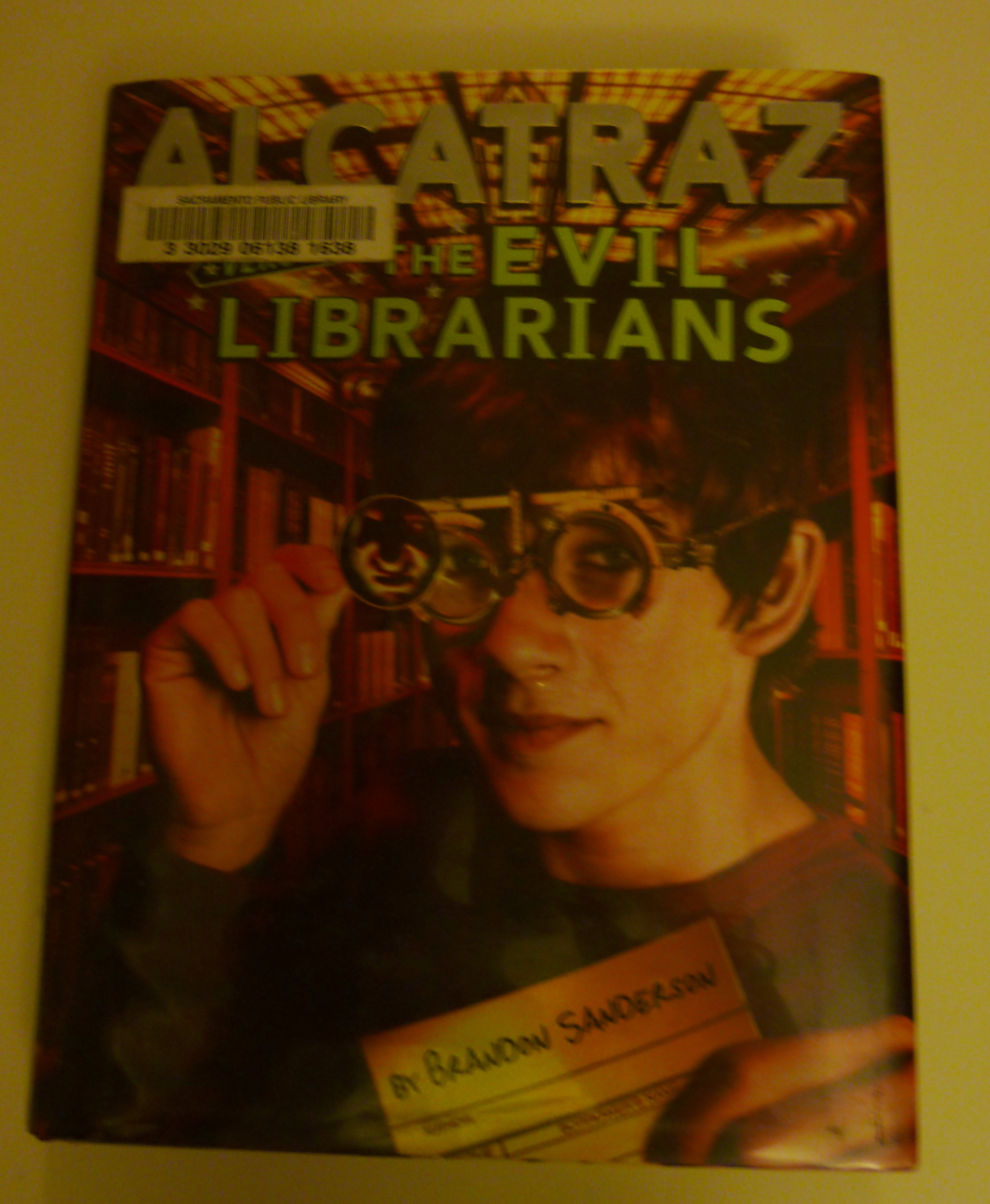
I suppose the title should have warned me.  One of my book club’s recent selections was Alcatraz vs. the Evil Librarians by Brandon Sanderson.  It was a departure from our usual genres.  I think we were all intrigued by the idea of evil librarians.

I for one was expecting it to be a group of really awesome evil librarians.  There are plenty of awesome villains out there, and a really cool group of sinister, book-wielding librarians sounds amazing.

Too bad that isn’t what this turned out to be.  First thing–Alcatraz is the lead character’s name, and the book has nothing to do with the island or the prison.  Second, and even more importantly–the evil librarians were a LONG way from awesome.  Nor were they an isolated group.  Instead, the premise of this book is that all the librarians of the world are engaged in a vast conspiracy to feed everyone misinformation.  And they’re painfully stereotypical librarians, with horned-rim glasses and buns, or bad bow ties for the men.

I cannot at all fathom why anyone would write a book insulting librarians.  I mean, they’re librarians! I may be particularly ill-suited for this premise, considering I have four friends who are librarians, and I can’t remember a time when I didn’t have an active library card.  But anyone likely to be reading this book probably likes books.  And if you like books, you probably like libraries and librarians–I mean, people who help you get free books, what’s not to love?

And what exactly is the message for kids here?  Librarians are evil and untrustworthy, libraries are dangerous, and almost any book you might pick up is both bad and foolish?  That’s the message that comes across.

Now, I do realize this book is not meant to be serious.  That comes across too.  But it never achieves quite that right tone of self-mocking to make it funny and not irritating.  It’s trying to give the reader a nice broad wink, and failing miserably.  I think it wants to be “Springtime for Hitler,” which is hilarious.  This book is not.

Not to mention, it’s just badly written.  Alcatraz is telling the story, and his goal is to prove that he isn’t actually a hero.  Rule #1 of writing is that the reader should like your lead character.  Or hate them, that works sometimes too.  If your reader is irritated and/or bored, your book is dead.  When your narrator states that his goal is to irritate the reader and he succeeds, there’s a problem.  Every chapter starts with a page or two of totally irrelevant introduction, in which Alcatraz interrupts the plot to ramble on about whether he’s a good person, whether the reader is irritated yet (answer: YES), tries to convince us everything going on is plausible and if we don’t believe it we’re just brain-washed morons, or points out the clever literary devices he’s using, for the purpose of being annoying.

Honestly, it’s like an example in how a book should not be written.

I haven’t even mentioned the plot, have I?  It’s not so bad, really.  Comparatively.  Alcatraz is an orphan with a talent for breaking things.  One day he meets his grandfather, who tells him he’s actually a member of a famous family who has special Talents, and Alcatraz begins to learn how he can use breaking things to his advantage.  His grandfather also tells him about the conspiracy of the Evil Librarians, and about an entire other society on a continent in the middle of the Pacific (knowledge of which the Evil Librarians have suppressed).  They set out on a mission to rescue a bag of really special sand that the Evil Librarians have stolen.

It’s not a terrible plot.  The Talents are entertaining, because they all sound like bad things (arriving late all the time) but turn out to be useful (the late person is constantly late for bullets, so he can’t be shot).  I like the idea of the secret continent.  I’ve often thought there was potential for a story in the idea that some basic fact is really false, but no one knows it, because how many things do we actually know from  first-hand experience?  How many of us have sailed across the Pacific?

It’s an okay plot in a terrible book.  And about that bag of sand.  The bag contains the Sands of Rashid.  You can definitely say “the sands of time” and I’ll accept “the Sands of Rashid” if necessary  But they keep on talking about the sands.  They have to rescue the sands and they have to get the sands back and the sands are really important.  “Sand” should not be plural!  It got to where I wanted to scream every time they said sands.

You know, I bet a librarian could have told Sanderson that you don’t make “sand” plural.

So why did I even finish this book?  Mostly because I knew that I’d be able to rant about it at Book Club and on my blog, and I figured I needed to finish it to be able to rant more effectively.

But you don’t need to.  Really.
Sympathy for the Devil

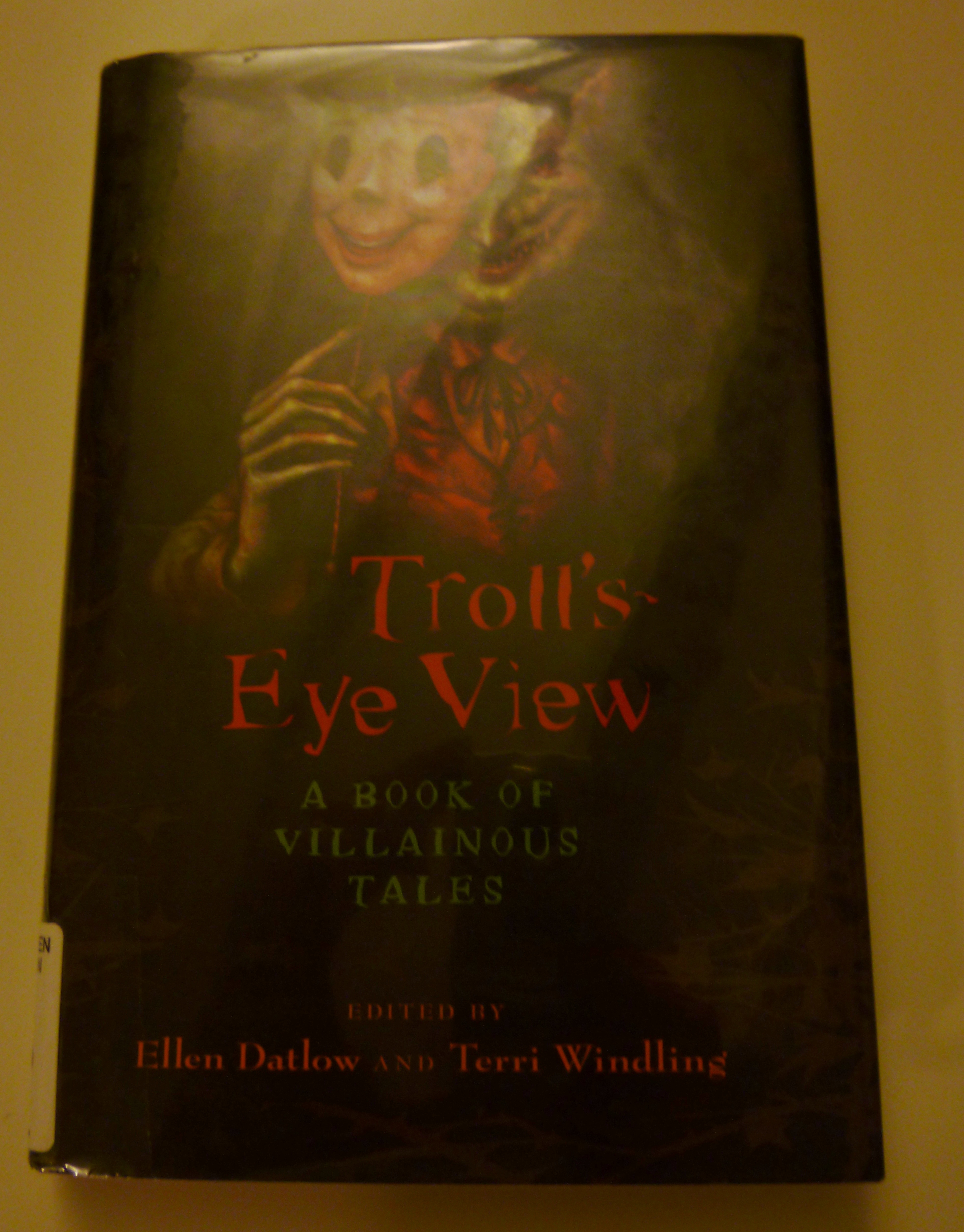
I found Troll’s Eye View in a very writerly fashion–I was doing research to see if anyone had come up with the same angle as I have for retelling “The Twelve Dancing Princesses.”  Subtitled “A Book of Villainous Tales,” it’s a collection of short stories, retelling fairy tales from the villain’s point of view.  That includes “The Twelve Dancing Princesses,” although calling the oldest princess the villain seems like a stretch (granted, she didn’t mind people being beheaded, in the original version).

The book is edited by Ellen Datlow and Terri Windling, and has some impressive writers included, like Garth Nix, Jane Yolen and Neil Gaiman.

There were some excellent stories in here, although I was dissatisfied with a number of them too.  I don’t know if you can tell from the picture, but it’s a slim book, and they fit fifteen stories into it.  I ended up feeling that several were nice ideas that didn’t get much development.  I think I’m the wrong age for those too.  I love children’s books, and very often find ones that are completely enjoyable to me as an adult.  Many of these stories, I think, really are better for just kids, who wouldn’t mind a simpler narrative.

And there were the excellent ones.  “Castle Othello” by Nancy Farmer is really clever meld of Bluebeard and Shakespeare, with a good twist to the ending.  Neil Gaiman contributed a dark poem based on “Sleeping Beauty.”  Nix and Yolen both had some good humor, although I think the shortness of the stories limited their scope.  Ellen Kushner’s “Twelve Dancing Princesses” retelling (actually, “The Shoes that Were Danced to Pieces” was how she titled it) was a clever idea, although another one with limited development–and not the same as my idea, fortunately.

My favorite, by far and away, was “A Delicate Architecture” by Catherynne M. Valente.  This would not have been the case when I was a kid, and in fact I think it probably would have given me nightmares!  But as an adult I can appreciate the creepiness of some of the images, and the beauty of the writing.  It starts out almost as a more poetic Charlie and the Chocolate Factory, with a little girl describing the wonderful creations of her father the candy-maker.  There’s beautiful, vivid imagery…until the story takes a darker turn, and then the images are just as vivid, but turn into nightmares.  (Spoiler warning, because I can’t resist telling you about it!)  The little girl becomes a young woman, until finally she learns that her father’s fanciful tale of creating her from sugar is all too true.  After that she’s treated not as a person, but as a cooking implement, and hung up on the wall of the kitchen at the royal palace, to be used for the desserts…and that’s the image that would have given me nightmares as a child!  Finally she becomes a gnarled old woman, who escapes into the woods to build a house out of candy…  It’s an excellent story, and makes me want to read more by Valente!

The book on the whole was more mixed.  But it was also a quick read, and worth it for the good ones!

An Urban Adventure from Tamora Pierce

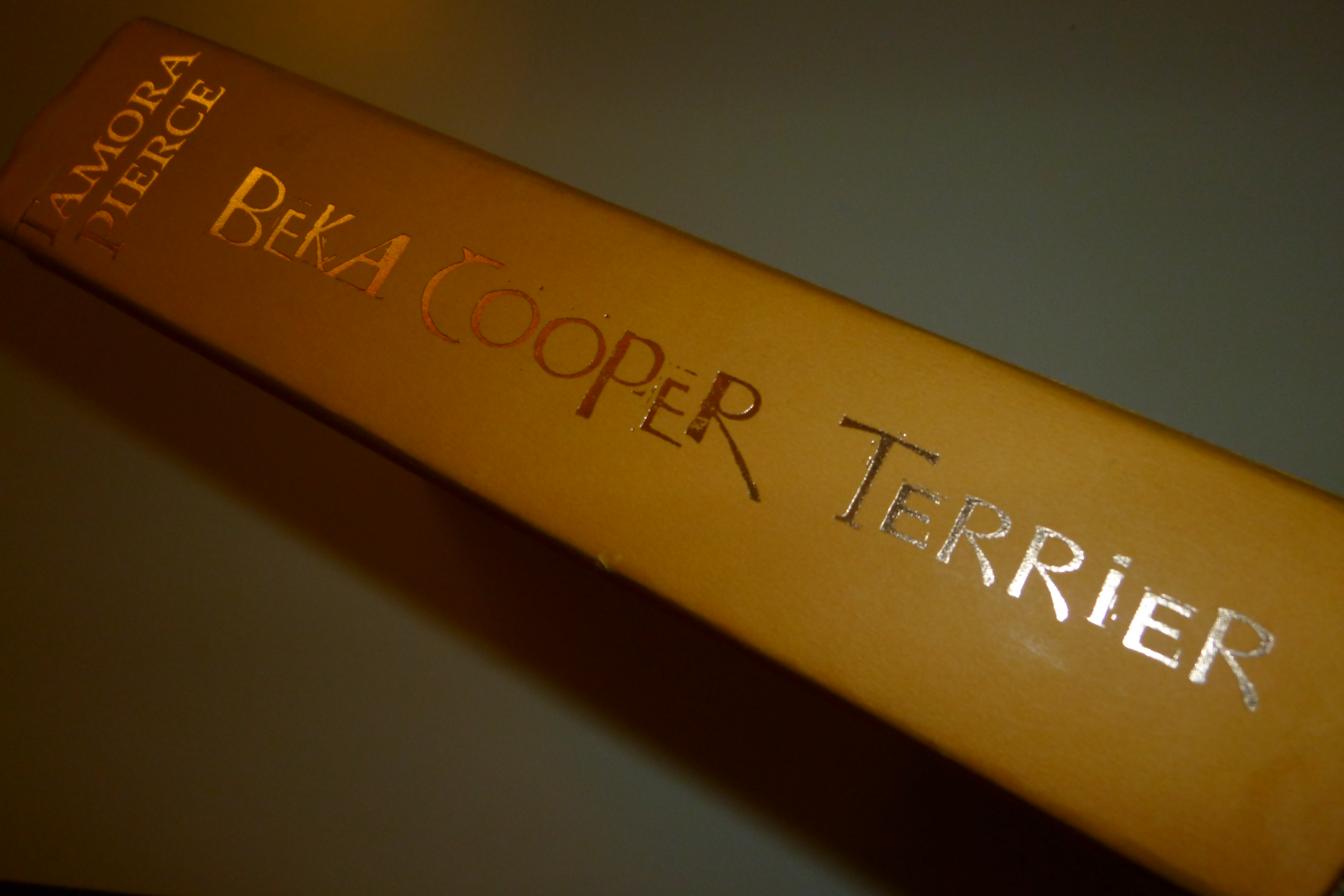
I recently reread Terrier by Tamora Pierce, in anticipation of the third book in her Beka Cooper series coming out (Terrier is the first).  As I generally expect from Tamora Pierce’s books 🙂 it’s an excellent story with a strong female lead and solid characters of both genders.

For those familiar with Pierce’s Tortall books, Terrier is set a few hundred years earlier than her usual time period.  George Cooper is a major character in Song of the Lioness and the Trickster books, and this series is about one of his ancestors.  George is the King of Thieves, but his ancestor was a…well, I suppose policewoman is the right word, though it sounds too modern.  She’s a member of the City Guard, who are a little rough around the edges but work to keep the peace in Corus, Tortall’s capital city.

Terrier is about Beka’s first six weeks or so as a City Guard, or a Dog as they’re known in the slang.  She starts out as a Puppy, assigned to two more experienced Dogs who mentor her.  Beka is from the poor Lower City, and that’s where she chooses to work too, among the people who are often forgotten.  She quickly latches on to two crimes to investigate–one involving a string of child-kidnappings and murders, another involving mysterious, magical rocks and mass-murderings of the men hired to mine them.

I love the plot of this.  Many of Pierce’s books cover a longer scope of time, and pick up more threads.  I love that too, but I also enjoy the focus of this one.  It’s essentially a weaving of two mysteries, while Beka learns the ropes of being a Dog, and grows in the process.  Some of the character growth, especially at the beginning, seemed a bit swift, but in some ways I did enjoy the compressed timeline that made things move faster.

There’s a good cast of supporting characters, from Beka’s mentor Dogs, Goodwin and Tunstall, to her friends, among the Dogs and among thieves at the Rogue’s court–the Rogue is a bit like a mob boss, who has a tacit understanding with the Dogs because he keeps order among the criminals (that’s also George’s job, a couple centuries later).  Even the villains are well-drawn characters.  And I must say, I loved Lady Sabine, another female knight.  This was long before Alanna, when girls were allowed to hold the job.

There’s also Pounce.  Pounce is Beka’s enigmatic black cat, who has purple eyes and sometimes talks.  You may remember how much I love Faithful, Alanna’s purple-eyed, talking black cat.  Definitely not a coincidence, and we get just a little more insight into Faithful/Pounce’s origins here.  Much as I love Faithful, though, I’m not sure Pounce gets developed to the same extent.  I enjoy him immensely, but I don’t think he has the same bond with Beka that he had with Alanna.

Beka, however, is another good heroine.  She has big dreams and goes after them, and she’s a strong female role model, as Pierce is so good at writing.  She’s grittier than some of Pierce’s heroines, with her Lower City background.  This is the most urban Tortall book I’ve read–I’m not sure there’s a plant in the whole novel.  Usually other books set in Corus are at the Royal Palace, and somehow I think there’s more open park around there.  Beka has magic, but a new kind–and a grittier one!  She can hear ghosts.  People left with unfinished business–often those murdered–will end up as ghosts, inhabiting pigeons.  Beka has learned to seek out these ghosts to get clues to crimes.  She also can hear voices captured by dust devils, which apparently hang out on certain corners.

I did have one problem with Beka’s character.  She’s supposed to be shy.  I’ve read this book twice now, and I just don’t quite believe the shyness.  I find it hard to accept that a girl who grew up in the rough Lower City, who wants to be a City Guard, and who can leap into a tavern brawl, baton swinging…can’t look a new acquaintance in the eye and answer a direct question.  Fear of public speaking, sure.  Fear of approaching strangers, inability to come up with quick replies to saucy comments, sure.  But Pierce takes it one too far, I think, and it just doesn’t ring true to me with the rest of her character.

But that’s one flaw in an otherwise very good book.

There’s far less shining lights and dramatic magic and epic swordfights in this book than in many of Pierce’s others.  This is more a pound-the-pavement, get into fist-fights kind of book.  In some ways it’s darker, although there have been monsters and murders in earlier series too.  And next to something like The Hunger Games, this is a cheerful book.  I like the realism of fighting to make a positive impact in a tough world, and the hopefulness that it really is possible to do that–and to make good friends, chase your dreams, and have some laughs along the way.

Author’s Site: http://tamorapierce.com/

Exploring the Origins of Dracula

What could be a better review for Halloween than the ancestor to so much horror fiction–Bram Stoker’s Dracula.  I’d been meaning to read Dracula for ages–it was one of those classics I thought I ought to know about.

I kept not getting to it for a couple of reasons.  Mostly, I thought it might be disturbing.  It is horror, after all, and being old doesn’t prove anything–Poe can be pretty disturbing.  Or, I thought it could be very literary and difficult to read.  Fortunately, both fears proved unfounded.

To address the second one first, Dracula isn’t a difficult read, though it is slow at times.  Some books transition into the current day just fine; with others, it’s immediately obvious that they were written in the 1800s.  It’s a stylistic thing, but it’s not difficult, just dry sometimes.

As to being disturbing, it really wasn’t.  But, to give you fair warning, I do most of my reading during the day.  I’m convinced that we have some kind of deep-seated primordial instinct that makes everything seem much creepier when it’s dark out.  I have two friends who read this at night–one said it was fine, the other said it was terrifying (and she’s usually good with horror) so take from that what you will.  For me, it certainly had some dark moments and images, but it didn’t particularly give me chills and thrills.  Honestly, nothing had the tickle-your-spine creepiness of Bela Lugosi descending the stairs and purring, “I am…Drrrracula.”

Speaking of Mr. Lugosi, he’s always been my image of Count Dracula.  So I was taken aback to find Dracula described as a white-haired old man with a drooping mustache and hairy palms.   I was actually fascinated by how consistently Dracula is described as ugly and repulsive.  And this is the origin of the culture’s vampire obsession?  (But then, I find the Phantom of the Opera a plausible romantic lead, and that’s equally strange if you only read Gaston Leroux.)

The leap from Bram Stoker to Stephenie Meyer is mind-boggling.  Dracula to Twilight is a long trip.  I couldn’t imagine how we got from Stoker’s ugly, foul-smelling demon spawn, all the way to Meyer’s breathtakingly gorgeous (and sparkly!) Edward Cullen.  I talked to a friend who’s more interested in vampire literature than I am, and she tells me that the bridge is Anne Rice.  Apparently she’s the one who made the vampires seductive.  Stoker’s Dracula is not in the least seductive–the female vampires are a bit, and the Count has a certain mesmerizing quality, but it’s much more hypnotic than attractive.  110 years has clearly made a big difference in the perception of vampires.

Speaking of the gulf between portrayals, there are few characters less like Hugh Jackman than Stoker’s Van Helsing.  The Hugh Jackman movie is a fun romp about a man fighting monsters, but the original character is a sweet old man.  He wields a stake when he needs to, but he’s much more an intellectual than a fighter.

To circle back to Stoker vs. Meyer, another interesting question is whether the vampires are damned.  In Stoker, there’s no doubt about it.  He doesn’t allude or hint.  He just flat-out says that God has forsaken any and all vampires–even if you didn’t want to become one.  You get bitten a few times, drink some vampire blood (even force-fed), and you’re condemned.  It bothers me from a narrative and especially a spiritual perspective  that people could lose their souls unwillingly.  I actually have to give a nod to Meyer here for making it more complicated–the after-life of vampires is no more certain than for anyone else, and the mere fact of being a vampire doesn’t mean someone is evil.

On the other hand, when it comes to strong female characters, I’m giving that one to Stoker.  He has a couple of major female characters.  Lucy is endlessly described as sweet and good and beautiful, and not much else.  Mina, however, has got it all over Bella.  She’s right in there with the men devising their plans for fighting Dracula, and I think she has as much nerve and brains as any of them.  She ends up constrained by her gender a few times, but the men clearly hold her in immense respect, and when they do occasionally try to push her out of something (for her own protection, of course) I get the sense that she thinks she’s equally capable–and that she’s right!  Not bad, for 1897.

“Not bad” is probably a fair estimate of the entire book.  I didn’t love it, but it was definitely interesting for its place in literary history.  Taken simply as itself, it had some good characters, a good premise, it was kind of slow and I’m not crazy about the writing style.  All in all though, it was pretty good–or not bad!

Out on the Moor with Mr. Holmes

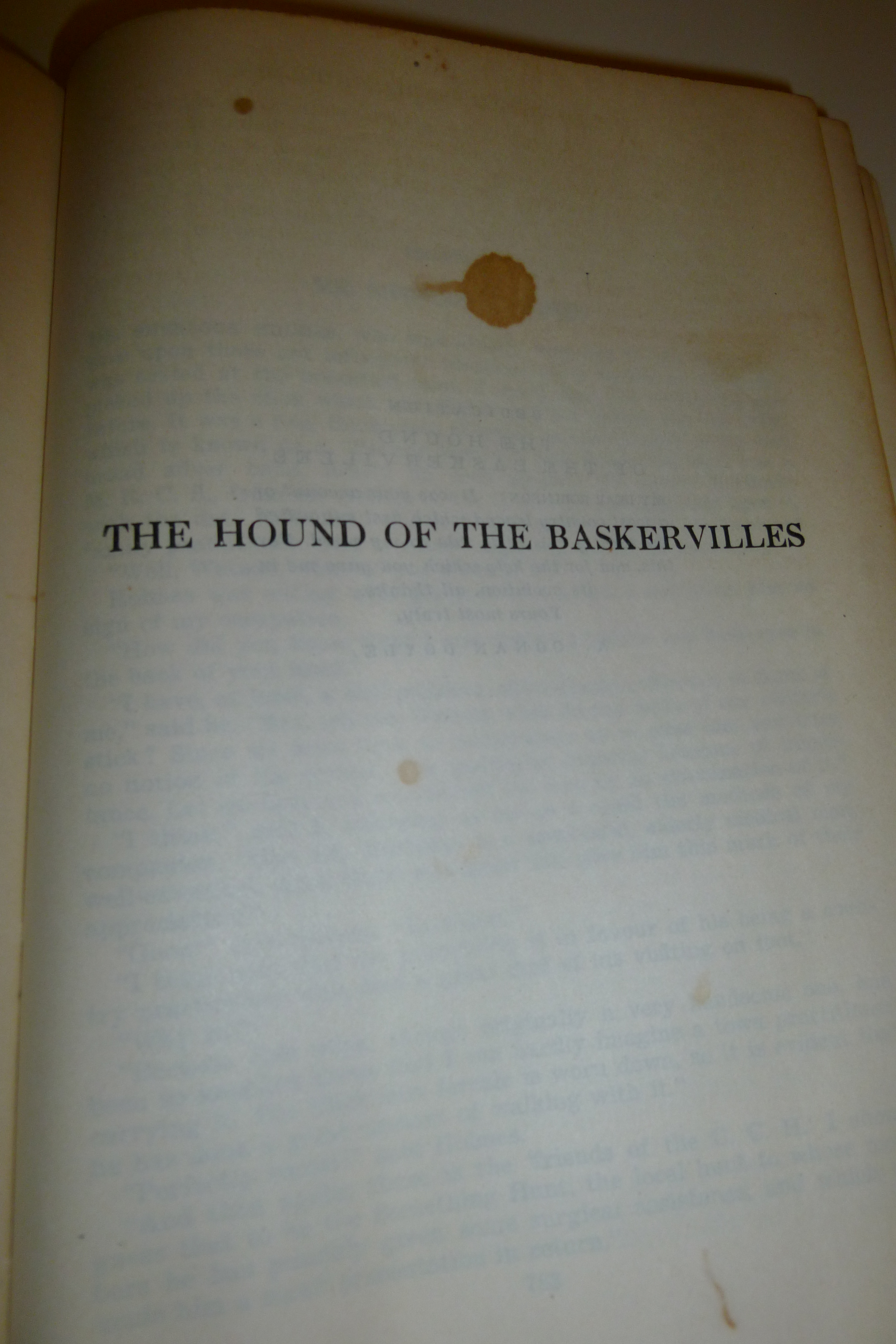
Don't you love battered, yellowed old books?

I’ve heard The Hound of the Baskervilles described as a horror novel.  I don’t think I’d go quite that far, but there definitely are some horror elements to it.

The Hound of the Baskervilles by Sir Arthur Conan Doyle is my favorite Sherlock Holmes novel, maybe my favorite of any of the stories.  Holmes and Watson leave their usual stomping grounds of London to venture out onto the moor.  This is the biggest horror-story element.  I loved the setting: the spooky, eerie, mist-covered moor, full of strange croppings of rock, treacherous bogs and mysterious noises.  I felt rather like I had followed Holmes into a Bronte novel.  There’s even a big, gloomy pile of an old manor house: Baskerville Hall plainly belongs in the same neighborhood with Wuthering Heights and Thornfield Hall.

Holmes and Watson are out on the moor investigating the recent death of Charles Baskerville, which seems to be tied in some way to the legend of a monster hound stalking the Baskervilles through the centuries.  Something is stalking Sir Henry Baskerville, Charles’ heir and the new lord of the Hall, and Holmes and Watson launch into an investigation.

Sir Henry is a poor substitute for Mr. Rochester, with a mostly place-holder role in the story, but it doesn’t much matter.  Holmes and Watson are always the significant characters, and there’s a fairly good cast of strange secondary characters surrounding them.

This felt the most like a horror novel when Watson and Sir Henry first arrive at Baskerville Hall (Holmes coming later) and explore the dark rooms.  It seems like just the sort of place to have Frankenstein’s monster on a slab in the basement.  The Hall even comes with an ancient butler and his wife, who have their own secrets.

Quite apart from the horror setting (and, of course, the possibility of a spectral hound), this is a good Sherlock Holmes mystery.  There are strange happenings, unsuccessful inquiries, and odd clues that all come together in the end.  I always love books that end up with all the random bits pulling together to explain everything.  Since Doyle follows a pattern of having Holmes lay it all out for Watson at the end, his stories are uniquely suited to managing this trick.

It causes an interesting problem for Doyle, I would imagine–Holmes always solves everything long before Doyle wants to reveal the answers to the reader.  He creates an extra layer between us and the answer by having Watson narrate, and Watson always stays as much in the dark as the rest of us.  The flaw there is that this means Holmes can’t tell Watson anything either, which sometimes seems a little forced.  Mostly Doyle justifies it by making Holmes, by temperament, an extremely laconic and uncommunicative man.  It stretches a bit, but I’ll take it.  I’ll suspend disbelief a touch for the sake of the story.

It is necessary for Holmes to play it close to the vest, because there wouldn’t be any tension otherwise–and Doyle is very good at tension.  I love the way he plays the story out bit by bit, drawing the reader along through the maze, heightening the danger as he goes.  There’s not actually that much action–it’s mostly people talking–but it’s somehow a very tense and exciting story.

My favorite moment in probably any Holmes story (and I’ve read a lot of them) is midway through Baskervilles.  I don’t want to ruin it for anyone–but Watson is out on the moor, and he’s anticipating a confrontation.  Nothing is happening.  He’s just waiting.  And yet Doyle keeps building the tension higher and higher, and then all of a sudden it snaps…and it’s brilliant.  It’s fairly predictable, but it’s still brilliant.

I love Sherlock Holmes stories, and Hound of the Baskervilles is an excellent one.  I don’t think it’s a horror novel, but it is perhaps a Gothic Sherlock Holmes story, and well-worth the read.