Mini-Monday: A Tale of Two Cities

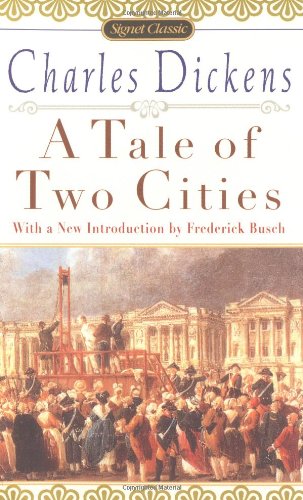
I am happy to report that I seem to have cracked the secret to a more satisfying relationship with Mr. Charles Dickens—audiobooks.  I’ve always wanted to like Mr. Dickens, the quintessential British author, but he’s always felt so slow.  I don’t exactly mean the pacing is slow, but somehow it has always taken me far longer to read one of his books than it seems like it should.  But due to a recent move my commute has expanded, and it seemed like the perfect time to make another attempt on Mr. Dickens.  And so far, a successful one!

At the time of writing this, I am almost done with A Tale of Two Cities, and feel confident enough to make a positive report.  I can still tell sometimes that Dickens was (or at least feels like he was) paid by the word—I knew “It was the best of times.  It was the worst of times” and heard it with a minor thrill, but no one ever told me he followed it with a dozen or so “it was this and it was that,” probably six more than needed!!  But an audiobook just keeps rolling along, and whatever was slowing me doesn’t seem to be in effect.

Two Cities does begin a bit slowly, but it picks up its speed, particularly once the French Revolution breaks, and becomes much more dramatic and exciting than I might have expected—but then, it is the French revolution.  This book really feels like a kind of melding of Charles Dickens and Victor Hugo, as so much reminds me of Les Miserables.  And there’s a scene of the mob sharpening their weapons to kill the prisoners that is stunningly vivid and terrifying.  I genuinely did not know Dickens had that in him!

I’m not quite to the famous last lines yet, and it adds some suspense to see if my guess on who says them is correct—so no spoilers, please!

So far, so good on the Dickens experiment.  It may be this book, but I hope it’s the audio, as I plan to try another one soon!

Mini-Monday: Interpreting God and Translating the Bible

Another new feature I thought I’d explore–since I haven’t had time for long-form reviews, how about some brief updates on recent reads?  I’m still doing spiritual reading, and read a couple interesting ones in the last few weeks.

The God We Never Knew by Marcus Borg – I actually wanted to read Meeting Jesus Again for the First Time, recommended by Nadia Bolz-Weber, but this was the Borg book my library had.  And it was interesting!  The fundamental premise, as I took it, was that there are two ways to think about God: as a supernatural being out there somewhere, or as a transcendent spirit who is all around us.  The first concept has dominated to large extent, while Borg makes a compelling case for both the spiritual power and the Biblical basis of the second.
I found Borg to have a lot of interesting ideas, though he could get academic at times in his language.  He was less revelatory and more validating for me, but I come from a Franciscan tradition within Catholicism, and I feel like I’d already been exposed to a lot of these ideas.  He’s right that they’re not always mainstream, though, and I appreciated an eloquent exploration of them that, as I said, was validating.

**********

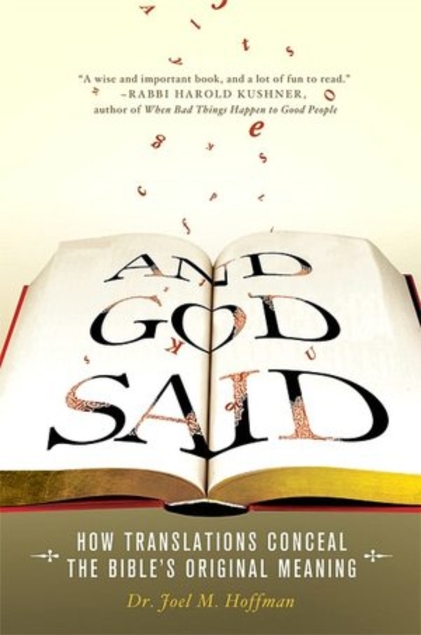
And God Said: How Translations Conceal the Bible’s Original Meaning by Dr. Joel M. Hoffman – I found this one on my library’s bookshelf and picked up on a whim, curious about that slightly provocative title.  Plus it was blurbed by Rabbi Harold Kushner.  Well, after reading, the good news seems to be that the title was an exaggeration.
Hoffman goes into extensive (sometimes too extensive) detail about how to achieve an accurate translation, with a lot of emphasis on looking at specific words as they’re used in context, and comparing multiple uses to build a full picture.  He spends the second half of the book looking at specific examples, most of which he says are dramatic mistranslations but…I don’t know, I didn’t think so!

I’ve always known (in the time I was thinking about Biblical interpretation, anyway), that the English Bible I’m reading is a translation of Ancient Hebrew or Greek, and (in the case of New Testament dialogue), the original writing was a translation of spoken Ancient Aramaic.  And it all contains cultural references of a people who lived a minimum of two-thousand years ago, in a different kind of society.  So yes, of course some nuances are going to be lost or unclear, and trying to uncover those original concepts is fascinating and enriches the interpretation.  But concluding that ancient Israelites thought shepherds were more heroic than we do today doesn’t really make “The Lord is my shepherd” a poor translation.

Most of his other points were similar, and some mattered a lot less.  So I walked away from it concluding that, based on the half-dozen examples from a scholar trying to find mistranslations, the Bible is actually translated pretty accurately!

******

Because I’m wordy, this was not all that mini after all…so I’ll call it done here! 🙂

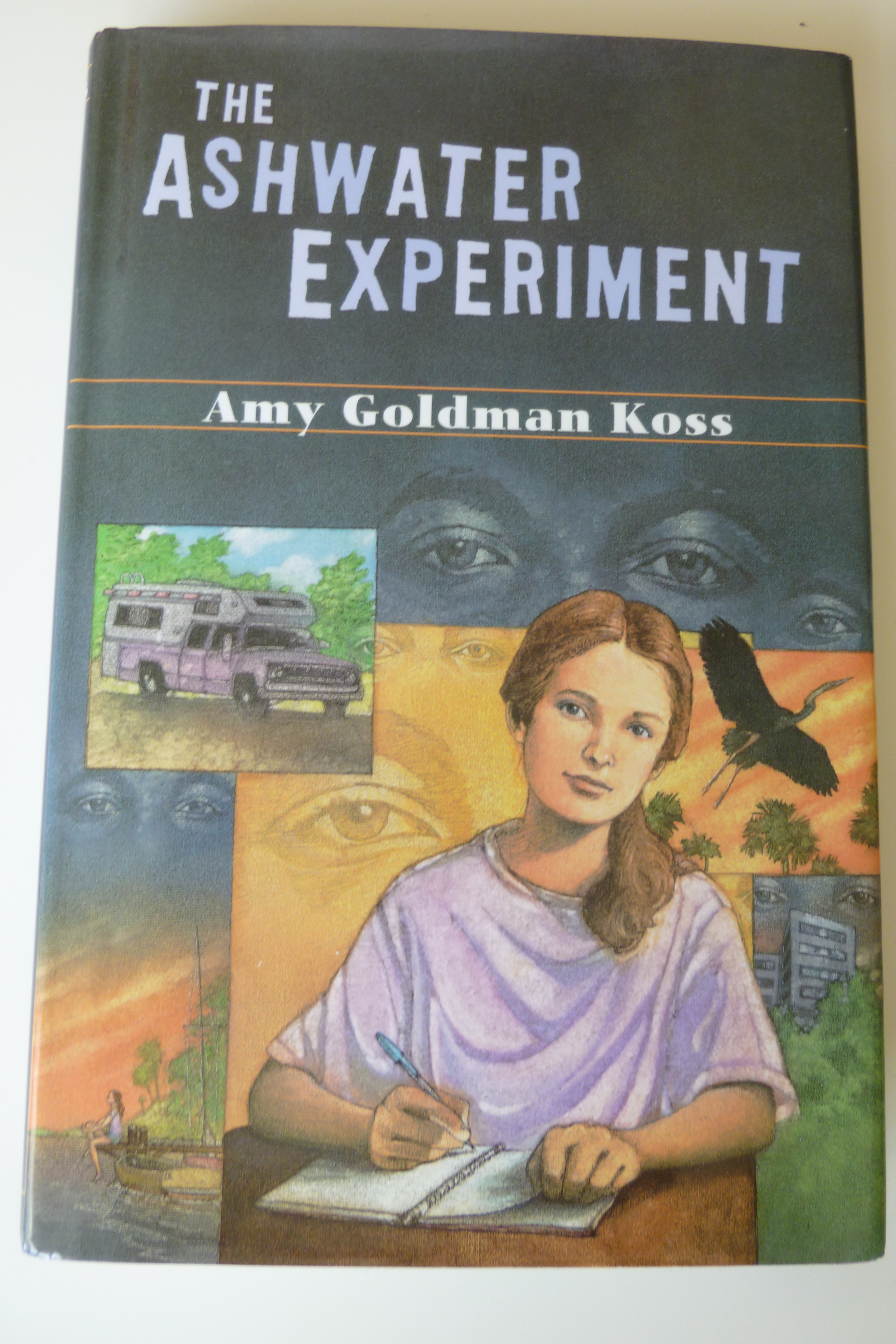
Classic Review: The Ashwater Experiment

I thought I’d look back at an old review this week, and found this one on a very good YA book I ought to reread!  A fascinating premise with such good characters, I’ve read it several times and always found it engaging!

Have you ever felt that you’re not quite like anyone else around you?  I’m guessing most people have felt that way at some time or another–and that feeling is at the center of The Ashwater Experiment by Amy Goldman Koss.

Hillary wonders if she’s the only person who’s real.  You can hardly blame her for feeling disconnected from the people around her.  She and her parents wander the country in their RV, selling trinkets at craft fairs and never staying anywhere long.  By seventh grade, Hillary has been to seventeen different schools and is firmly settled in her pattern of never making ties to anyone.  So when she finds out her parents plan to stay in Ashwater for nine months–longer than they’ve ever stayed anywhere–Hillary feels trapped.  That’s when she comes up with the Watchers.

What if she’s really the center of an experiment?  Part holodeck and part Truman Show, she imagines that the world she experiences is really created just for her, with nothing existing outside of what she can see in that moment.  At first it’s easy to imagine–everywhere she goes has always seemed to have a pattern, with the same kind of people at every school.  As she stays longer in Ashwater, though, people start to seem more real than ever.

I’ve read this book before, and in the past I think it was Hillary’s imaginary (but sometimes so real-feeling) game about the Watchers that struck me.  This time, that seemed more like a sidenote.  It’s a very interesting sidenote–but the heart of the story for me on this read was Hillary’s feeling of being different, and of her gradually increasing understanding for the people around her.

When she first meets the kids at her school, she easily classifies them and easily sees them as stock characters.  As she gets to know them, she finds unexpected depth to Cassie the bookworm, Serena the society queen, and Brian the class clown.  Even the more minor characters, like Serena’s mother or Cassie’s grandmother, the nasty girl who resents Hillary and even Hillary’s own parents and grandparents, are eventually revealed to have their own problems and motives and complexities.  No one is simple.  And we all feel different sometimes–paradoxically, it’s a feeling we often have in common.

This is another one of those books that reminds me just how good and how deep a YA book can be.  It definitely is YA (or even Juvenile), appropriate for young readers and focused on young adults.  Hillary is in seventh grade, and she has seventh grader concerns: whether the girls at school like her, how well she’ll do on the math competition, whether her parents are weird.  But the larger feelings Hillary struggles with are really universal, and there’s a depth that makes this appealing–even though seventh grade was a long time ago for me.

Author’s Site: http://www.amygoldmankoss.net/

Classic Review: Much Ado About Nothing

Today happens to be Shakespeare’s birthday (if you’re a Stratfordian, which I am) and so it seems appropriate to bring out this long ago review of my favorite Shakespearean comedy!

My love affair with the Bard goes back to high school, where I was a charter member of my school’s Shakespeare Society.  A lot of my best memories from high school involve Shakespeare (or Johnny Depp, but that’s another story!)  So I was definitely instrumental in my book club selecting a Shakespearean play last month.  Not solely responsible, but I was one of the ones who pushed.

Which is how I ended up rereading Much Ado About Nothing recently, and remembering why this is my favorite Shakespearean comedy.  It’s a great gateway play for people not very familiar with Mr. Shakespeare.

The story follows two romantic couples.  There are Claudio and Hero, whose romance takes a dark turn when Hero is falsely accused of wanton behaviour (and Claudio, the cad, believes it).  And there are Beatrice and Benedick, both known for their wit, who are continually baiting each other.  Their friends decide that they’d be perfect for each other, and set about on a plan to make each believe the other is madly in love with them.

My favorite scenes in the play are the gulling scenes, when each group of friends stages a conversation for the eavesdropping Beatrice or Benedick.  This preference may in part be because I performed in each of those scenes in my high school’s Shakespeare Festival.  But they really are brilliant comedy. Edited to add: Since originally writing this review, I saw David Tennant’s Much Ado.  His gulling scene is by far and away the funniest I’ve ever seen, though I can’t find it on YouTube, alas.  Nor is it on DVD yet, but I live in hope! </edit>

I was particularly noticing on this recent read-through how little Shakespeare gives in stage directions (though there is that one immortal stage direction in A Winter’s Tale: “Exit, pursued by a bear”).  It leaves a lot open to interpretation.  It doesn’t say that Benedick knocks over the potted tree he’s hiding behind at this point–but he can.

More significantly, many lines change completely by whether you believe the speaker is serious.  Was Don Pedro really proposing to Beatrice?  Are Benedick and Claudio really friends at the end?  You can go too far believing characters don’t mean what they’re saying, but there is room for reasonable interpretation–which makes the plays even richer.

If you’re at all interested in Shakespeare, try Much Ado About Nothing.  I recommend the Folger Shakespeare Library edition–good footnotes, and they put them on the facing page, which I find easier to read.  If you don’t feel up to reading Shakespeare, watch the Kenneth Brannagh version.  Excellent, although I can’t remember if he knocks any trees over.  I think I do recall some splashing about in a fountain though…

Book and TV Review: Father Brown

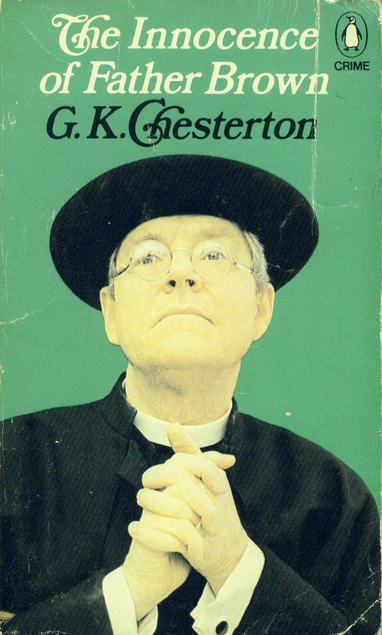
I’ve been watching the TV series Father Brown (a BBC series, available on Netflix) for many months now, and it’s quite delightful.  I thought I’d try the original stories, written by G. K. Chesterton, and got The Innocence of Father Brown. the first collection of short stories, from the library.  It was an engaging book with some clever mysteries–though not quite the Father Brown I was looking for.

Father Brown is a Catholic priest in England, with a knack for solving mysteries.  Many of the short stories in this first book feature Hercule Flambeau, first as a criminal and then reformed into a detective.  The setting is mostly London, I think in the late 1800s.  Some of the stories relate to Father Brown’s activities as a priest, though less than you might expect.  The connection is more through the insights Father Brown has gained as a priest than through plot connections.

The TV show, on the other hand, moves the setting to the Cotswolds in the 1950s, where Father Brown is pastor of St. Mary’s Church.  Here his parish work is much more integral to the stories, as usually some aspect of his priest work brings him into contact with the crime–nearly always murder.  The TV show adds in additional supporting characters: Mrs. McCarthy, parish secretary and quite proper; Lady Felicia, local aristocracy and not so proper; Sid, chauffeur to Lady Felicia; and, in later seasons, Bunty, Lady Felicia’s very modern niece.  There’s also an ongoing parade of local police chiefs, none of whom appreciate this priest interfering in the world of crime.

The short stories were interesting and engaging, but the TV show is charming and delightful–so it probably didn’t set me up that well for the short stories!  The tone just feels very different.  The Cotswold setting is a big part of the charm (though one does have to wonder about the number of murders happening in this idyllic rural village!) Continue reading “Book and TV Review: Father Brown”