A Long Stretch of Rope

My second movie for “Peril on Screen” for Readers Imbibing Peril was classic Hitchcock, Rope.  The movie opens with a man being strangled.  The two murderers, Brandon and Philip, hide his body in a chest in their apartment, and proceed to host a dinner party they’ve been planning–for the victim’s friends and family.  They serve dinner from the top of the chest, and Brandon cheerfully philosophizes about murder as an art for the superior being.  It’s a bizarre, ghoulish and fascinating movie.

As I would expect from Hitchcock, the movie is carefully and brilliantly handled in so many ways.  Brandon’s psychopathic beliefs about the inferiority and unimportance of David, the victim, is juxtaposed against the clear love of David’s friends and family for him.  A character who is in the movie for about four seconds is nevertheless made incredibly central and vivid for the audience.  Similarly, the action of the movie is mostly those first four seconds.  The rest of the movie is an ordinary dinner party…except!  Hitchcock layers in so many little touches, and little lines with double-meanings and insights that are terribly clever and keep the tension going.

As I’ve said before, I love the subtlety of old movies.  There’s a tiny line where a character is talking about an actor she loves and how sinister he is.  It points up the wide divide between the idea of murder and dark deeds…and the reality.

As the evening progresses, Brandon maintains his superior cool, while Philip begins to unravel–especially when another party guest turns suspicious.  Brandon also invited Rupert Cadell, their former professor and the man who taught them this theory of murder for the superior.  Rupert is played by James Stewart, and if you know good ol’ Jimmy, that may already tell you that the movie won’t end with Rupert congratulating them on their art…

Hitchcock, the lead actors, and THE chest

In some ways my favorite thing about the movie is on the technical side.  The movie is, basically, all one shot.  The camera pans, but it never cuts.  It moves around the apartment and it zooms in for close-ups, but it never blinks from one shot to another.  Technology of the time was not quite up to Hitchcock’s vision–reels weren’t long enough to actually shoot the entire movie in one shot, so he does have to zoom in on backs a couple of times, the screen goes black, and then it pans on, on the next reel.  However, setting that minor point aside, it’s brilliantly done, and so different.

The single-shot style was innovative at its time, and I feel like it’s even more so now, when movies and TV have gone the opposite direction.  Typical average shot length is a few seconds, and I’ve heard it’s been declining in the last few decades (naturally I can’t find an article on the subject right now…)  When that’s what’s typical, it feels very different watching Rope, and I think it adds a lot to the atmosphere.

If you get the DVD, there’s a 30 minute “Making Of” extra feature, “Rope Unleashed.” It opens with a minute or two of quick cuts between different shots in the movie–and after an hour and a half of a steady shot, I found it positively dizzying.

Apart from the technical aspect, I mostly found Brandon’s character to be fascinating, along with the interplay between him and Philip.  From the first moment it’s clear who the power is in the relationship, and I find fascinating the concept of the psychopath and the weaker-willed friend he pulled along.  Rupert’s character is also intriguing, and I’m not sure he was fully explored.  In many ways he’s also very culpable in this murder because he gave Brandon the theory that was then put in practice.  He’s clearly revolted by the actual deed, though, and I’m not sure that tension between his theories and their result, or his weight of guilt, was really got into.  Much as I love Stewart, he may not have been the right one for this role–because he’s good old Jimmy, so he can’t really be responsible in this situation.

All the grim, ghoulish delights of the movie aside, there’s actually some humor in here too, and I would be remiss to not mention David’s aunt and her extended conversation about recent movies and movie stars.  (I kept waiting for a Jimmy Stewart reference!)  She loved Cary Grant and Ingrid Bergman in that recent movie, “the Something of the Something.  Oh no, that was the other one.  This was just plain Something.” (Possibly Notorious, also Hitchcock.)  Rupert picks it up and with wry seriousness starts talking about when he saw Something Something.

All in all, if you like lots of jumps and screams and blood in your horror, this is not the movie for you.  But if you’re willing to take in a slow, complex character study of a horror movie, I recommend it.

Other reviews:
Canadian Cinephile
Better Than Avatar
The Geeky Guide to Nearly Everything
Anyone else?

Buy it here: Rope

Thieving Through a Mythical Landscape

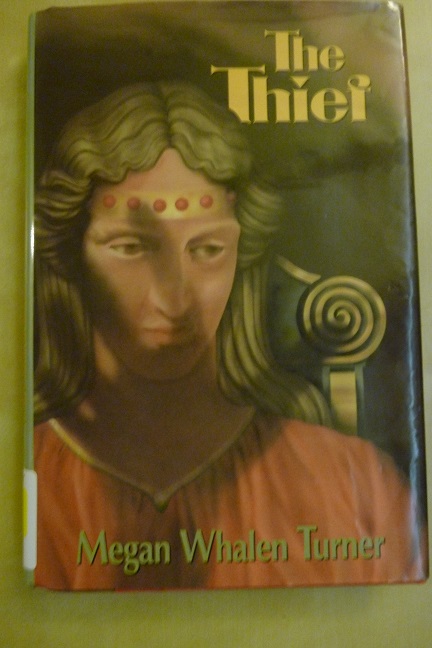
ThiefI’ve read The Thief by Megan Whalen Turner at least four or five times–and I feel like I see something new every time.

The story is about Eugenides (Gen for short), who claims to be the greatest thief in the world.  It appears there is only one thing he can’t steal–himself, out of the king’s prison.  He finds his opportunity, though, when the king’s advisor, the Magus, selects Gen for a mysterious quest, with something to steal at the end.  Joined by the Magus’ two apprentices and a body guard, the party travels through three countries and a landscape rich in mythology.

Gen is a splendid protagonist, apparently a crude thief but with undertones of thoughtfulness and depth.  He also has considerable pride in his art and a healthy belief in himself.  He’s in some ways an unlikely hero–small, apt to laze and complain, and with few indications of the nobility and honor you might expect from a fantasy hero.  But as I said…there’s depth!

I don’t want to give too much away here–but Gen is also an absolutely brilliant unreliable narrator.  He doesn’t lie so much as he omits…and sometimes he tells very revealing truths, but in such a way that the reader will most likely misread them and not learn anything after all.  It’s so well-done that I’m not too worried about spoiling it, because I doubt even someone watching for it will be able to spot what’s really being said!

The Magus also develops increased depth as a character, as he and Gen come to a wary–but by no means certain–respect for one another.  I have less to say about the rest of the traveling party, but suffice to say we get them to know them all as well, and there’s generally unexpected depth going on all around…

Apart from Gen and the secret twists of the book, the best aspect is the setting–something I rarely say about a novel!  The three countries of Sounis, Eddis and Attolia are clear and distinct.  The book manages to paint the economic and trade situation for the three countries, and situate it in the picture of the larger world…none of which are things I would expect to find interesting, yet here are plot-important and easy to understand.

There’s also the mythological landscape, which adds an extra layer.  Gen and the Magis tell a few mythological stories along the journey–and eventually the gods come to have a very active role in the current story as well.  The mythology is loosely based on Greek, but not in a one-to-one kind of way.  For one thing, the head of the pantheon of gods is female!  Despite the all-male traveling party we’re with most of the book, there are some strong women in here too, goddesses and humans.

The Thief is actually the first book in a larger series…which is something I try to forget.  I know there are people who love the rest of the series just as fiercely, but I simply don’t.  I really, really tried–I read the second book TWICE.  Unfortunately, I just can’t wrap my head around some of what happens to the characters later on–and especially some choices Gen makes.  So far, I haven’t been able to bring myself to read the following books.

However–I love the first book.  Read it.  Then go get some other opinions and decide whether to read the rest.

Author’s Site: http://meganwhalenturner.org/

Other reviews:
The Flyleaf Review
Christina Reads YA
Caught Between the Pages
Anyone else?

Buy it here: The Thief

Entangled on Sunset Boulevard

I’ve been meaning to rewatch Sunset Boulevard for literally years.  What with watching The Emperor’s New Groove recently (I’m convinced Yzma is based on Norma Desmond from Sunset Boulevard) and the beginning of Readers Imbibing Peril, now seemed like the time!

You see, Sunset Boulevard is very possibly the creepiest movie I’ve ever seen.  Not the scariest, not the most horrifying, but the creepiest–with all the old subtlety and art of the 1940s classics.  It’s not Hitchcock, but it feels like it could have been.

The movie opens with the main character, Joe (William Holden), floating dead in a swimming pool.  And that’s not the creepy part!  We immediately flash back in time, with Joe as the voice-over narrator.  We learn about his life as a struggling Hollywood writer, dreaming of success but unable to make his car payments.  By chance and circumstance, he meets Norma Desmond (Gloria Swanson), star of the silent film era–and she has never forgotten it.  She’s obsessed with her own stardom, and adamantly refuses to believe that her time has passed.  She lives in an insanely-over-the-top mausoleum of a mansion, alone except for her butler, Max, who is equally unbalanced.  Norma draws Joe into her web, and try as he might, he cannot find his way out again…

To quote The Emperor’s New Groove, Norma is pretty much “scary beyond all reason.”  Unlike Yzma, she’s not actually an unattractive woman–but she has these crazy eyes and dramatic hand movements and wildly creepy smile.  And she is SO emotional and SO desperately clinging to her past–and, as the movie goes on, to Joe.  It would be easy to write off Norma as simply insane, but the movie gives us little moments of sympathy and insight for her.  It’s not a movie about a madwoman–it’s a movie about a woman driven mad by fame, and the need to always be the perfect star she was on the screen.
At one point Joe’s narration remarks, “You know, a dozen press agents working overtime can do terrible things to the human spirit.”  I don’t think he means that negative press destroyed Norma.  I think he means the positive press.  The legend, the star persona, simply became overwhelming.  It’s a message that’s still immensely relevant; glance at the entertainment magazines some time for star after star self-destructing in magnificent ways.

Even though he narrates, I have less to say about Joe’s character.  He strikes me as essentially an Everyman, one with enough insight to tell us about the far more complicated Norma.  He does have his own story about failing to achieve Hollywood success, but I feel like the movie is really less about him than it is about how he gets caught by Norma.

I mentioned the subtlety of old movies–and the creepiness of this one.  There are some, shall we say, less subtle creepy elements.  Near the beginning, Norma is holding a funeral for her pet monkey, and Max the butler occasionally bangs away on an old pipe organ.  However, I found that what really gives the movie its creepiness is the more subtle things.  It’s Norma’s crazy eyes, or her huge empty house, overflowing with pictures of herself.

One of my favorite moments is so tiny and so quick that if you blink, you could miss it.  At one point, Joe tries to leave Norma’s house and escape back into the larger world.  As he goes out the front door, his watch chain catches on the handle, and he has to stop to untangle it.  And sure enough, Norma draws him back again…

I mentioned that the movie opens with Joe floating dead in a pool, which certainly seems like the most spoilerific of openings.  And yet, even though I know that’s how this ends–even when I’ve seen the movie before–somehow it draws me in so much moment by moment that I can’t really remember that that’s where it must be going.  I know it intellectually, but I can’t feel it.

Believe it or not, Andrew Lloyd Webber made a musical version of Sunset Boulevard (but then, I don’t know how anyone would read Leroux’s Phantom and think of doing a musical).  I’m desperately curious, mostly because of the song “As If We Never Said Goodbye.”  It makes me suspect there’s an even more sympathetic portrayal of Norma, and I really wonder how it’s handled–but alas, no filmed version, and I don’t know of anywhere it’s playing…

Until I can track down the musical, I’ll just have to recommend the movie to you–for all its subtle underplays and clever creepiness.  Norma, in her own cracked way, insists a few times that dialogue was unnecessary in the silent films because they expressed everything with their faces.  The funny thing is, she’s kind of right–most of this movie is expressed in the eyes.  Though there are some wonderful lines of dialogue too.  For instance, when Joe remarks that she used to be big, she fires back, “I AM big.  It’s the pictures that got small.”

Then, of course, there’s the famous last line…  “All right, Mr. DeMille–I’m ready for my close-up.”  And oh, how wonderfully terrifying it is, as she looks deep into the eyes of “those wonderful people out there in the dark.”

Other reviews:
The Ace Black Blog
Derek Winnert
Blogcritics
Anyone else?

Buy it here: Sunset Boulevard

Magic in the Tanglewood Forest

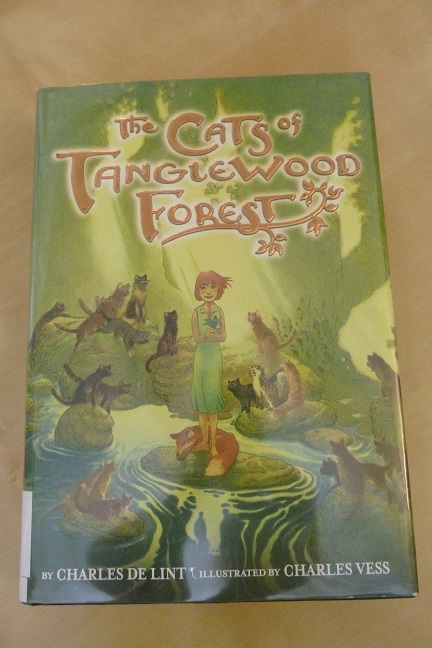
Cats of Tanglewood ForestTalking cats and Charles de Lint–now how could I resist The Cats of Tanglewood Forest?  This made the rounds of the blogs I follow when it first came out, and I’ve finally jumped in to read it too.

De Lint gives us a folk lore-like story about Lillian, a girl who loves all the creatures in Tanglewood Forest–the real ones, and the ones who may be only stories.  When Lillian is bit by a deadly snake, the cats of the forest turn her into a kitten to save her life.  Lillian is offered what seems to be an easy and complete solution to her problem…but as Rumpelstiltskin would have warned her, magic always has a price, dearie.  When that price turns out to be higher than she ever imagined, Lillian must find a way to change things–even if it means she’ll go back to being a cat.

I finished this book several days ago…and I’m still not entirely sure how I feel about it.  On the one hand, I was a little disappointed to not see de Lint’s usual edge.  It was a different style than I expect from him–but it is a book for a younger audience, and the folk lore style that is here is very well done.  So that’s not really a complaint, though perhaps a warning for de Lint fans who may also have different expectations.

The plot is a little more of a problem.  Everything progresses in a reasonable fashion, but once I got to the end, I felt like the entire midsection–the bulk of the book–was really just a divergence.  That’s especially a shame because that section ends with Lillian deciding to make (what seems to me) a significant sacrifice for a loved one–and I don’t feel like de Lint gave that the emotional power it should have had.  If the midsection had been about Lillian’s growth to be able to make this huge sacrifice, great!  But it didn’t quite read that way for me.

All right, so much for cons.  On the pro side, the book moves along in a quick, easy read (so even a divergence doesn’t take long) that stays engaging.  There are a number of intriguing, folk lore characters that are fascinating to read about, from the comical Fox to the horrid Bear People to the mysterious Apple Tree Man and even more mysterious Father of Cats.  And all cats are pretty mysterious, of course!

Lillian is a likable heroine and I love her love of nature.  She’d fit in beautifully with L. M. Montgomery’s heroines, who love their wild surroundings and leave out milk for cats or for fairies.  Lillian is a little rougher around the edges, a little more hands-on than Montgomery’s heroines, but that probably improves her for a modern reader (with all due respect to Anne, Emily and the rest).

The best part of the book, though?  It’s illustrated, with gorgeous illustrations by Charles Vess.  Every chapter opens with an animal twined around the first letter, and every few pages there’s a full or half-page illustration breaking up the text.  The pictures are lovely soft water colors that give so much warmth and heart to the story.

So consider yourself warned that this is folklore, not urban fantasy, and the plot makes some strange choices…but it’s a good read anyway, and a visually beautiful book.

Other reviews:
A Reader of Fictions
Fantasy Literature
A Book Obsession
Sturdy for Common Things
The Green Man Reviews
Anyone else?

Buy it here: The Cats of Tanglewood Forest

A Trilogy of Non-Oz Oz Books

I’ve been doing a slow reread of the Oz series by L. Frank Baum, and blogging on subsets of books as I go.  If you missed them, you can read my reviews of Books 1-3 (The Welcome to Oz Trilogy) and Books 4-6 (The Aimless Journeys Trilogy).  Today, I’m skipping past Book 7 until a later grouping, and looking at Books 8-10–as I like to call them, The Non-Oz Oz Trilogy.

It’s known history that Baum didn’t really want to keep writing Oz books.  He wanted to write other magical adventures, but the public (and I assume his publisher) kept insisting they wanted Oz.  I blame this lack of interest on Baum’s part for the so-so quality of The Aimless Journeys Trilogy.  Fortunately (in my opinion) he found a different solution later in the series, by writing Oz books…that aren’t really Oz books.

**************

Oz 8Book 8, Tik-Tok of Oz, begins in a backwater corner of Oz with Queen Anne of Oogaboo, who decides to gather all the men in her kingdom (eighteen) and go conquer the world.  Meanwhile, Betsy Bobbin and Hank the mule are victims of a shipwreck, which lands them in the magical Rose Kingdom.  Betsy eventually meets the Shaggy Man, who is on a quest to find his lost brother.  They’re joined by Tik-Tok and Polychrome, and eventually the group meets up with Queen Anne and her party, and the whole lot of them go to confront the wicked Nome King, who is holding Shaggy’s brother captive.

The plot is made to sound more complicated than it is by the wide ensemble of characters, but apart from the difficulties of getting everyone together, it’s basically a quest story that quickly becomes an extended confrontation with the Nome King–and features a side-journey through the center of the Earth to a land of Fairies.  Random though it may be at times, I love that there is a goal, and a valid one.  Rescuing a long-lost brother is a much better focus than journeying to Ozma’s birthday party (Book 5).  The confrontation with the Nome King also presents a real villain, and one who interacts with the characters throughout the book instead of merely appearing at the end, as happens in other volumes.

I quite enjoy this installment–there are some lovely images and magic, especially in the Land of Fairies, and the Nome King is an effective villain (more so here than at other times).  Betsy is a perfectly acceptable “sweet girl heroine” (a character-type Baum used often) and I always enjoy Polychrome.

But is this an Oz book?  Well…after the first chapter, we don’t get back to Oz until the last two chapters.  Tik-Tok and the Shaggy Man are the only familiar characters who are from Oz (Polychrome isn’t).  Really it’s more of a Nome King story…with some Oz accents.

**************

Oz 9Book 9, The Scarecrow of Oz, is really a Trot-and-Cap’n-Bill story.  Baum wrote two previous books about little girl Trot and her sailor friend Cap’n Bill, and then decided to send them to Oz.  The two are sucked down into a whirlpool while out sailing, and find themselves trapped in a cavern.  A series of adventures gets them out of the cavern and leads them to join up with the flying Ork (one of Baum’s stranger creatures) and old friend Button Bright.

They eventually reach Oz–but land in Jinxland, which is cut off by mountains from the rest of Oz.  There they get involved with local politics, fighting King Krewl and an evil witch who stole the throne from…well, either Princess Gloria or gardener Pon, depending how you look at it.  Ozma sends the Scarecrow along to help, and to lend his name to the title.

This is one of my favorite books in the series.  I like Trot and Cap’n Bill quite a bit.  Their friendship is sweet and Cap’n Bill, with his wooden leg and past sailing life, has a little more depth than you see in most Baum characters.  They also tend to have adventures that feel genuinely hazardous.  Not too hazardous–Baum is always light and whimsical–but when they’re trapped in the cavern and low on fresh water, it feels like real danger, unlike when Dorothy fell through the earth in an earthquake (Book 4).

This book also has the benefit of one of the very few romances in Oz, between Pon and Gloria.  It’s not one of the great romances of literature…but hey, it’s there!

But like Tik-Tok of Oz, this isn’t really an Oz book.  Technically Jinxland is in Oz, but for all intents and purposes it might as well not be, meaning we don’t properly get to Oz until the last few chapters.  Really it’s a Trot-and-Cap’n-Bill book, with the Scarecrow in a guest appearance.

**************

Oz 10Of all the non-Oz Oz books, Rinkitink in Oz is the most strikingly non-Oz.  The story is about Prince Inga, whose tiny island country was conquered and his parents and people taken away to be slaves.  Fortunately, Inga possesses three magic pearls–one that gives great strength, another that grants invulnerability, and a third that speaks wisdom.  With his friend King Rinkitink, Inga sets off to rescue his people, running into a series of dangers along the way, and is eventually forced to confront the Nome King to rescue his parents.

Where, you ask, does Oz come into this?  Well, Baum originally wrote this as a non-Oz book, with no connection at all.  Then he changed it–and this is the one time I think the public’s preference for Oz harmed one of the books.  At the very end of the story, Dorothy shows up in a complete deus ex machina to scold the Nome King and solve all the problems.

I wish I knew what the original ending was, because the existing one is disappointing.  Inga was an effective and likable hero throughout the book, who deserved a heroic end to his story.  Instead Dorothy arrives…and all the tension leaves.  She’s blissfully confident she can handle the Nome King, she brings the Wizard along as back-up, and Ozma is keeping an eye out just in case.  This may point to one problem Baum was having writing Oz stories–he had made his characters too powerful to sustain plots.

Ending aside, Rinkitink is actually one of my favorite “Oz” books.  Prince Inga, his island kingdom, and his magic pearls are as delightful as anything going on in Oz–and like Tik-Tok, the book is driven by a real goal, Inga’s desire to rescue his family.

**************

Personally, I don’t mind at all if Baum wanted to give us non-Oz stories and stick Oz in the title.  I know some readers object that these books aren’t really about Oz characters (mostly) but I find the characters who are here to be just as engaging–and I can’t say I strongly miss the ones who aren’t present.

I’ve read Baum’s books that really aren’t part of the Oz series, and they tend to be very much the same–whimsical fantasies with strange creatures and kingdoms, and sweet boys or girls making their way through them.  That’s the case for the truly Oz books, and for these three too.  If you’re open to new landscapes and new characters, I find these three to be strong contributors to the series.

Other reviews:

Story Carnivores (Tik-Tok and Scarecrow)

Cavalcade of Awesome (Tik-Tok, Scarecrow and Rinkitink

Tor.com (Tik-Tok, Scarecrow and Rinkitink)

Anyone else?

Buy them here: Tik-Tok of Oz, The Scarecrow of Oz, Rinkitink in Oz