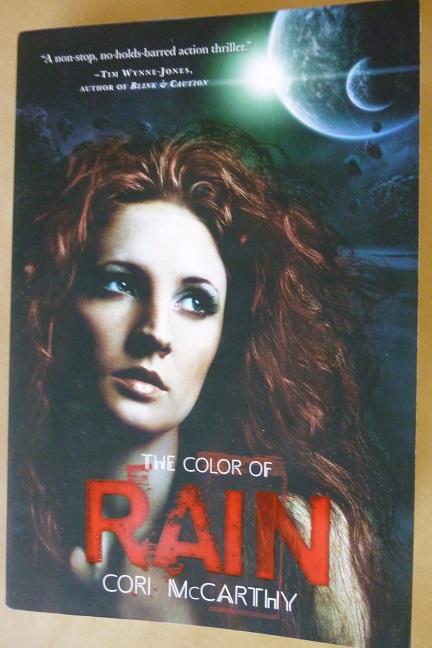
The Color of Rain by Cori McCarthy

Color of RainThe cover of The Color of Rain by Cori McCarthy describes it as “non-stop, no-holds-barred,” and they’re really not kidding.

Rain White lives in Earth City, a crumbling, future factory town with no prospects and very little hope.  Rain is desperate to escape on a spaceship traveling to the Edge.  There, she might be able to find a cure for her little brother, one of the Touched–a terrifying disease that strikes without known cause and steals a person’s memory and sanity.  Rain will do anything to save him, including turning to prostitution (not unlike Fantine, in fact).  Johnny, a dashing spaceship captain, seems like the perfect answer.  Despite some ominous indications, Rain agrees to be “his girl” in exchange for passage for herself and her brother.

Once in space, however, Rain learns that Johnny has many girls–he’s a pimp and a slaver, and runs his business ruthlessly and without morals.  Now Rain’s survival (and her brother’s) depends on doing anything necessary.

This is marketed as YA, but as should be clear just from the plot, it’s a very upper, very dark YA.  Don’t be fooled into imagining that it will pull any punches.  Frankly, the only thing that makes it YA, I think, is that Rain is seventeen.  From the movie rating system, I’d call it an R, for sex, language and violence.  It would have been possible to be more graphic–but I wouldn’t describe this as discreet either.

I think it’s worth comparing this to what it’s not.  In Edgar Rice Burroughs’ books, the worst is frequently threatened–but never actually happens.  Here, the worst happens…again and again, because every time I thought we’d seen the worst, the specter of something even worse loomed up.  A few of those specters don’t materialize–but most do.

This is a much darker book than I usually read, and it goes place I’d rather not go.  However, I do acknowledge that for this story, it’s not gratuitous.  I’m reminded of something my writing group’s resident horror writer has said–that he writes about horrific things in order to write about how people overcome them.  And that is ultimately  what this book is about, about holding onto that last piece of humanity and identity when it seems as though everything has been stripped away.

Part of that uplifting strand is inside Rain herself.  She’s stubborn and tough, and while she may at times be beaten, she’s never defeated.  After every worst happens, she finds a way to keep going.

The other bright spark in the otherwise almost unrelenting darkness is Ben, Johnny’s assistant and slave.  Ben is a Mec, genetically and mechanically enhanced, but still the most human person on Johnny’s ship.  Ben still believes in morals and the value of human life, and his treatment of Rain is in marked contrast to pretty much everyone else she meets.  It’s a slight spoiler to say that there’s an eventual romantic relationship, but that becomes obvious very quickly.  In fact, if I have one real critique of the book, it’s that Ben and Rain connect a little too deeply too quickly; there are a few points very early on when she clearly feels this connection, and there doesn’t seem to be a basis for it.  However, there is more grounding as the book progresses, and the relationship evolves into something really lovely.

The book is obviously sci fi, although I feel like that takes a very backseat compared to the human drama.  It’s an aspect of the book, but not that much a focus, and there isn’t a lot of worldbuilding.  For the most part we’re thrown in without explanations, and for the most part that works…though there were a few explanations I would have liked and never ended up getting.

Final assessment…excellent written, this book was too dark for my taste, and I think many (most?) readers would find it challenging at times.  But for what it is, it’s gripping, compelling, suspenseful, non-stop and no-holds-barred.  If you like dark thrillers, you may want to consider reading this in one sitting!

Disclaimer: I received this book for free from the publishers, in exchange for an honest review.

Author’s Site: www.corimccarthy.com

Other reviews:
Finding Wonderland
The Compulsive Reader
Wild About Words
Books Without Any Pictures
Anyone else?

Buy it here: The Color of Rain

Zombieland and Warm Bodies

As a general rule, I’m not much of one for zombie movies.  I’m not much of one for blood and guts in general, so…yeah.  But I had a movie night with friends recently, and watched Warm Bodies, which was really quite a bit of fun.  I watched Zombieland (with the same people) on a different occasion.  Since it’s another funny zombie movie, I thought–why not a joint review?

Zombieland (2009) focuses on the last handful of people left alive in a world overrun with zombies.  Jesse Eisenberg plays (of course) a shy, nerdy college student, who cites his survival to his list of rules–like Rule#1: Cardio, and Rule#4: Don’t be a hero.  The movie turns into a sort of strange, zombie-filled road trip–and of course one of the only other surviving humans happens to be an attractive girl (Emma Stone) the same age as the main character.

On the con side of things, there are some moments of zombie gore and guts (particularly in the first few minutes).  If you’re squeamish, watch with someone who has seen the movie and can warn you (that’s what I did).  As far as zombie movies go, it’s not really a heavily gory one, though (or so I’ve heard).  On the pro and con side, there’s an awesome, super tough girl…who then ultimately does something stupid and has to be rescued by the not-nearly-as-awesome guy.  Sigh.  But the whole thing is something of a geek-guy fantasy, so I suppose it’s just how it goes.

On the pro side–it’s frequently a very funny movie.  And–the Rules!  The Rules are how I ended up watching this to begin with.  I’m writing a novel with a character who has a list of rules for life–and I had never seen this movie.  Everyone in my writing group told me I had to watch Zombieland.

The Rules were awesome…but I feel cheated.  We hear about Rule #30, so there must be thirty rules, but we only actually hear maybe a dozen of them.  For the record, my character has around 35 rules, and they are all in the novel.

Aside from too few rules and too much gore, though, it’s a fun time.

Warm Bodies (2013) tells the story from the point of view of one of the zombies.  His name is R–he can’t remember the rest.  He’s pretty depressed about his non-life, and dreams of being able to connect with another person.  And one day, he does; he meets Julie, a human from a hold-out community of survivors, who R chooses to protect during a zombie attack.  The more time they spend together, the more R begins to change…
On the pro side, R has a fantastic inner monologue going on.  It’s witty and funny, offering commentary on life and on zombie tropes, and giving such an interesting insight into his head.  R has to work so hard to overcome his zombieness, and to connect with Julie–prompting monologue such as “Don’t be creepy, don’t be creepy…”

The gore level is a bit lower than Zombieland, although it does have its moments, so watch out.  On the pro and con sidethey do something really fascinating with the trope of zombies eating brains.  The idea is that eating someone’s brain enables the zombie, at least temporarily, to relive that person’s memories, and remember what it feels like to be alive.  If you can get past the ick factor (eating brains!), I love the concept.

On the con side, well, don’t expect much of this to make any kind of scientific sense.  R doesn’t remember how the zombie infection got started, and pretty much nothing about the nature of the zombies is explained or even seems terribly reasonable.  But honestly, it doesn’t matter that much.  I mean, it’s a surprisingly clever zombie movie with engaging characters.  For me, the science becomes secondary.

I’m still not a fan of zombies in general…but if you want a funny twist on zombies, these were a couple of good ones.

Star Trek: Into Darkness

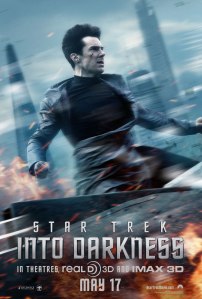
StarTrekIntoDarknessEnterprisePosterI went to see Star Trek: Into Darkness on opening night, and can happily report that I thoroughly enjoyed myself…although in the end, I feel mixed about the movie.  It was a very good time–and yet there are issues.  I feel rather that way about the previous movie too, although the particular issues are different ones.  The first (eleventh) movie had rather a mess of a plot but excellent characters and some fantastic moments.  This one had an engaging plot, made rather a mess of the characters…and had some fantastic moments.

The movie opens with the Enterprise on a routine survey mission that is on the brink of going horribly awry.  This felt a lot like an old-style Trek adventure, and was a very fun way to start the movie.  Kirk breaks regulations to pull a victory out of chaos, but is still smacked-down by Starfleet for breaking the rules.  This is quickly set aside, however, when Starfleet comes under attack from the mysterious John Harrison (Benedict Cumberbatch) and the Enterprise sets out to round up the fugitive.  Beyond that, it’s hard to discuss plot without serious spoilers.

Suffice to say, the plot was at times implausible or convoluted, but also exciting and engaging.  There are some good twists and very good chase sequences, although some of the action parts went on longer than necessary.  And there were far too many flashing lights!

Cumberbatch2But  there was also Benedict Cumberbatch.  Pardon while I gush.  I don’t think I would have enjoyed this movie half as much without Cumberbatch.  Whatever was wrong with the characters (I’ll get to that), the problem was not the villain.  He was completely awesomely amazing  every time he was on screen.  He was one of those villains who is just so damn cool that you want to root for him–while realizing fully that he’s a horrible person who must be stopped.  I’ve only ever seen Cumberbatch before in Sherlock, and this was like the evil Sherlock.  Sherlock if he really was a pyschopath, and not nearly as funny.  So.  Brilliant.

They hold back the reveal on his, shall we say, secret identity for quite a while and I won’t reveal it either.  But I heard a definite exhale go through the audience when it finally came out.  If you’re on the fence about seeing this movie, it’s worth it for Cumberbatch alone.

But he isn’t the only good thing in the movie.  Scotty, McCoy and Chekov are all really delightful every time they’re on screen–which, in the case of McCoy especially, was not often enough.  There are some very funny moments, which was good and bad–and I think that brings me up to why I feel mixed.  Some of the lines made me laugh…except that the characters shouldn’t have been saying them.

I had problems with the portrayal of the characters, and when I say “the characters” I think I mostly mean Kirk, though not exclusively.  Part of the trouble is the whole “prequel” concept that they set up in the last movie.  At the end of that movie, a group of (essentially) college students were put in charge of the top-of-the-line, pride of the fleet Starship Enterprise.  In this movie, the college students are running things–but they’re still behaving like college students.  They flirt, they argue, they have relationship discussions in the middle of a battle sequence, they disregard regulations and blithely expect to get away with it.

Now I’ll grant you, the original series characters always had their moments.  But there was also always a baseline of professionalism.  There was rank, there was protocol, there were regulations and procedures and a rational chain of command.  And they behaved (mostly) like professionals.  They felt like mature adults.  The dynamic and the interactions in this new movie just didn’t feel right to me for Starfleet officers, or for these characters.

I know this sounds like a nitpick, but the continued unprofessionalism was threaded throughout the movie, and when something is just a little bit wrong every third line of dialogue, that’s not a little thing anymore.  It was everything from Kirk making pointed-ear references (which is McCoy’s sole prerogative) to Sulu or Chekov saying things like, “I don’t know if I can do that but I’ll see what I can manage,” when the only appropriate response is “Yes, Captain.”  And then there was Scotty calling Kirk “Jim,” repeatedly.  Only Bones calls him Jim regularly, that’s what makes him special (or maybe I should say, his specialness lets him do it–not that anyone writing this seemed to understand that McCoy is important.  A different issue).  The worst was when Uhura and Spock had a relationship spat mid-landing party.  People: professionalism!  (The fact that they even have a relationship to have a spat about–that’s so wrong I can’t even touch it.)

The lack of maturity was especially a problem for Kirk, because they apparently decided to give him a character arc about needing to grow up into the role of captain.  And yeah, I know, prequel–except that he’s already captain, with the same crew he had on the original series, and the idea in that context that he doesn’t know what he’s doing yet and that, I don’t know, his pre-frontal lobe is still developing or whatever…no, it just felt wrong.  I love Kirk because he is every bit as awesome as he thinks he is, he always knows what he’s doing, and he always bends the rules in exactly the right way to get a victory and stay out of trouble.  Always.  If they want to tell a story about how he became that person, it should have happened before he was sitting in the Chair.

So much for my rant.  Just when I was getting thoroughly frustrated with things, though, we got into the last half-hour or so…which will be a spoiler to discuss.  So I’m putting it in white, highlight the next paragraph if you want to read it.

Loved the last portion of the movie.  I thought the role reversal of Kirk and Spock was mind-bendingly brilliant.  This is by far and away the best example so far of taking the altered timeline and doing something really clever with it.  Loved the chase sequence with Spock and Khan.  Loved that a tribble was part of the key to saving Kirk.  Loved that Khan was shown still alive–and smiling–at the end.  That man’s not going away (I hope).  Loved that Leonard Nimoy had a cameo.  It was a pretty much unnecessary cameo–except that he’s Nimoy, and therefore is necessary unto himself, it doesn’t have to do anything for the plot.

And though it is about the end, it’s not a spoiler to say that using the original music for the end credits gave me the warm fuzzies.  🙂  Suffice to say as a non-spoiler, the last half-hour was brilliant, and while I stand by my issues with the other portions of the movie, it brought me around to a positive on the movie overall.

Next time–because I trust there will be a next time–I’m hoping for more McCoy (please, more McCoy!), less flashing lights and weird reflections, more maturity from the crew and especially Kirk, and with any luck, more Benedict Cumberbatch!

Movie site: http://www.startrekmovie.com/

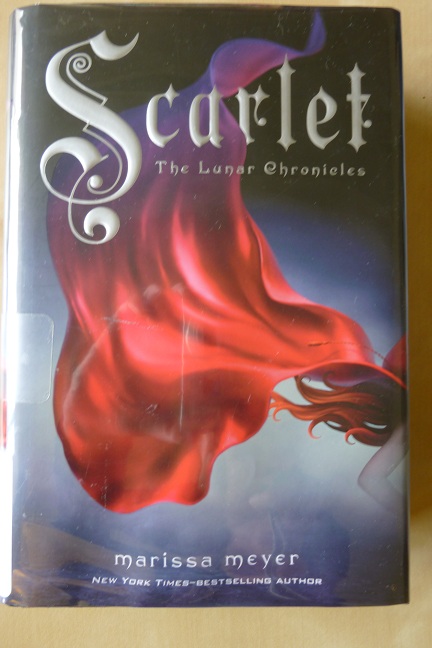
Scarlet: Book Two of the Lunar Chronicles

ScarletI came late to the game last year with Cinder by Marissa Meyer, so I was determined to jump in sooner with this year’s sequel, Scarlet.  It was a great read, and now I’m eagerly waiting to see where she’ll take the adventure in the next book!  Read my review of Cinder here, and be warned, there will be spoilers for that book in this review for Scarlet.

Cinder is a sci fi fairy tale retelling, featuring a cyborg Cinderella (who leaves her foot on the palace steps!)  The last book ended with Cinder under arrest, soon to be handed over to the vicious, mind-controlling Lunar Queen.  Scarlet brings in several new characters, starting us off with title character Scarlet, whose beloved grandmother recently disappeared.  She’s soon pulled into a much larger and more dangerous game than she realized, and reluctantly accepts the help of a mysterious street fighter she knows only as Wolf.

Meanwhile, Cinder swiftly breaks out of jail and goes on the run, by accident and necessity working together with Carswell Thorne, conman, smuggler and thief.  The stories converge when Cinder and Carswell also end up on the trail of Scarlet’s grandmother, everyone intent on what secrets the woman could be hiding.

As you’re probably already guessing, this volume brings in “Little Red Riding Hood,” though only in the loosest sense.  I do love it that Scarlet wears a red hoodie, though!

The split plotlines gave me some trouble at first–I kept wanting to be in the other one, whichever one I was currently in–but once I got adjusted to that, I very much enjoyed the book.  Meyer ratchets up the stakes and the conflict, and introduces us to some excellent new characters.

I have a soft spot for charming rogues, so Carswell was a great addition.  He’s a very arrogant criminal who expects everyone else to be as impressed by his exploits as he is.  He brings some humor into a frequently dark book.  Scarlet is a good character as well, a fierce young woman who is determined to forge ahead and deal with things.  I hate passive heroines, and Scarlet is anything but.  Wolf is fascinatingly complex.  I have kind of a thing for dark, brooding heroes too, and he’s a wonderful blend of strength and wariness.  He’s immensely capable about some things (see: street fighter) but so nervous about others (like romance).  I love that blend.

My favorite character from the first book was also back, though I would have liked more of her…Iko, Cinder’s android friend.  She was dismantled in the last book but Cinder saved her personality chip, and in this book installs it into their spaceship.  Iko’s freaking out about whether she’s still attractive as a spaceship (“But I’m so huge!”) is absolutely wonderful.

Scarlet is living in France, and her search for her grandmother eventually takes her to Paris.  Being me, my first thought was, hey, maybe there’ll be an Opera House reference!  So imagine my delight when it turns out the kidnappers have actually made the Opera House their base. 🙂  This is set a long stretch into the future, so we get to go wandering through the crumbling but still recognizable remains of the Opera House, including the grand foyer, the marble stairs, and the auditorium.  Loved it.

The book takes a turn near the end, and I’m not sure how I feel about it.  For one thing, it suddenly gets a good deal more violent, and I could have lived without some of the blood.  For the other, possibly larger thing, some details are revealed on the Lunar Queen’s army, and I’m not sure if I like where this may be going.  But I can’t really tell, until the next book comes out!

I enjoyed Cinder and I think I may have actually liked Scarlet a bit better.  Or maybe it’s just fresher in my mind.  Either way, it didn’t disappoint, and I’m looking forward to #3!  The title is Cress, so I’m thinking…Rapunzel, maybe? 😉

Author’s Site: http://www.marissameyer.com/

Other reviews:
Dreaming of Books
Sophistikatied Reviews
Dark Faerie Tales
Others?

Buy it here: Scarlet

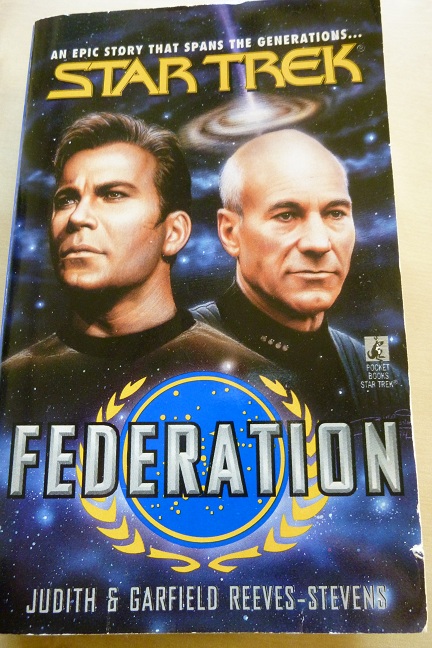
Federation: Star Trek Across Eras

FederationOne of the nearly-last books on my Sci Fi Experience reading stack was Federation by Judith & Garfield Reeves-Stevens.  This was a re-read, but it had been years and I’d forgotten most of the details…but I did remember it was a good one.  The Reeves-Stevens also wrote one of my favorite Trek books, Prime Directive, and are absolutely brilliant at capturing characters.

Federation takes a broad scope, with three storylines across times, which ultimately intertwine.  We follow Zefram Cochrane, inventor of warp drive, through the early days of warp technology and into World War Three.  In the 23rd century, Kirk is facing fire from Starfleet over a recent mission–the one in which they met a much older Cochrane (“Metamorphosis”), who asked to be kept secret.  In the 24th century, Picard is hoping to obtain a piece of Borg technology that could be vital to the defense of the Federation.

There’s a lot to juggle here, and this is a case where, as a writer, I can very much appreciate how well the Reeves-Stevens handled it.  The divergent plots feel like they should be confusing, but aren’t; they ground us very well in each storyline, and a tight point of view helps a great deal too.  We’re only ever in the points of view of Cochrane, Kirk or Picard, and move in regular sequence between the three.

The Cochrane plotline provides a very interesting window into an earlier era of Trek history–even if it turns out not to be canon.  This was written before First Contact, and there’s a very prescient author’s note remarking that later films might invalidate the ideas set out in the book.

With all due appreciation for First Contact, I like the Reeves-Stevens’ version better.  It feels more like possible history and less like an action film.  Cochrane develops warp flight with financial backing from an idealistic billionaire (who I’m pretty sure is the long-lived Flint from “Requiem for Methuselah”), and is instrumental in founding early colonies.  He gets tangled up with World War Three because one military leader believes that Cochrane holds the secret to the ultimate weapon, a so-called “warp bomb.”  It’s exciting, while blending in philosophy, economics and galactic politics in a way that’s remarkably believable.

Kirk’s plotline draws very closely from original series episodes.  The plot points are mostly from “Metamorphosis,” but the timing is directly after “Journey to Babel,” with Ambassador Sarek still aboard at the beginning of the book.  There’s a wonderful scene with Kirk, Spock and Sarek playing poker in Sickbay.  I really enjoyed how much this was grounded in particular episodes.  Most Trek books seem to take place vaguely “on the five-year mission” (maybe in the last year after the final episode).  That’s fine as a rule, but tying it in so closely made me feel oddly nostalgic.

The best thing about Trek are the characters, and I think I love the Reeves-Stevens so much because they know how to tell Kirk, Spock and McCoy.  Trek books live and die for me based on whether Spock and McCoy snipe at each other–and they do here!  It’s understated, but perfect.  They go back and forth a few times, with Spock giving very precise estimates, McCoy rolling his eyes, and at least once Spock is deliberately vague, just to bait him.  It’s excellent.

The Picard plotline had its own mysteries and tensions, which is good since for most of the book it felt completely unrelated to the other two plots.  It comes together in the end, and the authors try to tie it closer together with an Ambassador Sarek connection…but mostly I think the reader has to just take it on faith that the plotline is relevant and enjoy it for itself in the meantime.  The way it ties together is ultimately a bit far-fetched…but personally I’m willing to just go with it.

If I have any major criticism, it’s that the frame-story felt unnecessary.  I see what they’re doing–it’s a thematic thing–but it didn’t work for me.  The book starts with a prologue about a very depressed Kirk coming to the Guardian of Forever.  The timing is right before Generations (which I’d prefer to IGNORE, if you don’t mind) and Kirk is having a premonition that his life is over and there’s no purpose anymore and etc. etc.  The Reeves-Stevens are so good at portraying the characters, but this was odd…and just depressing.  There’s a thematic point about the purpose of it all, and humanity’s journey and the exploration of that idea within the book is inspiring–but it doesn’t need the prologue to draw that out.  So if you pick this up and the first few pages aren’t working for you…skip ’em.

And after the first few pages, this is absolutely worth picking up.  Watch “Journey to Babel” and “Metamorphosis” in preparation, and then I think you’ll thoroughly enjoy Federation!

Authors’ Site: http://www.reeves-stevens.com

Other reviews:
Pareidolia Book Blog
That’s all I found!  Anyone else?  Tell me about yours!

Buy it here: Federation by Judith & Garfield Reeves-Stevens