An Enchantress or an Alien–or Both

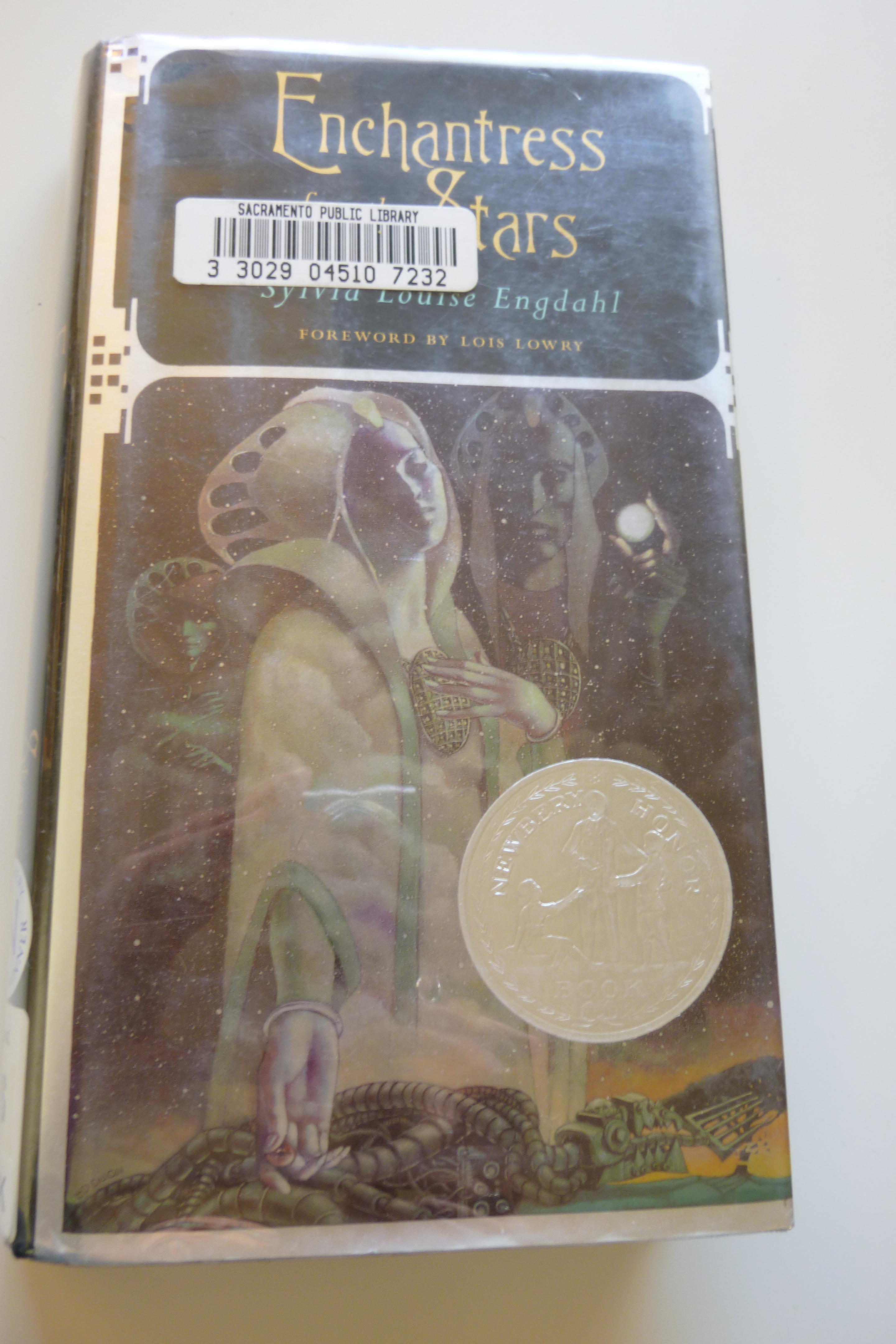
Science Fiction and Fantasy get lumped together all the time, in discussions, in “Best of” lists, in the bookstore.  But you rarely see them together in a single novel.  Enchantress from the Stars by Sylvia Engdahl is a brilliantly-devised story that could be in Earth’s distant past–or even more distant future.

The story is told by Elana, who belongs to a society far advanced beyond present-day Earth.  She is part of a Federation of many planets, joined together in peaceful cooperation.  They study less advanced worlds, but have a strict non-interference policy, believing that it’s best for cultures to develop without knowing about more advanced races.

(For the Star Trek fans–I know, I know.  All I can tell you is that this was written in 1971, but feels less like Star Trek when you’re actually reading it.)

Elana is training to be one of the scientists who studies Youngling worlds, when she stows away on a mission to Andrecia.  Andrecia’s native people are at roughly a Middle Ages level of development.  Their future is threatened by colonists from another world–the Imperials have developed space travel, but have not yet achieved the level of Elana’s people, either technologically or culturally.  The Federation team’s mission is to induce the Imperials to leave, without harming either race’s culture.

Elana ends up taking on the role of Enchantress, to relate to the Andrecians in a way they can comprehend–she especially connects with one, Georyn.  She teaches him magic spells (combinations of technology and telekinesis), so that he can go fight the dragon (the Imperials’ digging machine).  The hope is that if an Andrecian uses powers the Imperials can’t understand, they’ll be convinced to give up their colony.

The brilliance of the story is that it’s told from three very different points of view–Elana, from her advanced, enlightened perspective; Georyn, who tells a Brothers Grimm-style story about a beautiful Enchantress, a dragon served by terrifying demons, and magical spells; and Jarel, an Imperial who questions what his government is doing but doesn’t know how to act–and is probably the closest to all of us who are reading.

The three perspectives are intertwined and so different, yet work so well together.  It’s emphasized, in Elana’s sections, that Georyn’s perspective on events isn’t wrong either–he simply has a different understanding, a different way of viewing what’s happening.  In some ways, he proves to be the most intelligent and the most insightful of any of the characters.

Elana is very interesting too, because we see her as the uncertain, often naive girl she is on the mission; as the strong and wise enchantress Georyn sees her as; and as the more mature voice telling the story after it’s all over.  Her character growth, throughout the story and from the after-perspective, is very excellently done.

This is a good adventure with compelling characters, and it’s ultimately a very hopeful story.  Engdahl is careful to place Andrecia, Elana’s home world, and the Imperials’ home planet all in the position of third from their stars.  It notes in the introduction that any of them could be Earth–this could be a story about our past, or a story about our future.  Ultimately, I don’t think it matters.  We’re all of them.  The hopeful part is that the book makes it clear that Georyn’s people, and Jarel’s, and us, can all learn and grow and eventually reach the wisdom of Elana’s people.

In that way I guess it is like Star Trek, as a vision of a hopeful future.  But if you want to take this as science fiction, as fantasy, as philosophy, or even as something with some of the same elements as Star Trek, it’s worth reading–it’s a wonderful book.

Author’s Site: http://www.sylviaengdahl.com/index.htm

Other reviews:
Book Snatch
Jenna St. Hilaire
Yours?  Let me know!
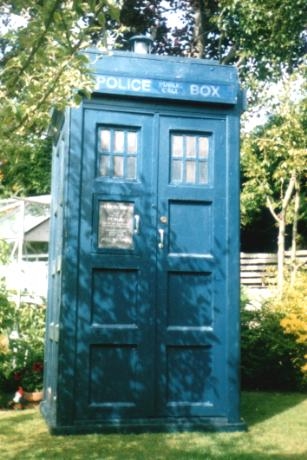
So I Finally Watched Doctor Who…

The TARDIS - it's bigger on the inside

For ages, everyone told me I had to watch Doctor Who.  So I finally did–and they were right!  I always say my main interest is stories, not exclusively books…so why not a review of a TV show with truly brilliant storytelling?  And it gives me an opportunity to be gleeful about Doctor Who!

The history of the show is complicated.  It ran on the BBC for 26 years, starting in the sixties.  One reason it took me a while to start watching is because I just didn’t know where to start.  But finally enough people told me I could just begin with the recent series, which runs from 2005-present, and that’s what I did–you can too.

The premise has to be every storyteller’s dream, because it’s so limitless.  The Doctor is the last of the Time Lords, and he travels around the universe in the TARDIS, which from the outside looks like a blue phone booth–but it’s bigger on the inside.  It has incredible power, and can travel through time and space.  So you can go into the future and have a sci fi show–go into the past and meet Queen Victoria–invent all kinds of aliens, which sometimes resemble the supernatural (which means you can have ghost stories)–and if things ever get dull, recast the Doctor and give him a new sidekick.  You see, the Doctor never dies, he just regenerates with a new face, which is how they can now be up to the 11th Doctor.  He usually travels around with a companion, but the companion is open to replacement.

So you have a premise with pretty much no boundaries.  And the show itself is exciting, witty, suspenseful, hilarious…  I’ve just finished Season Two, so I can’t yet comment on anything after that.  But the first two seasons are fantastic.

I admit it did take me a few episodes to get into the show.  The recent series opens with the 9th Doctor, played by Christopher Eccleston.  He’s a sort of goofy action hero, who will save the day, while grinning and making jokes.  At first I wasn’t sure I liked it–then I had a complete turn-around and loved it.  One cool thing about a constantly funny hero is that when he does turn serious, it means a lot.  His face goes solemn and the tension rises through the roof.

The Doctor regenerates at the end of Season One, to be replaced by David Tennant.  He’s goofy, but in a different way.  Still very mercurial, but he gets serious more often.  It took me a few episodes to forgive him for not being Christopher Eccleston, but by the time he crashes a white horse through a mirror into a French ballroom, I decided I loved him too.  He brings a whole new level of awesome to the character.

I have not yet watched enough to get to know the Doctor’s later companions, but for the first part of the series he travels with Rose.  She rises above really bad make-up to be a quite good character, and there’s excellent chemistry between her and both Doctors.   When I say “chemistry,” though, I don’t mean romance, and that’s actually something I love about the show.  The Doctor and Rose are very, very close–but they’re friends.  There isn’t even any flirting or innuendo.  They’re just really, really good friends.  You don’t see that very often in TV.

Another thing that strikes me about the show is its confidence.  I think it comes of having a forty-year history and apparently an enormous British fanbase.  I don’t quite know how to explain how a TV show can be confident–but I think it’s that they present sometimes absurd things and treat them seriously.  They don’t mean it ironically, it’s not campy, and yet instead of laughing at them–I end up believing them!  For instance, the Daleks.  They’re this alien race that’s totally ridiculous-looking, these rolling tank things that look like they belong in Lost in Space, and they roll around with funny voices saying, “Exterminate!  Exterminate!”  But the Doctor says that they’re the ultimate evil and very dangerous, and he and everyone else takes them very seriously, and I find myself looking at other alien races on the show and thinking that they’re not as threatening as the Daleks.  Really, I don’t know quite how they do it.  And sometimes, the show does know it’s being absurd, and has really funny episodes as a consequence.

Some TV series will have funny episodes, and tragic episodes, and spooky episodes.  Doctor Who manages to do it all at once.  There are terrifying aliens, really clever lines, heartbreak and hilarity.  And the show is often absolutely riveting.

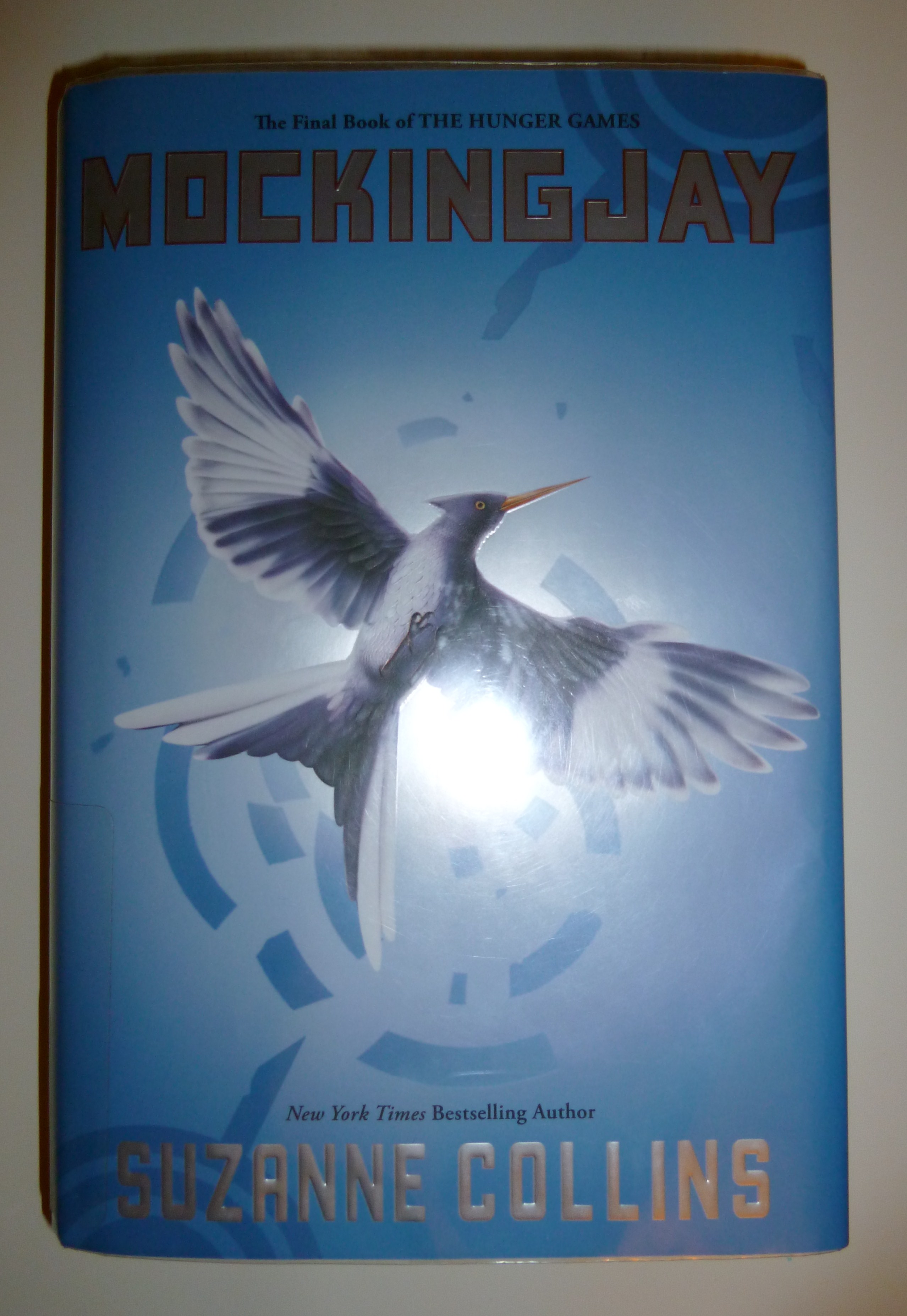
Disappointed with the Mockingjay

I am so sorry to say this, but–I was disappointed by Mockingjay.  If you read my earlier reviews, you know that I thought The Hunger Games was brilliant.  Catching Fire had flaws, but was promising.  And Mockingjay never fulfilled on the promises.

My Katniss problems of the second book magnified enormously in the third.  She carries on with her inability to figure out what to do.  I had hoped that this was a second book, bridge-segment issue, and that it was just setting up the third book’s resolution.  But no.  The rebellion is in full swing by this point, but Katniss still spends large portions of the book moping and moaning and debating what she should do.  Even after she makes some decisions, she still spends way too much time hiding in closets (yes, literally), heavily medicated, or sunk deep in depression.

Part of me wants to be understanding.  She has, after all, been through Hell, and is in some ways still there.  But so has everyone else.  And a lot of people are handling it much better than Katniss.  People are literally fighting and dying for their freedom, Katniss is in a unique position to help the cause–and she can’t seem to rise to it.

That, I think, is the crux of the problem.  I wanted the story of Katniss taking her pain and her horror, using it all to become a stronger person, and to grow into her role as the Mockingjay, the rebellion’s symbolic leader.  Instead, I feel like I got the story of how Katniss (and Peeta, Gale, Haymitch, Finnick…everyone, really) has been severely damaged by all they’ve been through, and will never fully recover.  It’s probably very realistic.  But it’s not narratively satisfying.

I find myself looking at stories from two angles.  Is it realistic–can I believe that it could be real?  Yes.  But was it a good choice for the writer to make?  I don’t think so.  Maybe Katniss really would lose it completely.  But I can’t imagine why a writer would choose to have her protagonist fall to pieces for the second half of a trilogy (starting midway through book two and going on until the end).

Another problem is that we’re so removed from the rebellion in many ways.  Katniss is a symbolic leader, but she’s not a strategic leader and she only occasionally engages with real fighting.  Mostly, she’s used by the rebel leaders for PR purposes (which actually are some of the best parts, because at least she’s doing something).  In a way it makes sense, but it also traps us in the point of view someone who is only peripherally engaged in this huge sweeping conflict.

I really liked Gale.  He does develop a ruthless streak that certainly wasn’t admirable, and he doesn’t always know the right thing to say to Katniss.  He’s flawed.  But he takes an active role in the rebellion, he engages with what’s going on and understands what they’re fighting for, and he’s still trying to protect the people he loves.  There’s a scene where the community is threatened, and it’s actually Gale, not Katniss, who makes sure that Katniss’ sister is all right.  He’s still thinking straight.  Unfortunately, he’s not the protagonist.

It’s still an exciting book, and I did find it absorbing–although one reason it was a page-turner was because I was trying to get to a more satisfying part of the book, and then I never did.  I liked the grayness of good and evil, which we saw before and was even more evident now.  The character development, so good in the others, was lacking.  When new characters were introduced, they didn’t feel as vivid as similar minor characters in the first two books.

As to the love triangle.  Well.  It was resolved, but it was resolved quickly, and ultimately I didn’t find it that satisfying.  Maybe this just wasn’t the right setting for a romance.  But the first book managed such a nice balance with that, I feel like there must have been a better way to do it.

I realize that some of what I wanted from the book may be cliches.  Maybe Collins was trying to tell something really different, that didn’t follow the normal conventions of a coming-of-age story, or of a traditional romance.  But you know something?  Some devices are used a lot because they work.

I still think The Hunger Games is one of the best books I’ve read this year, and it was worth reading the other two just to find out what happened.  I just wish I’d liked what happened!

Author’s Site: http://www.thehungergames.co.uk/

Oh, THAT’S What the Obelisk Is!

I’ve just finished reading the ABC of classic science fiction writers–Asimov, Bradbury and Clarke.  I’m not sure which is my favorite, although Asimov is the one I’m most likely to read more by.  For all of them, I felt I could really see their place in the science fiction canon.  It’s nice to go back and see the originals that have filtered out into the culture in references and inspirations.  Although I read novels by all three, all of them felt somewhat like short story collections.  Maybe it’s a product of being from a time when science fiction magazines publishing short stories were much more prevalent.  Anyway, I feel I have better geek cred now that I’ve read more of the classics–and also because I recently watched Firefly.

But today I actually wanted to talk about Arthur C. Clarke.  Or his novel, that is–I decided to read 2001: A Space Odyssey, mostly because I wanted to see if it made more sense than the movie.  Amazingly enough, it did!  It’s worth reading the book just for that–it’s like being handed the magic keys to unlock the secrets of this classic and utterly incomprehensible sci fi movie.

The book follows essentially the same path as the movie, beginning with primordial man, who sees a strange black obelisk one day, and then picks up a bone and discovers tool use.  But what the book tells you (and the movie doesn’t) is that the obelisk is an unmanned probe sent by highly advanced aliens who are seeking intelligent life.  They see potential in primordial man, and the obelisk actually helps him to discover tool use.

The book goes on as humanity leaps ahead to (a very advanced) year 2001, and discovers an obelisk on the moon.  The obelisk sends a message to Saturn (Jupiter, in the movie), and astronauts are sent out to see if anything received the message.  This gives us the best part of the story, as astronaut Dave battles with his shipboard computer, HAL, who seems to have gone insane.

That’s by far the most relatable part of the book.  When HAL receives a command at one point, he responds with, “I’m sorry, Dave, I’m afraid I can’t do that.”  I think that’s been the mantra of every computer since.  I can’t do this thing I’ve always done in the past.  No, I can’t explain it.  I just can’t.  I’ve been tempted to name every computer I’ve ever owned HAL, except I feel it would be asking for trouble.

2001 has some good moments, though it certainly isn’t a perfect book.  Even though it’s about the biggest moments in human history–the discovery of tools, the discovery of alien life–there are still long stretches where nothing much happens.  In that regard, the movie is significantly worse, but it’s an issue for the book too.

If the actual events dragged at times, at least the concepts of the book were fascinating.  I don’t know if they were ground-breaking at the time.  Despite what the cover quote says, I didn’t find it all that mind-bending; I’d already encountered a lot of the concepts by way of Star Trek–advanced aliens who have evolved into noncorporal beings, unmanned probes, aliens helping other races along on their evolutionary path, a future where Russians and Americans work together in space, travel by way of wormholes.  I don’t know if either influenced the other, or if they’re just sci fi archetypes, but there were definitely shared concepts.

The book is not big on humor.  The funniest part was in the introduction.  Clarke was writing about how pervasive 2001 has become, and mentioned talking to the astronauts who were the first ones to circle around to the far side of the moon.  They told him they had considered radioing back that they were seeing a giant black obelisk, but thought it would be ill-advised…

2001 is a good book if you want to delve into sci fi’s history, and even more so if you care about finding out WHY there was a baby floating in space at the end of the movie (there really is an explanation).  I enjoyed it for those reasons, but otherwise I’m lukewarm.  Though it does give me a great framework for relating to my computer.

Author’s site: http://www.arthurcclarke.net/

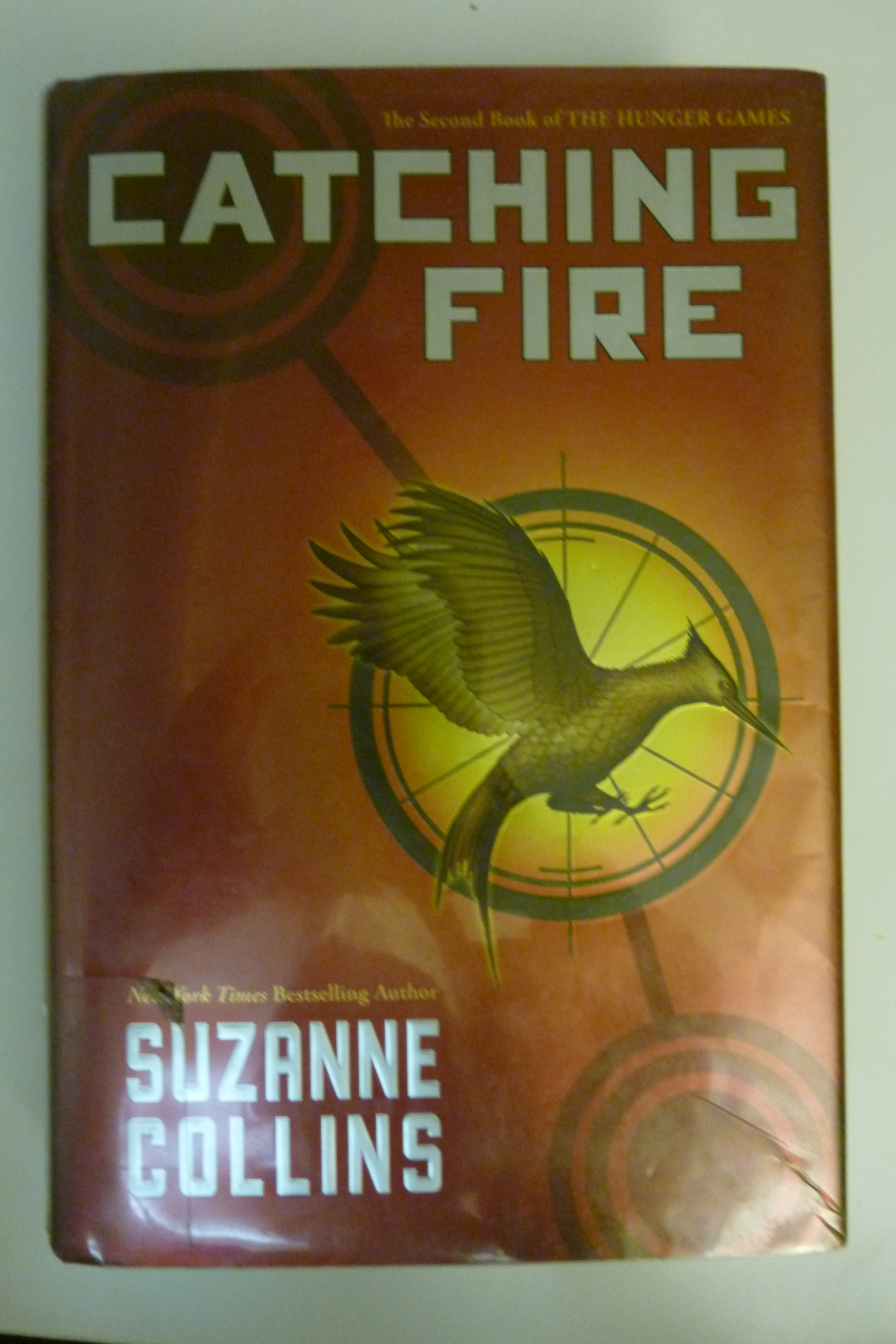
Catching Up with Catching Fire

I just finished Book Two of the enormously popular Hunger Games trilogy, Catching Fire by Suzanne Collins.  Read my review of Book One here.  Be warned, there will be spoilers for the first book, going forward!

I enjoyed Catching Fire, and it had much of the same page-turning quality of the first book.  In fact, I was late for something because I wanted to finish reading the last chapter!  However, enjoyable as it was, it didn’t feel as strong as the first book.  My hope is that this is just the common fate of the Part Two’s of many trilogies.  The first one is new and different and introduces you to everything; the third one is the final epic battle.  The second one is doomed to be primarily a bridge between the two.

The book felt somewhat unfocused, and it may be because of everything it was trying to do, as that bridge for the trilogy.  It begins after Katniss and Peeta have returned to District 12 as the two victors of the Hunger Games.  Quite unintentionally on their part, their dual victory has become a symbol of resistance against the Capital.  The Districts are growing increasingly restless, with rumblings in some and actual uprisings in others.  The first part of the book is mostly about Katniss and Peeta’s attempt to carry on their (mostly) fake love affair, in an effort to present themselves as not at all trying to incite rebellion.  The second part of the book takes us through the 75th Hunger Games.  In the midst of it all, Katniss is still trying to choose between Gale and Peeta, and to decide if she even wants a romance with either, and to figure out how to keep the people she loves safe as the world gets even more precarious.

I think this book definitely succeeded in raising the stakes.  Between the beginnings of a revolution and the Capital’s much more targeted enmity towards Katniss, the scope of the conflicts seems larger.  The dangers feel bigger (and considering it was literally life and death before, that’s impressive).  The threats seem more far-reaching.  I never had to worry about Gale in the first book.  In the second book, anyone could be a victim.  In terms of building towards a climax in the third book, I think this book does do really well.

Catching Fire also carries on Collins’ skill at developing characters in pretty much no time at all.  We get to know some characters from the first book better, and get to meet a lot of interesting new characters too.

I was a little disappointed when it became clear we were going back to the arena for another round of the Hunger Games, because it felt too much like it would be a repeat.  In some ways it was, but it was also very different in very interesting ways–although I was hoping for more dramatic twists than actually developed.

As much as I liked a lot of the characters, I somehow liked Katniss less in this book, and I can’t quite put my finger on why.  Maybe it was that some of her reactions didn’t make her quite as sympathetic.  Maybe it was because there’s clearly something really big developing in terms of a revolution, and Katniss can’t quite seem to figure out how to engage with it, or even if she definitely wants to.  Maybe it’s that she still can’t quite commit definitely to Gale or Peeta, even though she has both time and opportunity (unlike in the first book).  Maybe it’s that she completely fails to see a clue to the twist ending that I found almost painfully obvious (though maybe that’s the author’s fault).  I still like Katniss–but something was a little bit off, and I wasn’t staunchly with her in the same way I was in the first book.  On the other hand, I might’ve liked Peeta better–except I can’t quite decide if he’s skirting too close to being too good.

I think it’s the unfocused plot and whatever it is that’s bothering me about Katniss that leads me to rank this one a bit below the first one.  But don’t get me wrong–it’s still better than a lot of other books!  I’m really hopeful for the conclusion to the trilogy.

And I will say this for Catching Fire–there’s a fantastic moment in here that is probably my favorite of the trilogy so far.  I don’t want to give it away for anyone who hasn’t read it, but for those who have–it’s the interviews with Caesar, especially Peeta’s.  Brilliant.

Author’s site: http://www.thehungergames.co.uk/