Book Review: Relativity

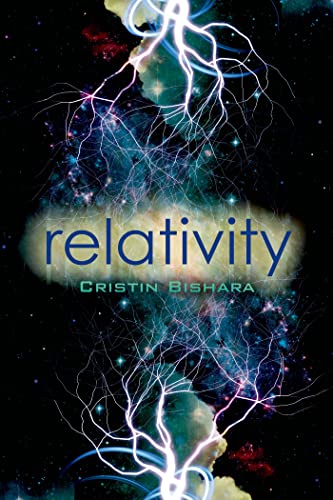
Still catching up on some of my unreviewed challenge reading from late last year…  My last parallel universe book was Relativity by Cristin Bishara.  Another YA one, it explored how a family and a town can change in different universes.

Ruby’s mother died when she was four; now sixteen, her father recently moved them from California to a tiny town across the country, with a new stepmother and horrible stepsister.  But then Ruby finds a mysterious old oak with a door in the trunk—and going inside takes her to alternate worlds.  What if her mother didn’t die?  What if she had an older brother?  What if the town was a haven for art and science instead of, well, not one?  What if her best friend from California lived in this town instead?  How is Ruby different—and can she find the perfect life?

This was a great one for exploring my favorite parallel universe question—how does one event in the past change everything that follows?  I really enjoyed the exploration of Ruby’s different lives and how different she herself is.  Her desire to find the “perfect” life is very relatable—and heartbreaking, because it’s so clearly a doomed quest. Continue reading “Book Review: Relativity”
Movie Review: Rogue One

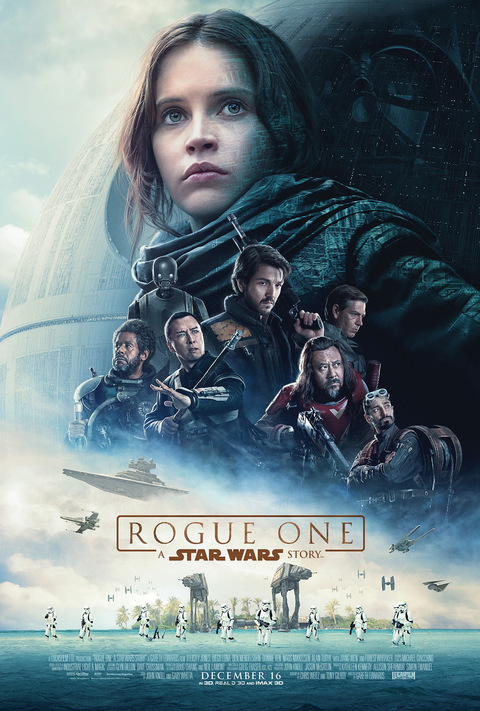
rogueone_onesheeta_1000_309ed8f6Apparently it’s movie week on the blog.  I didn’t intend to do a theme around scrappy people with few resources fighting governments, but, well…  Today, from a galaxy far away, Rogue One: A Star Wars Story.

Billed as the story of the Rebel team who stole the Death Star plans, this is a prequel (but not a prequel, if you know what I mean) to A New Hope, set in the weeks just before it.  It’s the story of Jyn (Felicity Jones), daughter of the Death Star’s designer.  We meet her in an Imperial labor camp, imprisoned for vague reasons, from which she is swiftly recruited by the Rebel Alliance.  She joins new characters like Cassian (Diego Luna) and converted Imperial droid K-2SO (voiced by Alan Tudyk of Firefly fame), and familiar ones like Mon Mothma and Bail Organa, as they assess the Empire’s new threat.

This was a…different Star Wars movie.  I feel rather oddly about it.  I didn’t exactly dislike it.  It wasn’t perfect but I wouldn’t say it’s bad.  But it wasn’t quite my type of movie either.

More than any other Star Wars movie, this one was a war movie.  Yes, “war” has always been there in the second word of the franchise title, but it’s always been a space opera.  There was always a layer of unreality.  We all know that the stormtroopers will never fire a lethal shot at the heroes, and even though Darth Vader tortured Leia, it didn’t rumple her (iconic) hairstyle.

Rogue One was gritty.  We’re visiting a galaxy that has been ground under the Imperial boot for twenty (give or take) years, and shows it.  It’s visible in the devastated landscapes, the eyes of the rebels, and the layer of dirt on Jyn’s face.  The original trilogy gave us a picture of a fight between good and evil (or light and dark).  Rogue One gives us a Rebel Alliance with infighting and factions, where even the “good” guys do morally questionable things.  Some of this draws out impassioned repudiation, as when Jyn accuses another character of being no different than a Stormtrooper if he’s going to follow bad orders blindly.  But it’s lines like that that stand out in a darker, grayer galaxy. Continue reading “Movie Review: Rogue One”

Book Review: A Crack in the Line

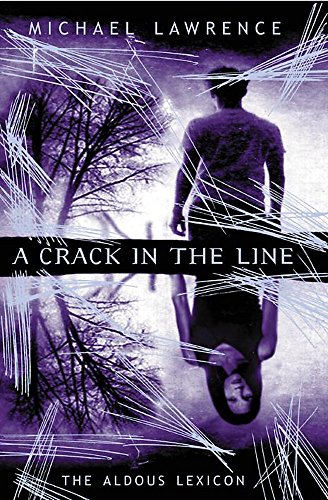
I’m carrying on my parallel universe reading with A Crack in the Line by Michael Lawrence, featuring one of the more unusual alternate life scenarios.

Sixteen-year-old Alaric lost his mother two years earlier in a train accident, following surgery where she had a 50-50 chance of survival.  One day he slips into an alternate version of his house…but in this life his mother survived.  But something else also changed earlier: Alaric meets an alternate version of himself.  Naia is as close to being Alaric as possible–except she’s a girl.  Alaric and Naia begin to explore the differences between their lives, how the parallel worlds work, and mysteries in their family’s past.

This read was a mixed experience.  I liked the concept a lot, and in some places the emotional impact was very well done.  I didn’t mean to read two parallel universe books involving grief in a row; that just kind of happened.  Alaric’s grief over his mother, and the extremely complicated feelings of knowing she’s alive in another universe were well-explored.

I liked the parallel universe mechanics here.  This follows the basic idea of shifts in the key events in the past causing a different present/future.  A lot of versions of that emphasize choice, but this one emphasized even odds.  There’s at least one example where a conscious choice changed things, but the main things (the mother’s survival, Alaric/Naia’s gender) wasn’t really under anyone’s control.  It was just a case of even odds, so universes formed where each option happened.  (It does open the question of whether universes exist for every individual to be gender-swapped…but that’s a bit much to encompass.)  I also liked that it explored multiple changes, instead of just one.  There are at least three key differences between Alaric’s and Naia’s universes, so different results kept happening at different times. Continue reading “Book Review: A Crack in the Line”

Book Review: The Square-Root of Summer

I think I’ve managed a first for me in my challenge reading.  I put The Square-Root of Summer by Harriet Reuter Hapgood on my random To-Read list on my phone (I think I stumbled on a blog post review while at work—more on that later, and why it really was work).  I requested it from the library without remembering it clearly—and found myself stumbling accidentally into a parallel universe novel!

Gottie’s world is coming apart.  Literally.  Seventeen, on the cusp of needing to figure out what to do with her life (or at least whether to go to college), Gottie’s attention is focused on the past.  On her grandfather’s death almost a year previously.  On the return of her childhood friend Thomas, out of touch across an ocean for five years.  On the memories of her secret summer fling last year with her brother’s friend.  And all around her, wormholes are opening up, sending her hurtling back into the past.

First, the mechanics of this.  I never quite got them, even though Gottie is a math genius who spends a lot of time discussing equations and theories.  But in practical and storytelling terms, the point is that she’s periodically encountering wormholes which send her mentally (but not physically) flashing back to earlier points in her life.  As the novel progresses, the effects become more dramatic, until she’s physically moving to parallel lives, not moving through time but moving to a universe where an earlier choice caused a change.  And ultimately cause and effect become confused, and things like writing an email response turns out to be the message that inspired the email that she was responding to.  If you see what I mean. Continue reading “Book Review: The Square-Root of Summer”

Book Review: Sidewise in Time

My parallel universe reading has taken me back into some classic science fiction, to read what I believe is the very first published example of a parallel universe story.  At least, that’s what the author’s introduction and Wikipedia say!  Sidewise in Time and Other Scientific Adventures by Murray Leinster was an excellent collection of shockingly prescient stories from the 1930s and 40s, leaving me wondering why I’ve never heard of this author before!

“Sidewise in Time” is a novella, so I’m counting it as a read for my challenge.  It features a collision between universes (I think—it’s technobabble), such that suddenly different patches of parallel universes are aligned.  So as you move geographically across land, you also pass into patches of other universes.  And just to make it even messier, nothing’s settled so the universes are still moving.  The story mostly follows one group of explorers moving through portions of Virginia and in and out of universes, with intermittent sections on other chaos happening elsewhere.

It’s a good story in its own right, but I was fascinated by how complete this idea of parallel universes was, here in its first incarnation.  Leinster has fully established the concept of different occurrences in the past spawning new universes, with subsequent different results in the present. Continue reading “Book Review: Sidewise in Time”