Dark Poets and Untimely Death

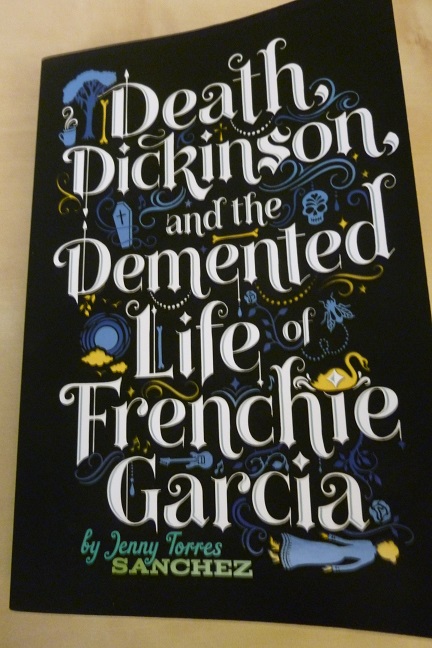
Death DickinsonFrenchie Garcia likes to talk to Emily Dickinson.  The cemetery near her house has a grave for Emily Dickinson, and though it’s not the famous one, Frenchie likes to pretend.  She views “Em” as a kind of imaginary friend–and that idea was what drew me into reading Death, Dickinson and the Demented Life of Frenchie Garcia by Jenny Torres Sanchez.

As you might already guess, Frenchie is a somewhat unusual teenage girl, considering she feels a kinship with a reclusive poet, and thinks about death a little more than may be healthy.  Frenchie is struggling with changes in her best friend, doubts about her plans post-high school, and a depression no one else seems to recognize the depths of.  What no one realizes is that Frenchie’s worries are tied to one wild, unexpected evening she spent with Andy Cooper, a near-stranger but long-time crush.  Andy committed suicide just hours later.  Wracked with guilt and uncertainty, Frenchie sets out to re-create her evening with Andy, hoping to find answers.

Despite being about depression and death (and Dickinson), this book isn’t nearly as much of a downer as you might expect!  Frenchie is experiencing a lot of darkness, but the book is fast-paced and ultimately more about life than death–so if you’re turned off by the apparent bleakness, I can tell you that I personally didn’t find it to be a depressing read.  (Hmm, lots of Ds in that paragraph…)

Frenchie’s voice and character are strong even when she’s feeling lost.  Many of her feelings are very relatable, even if she’s experiencing them to a more extreme degree than (I hope) most readers.  There are questions about friendship, choosing a path in life, how well you can know a person, how to handle changes and let-downs, and what it all really means.  Some of Frenchie’s apparently profound revelations felt a little basic, but I am older than both her and the book’s target audience, so that may be a factor there.  On the whole, it addresses some powerful issues.

My favorite aspect to the book is actually a kind of subplot, around Frenchie’s best friend, Joel, and his (relatively) new girlfriend, Lily.  The book is first person from Frenchie’s point of view, so we only have what she tells us about Lily–but it’s handled carefully enough that I could tell Frenchie wasn’t a reliable narrator on this subject.  Most or all of her hostility towards Lily is unjustified by who Lily is.  Though at the same time I can understand completely why Frenchie feels the way she does, so I felt sympathy for her.  It was a nicely-handled presentation of a familiar scenario in teen books, but without the conventional conclusion to the situation.

My biggest reservation, on the other hand, is Colin, Frenchie’s choice to accompany her on this re-created night.  He’s a near-stranger, which is what she needs for the situation, but I never quite believed that he was willing to go along for this apparently irrational ride.  I get that he thinks she’s cute…but there was more than enough to scare just about any guy off.  While so many other characters (Andy included) were complex and effective, Colin I found less believable.

I won’t tell you the ending, but I will say that it’s satisfying, without being too pat or neat.  It ends positively, but not in a place of implausible solutions or easy answers.  After all, you can’t have too happy an ending, when your book has “Dickinson” in the title!  And, you know, “death” too.

Disclaimer: I received a copy of this book for free from the publishers, in exchange for an honest review.

Author’s Site: http://jennytorressanchez.com/

Other reviews:
YA-aholic
Candace’s Book Blog
Teen Librarian’s Toolbox
Anyone else?

Buy it here: Death, Dickinson, and the Demented Life of Frenchie Garcia

Witches and Hangings and Swampland, Oh My

ChimeI’ve been hearing about Chime by Franny Billingsley for quite a while now.  What finally drew me in to pick it up, though, was the opening line: “I’ve confessed to everything and I’d like to be hanged.  Now, if you please.”  So intriguing!  What does it mean, what’s the story?  Dark, but rousing my interest wonderfully.

Well…the mystery was better than the solution.  This was a good book but, as sometimes sadly happens, it was never quite as good as I hoped it would be.  Since a lot of people really loved this one, my reaction may be a product of my waiting too long to read it, and building the whole idea up just a bit too much!

Chime is narrated by Briony, who believes she’s a witch—Stepmother explained it to her.  Briony has the Second Sight, the ability to see the wide variety of magical creatures living in the swamp outside her village.  She believes that when she loses control of her temper, terrible things happen to the people around her—like the accident that left her twin sister Rose with the mind of a child, or the great wave that crippled Stepmother.  Briony is careful to present a smiling mask to the world and to remember to hate herself and her wicked deeds—until she meets Eldric, who makes her wish witches could love.

Briony should have been an intriguing character, and in some ways she is.  The trouble is, while I grew to like her, I also got frustrated with her very quickly.  Certain twists became obvious (to me) almost immediately, and I wanted to shake Briony for not figuring them out.  Considering certain trauma she had been through, her inability to see was probably realistic and I acknowledge that—but that didn’t make it less frustrating to read.  There are additional twists and revelations as the book goes on, some of them more unexpected, although most I worked out sooner than Briony did.

That may be part of the fundamental problem of Briony’s character.  She’s supposed to be very clever—but she doesn’t act that way.  Briony and Eldric also felt consistently younger than they were supposed to be.  To me, they often felt more like fourteen, instead of seventeen and twenty-two, respectively.  I think Eldric was meant to be witty, and at times he was…but he came across as silly a bit too often.  And I must say, having a man and a woman form a “Bad Boys Club” in the style of Tom Sawyer really doesn’t seem like the best of ideas for setting up an adult romance…  There were some satisfying moments in the end, but it was rough in patches along the way.

I did find the magic more effective, once I got into it.  It was initially difficult to figure out the setting—there’s a strong New England and Salem Witch Trials feel to the little town, and since it’s supposed to be an (old country) English village in the early 1900s, that threw me some.  But—once I got grounded, I did like the world of spooky, magical creatures in the swamp—everything from a Brownie to ghost children to a Dead Hand—and the ways the villagers had learned to deal with them.

In some ways, Rose, Briony’s sister, became one of my favorite characters.  She has more depth than was immediately apparent, and in her own obscure way, she really is clever.

The book picked up as the action did and the second half is at least an engaging ride that ultimately presents some good twists.  And there is a reason Briony wants to be hanged—now, if you please.  Not a wonderful book—not a bad book—a pretty good book that almost might have done better with not quite such an intriguing opening.  Perhaps I would have enjoyed it more expecting less!

Author’s Site: http://www.frannybillingsley.com/

Other reviews (some who liked it much more than I did):
Things Mean a Lot
That’s What She Read
Good Books and Good Wine
The Allure of Books
Anyone else?

Buy it here: Chime

A Girl, an Alien and a Cat

True Meaning of SmekdayI don’t remember anymore where I originally heard about The True Meaning of Smekday by Adam Rex, but I know I read it because I couldn’t resist that title–or the premise that came with it.

Sometime in the future, aliens called Boovs land on Earth on Christmas Day (in true Doctor Who tradition) and proceed to take over the planet.  Resistance is, shall we say, futile.  The Boovs rename Christmas as Smekday, in honor of their General Smek who conquered Earth (Smekland).  Our heroine is Gratuity Tucci–her friends call her Tip.  Tip’s mother was abducted by the Boov on Smekday, a story she begins to relate for a school writing assignment on “The True Meaning of Smekday.”

When all humans are ordered to relocate to Florida, Tip sets out alone in her car (she’s eleven, but she taught herself to drive after her mother disappeared), accompanied only by her cat, Pig.  Along the way, she meets a Boov named J.Lo (his Smekland-name).  He has his own troubles, and they form an uncertain alliance.  They realize that the troubles for Smekland have just begun, when another race of aliens comes to invade: the Gorg, known throughout the civilized galaxy as the Takers.

I am always impressed by books which can manage satire-level humor, balanced with genuine tragedy and heartache.  Telling an absurd abduction story is one thing.  Telling a tragic abduction story is another.  Doing both at once–now that’s really something.  There’s a lot of humor throughout the book, but there are also serious dangers and serious tragedies.  Neither detracts from the other.

Tip is a spitfire narrator, brash and brave while also possessing real fears and pain, particularly around the loss of her mother.  She has an incredibly strong narrative voice that’s a lot of fun to read.  J.Lo is wonderfully funny in his not-quite-grasping human culture, his endless munching on truly awful things and his nutty technology.  Balanced with the humor is the growing friendship between J.Lo and Tip.  And it becomes clear that, regardless of how many legs he has, J.Lo possesses so many of the qualities that make us all human.

I mentioned satire above, and there are definitely strong strands of commentary here on the real world.  The most obvious (sometimes pointed) one is the comparison between the Boovs sending of humans to a reservation, and the Europeans doing the same thing to the Native Americans in history.  There’s a Native American character who is great in many ways, but almost makes the satire a little too hit-you-over-the-head-with-it.

On a less serious parallel to the real world, parts of the book take place in Happy Mouse Kingdom in Orlando, Florida.  Need I say more?  And despite the humor, the book gets into surprising depth about what makes “Happy Mouse Kingdom” so appealing.

There are some interesting experiments in the actual telling of the story.  Besides Tip telling the story, the words are illustrated by Tip’s Polaroid photographs (drawings), and supplemented in places by J.Lo’s comics.  It’s cleverly done, and adds some depth, especially to the portrayal of the Boov.  The comic section detailing their history as a culture was one of my favorite parts (and there was some pretty heavy satire there too).

I read the print edition, but there’s also an audiobook that won an Odyssey.  And Dreamworks is planning a movie for 2014, which I am now looking forward to!

Tip is eleven, and that’s probably a good target age for the reader too, though obviously it’s a lot of fun even if you’re older!  It’s a funny story about aliens, a heartwarming story about friendship and family, and an effective satire about culture, environmental issues and politics.  All that, in a Middle Grade book.  Never tell me books for kids can’t have depth. 😉

Author’s Site: http://www.adamrex.com/

Other reviews:
There Be Words
The Bookshelf Gargoyle
The Cazzy Files
Anyone else?

Buy it here: The True Meaning of Smekday

Princess of the Silver Woods

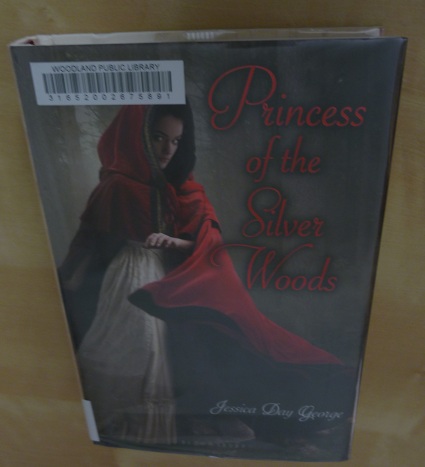
Princess of the Silver WoodsI recently reread Princess of the Midnight Ball by Jessica Day George (review), which turned out to be great preparation for reading the third book in the series, Princess of the Silver Woods.  Thank you, Lark, for letting me know it existed!

The first book retells the story of the Twelve Dancing Princesses.  There’s a second book, loosely retelling Cinderella, Princess of Glass (review).  As the cover makes clear, the third one draws from Little Red Riding Hood—if very loosely!  Fairy tale or not, this is definitely another good one for Once Upon a Time.

The third book focuses on Petunia, the youngest of the princesses, who starts the book traveling through the woods to visit an old friend from a neighboring royal court, the Grand Duchess Volenskaya.  Along the way, she runs afoul of bandits wearing wolf masks–particularly their leader, Oliver, who abducts Petunia more or less by accident.  She makes it eventually to the Grand Duchess’ and all should be well—except that she and her sisters have recently been plagued by particularly vivid nightmares, shadowy forms are lurking in the garden, and the Grand Duchess may have ties to their old enemy, the King Under Stone.

There are elements of Red Riding Hood here and there, but mostly this novel is a second confrontation with the King Under Stone and his macabre court.  This felt like a much more closely connected sequel than the second book, which was primarily a separate adventure.

I really enjoyed seeing the twelve sisters again.  George managed her deft juggling of many characters once again, and I didn’t feel troubled trying to sort out which princess was which.  As in the first book, it’s always self-evidently obvious—Jonquil must be the hysterical one, because she’s always collapsing whenever we see her.  Poppy (the lead of the second book) is obviously the bold one, because she’s always being bold.  It was nice seeing Galen again (who really is lovely), and I liked that we got a little more of Heinrich, who just barely shows up in the first one.  And I love that all the princesses’ have taken up knitting!

Petunia didn’t blow me away as a heroine, but she’s scrappy and likable, and I do enjoy when she starts ordering her demon-suitor around.  Oliver is a bit of a Robin Hood figure, a displaced earl who turned to banditry to feed his people.  Again, likable, if a little typical-hero-type.

The romance didn’t do much for me.  There was nothing wrong with it—it just didn’t feel like it added much to the adventure.  Petunia and Oliver have very few opportunities to interact, and while that was true for Rose and Galen too (Galen even makes a comparison at one point), somehow I felt the romance in the first one much more than I did here.  And I was a bit annoyed with Oliver when both Petunia (a girl he had barely met) and his men (who he had lived with and fought with all his life) were in mortal peril, and he seemed to find these concerns equally troubling, with a possible slight edge to Petunia.  Really?

But while the romance may have been a bit of a non-thing, the adventure was excellent.  The King Under Stone and his brothers are thoroughly creepy, and the fact that they were defeated once already doesn’t at all seem to lessen the threat.  George did a nice job of re-exploring familiar territory, while convincingly raising the stakes and the tension.

Overall, I’d say that Princess of the Midnight Ball was the stronger book, but this third one was good fun to read as well—and I enjoyed spending more time with the twelve princesses, and getting a little more of their story.  The first one can stand alone, but I’d recommend the next two as well.

Author’s Site: http://jessicadaygeorge.com/

Other reviews:
The Bookwyrm’s Hoard
Escaping Reality (One Book at a Time)
Tressa’s Wishful Endings
The Book Smugglers
Anyone else?

Buy it here: Princess of the Silver Woods

Princess of the Midnight Ball

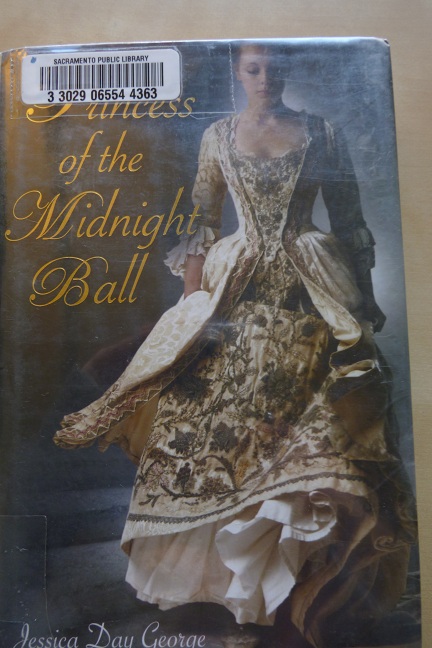
Princess of the Midnight BallSomewhere in the last couple of years, “The Twelve Dancing Princesses” (or, “The Shoes That Were Danced to Pieces”) became one of my favorite fairy tales.  I’ve read many retellings, and even wrote one for NaNoWriMo 2011.  For the Once Upon a Time reading experience this year, I decided to go back and re-read one of the first retellings I encountered, Princess of the Midnight Ball by Jessica Day George.

This is a lovely, magical retelling that evades the typical pitfalls of the story, while shining mostly for its two lead characters.  The point of view is split between Galen, a young soldier just returning from a long war and taking up a job as under-gardener at the palace; and Rose, the oldest princess, trying to hold her sisters together as they suffer through a curse, evading questions about their mysteriously worn-out slippers.

Rose and Galen both have a way of looking harmless, with unexpected depth and strength beneath.  Rose is a pale, beautiful princess–but that doesn’t mean she doesn’t have intelligence and strength of will.  Galen is a gardener who spends his spare time knitting–which proves to be a surprisingly valuable skill.  When I think about it, the two of them don’t spend much time together.  But I don’t really think about it when I’m reading the book, and this is a rare occasion when I find myself completely buying into a very cute romance, even when the characters don’t really have much opportunity to get to know each other.

The other eleven princesses largely run together, which tends to happen quite a bit in these retellings.  It actually worked rather well in this one, though, I think because George hit a very nice balance of giving me just enough information, while not making me feel like I should be knowing/remembering more.  I’m not sure that makes sense…but for example, on the princesses’ ages: Rose and Lily are the two oldest, at eighteen and seventeen.  Petunia and Pansy are the youngest, seven and six.  The other eight exist in some vague space in between, and while I don’t know precisely how old they are, I also never felt like I needed to know.

Similarly, I had a slight sense of the personalities of roughly half the princesses, and that seemed to be enough.  George has a nice way of never asking the reader to remember the princesses’ personalities, because it’s self-evident whenever that particular princess is referenced.  Poppy is the boisterous one, and it was no effort to remember that because she’s always being boisterous whenever we see her.

For the most part this is a very light retelling, though there are a few moments of genuine creepiness.  It follows pretty close to the original fairy tale, and comes up with some very nice explanations and backstories, filling in the empty spaces in the Brothers Grimm’s much shorter tale.  Some retellings move farther away from the original and it works…but others have completely floundered in the process.  This one didn’t try to go too far, and succeeded very well within its own scope.

I remembered this as one of the best of the retellings I’ve read, though it was hard to judge since I read it before most of the others.  Happily, I was right!

Author’s Site: http://jessicadaygeorge.com/

Other reviews:
Lili’s Reflections
The Dead Authors’ Club and More
Bird on a Pencil
Anyone else?

Buy it here: Princess of the Midnight Ball