

Bloody Jack–at School, at Sea, and on the River

Mississippi Jack
Book 5, which has 14 discs in all

I have been continuing through the audio adventures of Jacky Faber by L. A. Meyer, read by Katherine Kellgren, and am now halfway through the series.  They continue enormous fun, and are great to listen to one after another, as they tend to directly follow each other chronologically–though I’ve decided to take a break for a while after the fifth one.

I reviewed the first audiobook here, Bloody Jack, about how a London street urchin disguises herself as a boy to join a Royal Navy ship, hoping to “better her condition.”  Along the way, she meets close comrades and gains the nickname “Bloody Jack”–which, as Jacky likes to say, is not her fault.  Mostly.

I’ll try to refrain from spoilers, but I will tell you that her deception is found out by the end of the book.  Book Two, Curse of the Blue Tattoo, picks up with Jacky being dropped off in Boston at The Lawson Peabody School for Young Girls, where the formidable Mistress Pimm will try–with mixed success–to turn her into a proper lady.  We get to meet two of my favorite characters in this volume.  First, Amy Trevelyne, Jacky’s dearest friend, who comes out of her shell under Jacky’s influence, and who tries–with mixed success!–to rein in Jacky’s wilder impulses.  Second, we meet Jacky’s nemesis, Miss Clarissa Worthington Howe (of the Virginia Howes), who is very much the fine lady–but can hold her in a fight too, with words or claws.  This book also has an element of mystery to it, as Jacky gets involved exploring the death of a serving girl, and the very creepy minister who lives next door.

Book Three, Under the Jolly Roger, sees Jacky at sea again.  Through a series of mishaps, she ends up on the H.M.S. Wolverine, commanded by mad Captain Blodgett.  Jacky’s gender is discovered and her virtue is sorely threatened, but as usual she carries on with aplomb.  This book is really two plots, and Part Two sees Jacky setting up as a privateer–and fighting at the Battle of Trafalgar in the climax.  I remember when I read this one the first time, I had to stop reading it before I went to bed.  Too exciting!

We meet another favorite character here, Higgins, Jacky’s ever faithful man servant.  I can’t tell you how delighted I was listening when Higgins first turned up!  It’s been a long time and I’d forgotten exactly how he got into the story.  Higgins is a prim and proper gentleman’s gentleman, who nevertheless has a taste for adventure.  He faithfully follows Jacky through her madcap adventures, always ready to offer a wise word, a tut of disapproval, a cup of tea or a hot bath.  Just to clarify here, it becomes quickly apparent (though never said in so many words) that Higgins is gay, which makes him one of the few men Jacky doesn’t flirt with.

Book Four, In the Belly of the Bloodhound, sends Jacky back to Boston and school, trying to lay low and avoid the British intelligence officers pursuing her for piracy.  The plan to stay out of trouble goes awry when Jacky and the girls of the school are abducted by slavers, and carried towards South Africa aboard the Bloodhound.  This is my favorite book in the series to date.  Jacky is certainly not going to take slavery lying down, and she martials the girls into a fighting force.  I love the girls of The Lawson Peabody School, and I love watching them grow ever stronger and more confident.  We get a lot of Clarissa, as well as little Rebecca Adams (granddaughter of John Adams) and Dolly Fraser–who later marries Mr. Madison.  Along with getting a wonderful cast of brave girls in this book, Jacky doesn’t meet any pretty boys–meaning for once she has to curtail her sparking.

Jacky lights out West in Book Five, Mississippi Jack, commanding a showboat down the river along with Higgins and a host of familiar and new characters.  Jacky meets Native Americans (including this unnamed Indian woman who went west with that expedition…) and the delightful, hilarious, roaring river man Mike Fink.

As I think about my plot summaries, I realize I’ve left off a major character–Mr. Jaimy Fletcher, who is doomed throughout this series to chase along always a few steps behind Jacky, his fiancee.  Meyer often intersperses Jacky’s adventures with letters (literal or mental) from Jaimy to Jacky, updating what’s occurring with him.  And here I come to my biggest criticism of the series.  On my first read-through, I recall being pretty neutral about Jaimy.  On this second pass, I have to say I think he’s all wrong for her.  They meet as children in the first book and are faithful to each other (mostly) for nine subsequent books…but honestly, I’m not convinced of their relationship’s validity because they’re so rarely actually together.

A bigger problem–Jaimy keeps wanting Jacky to settle down.  And that’s just not who she is.  I don’t have a problem with Higgins or Amy, who clearly value Jacky for her high spirits and just wish she would restrain some of her more dangerous impulses.  Jaimy wants to marry Jacky and install her in a cottage somewhere while he goes to sea and she…I don’t know, raises babies?  I don’t believe Jaimy loves Jacky for who she is; he’s imagined the girl he thinks he wants, and for some inexplicable reason has given her Jacky’s face.  I’d like to believe Meyer will eventually break the two of them up…but I just don’t see it happening.  So I have to hope Jaimy will mature a bit.  As of book ten, he’s still working on it.

As I mentioned, I’ve been listening to the audiobooks on this pass through–the books are great as paper novels, and they’re also wonderful on audio, thanks to the delightful talents of Katherine Kellgren.  She gives us Jacky’s Cockney accent, brings believability to her melodrama, and makes me like Jacky’s singing much more than I ever did on paper.  She also gives us excellent voices for a vast cast of characters, with accents from British to American to deep South to Irish to French, with characters who are male, female, young, old–or even bellowing Mike Fink.  She even makes different characters sound different while singing.  All in all, I’m a big fan.

But I’m a fan of the whole series.  On paper or audio, I highly recommend following the adventures of Bloody Jack!

Author’s Site: http://www.jackyfaber.com

Other reviews:
Gallivanting Girl Books
The Lostent Wife
The Magic of Ink
Anyone else?
Off to Sea with Bloody Jack

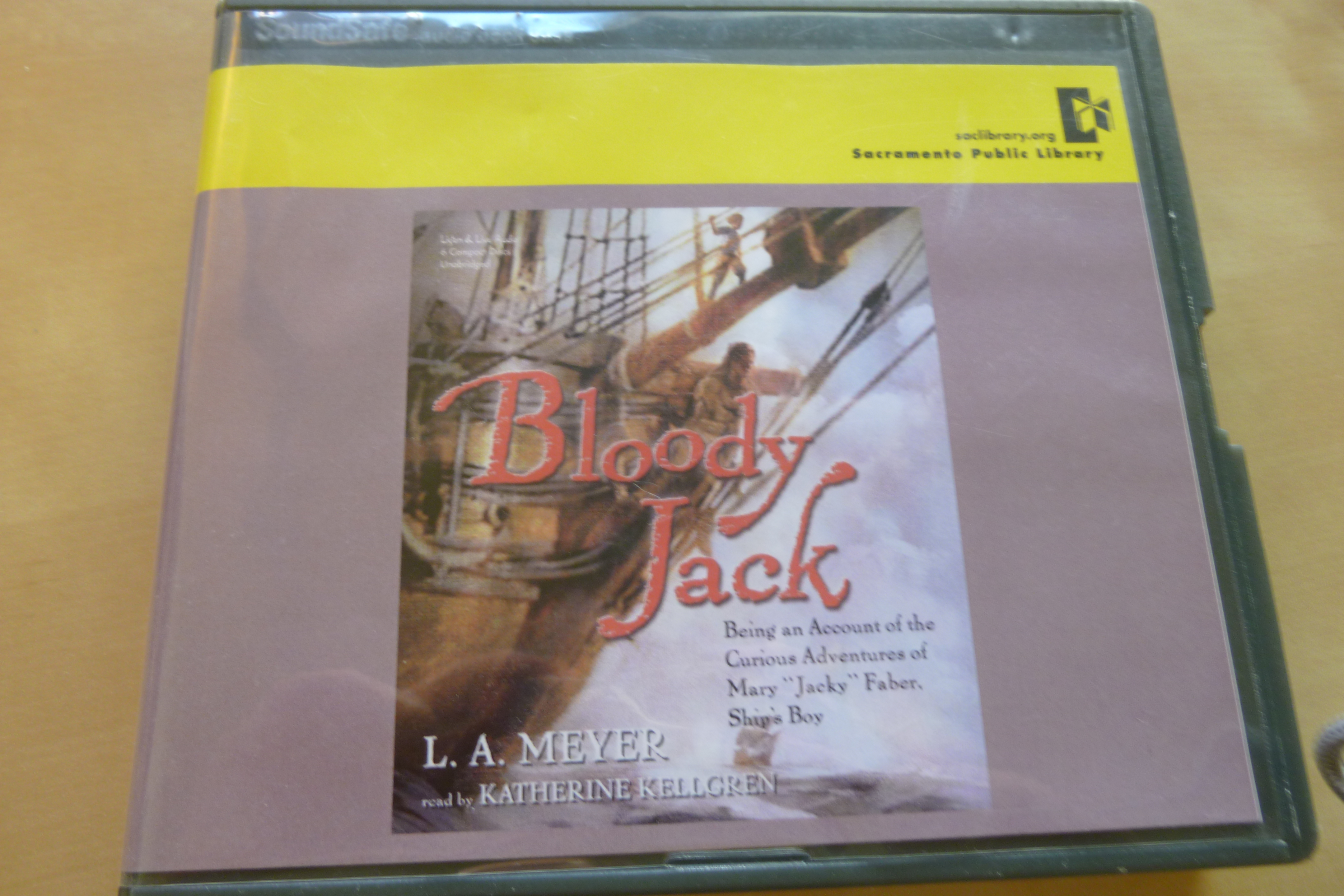
I have finally ventured into the wonderful world of audiobooks, which I entirely blame on all the bloggers who keep raving about them.  I’ve resisted because I work from home–no regular commute to make convenient listening time.  But I’ve increasingly had longish drives for social events, and thought I’d try an audiobook–and now I strongly suspect I’m hooked, for at least nine books.

I’ve started listening to the Jacky Faber books by L. A. Meyer on audio, and now I think I’m in for the series.  I’ve been reading the books for years as they come out–I recently reviewed number ten, Viva Jacquelina.  It’s been a long while since I read the early ones, but I have too many books lined up–where was I going to fit in nine re-reads?  Audiobooks seemed like a natural solution, especially because I was guessing these would be particularly good read aloud–and I was right!

The first book in the series is Bloody Jack, and begins the tumultous adventures of Jacky Faber.  An orphan girl living on the streets of London, Jacky disguises herself as a boy and talks her way onto a Royal Navy ship as a shipboy.  Mostly, she’s hoping for a decent meal–and she longs to see “the Bombay rat and the Cathay cat and the kangaroo.”
Katherine Kellgren does a wonderful job with the reading.  It never sounds like she’s reading–it sounds like Jacky telling you her story, cockney accent and all.  The book is in first person, present tense, making it very immediate.  It’s fast-paced (especially as the series goes on) and the audio swept me right along.  Jacky is very emotive and dramatic, and Kellgren manages to bring believability to Jacky’s most over-the-top exclamations.

Jacky is without question the best part of this very good series.  She’s daring and exhuberant and never, ever manages to stay out of trouble.  She swears she’s really a coward, but that never stops her from diving into scrapes when the situation calls for it.  She’s staunchly loyal, endlessly charming, and one of the most engaging heroines I’ve ever met.

Jacky inevitably gathers friends and enemies around her, and it was fun going back to this first book where we get to start meeting major characters.  Kellgren gives characters different voices in the dialogue, without getting cartoonish about it.  Liam has an Irish accent, the captain sounds stern, and you can just tell immediately that Jaimy is handsome and well-born.

The story is wonderful as a book or on audio.  The adventures are exciting, Jacky is delightful, and, well, it’s just irresistable find out what she’ll do next!

Author’s Site: www.jackyfaber.com

Other reviews:
Good Books and Good Wine
Audiobook Heaven
Finding Wonderland
Anyone else?

Dodging Through Victorian London

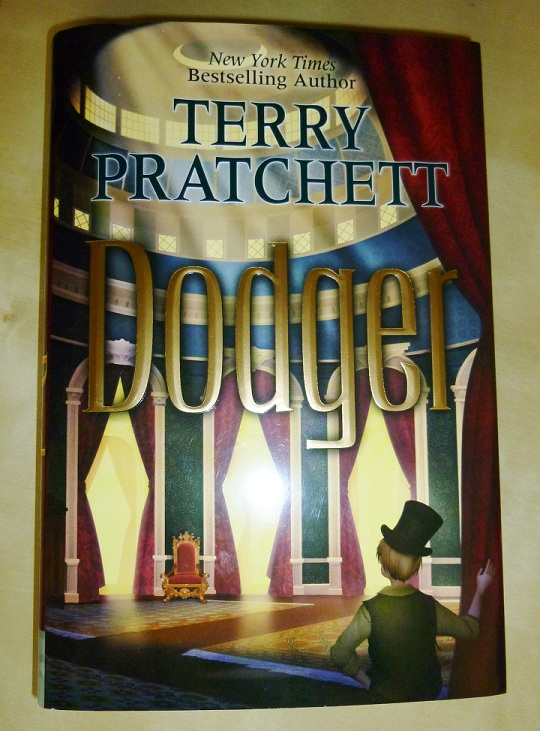
Considering how much I love Terry Pratchett’s Discworld books, I have been impatiently awaiting his latest book–even if it isn’t Discworld.  Dodger is not quite on the level of the best Discworld, but it was a fun read of its own.

To clarify one thing at the beginning, the book is not really about the Artful Dodger from Oliver Twist–at least, not exactly.  Say rather it’s a young man who could be the inspiration for the Artful Dodger–considering his connections to Charlie Dickens, and all.

Dodger is a tosher by trade, a seventeen year old boy who makes his living searching through the sewers of Victorian London in search of lost coins, jewelry and other treasure.  And if occasionally things happen to fall out of their owner’s possession and into Dodger’s hands, well, who is he to dispute with a bit of good fortune?  Everyone knows Dodger, and everyone knows Dodger never gets caught.

There’s no Fagin, but there is Solomon, a wise old Jewish watchmaker who gives Dodger a place to sleep and helps him stay on the straightish and somewhat narrow path.  There’s no Oliver Twist, but there is Simplicity, a young woman Dodger rescues from a couple of thugs–a young woman who turns out to have crowned heads of Europe intensely interested in her.  His efforts to help her will take Dodger into a whole new part of society and bring big changes into his life.

All in all, I didn’t love the book, but there is a great deal here to like very much.  There’s enormous fun in the various historical figures Dodger’s path crosses–from Fleet Street journalist Charlie Dickens to up-and-coming politican Benjamin Disraeli, and a host of others I didn’t have enough historical grounding to recognize (but there’s a helpful afterword).  We also wander into fictional territory when Dodger meets Sweeney Todd, more sad than demonic and a powerful lesson about the tendency of the world to create the story they want to hear.

Dodger’s character growth throughout the book is excellent.  At first, he seems a little too noble (in the character sense) for a boy on the streets, but as the book develops and his character does too, it fits more easily.  It’s not an easy growth, and Dodger finds a certain loss of identity (or at least uncertainty) in his sudden rise in standing and character.

My favorite things are a couple of character quirks.  First, especially near the beginning, Dickens has a tendency to make a remark, get a look in his eye, and hastily jot something down–as when he made a reference to “our mutual friend.”  I would have loved even more Dickens quotes sprinkled throughout–though there may have been more that I just missed.  Second, I love Solomon’s religious life.  He frequently explains situations to God, perhaps when someone is doing something a bit, well, dodgy.  But Solomon will make matters clear to Him, in a lightly humorous and never offensive way.  It has much the same feel as the beginning of the song “If I Were a Rich Man” in Fiddler on the Roof.

My least favorite thing…well, I found out a bit more than I really needed to know about Victorian sewers, and I could have lived with far fewer references to, shall we say, Victorian waste, human and animal, in and out of sewers.  The most recent Discworld book featured an interest in bathroom humor, and I sincerely hope this is a short-lived trend in Pratchett’s writing.  It’s more often nasty than funny, and frankly, I know he’s more clever than to need to resort to that.

Still, this is a fun trip through Victorian London with solid characters and a plot with a few good twists.  Don’t come here expecting the high hilarity of Discworld, but it is an enjoyable historical novel.

Author’s Site: http://terrypratchettbooks.com/

Other reviews:
Things Mean a Lot
Katie’s Book Blog
Wickersham’s Conscience
Book Aunt
Fyrefly’s Book Blog
Yours?

Reveling in Revels Below Fairyland

I spent this past weekend reading The Girl Who Fell Beneath Fairyland and Led the Revels There by Catherynne M. Valente.  I loved it.  It’s my second contender for “favorite new book this year” which is not altogether surprising–since it’s tied with The Girl Who Circumnavigated Fairyland in a Ship of Her Own Making.
I already reviewed the first book in the series, and all the wonderful things from that book carried over here–the magic and the whimsy and the beautiful, beautiful writing.  This series combines so much of the loveliness of classic children’s fantasy with more complex characters facing more complicated choices.

The last book promised us this sequel was coming, and I think it’s worth quoting that line again: All stories must end so, with the next tale winking out of the corners of the last pages, promising more, promising moonlight and dancing and revels, if only you will come back when spring comes again.

The second book begins with our heroine, September, eagerly looking forward to a return to Fairyland.  I’m drawn in right at the beginning, as Valente explores how hard it really would be for Dorothy to go back to Kansas–I mean, for September to go back to Nebraska.  It doesn’t take long for her to fall back into Fairyland, where she eagerly anticipates fun adventures with her friends–only to discover that something has gone awry.  September lost her shadow in the first book, and now she finds out that someone has been stealing shadows (and with them, magic) away from Fairyland.  September must go on a quest into Fairyland Below–and there we find “moonlight and dancing and revels.”  September meets old friends strangely changed and many new creatures and places that are decidedly odd indeed.  Fairyland Below is a darker, more mysterious place and September doesn’t always know who she can trust.

The Girl Who Fell still has L. Frank Baum’s whimsy and J. M. Barrie’s charming way of addressing the reader, with an added dash of Lewis Carroll.  September goes to a quite strange tea and coffee house, and we see chess references occasionally too.

Unlike Peter Pan (or really all the endlessly-young, never-changing children of classic fantasy), September is begining to grow up in this volume.  She feels things a little deeper, thinks a little more, and there are just a few hints of romance.  I love September; she’s a brave, resourceful girl who wants to solve the problems around her and do the right thing.  But she doesn’t always know what the right thing is, and she struggles to know who she is herself, and what role she’s meant to play.

Many major characters from the previous book, like A-through-L, September and the Marquess return in this one–but Fairyland Below is dark and mysterious and all may not be quite as it seems.  We also get to go to a Goblin Market, meet a minotaur and a dodo bird, and seek out a sleeping prince.  There’s philosophy and there’s lyrical writing and we even get to play a bit with fairy tale tropes.

It is perhaps not a perfect book.  There are a few time-jumps that are slightly disconcerting, and the ending is maybe a touch convenient.  Though the ending makes me happy, so I don’t actually mind that much.  And even if it’s not perfect, it comes very close.  Unquestionably one of the best new books I’ve read this year.

Really, I don’t know how to do justice to this book.  I loved it.  I really, really, really loved it.  I follow Valente on Twitter and she’s been referencing work on Fairyland 3.  I will be pre-ordering that one as soon as it becomes available!

Author’s Site: http://www.catherynnemvalente.com/

Other reviews:
Little Red Reviewer
The Book Smugglers
Books Writing Tea
Anyone else?

Visiting Madrid with Bloody Jack

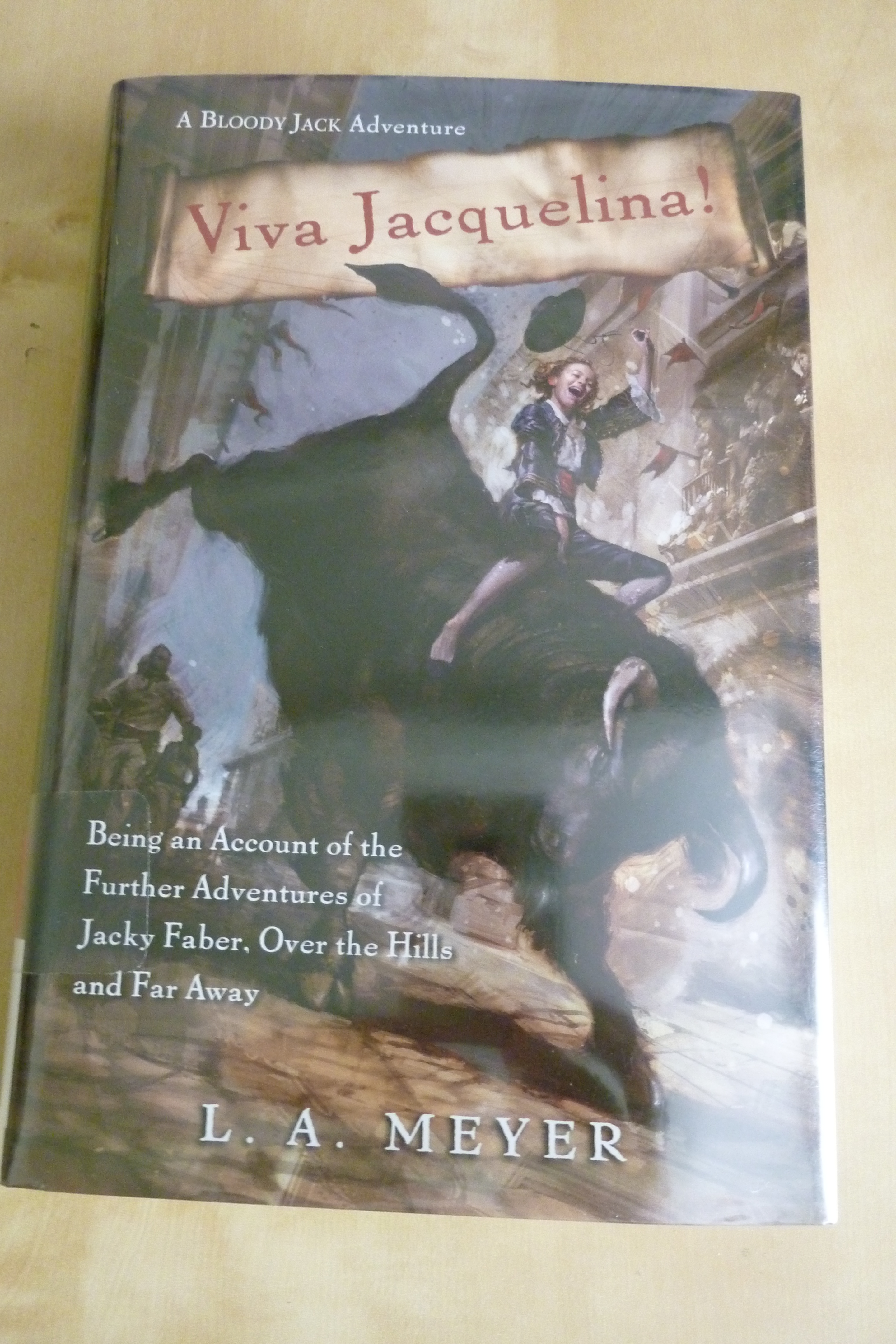
Every fall I look forward to the latest installment of the adventures of Bloody Jack.  This year, it was Viva Jacquelina!, L. A. Meyer’s tenth book about the irrepressible Jacky Faber.

Jacky has, in her various adventures, been a British Navy sailor, a merchant captain, a pirate, a member of the British intelligence, and sometimes even a fine lady.  As you might guess, this installment takes Jacky to Spain.  It begins on the battlefields of the Napoleonic wars, before Jacky is sent on a spy mission to Madrid.  Separated from her friends, she finds work at an artist’s studio, learning painting, posing as a model, and flirting with the local boys.  Jacky’s adventures go on to involve bull-riding, the Spanish Inquisition, and a band of gypsies.  In other words, it’s the usual Jacky Faber fare.

Jacky is still the charming, undaunted, ever-cheerful and ever-resourceful girl we’ve met in nine previous books.  She’s grown more confident but no more cautious or sensible.  The adventures come fast and furious here, which is good and bad.  The book keeps moving along at a quick clip and there’s never a dull moment–but sometimes I did wish it would slow down and give us more depth and more detail.

It strikes me that we’ve entered an interesting place with these later books in the series–they’re still enormous fun, I still love the characters, and I still can’t resist reading on to find out what happens next.  At the same time, the books are starting to lose the depth and the originality of the early ones in the series.  In some ways this book reminded me a bit of the second one, Under the Blue Tattoo, in that Jacky spends some months settling (relatively) quietly into a town and a household.  But this book racketed along at a much faster pace than the second book, and we never delved as deep into the characters or developed a plot that was as complex.

Jacky is also beginning to seriously grate on my nerves when it comes to her constant flirtations.  In the span of this one (relatively slim) book, she gets into pretty serious sparking with five men–all while her heart belongs to her one true love Jaimy, of course.  Jacky’s always been a bit free with her affections, but I feel like in this book she went farther faster and with greater numbers, and never seems to grasp that any of these men might take her seriously.  When her attitude starts to become, “ho-hum, another one swearing undying love,” it gets just a little annoying.

But I do still love Jacky–only I’m starting to feel like her best friend, Amy Trevelyne, who is frequently apt to sigh and wish Jacky would learn some restraint.  On the other hand, it is kind of fun that Jacky turns on its head the cliche of the roving man with a girl in every port.

All in all, I’d say this book isn’t up to the brilliance of the earliest ones in the series…but it’s still a very enjoyable read.  I wouldn’t suggest starting the series here, but if you haven’t read Bloody Jack, I do recommend picking it up!  This is a wonderful series to explore.

Author’s Site: http://www.jackyfaber.com

Other reviews:
Fyrefly’s Book Blog
In Bed with Books
Bookyurt
Anyone else?