A Sci Fi Retelling of Cinderella

First, a bit of business–the first post for the Going Postal group read goes up a week from tomorrow.  I contacted everyone who let me know they were interested, but there’s still plenty of time to join in–so let me know if you’d like to!  Now, on to the review…

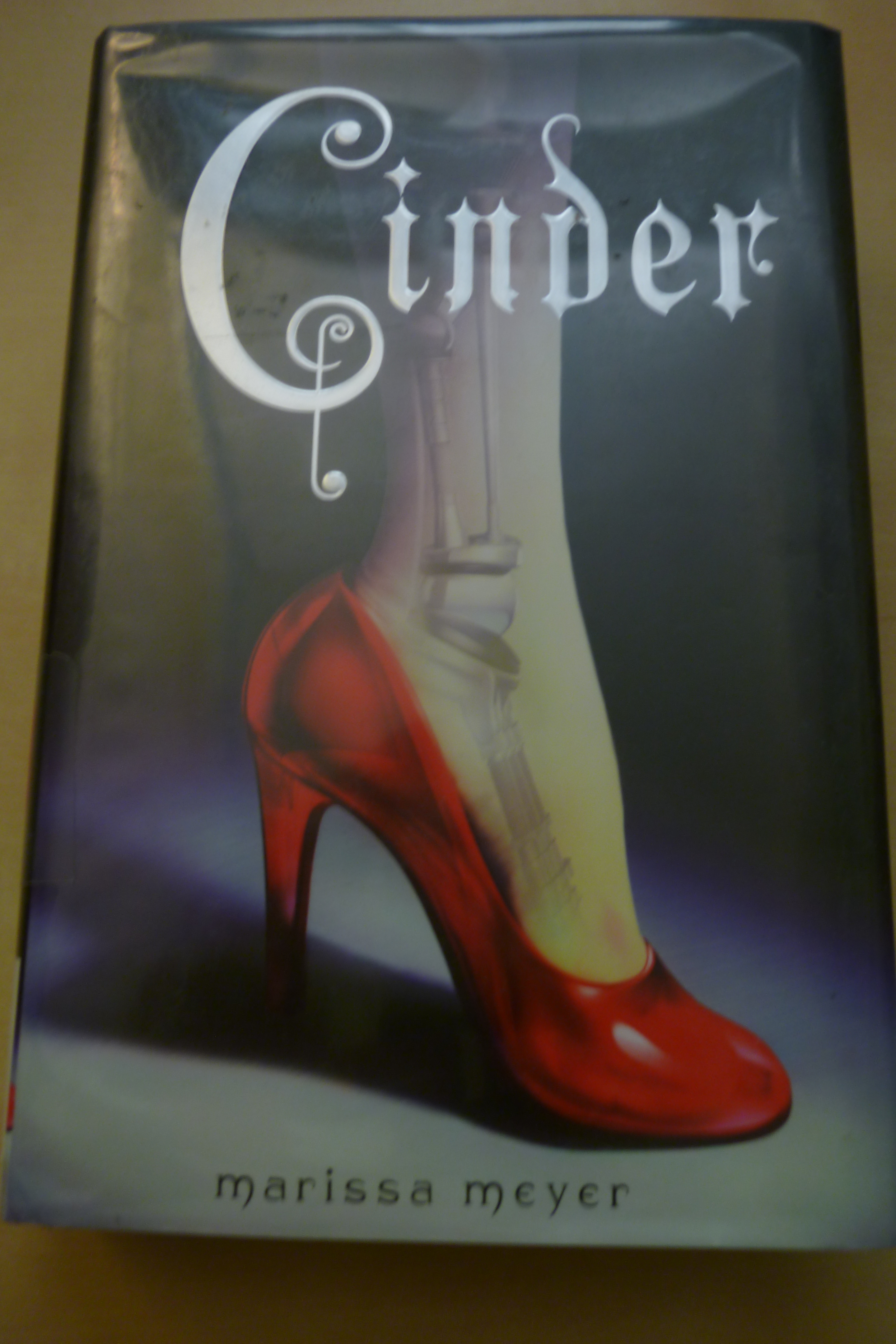
I put Cinder by Marissa Meyer on hold at the library at the beginning of the Once Upon a Time Challenge–in mid-March.  It’s only fair to say that my library usually runs through hold lists pretty quickly…but in this case, the book finally got to me in mid-June.  I managed to read it about five days before the OUaT Challenge ended!

So was it worth the wait?  Yes–because I was very curious about it.

As you may have guessed or known, Cinder is a retelling of Cinderella, though I was surprised by how loose a retelling it actually was.  Set a vague distance into the future, Cinder is a cyborg, mostly human but with a mechanical hand and leg, and circuitry in her brain.  While she is downtrodden by her (adoptive, not step) family, and there is a prince and a ball, the book mostly focuses on the search for a cure for a pandemic sweeping the globe, as well as rising tension with Lunars, the human moon-dwellers who have developed mental powers to manipulate others.

I quite liked Cinder.  She’s a strong Cinderella who’s plotting escape from her family and doesn’t actually care that much about the ball–she has bigger problems to think about.  I loved the cyborg-ness too, and wanted more of that element.  What was there was fun, from the low-tech (storing things in a compartment in her calf) to the high-tech (she can mentally connect to the internet, and her body warns her when she’s overheating).

Prince Kai was a nice guy, though a bit bland.  He served his role in the story perfectly well, and had a little more complexity in his uncertainties about how to fulfill his position as prince (and soon to be emperor), but he didn’t strike me all that much either.  In a bit of a reversal of that, my one biggest issue with the book was that I wasn’t sure why he was so struck by Cinder.  He starts singling her out almost as soon as he meets her–and I do appreciate that they meet and start developing a relationship well before the ball.  It’s just that I’m not sure what prompted him to pursue that relationship.  I mean, I like Cinder–but I’m really not sure why the prince, who has every girl in the country to pick from, decided he liked this particular one.  I’m all in favor of the idea that he saw something special in her, only I don’t feel like the book ever made clear what exactly it was, or even if there was something–I’m just assuming there must have been.

So it wasn’t a heart-stopping romance, at least not for me, but I am curious to see where it goes.  This book is the beginning of a series, and there are a lot of threads still to be explored.  There are some good tensions in Cinder and Kai’s relationship, like the political marriage he’s being manuevered into with the Lunar Queen, and the small fact that Cinder is trying to hide being a cyborg from him.  Cyborgs are looked down on as somehow less than human, in what I’m sure is intended to be a reimagining of the social structure of Cinderella’s original setting.

I would be remiss if I didn’t also mention Iko.  She (it?) is Cinder’s friend and somewhat fairy godmother-like figure, and she’s a robot.  She’s a robot who is also a hopeless romantic, quite forward, and often funny.  She wants Cinder to go to the ball more than Cinder does, and she’s really rather adorable at times.  The most moving moment in the book for me involved Iko’s personality chip–and that’s all I’m going to say, to avoid any spoilers!

So, to sum–fascinating concept, good characters (especially Cinder and Iko), okay romance, pretty good plot though at times it stretched on a bit, and one late-in-the-book twist was really obvious (maybe that was just me–but I don’t think so).  I liked the book–I didn’t love it–but I am adding it to my list of series, and plan to read the next one when it comes out!

Author’s Site: http://www.marissameyer.com/

Other reviews:
Stella Matutina
At Home with Books
Book Journey
Andrea’s Book Nook
Book Nut
I saw this on a LOT of blogs before it finally got to me…did I miss yours?
Delving into Complicated Dreams

Dreams–meaning hopes and goals and aspirations–can be a complicated business.  They usually aren’t, though, in Juvenile and YA books.  Usually the message there is that if you believe enough and work hard enough, you can achieve anything.  I believe that (to a point) and it’s a message with value.  But I was impressed that Aria of the Sea by Dia Calhoun, a definite YA book, tackles the question of dreams in a far more complicated way.

Cerinthe, the heroine, has always loved to dance.  She’s also a skilled folk healer, but when her skills fail to save her mother’s life, Cerinthe resolves to give up healing and sets off for the capital to join the Royal Dancing Academy.  After some slightly contrived difficulties getting in, Cerinthe quickly begins to shine at the Academy.  This puts her in fierce competition with Elliana, the reigning star pupil.

There’s a pretty good plotline and good characters, but it was really the setting and the themes that stood out to me.  Both the dancing school and other areas of the city are brought to vivid life through descriptions, and I enjoyed following Cerinthe through them.

It’s mostly the theme about dreams that has stayed with me after reading this book.  It’s a little more complex than this, but for discussion’s sake, let’s say that achieving one’s dream depends on three qualities–talent, passion and discipline.  Usually stories (and not only YA ones) assume that characters will have all three.  In Aria of the Sea, we see dancers who have the desire and the willingness to work hard, but simply don’t have the natural skill to succeed.  Elliana has the skill and the passion, but lacks discipline.  Another supporting character has the talent and the willpower but feels no joy in her dancing.  And Cerinthe–well, Cerinthe finds out another complicated thing about dreams.  Namely, it’s not always so easy to determine just what your dream really is.

In the old fairy tales, beauty and goodness (and conversely, ugliness and evil) are almost always equated.  A good character is always beautiful.  We’ve departed from that (somewhat), but I think there’s still a strong bias to make the good characters talented.  To some extent it just makes sense–a good heroine (or hero) is most of the time likable, and also possessed of qualities that will drive a plot, often some sort of talent.  As a rule I think it’s done because it works, but it’s also interesting to see a book that calls that correlation into question.  Elliana is deeply unpleasant but also extraordinarily talented–likability and talent don’t always equate.

I didn’t exactly love this book–the characters and plot were good but not landmark–but it was thought-provoking.  And another example of the depths that good YA can explore!

Other reviews:
Lectitans
The Reader’s Book Blog
I didn’t find many…anyone else?  Let me know and I’ll link yours!

Getting Inside the Outsiders

I first read The Outsiders by S.E. Hinton in 7th grade.  It was one of the major book projects of the year, and I remember the teacher passing out a boxful of battered black paperbacks.  I don’t think my copy is one of those, but it is the same edition—I can’t remember anymore where I got it, and to this day I can’t figure out which character is meant to be which on the cover!

The Outsiders is about Ponyboy Curtis (that’s his real name), and his friends, the Greasers.  Not quite hoods, the Greasers are poor boys from the rough part of town, with a nasty reputation that’s partially deserved.  Their sworn enemies are the Socs (short for Socials), the rich kids in town.

The plot is about Pony, his sad-eyed friend Johnny and tough guy Dally, and what happens to them all when an altercation with the Socs gets horribly out of hand.  The book is really more about Pony’s growth than it is about the plot.  It’s about how he sees the people around him and takes what happens to them to gain new insights on the world.

The voice is so strong in this book.  It’s a shock to know that S. E. Hinton is female, and therefore was never a fourteen-year-old boy.  There’s something wonderfully artless in the writing, the kind of effortless feel that probably requires a lot of work.  There are moments that should be bad writing—when most of the characters are introduced, Pony spends a paragraph or two describing each one.  Usually narration info-dumping to describe characters annoys me and takes me right out of the story.  I quit reading a book once because it spent the first two chapters doing that.  But it works for Pony.  It doesn’t feel like a narrator telling us about characters—it’s Pony telling us about the people he knows.

All the characters are vividly drawn—hard-working Darry; lazy, good-natured Sodapop; hard-edged, angry Dally; and poor Johnny, beat up by life.  I feel like I know all of them, and I care about them—which is actually kind of remarkable.  Most of the people Pony knows, Dally especially, ought to be terrifying.  They shoplift, they carry switchblades, and they have all the external signs of juvenile delinquents.  But we get to see them from the inside, from Pony’s point of view, and it doesn’t really matter if they’re likable, or admirable—they’re Pony’s family.  I hesitate to use the word “gang,” even though it’s the obvious one, because I think it has violent connotations a little beyond what the Greasers deserve.  Let’s say they’re a pack, with all those connotations of loyalty.

The Socs aren’t portrayed as extensively, but we do meet a couple of them, especially dreamy, tough Cherry, who gives us insights into the desperate, bored recklessness of the Socs.

I suppose the ultimate messages of this book are not too radical—it’s tough all over, don’t judge by what a person seems to be, don’t become jaded by the world.  But they’re good messages, and they’re conveyed through some of the most alive fictional characters I’ve ever met.

And this book is responsible for one of the few pieces of poetry I’ve ever memorized: “Nature” by Robert Frost.  It’s a lovely poem, inside an excellent, gritty novel.

Author’s Site: http://www.sehinton.com/

Other reviews:
Misbehavin’ Librarian
The Oubliette
Susan the Librarian
I didn’t find as many as I would have expected…did I miss yours?

Through a Maze, into the Past

Some books seem to make the rounds of all the blogs I follow.  That’s what brought me to The Freedom Maze by Delia Sherman.  So many bloggers loved it, I couldn’t resist giving it a read.  And I did enjoy it, largely for reasons that other people mentioned too…and I had a few reservations.  More on those in a bit!
The book is about Sophie Fairchild Martineau, thirteen years old and living in the American South during the 1950s, just as the Civil Rights movement is starting to take shape.  She’s bookish and awkward and doesn’t know how to be the proper, refined Southern lady her mother wants her to be.  Her mother has never forgotten that their family used to be wealthy plantation owners, before the Civil War.  Sophie is sent to spend the summer with her grandmother and aunt on what’s left of the family land, and wanders into the Maze, a labyrinth of hedges and paths.  She meets a strange Creature, and makes a wish…only to find herself back in 1860, where her Fairchild ancestors assume that this tanned, unkempt child must be a slave.

There’s a lot to love in this book, starting with Sophie.  I already loved her by the bottom of Page One.  She reminds me of Sym from The White Darkness, so obviously a thoughtful, lovely girl who’s being told by the people around her that there’s something wrong with her.  I love that Sophie likes to read–and she and I seem to have read all the same books!  It’s so much fun to have a heroine who has read Edith Nesbit and Edward Eager, and knows how this sort of adventure is supposed to go.  She knows the rules about wishes and magic creatures and native guides…but then nothing goes the way she expects.

I was so interested in Sophie and her family dynamics and life in the 1950s that I was almost disappointed when she went into the past.  But the family dynamics and the life in the 1860s turned out to be very interesting too.  The handling of the master/slave situation was fascinating.  The Fairchilds (with the exception of a very nasty daughter) are not cruel people, but they are slaveowners.  Through a combination of obliviousness, delegation of discipline, and a conviction of how the world is meant to be, they fully believe in their own goodness.  And in a way they are “good masters”–but that doesn’t mean the slaves are happy.  Neither are they desperately miserable in the day-to-day.  Sherman walks a narrow line to avoid falling into stereotypes in either direction, while vividly portraying the culture of the white society, and the community of the slaves.

Sophie is mistaken for the daughter of one of the men in the family, who’s currently living in New Orleans.  She has the Fairchild nose and tan skin from being in the sun, and so must be the offspring of a white master and his African slave–which makes her a slave too.  This was one of the most intriguing and disturbing aspects of the story.  I’ve certainly been familiar with the concept before, but I don’t think I had ever seen it brought to life.  Everyone, white and black alike, believes that Sophie is related by blood to the white family, but she’s still classed and treated as a slave.

Sophie meets many wonderful people, particularly among the other slaves, and somehow those characters are growing on me more as I get farther out from the book.  Strange!  The book takes on the feel of historical fiction the longer Sophie spends in the past, and I liked learning more about life in the time, though to some extent this was a more academic than emotional interest.

As interesting as it all was, it also began to feel somewhat purposeless.  It’s suggested, very clearly, that Sophie has been sent into the past for a reason, to do something.  I had to wait most of the book for any hint of what that might be, and at times I felt as though I was waiting for the main story to get going.  Sophie does ultimately end up helping another character in an important way, but the character wasn’t previously significant, and I didn’t have much reason to care.  If that was the whole point of it all…I could appreciate it from a humanitarian standpoint, but it didn’t have much emotional resonance for me.

The other point, I’m sure, was for Sophie to grow, to find a new view on the world, and to find the strength to seize her own freedom.  And I love that in theory…but in practice that aspect felt a bit rushed.

This book does many wonderful things–the way it does them doesn’t always feel quite as wonderful as they might have been.  But don’t let that dissuade you!  It is an enjoyable, fascinating book.  It takes what feels like a very familiar setting, finds new angles, and is thoroughly thought-provoking!

Author’s Site: http://deliasherman.com

Other Reviews:
Stainless Steel Droppings
Charlotte’s Library
Stella Matutina
Anyone else?

The Girl with the Geese

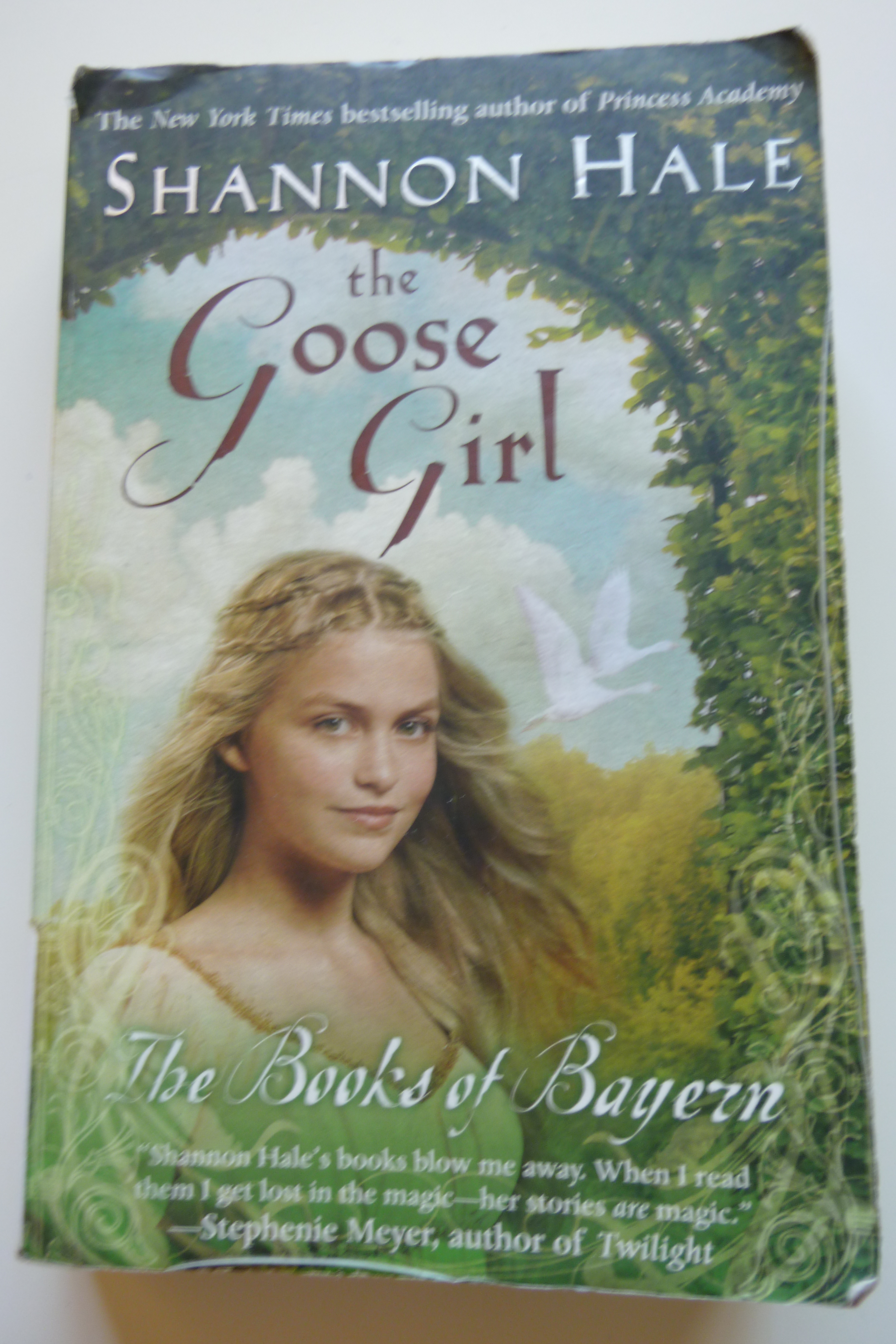
It made me a bit sad that my library’s copy of The Goose Girl by Shannon Hale was blurbed by Stephenie Meyer.  It’s a much better book than Twilight.

As you might guess from the title, this is another retold fairy tale, suitable for the Once Upon a Time challenge.  The Goose Girl is about Ani, a princess who’s never been very good at the job.  Her mother sends her to a neighboring kingdom to be married, but along the way her lady-in-waiting, Selia, stages a mutiny and usurps her place.  Ani makes her way to the capital, but has to hide from her enemies in the role of Goose Girl, tending to the royal flock.  And that’s where she begins to find friends–and her own strengths.

This book reminds me of a lot of other books, while being very uniquely itself.  It’s a story about a none-too-successful princess who has to find a way to save the kingdom.  There are plenty of books like that, but Ani and her particular path feel very different than most of them.  Most ordinary princesses are freckled tomboys.  Ani is a beautiful blonde who desperately wants to be a proper princess, but has lived all her life in the shadow of her strong-willed and charismatic mother.  Even though Ani tries very hard, she just doesn’t have her mother’s charm and poise, or talent for handling people.

Ani isn’t a plucky heroine who immediately sets about to save the day when the situation goes bad.  She spends much of the book hiding, with her primary goal being to save herself.  Somehow I liked that about her–she feels very real, and her challenges (and ultimate solutions) feel believable.  She’s a likable heroine with depth, and strength that emerges over the course of the book.  There’s some magic in the story (Ani can understand birds, and talk to her beloved horse), but it feels largely secondary to Ani’s personal growth, as she realizes her own abilities and begins to look beyond herself as well.

Hale’s writing is beautiful, with a nice fairy tale flavor while having much more detail and plausibility than the Brothers Grimm usually go in for.  She created a vivid world, with two countries that have clear cultures and customs.  And there’s some humor and romance in here too.

I thought the last hundred pages or so were somewhat dragged out, though the ultimate climax is exciting.  It’s a little hard to explain without spoilers; there was a plot twist that seemed unnecessary to me, and just pulled the story out longer before we got to the final confrontations.  The romance turns out rather convenient–but it IS a fairy tale retelling, so it’s just about what I would expect!  And it’s a sweet romance for all that.

If you like retold fairy tales, I’d recommend adding this one to your list.  The original “Goose Girl” has never been a particular favorite of mine, and I still thoroughly enjoyed this book.  Hale has made a wonderful story out of it–something she does consistently in other books too.  When people ask me about excellent fantasy authors, I’ve really got to start adding Shannon Hale to my litany (which goes something like, Tamora Pierce, Robin McKinley, Gale Carson Levine, Patricia C. Wrede and Diana Wynne Jones, if you were wondering!)

Author’s Site: http://www.squeetus.com/stage/main.html

Other reviews:
Reading for Sanity
This Blonde Reads
Liberating Libris
Anyone else?