Exploring the World of L. M. Montgomery

It occurred to me that I have not actually reviewed L. M. Montgomery.  She’s been woven throughout this blog, referenced here and there, but somehow I have not actually reviewed her yet.  Even though she’s among my top two favorite authors!

Maybe the problem has been that I don’t know where to begin.  I’ve read 20 novels, 199 short stories (believe me, I’m searching for a way to get my hands on a 200th one!), her autobiography, three books of letters, and her five volume journal.  If it’s in prose, I’ve read it.  And now, where to start?

My L. M. Montgomery collection. I have...a few of her books.

I suppose I could take the obvious route.  Anne of Green Gables was her first novel, and the one I name when people look blank after I say L. M. Montgomery is my favorite author.  It’s a good place to start reading if you’re not familiar with her books.  Anne is a red-headed orphan who is adopted by Matthew and Marilla Cuthbert by mistake–their friend was supposed to bring them a boy from the orphanage, who could help Matthew on the farm.  The story follows how Anne found her place in Green Gables.  Anne is precocious, whimsical, imaginative, deeply in love with nature, and, though always well-meaning, apt to get into scrapes.  Once she dyes her hair green–another time she breaks her leg after walking on a roof on a dare.  Anne is a wonderful character and her adventures are funny and endearing.

That’s a good place to begin.  But I don’t want to stop there.  Because there’s also Emily, a dreamy writer, and Pat, who fiercely loves her home, and Valancy, who only starts to live her life when she thinks she’s dying.  And beautiful, tragic Kilmeny; Marigold with her imaginary and magical friend; capable and confident Jane.

I don’t know why Anne of Green Gables is Montgomery’s most famous book, because she wrote so many others that were at least as good.  The great gift of Montgomery is her ability to create appealing characters and place them in a beautiful world.  With very few exceptions, her books are all set in small towns in Prince Edward Island.  She herself grew up in Cavendish, a small town in PEI, and her books very much harken back nostalgically to the Cavendish she remembers in her childhood–a close-knit community where everyone knew everyone, and the chief social events were quilting circles, lectures and small dances–and weddings and funerals, of course.

Her books are also filled with nature.  Like Anne, Montgomery had a passionate love for the beauties of nature.  Pine trees, flowers, a range of hills against the sunset–from her journal you learn first-hand how deeply these affected her, and that carries into her books.  I once read a book that combined quotes from Montgomery about nature, with pictures that were meant to correspond.  I was amazed to find that none of the pictures were as beautiful as what she was describing.  She felt beauty so intensely–she was able to see it and then convey it in words, where someone else wouldn’t have seen the same thing at all.  A picture may be worth a thousand words, but not when the words were written by L. M. Montgomery.  She has a very unique writing style, which I obviously love–it may not appeal to everyone though, which is why I sometimes recommend starting with her short stories to see if it’s a style that works for you.  The Road to Yesterday or Chronicles of Avonlea are good collections.

Don’t get the impression, though, that her books are long treatises on nature.  The beautiful surroundings are the backdrop to human adventures.  They’re funny, exciting, romantic, sometimes tragic.  She had a gift for drawing out the emotions in events small and large–from the pettiness of carping relatives to the deep betrayal of a disloyal suitor to the fun of a picnic in the woods to the humor of an awkward dinner party.

There are some books I feel I’d love to live inside, and L. M. Montgomery’s certainly sit high on the list.  After reading her journals, I think she felt the same way.  Her life was not always happy, and the sunny world of her writing was sometimes an escape.  Fortunately, she’s made that world available to the rest of us too.
Guest Post Featured on the O.W.L.

I’m very happy to say that I have a guest book review up on the O.W.L. today!  Jill at the O.W.L. posted a few weeks ago about her plans for an I ❤ Lois Duncan month on her blog.  Lois Duncan is my favorite scary story writer, so I talked to Jill about participating.

You can read my review of The Twisted Window by Lois Duncan on Jill’s blog.

I’ve never been a fan of horror, but I do like suspense and sometimes a little supernatural creepiness.  I like to think of Duncan as the Hitchcock of writers–there’s something similar in her dark, sometimes mysterious, always suspenseful stories.  The Twisted Window is a particular favorite of mine; it lives up to its name with so many twists that you can never be sure you really know what’s going on…

But I won’t ramble on here.  I already talked all about it in my guest post.  🙂

Bear and Psyche, Sort Of

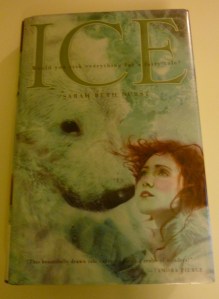
As you might know, one of my reading challenges for the year is to read novels that are fairy tales retold–because I really need to read more than I already do!  🙂  But, that goal is what led me to Ice by Sarah Beth Durst.

Cassie lives in the Arctic, at a research station with her scientist father.  Her mother, she believes, died when she was young.  Her grandmother, however, tells a fairy tale about Cassie’s mother–she was the daughter of the North Wind, and was promised to marry the Polar Bear King.  But she fell in love with a human, Cassie’s father, and bartered with the King–he could marry her daughter instead.  And when the North Wind found out that his daughter married a human, in his fury he blew her away to the castle of the trolls.

Such is the swiftly-established backstory, which probably could have been a novel (or at least Part One of a novel) in its own right.  But Ice really starts when Cassie is eighteen, and past believing in fairy tales–until the Polar Bear King actually shows up and wants to marry her.

As you might guess, the Polar Bear King is in fact a magical polar bear.  He asks her to call him Bear, and can conveniently change shape to a human on occasion–although there are complications.  Durst created a very interesting magical framework for her tale, which I enjoyed.  The unfolding romance was sweet as well, and when some of those complications separate Cassie and Bear, Cassie’s quest to find him is an exciting one.  It’s also implausible in certain ways I don’t want to get into to avoid spoilers, but if you suspend disbelief, it’s a good read.

Ice has a very strong fairy tale feel, complete with the fairy tale backstory and a castle of the trolls located “east of the sun and west of the moon.”  But it wasn’t actually immediately apparent which fairy tale this was.  A video interview with the author describes it as “Beauty and the Beast,” and from the initial premise I went into it expecting that.  Maybe I shouldn’t argue with the author, but I have to say, the farther I read the more I think it’s actually “Cupid and Psyche.”  Granted, Cupid is not usually a polar bear, but that complication involving Bear’s human shape was that Cassie couldn’t see what he looked like–which is straight out of “Cupid and Psyche.”  It also wouldn’t shock me to find out there’s a minor tale somewhere in Grimm’s that this follows even more closely.  It just has that archetypal fairy tale feel to it, and I imagine some of the elements have come up in a lot of different places.

I did have a few reservations about the book.  One of the biggest involves Cassie’s mother.  It’s not giving too much away to reveal that she does come back from the castle of the trolls–it happens fairly early on in the book.  Not knowing her mother was a huge motivation for Cassie at the beginning of the book, but then when her mother actually comes back, I didn’t feel like that was adequately developed.  It’s fair enough to say that meeting your mother for the first time at eighteen does not necessarily lead to immediate closeness, but I didn’t feel like Durst properly explored any relationship between the two of them, even if it was going to be an awkward or strained relationship.

Second, I had some trouble with the points where magic and reality met.  I believed in the research station.  I believed (in a fantasy book way, I mean) in Bear’s castle and in his magic.  But sometimes the two intersected, and I had a lot more trouble believing in a scene where a scientist doing research in the Arctic says, “yes, my wife was held captive by the trolls for many years.”  I don’t think it was just magic and the modern day intersecting–I’ve read urban fantasy that I really enjoyed.  I think it was that characters who showed no sign of believing in magic suddenly started talking about it as an accepted fact, and that was a little hard to buy.

However–it was still a good book.  And when I was getting down to the last few chapters, I even stayed up late to finish reading and see how it would turn out.

Author’s site: http://sarahbethdurst.com/contact.htm (check out the best ever FAQ section!)

Beauty (Maybe) and Her Beast

Beauty and the Beast has always been one of my favorite fairy tales–probably because the retellings are so good.  If you go back to the original story, it’s almost as flawed as any other traditional fairy tale.  But the retellings…are SO good.  Beauty by Robin McKinley is a particular favorite of mine.

The basic story is familiar, if you’ve read the original or even if you’ve seen the Disney movie.  From the Disney movie you’ll recognize the part about the terrifying Beast living in the castle in the woods.  A lost traveler spends the night and, upon offending the Beast, agrees to bring back his daughter, Beauty, to stay at the castle.  From the original story you’ll recognize the part about Beauty’s father being a rich merchant who lost his fortune, forcing them to move out to the country.  And Beauty had two sisters as well, and it was Beauty’s request for a rose when her father began his ill-fated journey that, in a way, put everything else in motion.

I think I read Beauty before I read the original fairy tale, so when I did read the original, I kept thinking, “oh, now I see where McKinley got that detail or this part from!”  But, like any great fairy tale retelling, McKinley has taken the slender original story and embroidered and expanded upon it, bringing the characters to life and explaining the bits that never quite made sense.

Beauty’s father and two sisters are very real characters, and the tragedy of going to the Beast’s castle is as much about leaving them as it is about going to an unknown fate with a monstrous Beast.  How a rich merchant family makes their way in a country village is a detailed and developed part of the story.

Beauty and the Beast are my favorite characters though.  Beauty, like the original and the Disney version, loves to read.  She’s also ugly, or at least considers herself so (not something from either version).  I LOVE that element.  If you read enough fairy tales, breathlessly beautiful heroines get very old.  They’re all very much the same, sweet-tempered and beautiful and sickeningly good.  So I love McKinley’s scrawny, mouse-haired, stubborn-minded Beauty–a name she picked up as a child and has been too embarrassed to request dropped.  The Beast is charming, sometimes unsure of himself, and really rather sweet.  I thought the romance was very cute.

My other favorite part is probably the castle itself.  It’s enchanted, of course, but there’s a wonderful practical side to the magic.  Beauty has a couple of enchanted breezes (sort of) attending to her, and in personality they’re quite fussy and straight-forward and focused on common sense.  And I’m so very, very amused by enchanted candles that light themselves–and sometimes have to admonish each other, “Hsst–wake up, you” when one of them doesn’t light.

Robin McKinley wrote another retelling of Beauty and the Beast called Rose-Daughter which, despite following the same basic plotline, is quite different (a lot more roses, for one thing).  It’s very good also, but much more surreal.  The magic, and even the non-magical characters, like the two sisters, feel less real-world to me–not unrealistic, exactly, but not so realistic either.  I recommend it too, but personally I prefer the more grounded Beauty.

But by all means, read both.  Or either.  Or pretty much anything else by Robin McKinley, because I can’t honestly say I’ve met a book by her I didn’t like.  Beauty may be my favorite, though.

Author’s Site: http://www.robinmckinley.com/

The Irrepressible Jacky Faber

I recently read the eighth book in the Jacky Faber series, and I’m wondering how long L. A. Meyer can keep this going.  And I’m hoping it will be a long while!

The series follows the adventures of Jacky Faber…sailer, soldier, pirate, fine lady, spy…oh, and Lily of the West.  Among other things.  Set around 1800, it all starts in Bloody Jack, when orphan Mary Faber decides that the way out of the gutter is to sign onto a Royal Navy ship as a Ship’s Boy.  Obviously that second word presents complications, so Mary becomes Jacky and disguises herself as a boy.

Jacky is an incredibly fun character.  She’s endlessly creative with her schemes and ideas, wildly emotive, rarely depressed no matter what life throws at her, fiercely loyal to her friends and endlessly ambitious to better her life and the lives of the people she cares about.  She has dreams of creating a worldwide shipping industry, and despite usually being only one step ahead of a vast number of people chasing her, she also manages to keep chasing those dreams.  Honestly, she’s like a cork–the world keeps trying to push her down, and she just keeps bobbing merrily up again.

Throughout the series, Jacky gathers a cast of equally memorable characters around her.  A couple of favorites: there’s Higgins, who always maintains the exemplary dignity of a gentleman’s man servant, is enormously helpful faithfully following Jacky through all her adventures, and always makes sure that she keeps her hair at least moderately clean.  And there’s Amy, a very proper young lady from Boston who is frequently shocked by Jacky but loves her like a sister anyway.

There’s also Jaimy, Jacky’s “own true love.”  To be honest, I’ve never been all that impressed by him myself, but she seems to like him.  I don’t dislike him, but (at the risk of a slight spoiler) they don’t spend a lot of time together and after the first few books I lose interest in their romance.  It actually feels like Meyer keeps contriving ways to keep them apart (not emotionally, more often physically apart) as a way to keep the adventure going.  While I approve entirely of keeping the adventure going, I wish he’d either just get them together and let them have adventures together, or break them up and move on.

However, that’s my one biggest criticism of the series.  And it’s a wonderful series–funny, suspenseful, exciting.  Jacky travels from England to America to Australia having a neverending series of mishaps and adventures.  I like to read before going to bed, and I’ve had to stop doing that with some of these because they’re too exciting and it wasn’t relaxing!

Adventure after adventure, I keep turning the pages with usually the same question: how is Jacky going to get out of this one?  After eight books, I don’t feel like the quality has dropped off–so I’ll keep reading to see how Jacky will escape from her latest entanglement.

Author’s Site: http://www.jackyfaber.com/