Blog Hop: Listening to Books

book blogger hopThis week’s Book Blogger Hop question: Do you believe audio books are the future and why do you believe that?
I don’t think audio books are the future any more than paperbacks or ebooks are.  There was a lot of talk when ebooks first appeared that print books would disappear, but I hear the percentage of ebooks to total books sold has leveled off.  I haven’t heard anything about audiobooks being particularly on the rise (though maybe I’ve missed a development?)  I think print books, audio books and ebooks are all co-existing because they each have different appeals to different people, and I think that will probably persist for at least a good while.  Print books may eventually disappear, but I don’t think it’s in the near future, and I don’t think audio books have a universal enough appeal to replace the other two.

I’m still sworn off ebooks, but I like my print and audio both, in different situations!


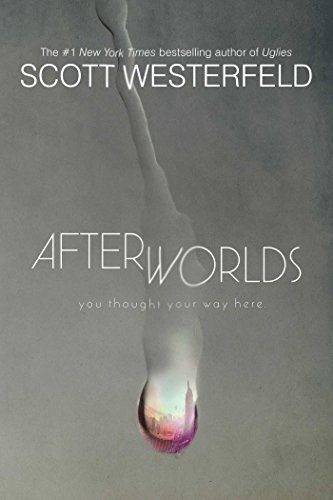
Book Review: Afterworlds by Scott Westerfeld

I want to start this review by saying how much I respect Scott Westerfeld as an author, due to his Uglies quartet.  That respect is why I kept reading his Afterworlds.  I still respect him…but Afterworlds was very disappointing.
The premise seemed appealing, two alternating storylines.  One is about Darcy, a new author, alternating each chapter with Darcy’s novel.  Cool idea!  However…

The book irritated me right out of the gate.  Darcy Patel is eighteen and wrote her entire novel during NaNoWriMo (not identified by name, but she wrote it all during November, so…), with no clarity on whether she’d written anything previously.  With minimal or no revisions, she promptly got an agent, sold her book to a publisher for a three-hundred thousand dollar advancement and a two book contract.  Which just does not happen.  Okay, maybe it does, but it’s about as likely as winning the lottery.  And the only author I’ve ever heard of it being that easy for was Edgar Rice Burroughs, ’round about 1910.

It doesn’t get better on that front.  Darcy moves to New York (because, of course), gets an apartment on her own in Manhattan and is adored by all the other writers.  She also gets an immediate new best friend who promptly and with no effort or angst from Darcy morphs into an awesome and incredibly understanding girlfriend.  And we are right smack in one of my pet peeves, the Too Beloved Heroine.  Because…really?

One of the best things in Darcy’s plotline, honestly, was when one of Darcy’s friends describes something as “nervous-making,” slang from the Uglies series that has crept into my brain.  Seeing it in a Westerfeld book made me happy.  Not a whole lot else in here did.

While everyone tells Darcy how wonderful her book is, I’m actually reading it in alternate chapters and…it’s just not that good.  Lizzie survives a terrorist attack and, in the midst of this near-death experience, accesses the underworld and meets Yamaraj, a sort of Hindu death god but not.  Ish.  We then fall smack into another pet peeve, Instaromance!  Because despite being midway through a terrorist attack and a near-death experience, Lizzie manages to describe Yamaraj as “beautiful” three times (that exact word) in his first five pages.  And it all just sort of goes from there. Continue reading “Book Review: Afterworlds by Scott Westerfeld”

Literary Pet Peeves

I like most of what I read, and even books with flaws are often enjoyable…but there are some things that just bug me.  A recent conversation with a friend involving a small amount of ranting on both sides about bookish disappointments (I have conversations like that a lot…) inspired me to write up a list of bookish pet peeves, in no particular order.

1) Instaromance: I get very annoyed by love stories where a couple meets and are madly in love all at once despite knowing nothing whatsoever about each other, or having any meaningful interaction.  Bonus negative points if this new life-altering love causes them to prioritize their new love interest over family, friends or comrades in arms.  Because that’s just not cool.

2) Slow-Burn Romances with No Transition: I love the opposite of Instaromances–Slow-Burn Romances (think When Harry Met Sally) but there are potential pitfalls here too.  A good Slow-Burn Romance has me eagerly awaiting the payoff–the moment when each half of the couple realizes their romantic feelings, and the moment when they communicate it to each other.  This could all be simultaneous or it could be three separate moments, but I get very disappointed if there’s no Moment at all.  (As Harry told Sally, “when you realize you want to spend the rest of your life with somebody, you want the rest of your life to start as soon as possible.”  And I want to read the realization, and the moment the rest of their lives starts.)

3) Nonreacting Characters: This one comes right from my writing experience, trying to make sure my characters are reacting.  When the problem exists in a book, I spend a lot of time demanding, “But how do you feel about that?” as momentous things happen and the point of view character says/does/feels nothing at all (I’m looking at you, Woodcutter Sisters!) Continue reading “Literary Pet Peeves”

Exploring My Bookshelves…for Fragile Books

Exploring My Bookshelves For EveryoneI’m jumping into a new-to-me bookish meme this week, Exploring My Bookshelves hosted by Addlepates and Book Nerds.  Each Friday, bloggers are invited to post a picture of their bookshelf, and write in response to a prompt about said-bookshelf.

Today’s prompt is…a book you don’t want to read for risk of damaging it.

I actually have four books like that, so I’m taking “bookshelf” slightly metaphorically, hauled all four off of their various shelves and took a photo of the group.  Pay no attention to the carpet.

IMG_0389

I actually am willing to read three out of four of these…just very carefully.

The Catalogue Raisonne of William Bouguereau is by far and away my most expensive book…but it’s a gorgeous collection of paintings by my favorite artist, and is pretty much the definitive book on his work.  It’s huge and shiny and gorgeous, and it’s the only book I have a conscious, self-imposed rule about not eating while reading it.

That slim green book is Nature and Other Essays by Ralph Waldo Emerson, 1884 edition–and it was weirdly cheap for that!  Even though it didn’t cost a lot, it feels valuable just for sheer age.  It’s holding up pretty well, but the spine is a little iffy and the pages are getting crackly, so it requires careful reading.

Poems by Browning and The Joy of Cooking are both books that belonged to my grandma, and both are a bit delicate.  Browning is holding up as readable, but I really am afraid to turn the pages in Joy of Cooking, so that one’s strictly decorative at this point.

Do you have any books you’re afraid–or at least cautious–about reading?  I’d love to hear!

Books That Lie

I raided the Broke and the Bookish for a topic idea again, and found this one that seemed quite intriguing: Top Ten Books That Are Totally Deceiving…

1) How I Stole Johnny Depp’s Alien Girlfriend by Gary Ghislain – I am sorry to say that my buddy Johnny was not in this for even a cameo.  He only came up in references–and the book had bigger issues anyway.

2) Dating Hamlet: Ophelia’s Story by Lisa Fielder – It really is Ophelia’s version of Hamlet, but the title (and cover) make it sound much sillier than it is.  It’s actually a reasonably dramatic retelling, and quite good.  The same deception is being cast by the companion novel, Romeo’s Ex: Rosalind’s Story.

3) Rejection Proof by Jia Jiang – You cannot explore rejection if you take all the vulnerability out of the experience, and after doing that, you cannot claim to be an expert on the topic.  Period.

4) Tarzan of the Apes by Edgar Rice Burroughs – Burroughs has his flaws, but he writes an exciting story–except for the first few chapters of Tarzan.  After the apes show up, it’s all good, but before that it’s astonishingly dull.  I wonder how many people have never got past chapter two?  If they do, they’re set up for a new deception at the end…because Tarzan doesn’t win Jane until the end of the second book, yet many “Classic Editions” fail to note a second book even exists…

5) Starcrossed by Mark Schrieber – You cannot claim to be writing a retelling of Romeo and Juliet if there is no feud parting the lovers.  And just because the heroine has a crack-pot theory about how Romeo and Juliet is her love story…no.  Just no.  As her boyfriend observed (really!), they’re about as much like Romeo and Juliet as they are like Hamlet.

6) Mairelon the Magician by Patricia C. Wrede – It’s probably just the particular edition I read that is deceptive.  The tagline was “Could his magic be real?”and the answer, revealed by maybe chapter three, is yes, of course it is, and it’s not even very shocking.  The edition offered a completely inaccurate summary of what the actual plot of the book is–and the book was wonderful!

7) The Time Keeper by Mitch Albom – An enjoyable read, but it didn’t really examine its premise.  The inventor of time must help two people who have issues with time…except they don’t.  One has messed-up priorities, one is depressed and suicidal.  Neither is really about time.

8) Wicked by Gregory Maguire – Deceptive because I am sure loads of edition have “The inspiration for the wildly successful musical!!!” blazoned across their covers.  This is true–but it gives you absolutely no concept of what you’re going to be reading, because the two bear shockingly little resemblance to each other (yes, they’re both about Glinda and the Wicked Witch at school…but that’s about the extent of the connection).  See the musical.  Do not (do not) read the book.

9) The Frog Princess by E. D. Baker – Similar deception to above, many editions claim this was the inspiration for Disney’s The Princess and the Frog.  True, I guess…but the entire, complete sum total of similarity is…a girl kisses a frog and turns into one.  That’s it.  Circumstances, characters, setting–all different.  Also, not a good book.  Watch the movie–or read Frogged, which has just as much in common with it but is better.

10) Alcatraz vs. the Evil Librarians by Brandon Sanderson – I have rarely been so irritated by a book, and this prompted what was probably my most scathing review ever (although Underworld is a contender).  There’s the title: the kid’s name is Alcatraz, the book has nothing to do with the prison.  And there’s the opening scene: Alcatraz is tied to an altar of encyclopedias, about to be sacrificed by evil librarians…but he’ll get back to that later.  And many chapters later, he reveals…that scene’s actually in the next book, not this one.  I think that makes this a book that literally lied to me.

Have you encountered books that, in their cover or plot description or marketing campaign (or even in their narration…) are totally deceptive?  I’d love to hear!