Federation: Star Trek Across Eras

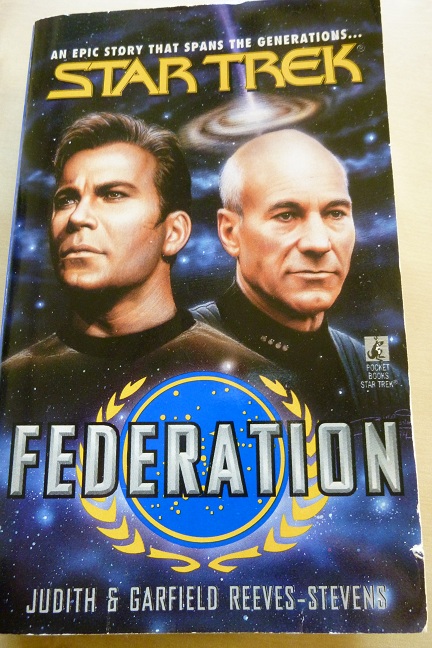
FederationOne of the nearly-last books on my Sci Fi Experience reading stack was Federation by Judith & Garfield Reeves-Stevens.  This was a re-read, but it had been years and I’d forgotten most of the details…but I did remember it was a good one.  The Reeves-Stevens also wrote one of my favorite Trek books, Prime Directive, and are absolutely brilliant at capturing characters.

Federation takes a broad scope, with three storylines across times, which ultimately intertwine.  We follow Zefram Cochrane, inventor of warp drive, through the early days of warp technology and into World War Three.  In the 23rd century, Kirk is facing fire from Starfleet over a recent mission–the one in which they met a much older Cochrane (“Metamorphosis”), who asked to be kept secret.  In the 24th century, Picard is hoping to obtain a piece of Borg technology that could be vital to the defense of the Federation.

There’s a lot to juggle here, and this is a case where, as a writer, I can very much appreciate how well the Reeves-Stevens handled it.  The divergent plots feel like they should be confusing, but aren’t; they ground us very well in each storyline, and a tight point of view helps a great deal too.  We’re only ever in the points of view of Cochrane, Kirk or Picard, and move in regular sequence between the three.

The Cochrane plotline provides a very interesting window into an earlier era of Trek history–even if it turns out not to be canon.  This was written before First Contact, and there’s a very prescient author’s note remarking that later films might invalidate the ideas set out in the book.

With all due appreciation for First Contact, I like the Reeves-Stevens’ version better.  It feels more like possible history and less like an action film.  Cochrane develops warp flight with financial backing from an idealistic billionaire (who I’m pretty sure is the long-lived Flint from “Requiem for Methuselah”), and is instrumental in founding early colonies.  He gets tangled up with World War Three because one military leader believes that Cochrane holds the secret to the ultimate weapon, a so-called “warp bomb.”  It’s exciting, while blending in philosophy, economics and galactic politics in a way that’s remarkably believable.

Kirk’s plotline draws very closely from original series episodes.  The plot points are mostly from “Metamorphosis,” but the timing is directly after “Journey to Babel,” with Ambassador Sarek still aboard at the beginning of the book.  There’s a wonderful scene with Kirk, Spock and Sarek playing poker in Sickbay.  I really enjoyed how much this was grounded in particular episodes.  Most Trek books seem to take place vaguely “on the five-year mission” (maybe in the last year after the final episode).  That’s fine as a rule, but tying it in so closely made me feel oddly nostalgic.

The best thing about Trek are the characters, and I think I love the Reeves-Stevens so much because they know how to tell Kirk, Spock and McCoy.  Trek books live and die for me based on whether Spock and McCoy snipe at each other–and they do here!  It’s understated, but perfect.  They go back and forth a few times, with Spock giving very precise estimates, McCoy rolling his eyes, and at least once Spock is deliberately vague, just to bait him.  It’s excellent.

The Picard plotline had its own mysteries and tensions, which is good since for most of the book it felt completely unrelated to the other two plots.  It comes together in the end, and the authors try to tie it closer together with an Ambassador Sarek connection…but mostly I think the reader has to just take it on faith that the plotline is relevant and enjoy it for itself in the meantime.  The way it ties together is ultimately a bit far-fetched…but personally I’m willing to just go with it.

If I have any major criticism, it’s that the frame-story felt unnecessary.  I see what they’re doing–it’s a thematic thing–but it didn’t work for me.  The book starts with a prologue about a very depressed Kirk coming to the Guardian of Forever.  The timing is right before Generations (which I’d prefer to IGNORE, if you don’t mind) and Kirk is having a premonition that his life is over and there’s no purpose anymore and etc. etc.  The Reeves-Stevens are so good at portraying the characters, but this was odd…and just depressing.  There’s a thematic point about the purpose of it all, and humanity’s journey and the exploration of that idea within the book is inspiring–but it doesn’t need the prologue to draw that out.  So if you pick this up and the first few pages aren’t working for you…skip ’em.

And after the first few pages, this is absolutely worth picking up.  Watch “Journey to Babel” and “Metamorphosis” in preparation, and then I think you’ll thoroughly enjoy Federation!

Authors’ Site: http://www.reeves-stevens.com

Other reviews:
Pareidolia Book Blog
That’s all I found!  Anyone else?  Tell me about yours!

Buy it here: Federation by Judith & Garfield Reeves-Stevens
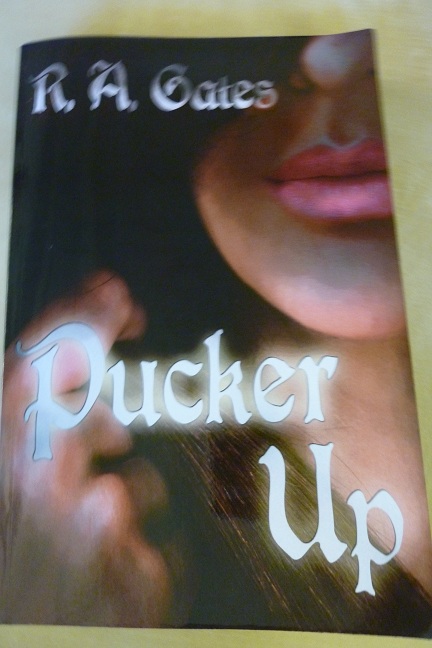
Pucker Up…and Wake a Dead Guy?

Pucker UpI think anyone who’s around this blog even occasionally knows that I love retold fairy tales.  There are so many fascinating and strange elements to fairy tales that modern authors can play around with.  So what’s not to love in an urban fantasy about a girl who needs to wake a sleeping prince with a kiss?  Pucker Up by R. A. Gates is a YA Fantasy that takes a fun spin on some old fairy tale tropes.  Disclosure–the author is a friend and member of my writing group, but I promise an honest review anyway!

Pucker Up centers on Ivy, a reluctant witch who finds herself on a quest to wake up sleeping Prince Sebastian.  Ivy lives in Salmagundi, the place of refuge for anyone with magic, hiding from the witch-hunting Eradicators.  Unfortunately, the spells hiding the town are breaking down.  Ivy’s cousin Thane believes the answer is to wake up Prince Sebastian, who created the spells to begin with.  Ivy needs the reward money to pay a debt to a very angry werewolf.  As a descendant of Sebastian’s true love, she should be able to wake him up with True Love’s kiss…except that she really doesn’t want to kiss a dead guy!

I always approve of heroines who set off to do things rather than waiting for a man to save the day, and I love the twist of a girl needing to wake up a prince instead of the other way around. Ivy is a fun, somewhat-reluctant heroine, with good mysteries in her past that kept me curious as I read.  The book also keeps moving with a series of adventures on the journey to find the prince.  We get a whole host of magical creatures, including vampires and werewolves and even dragons–like a cute baby dragon nicknamed Sparky.

There are serious moments, but overall there’s a light tone to the book.  It’s frequently funny in a tongue-in-cheek way…as with the ongoing series of necrophilia jokes.  I love retellings that are aware of the absurdities in their inspiration material.

When Ivy and Thane set off on their quest, they’re accompanied by Thane’s friend Garren, who Ivy finds immensely irritating.  Don’t expect too many surprises in the romance department…but even if it’s a bit predictable, it’s fun to read.  And there are more surprises in the plot.

This is the first book in a series, and with some twists in the ending, I’m excited to see where it goes in the next book!  Alas, not published yet…

I think I’ll finish up by borrowing a line from Ivy’s dialogue on the last page–it’s not a spoiler, and I think it sums up the book nicely.

“Don’t even think you’re rescuing me.  I’m no damsel in distress.”

Author’s Site: http://ragates.com/

Buy it here: Pucker Up in paperback or ebook

Hunting for Secrets in the Dark

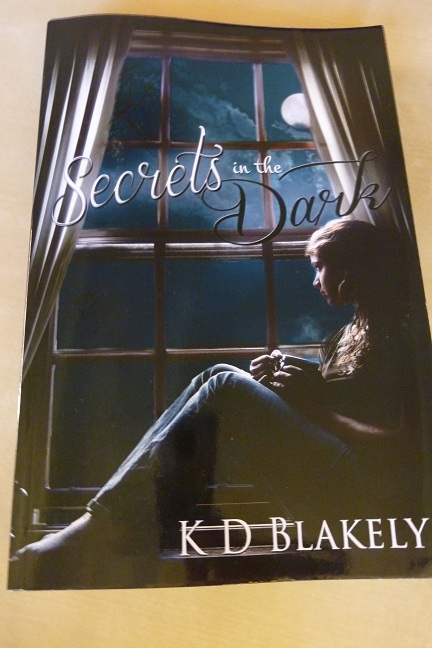
Secrets in the DarkI’m particularly excited to share today’s review, because I know the author, a member of my writing group, Stonehenge.  This may make me a little biased…but I promise you an honest review anyway! 🙂

Secrets in the Dark by K. D. Blakely follows the adventures of Kat and her two best friends–who definitely didn’t expect to fall into a magic world, when they were just trying to hide from a group of bullies.  They discover that an old tree in the town cemetary is a portal to another realm.  Every full moon, they and their friends can pass through to the magical world of Chimera.  It would be great…if the bullies didn’t keep following them, and if something hadn’t gone horribly wrong in Chimera, causing everyone living there to disappear.

This story is a lot of fun, and very engaging throughout.  The characters are my favorite part.  There’s a big cast of kids, but I never had trouble keeping people straight or telling them apart–and I’m not very good at that!  Kat is part of a group of five and there are four people in the group of bullies, so that’s quite a few people…but they all come to life as clear and distinct.  Kat and her friends all have their quirks, as well as their strengths and their flaws, and I particularly enjoy how they all have to work together with their different skills to deal with the challenges of Chimera.

Kat is a very likable narrator.  She’s not perfect but she is appealing, making for the best kind of heroine.  She’s twelve-going-on-thirteen, and is struggling to accept how much her world is changing.  It’s a very believable and sympathetic part of her character, and so appropriate for her age.

My favorite character may be one of Kat’s friends, Brady.  He’s super-intelligent, and talks that way.  His dialogue and the way he sees the world is so entertaining.  There’s also one major older character, Kat’s sister-in law, Ronny.  She has a special connection to Chimera, and does not always fit comfortably in the normal world.  In particular, she constantly gets sayings wrong–like “slow and steady wins with grace,” or “the grass is always cleaner on the other side of the fence.”  So much fun–and sometimes her sayings make a strange amount of sense!

I’ll end with one of my favorite aspects of the story: thanks to a wish that came true in an unexpected way, all the kids have familiars when they’re in Chimera.  The story is just asking for promotional-tie-in stuffed animals.  🙂  Kat and her friends have fun and adorable animals like a tiny owl, a cat and a fox.  They don’t talk, but they’re intelligent and often help as the kids explore the world.  The bullies, on the other hand, get rather nasty animals like a rat and a pig, which they keep trying to chase away.  The whole situation really makes me want a familiar…and who wouldn’t want a chance to explore a magical world?

If you find a tree (or a wardrobe) that lets you into a magical world, then by all means, have fun…but in the meantime, I highly recommend reading your way into the adventure!

Author’s Site: http://Kat-Tales.net

Buy it here: Paperback or ebook

3,000 Years with the Speaker for the Dead

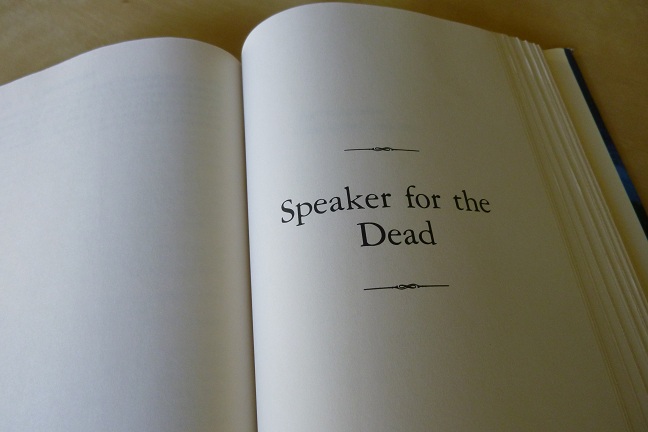
Speaker for the DeadLast year for the Sci Fi Experience, I read Ender’s Game by Orson Scott Card (review here).  It’s been a year now, and I finally got back to the series to read Speaker for the Dead.  Hopefully it won’t take me as long to get to the third book–because I really enjoyed this one!

I can see why Card felt he needed to write Ender’s Game to establish the backstory for Speaker for the Dead, because it’s remarkably complicated.  I’ll try to avoid spoilers as much as I can, though…

The second book is set 3,000 years after the first one.  Ender and his sister Valentine have spent much of that time traveling at almost-lightspeed, changing how time passes for them, so that they’ve only aged into their mid-thirties.  Humans have colonized the Hundred Worlds in a society connected by instant communication but very lengthy spaceflight trips.  For the first time, they’ve encountered another intelligent alien species, the piggies, on the planet Lusitania.  After the disaster with the Buggers, they’ve put an extreme Prime Directive into place, limiting contact between the piggies and the human colony to almost nothing, and striving to let nothing at all about humans be revealed, lest the piggy society be contaminated.  When the researcher studying the piggies is killed, Ender sets out for Lusitania in his role as Speaker for the Dead, to Speak the man’s death and discern the truth.

I feel like I’ve barely touched the surface of the plot here.  It’s a plot that deals with large-scale events, yet is really more about individuals, about one person’s pain and how he or she copes with it, and the results–and how that affects others, and how they respond, and so on.

I think I liked Ender better in this book than the first one.  He’s gained a great deal of wisdom, while still keeping enough human flaws to be sympathetic.  There’s a cast of strong characters, but my other favorite is probably Jane, a self-aware computer program (to vastly simplify), with a deep attachment to Ender and a considerable sense of humor.

This book is full of mysteries, and I read it quickly because I wanted so much to know what would be revealed next.  I think I had all my questions answered by the end–sometimes I had to stop and think a little to work out how it all fit together and explained earlier parts, but that’s all right.  I don’t often think about whether or not books make me think (if that makes any sense), but this one did, in a good way.

Most intriguing are some of the concepts here.  I think the piggies are the most alien aliens I’ve ever encountered in books or movies.  Star Trek usually uses aliens to extrapolate on some aspect of humanity, Star Wars gives us visually-strange creatures but little depth about them, and most aliens in other sources are either humans with strange faces, or mindless monsters.  The piggies are deeply complex biologically and culturally, and they are deeply alien.  But Card takes it seriously, so they aren’t alien as a farce or for the sake of being bizarre–they’re alien in a way that makes us think about our own understanding of the universe, and our own deepest-held assumptions.

Most stories about aliens either show them as immediate allies or immediate enemies.  The interaction with the piggies feels like what maybe really could happen, as two well-meaning species struggle to understand each other because of their inherent differences.  This isn’t a story where we all find out we’re really the same under the skin, but it does suggest we can still meet in some way.

The space travel was also fascinating, though I almost want to call it time-travel.  Most sci fi invents faster-than-light travel and links up the galaxy, or else has very separate and disconnected colonies on different worlds.  Card gives us a society that is deeply interconnected, even though it can take twenty years to get from planet to planet.  The sheer practicalities of it are fascinating, especially the way travelers don’t age appreciably–so for them, two weeks passed, while everyone they left at home has lived through years.

I was especially intrigued by the way Ender and Valentine used space-travel to move through the years, ultimately becoming historical figures in their own lifetimes.  Masterful though most of this book is, I don’t think Card really got into how hard that would be.  He gets into the personal level, but not on the level of dealing with a changing society.  It would be like someone from the Trojan War trying to function today, after only checking in for a few months here and there in the intervening centuries.  Language, customs, technology–everything would change so much.  And if everything doesn’t change during Ender’s 3,000 year span, well, that’s kind of a sad commentary on the future of humanity…

But that’s a small criticism, and probably it’s just necessary to make the novel work.  And it does work, and it’s fascinating.  I preferred this one to Ender’s Game, though I think the first book is necessary for understanding the second.

Speaker for the Dead was full of mysteries that kept me turning pages looking for the reveal, and full of thought-provoking ideas that I expect to linger.  Highly recommended.

Author’s Site: http://hatrack.com/

Other reviews:
Realizing Grace
Ada’s Technical Books
Been’s Blog
John Walters
Anyone else?

Buy it here: Ender’s Game or Speaker for the Dead

Quotable Maud Casey

“I was born with a reading list I will never finish.”

– Maud Casey