Fairy Tale Round-Up: The Twelve Dancing Princesses

I focus on fairy tale retellings often, and right now it’s the season for them, since I’m participating in the Once Upon a Time challenge.  I thought it would be fun–and maybe useful to someone–to spend a few Fridays gathering together lists of the retellings I’ve read.

I decided to start with a relatively minor fairy tale that has been getting a lot of press lately, “The Twelve Dancing Princesses or The Shoes That Were Danced to Pieces.”  It’s certainly not on a level with Cinderella as a cultural touch-point, but I stumbled on a number of retellings in the past few years, and then when I decided to write my own version, I started seeking them out.  It seems to be a popular story at the moment.

The Brothers Grimm story is “The Shoes That Were Danced to Pieces,” and is about twelve princesses who are wearing out their dancing slippers every night, even though they’re locked in their bedroom.  Their father the king puts out a call for champions, who will each be allowed to spend three nights in the princesses’ chamber.  If they can solve the mystery, they get to marry a princess.  If they fail, they lose their heads.  After a number of champions fail, an old soldier comes to try.  With the help of an invisibility cloak, he’s able to follow the princesses through a magic forest of silver, gold and diamonds, across a lake to a castle where they’re dancing with twelve princes.  By telling the king what’s happening, the soldier breaks the spell and marries the oldest princess.

It’s fascinating to see what is and isn’t in the original story, compared to the retellings.  There are definite trends in how the story has been retold.  The original is entirely the soldier’s point of view, but most of the retellings are from the princesses’ perspective, or from a new, female character who’s seeking to help them.  In the retellings, the king is well-meaning and at worst a bit stern; I’ve yet to read a retelling where heads are actually being chopped off.  The princes in the castle are usually cast as demons or monsters, although I personally don’t think that’s clear in the original.  And almost everyone struggles to develop twelve princesses as characters, which really is a remarkably large number to deal with.

So let’s see what’s been done more specifically…

Wildwood Dancing by Juliet Marillier was one of my first retellings, and a very loose one.  Only five girls, they’re not princesses, and they go dancing at a fairy court that is not as terrible as in most versions.  This story combines with a retelling of The Frog Prince, so that brings in some significant different elements.

Princess of the Midnight Ball by Jessica Day George is a much closer retelling, and one of the few that gives at least part of the story from the soldier’s point of view.  It does better than most at developing the relationship between the soldier and the oldest princess–and I rather love that the hero is brave and strong and also knows how to knit (soldiers have to get socks from somewhere!)  It also has some of the best-depicted princesses.

The Twelve Dancing Princesses by Marianna Meyer and illustrated by Kinuko Craft is a very beautiful picture book.  It doesn’t do anything too exciting with the story (though it is another one from the champion’s point of view) but the illustrations are exquisite.

“The Twelve Dancing Princesses” by Robin McKinley is a longish short story in her book, The Door in the Hedge.  I had such high hopes for this one (I mean, Robin McKinley!) and they were only partially met.  It’s a beautifully-written retelling with vivid imagery and all the details of description and character emotion that the Grimms always leave out.  But…there’s really nothing innovative about it either.  It’s pretty much precisely the original story (minus the head-chopping).

The Thirteenth Princess by Diana Zahler supposes that the princesses have a thirteenth sister, Zita.  Their mother died when she was born and their father banished her to be a servant in his grief.  She evades the spell that captures the rest.  It’s a cute version in some ways, although the twelve princesses are unusually undeveloped as characters.  The focus on Zita’s story means less focus on the twelve princesses’ adventure.

The Phoenix Dance by Dia Calhoun is another one that brings in a new heroine, this time the royal shoemaker’s apprentice.  Her master’s reputation is being ruined by the constantly worn-out dancing slippers–which, by the way, is a fantastic idea!  The original fairy tales never address that kind of detail.  I loved that premise, but then I didn’t love the heroine as well.  This is also a fantasy look at bipolar disease, and while I respect what Calhoun was trying to do, I actually had difficulty getting a sense of the character through the mood swings.

Entwined by Heather Dixon is one of the latest retellings, which made the rounds of all the blogs I follow.  This one more than any other I’ve read emphasized the beauty of the dancing, and played with the princesses’ love of dancing.  There are twelve princesses named in alphabetical order, which was very helpful for keeping track of the relatively bland younger nine.

The Night Dance by Suzanne Weyn meshes the dancing princesses with Arthurian legends. It’s a clever idea, but the book is hampered by some very slight characters.  They served their roles, but I can’t remember a single character’s name anymore.

Troll’s Eye View has “The Shoes that Were Danced to Pieces,” a short story by Ellen Kushner.  Mostly pretty light and silly, this captured better than any other version how annoying it could actually be to have eleven younger sisters.  The princesses are universally devoted to each other in other versions, and it was fun to see an oldest princess who finds her clamoring crowd of sisters overwhelming.

There you have probably more versions than you could ever actually want.  🙂  Recommendations…if you want a close retelling, go for McKinley’s short story.  If you want something close but more elaborated upon, read Princess of the Midnight Ball.  If you want to look at beautiful pictures, definitely get Craft’s picture book.  And if you just want to know which book is overall the best read…it’s only a loose retelling but a wonderful book…Wildwood Dancing.

And if I’ve missed a version–let me know!
Stumbling Upon Diana Wynne Jones

I have somehow had the great misfortune to miss Diana Wynne Jones-related blogging events in the past–so I was thrilled to be in time for Diana Wynne Jones Days!  Thank you to Charlotte, who mentioned it a few weeks ago and tipped me off about it.  DWJ Days is a celebration of all things Diana Wynne Jones which started April 12th, featuring bloggers sharing their experiences with the wonderful, magical books of Diana Wynne Jones.

It’s a little complicated to explain how my reading of Diana Wynne Jones began, because I managed to stumble across her for the first time–twice.  Maybe three times.  The first first time, I happened across Witch Week on my library’s shelves.  I don’t know how old I was, only that I was young enough to have no context at all for the Guy Fawkes references (he isn’t heavily featured in American history books for kids!)  Considering that lack of crucial knowledge, I’m almost surprised by how much I loved the book.  I think the world-similar-but-different-from-ours concept still seemed new and exciting, I enjoyed the magical mix-ups, and I was intrigued by the boarding school setting, even if it was a bleak boarding school.

My memory of what I read that long ago has gone vague, but I think I read Witch Week at least two or three times.  And…I didn’t think about looking for anything else by the author.  I’m almost sure I also read and loved The Spellcoats at some point around this age, but I have no memory of connecting the two books at all.  I had no idea that both books were part of series, or that this (very prolific!) author had written so many other books.

Years go by.  During high school, I wrote about a character named Richard Samuel Jones.  I was still very much a browser at the library when it came to picking up new books, and there came a day when nothing on the shelves seemed to be appealing to me.  So, on a whim, I decided to go see if anyone named Jones had written anything interesting.  I found the Diana Wynne Jones shelf, and picked up something, I don’t know what but maybe A Tale of Time City.  Whatever it was, I loved it, and this time I had the good sense to keep looking for more books by the same author!

I eventually realized I knew The Spellcoats when I read an omnibus of the Dalemark Quartet, and discovered that I had already read Witch Week when I made my way through the Crestomanci books.  It turned out this “new” author was an old favorite all along…once I put the pieces together!

It was years more before I ever realized how important Diana Wynne Jones is in children’s fantasy.  I think it was really only when she died, and suddenly all the book blogs I follow started talking about her, and all the authors I follow turned out to have known her personally, that I really got it. In a way, I’m glad I didn’t know–because she was “my” author that I happened to stumble on in the silliest of ways.

And I mostly went on stumbling over her books.  I have too many books on the To Be Read list to browse much anymore, but I was a browser for years, and on days when I couldn’t find anything, I could be sure of discovering something by wandering over to the J shelf.

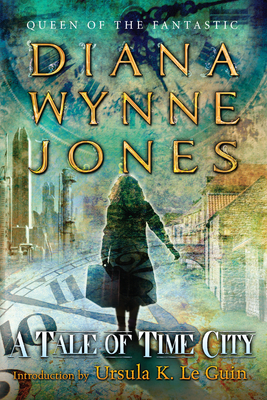
Part of the fun of Diana Wynne Jones Days is that Firebird is reissuing several of her books with new definitive editions.  Considering A Tale of Time City is one of my favorite books that I somehow don’t own, I may need to pick up a copy with that lovely cover up there.  Check out the list to see if they’re reissuing your favorite!

I’ve long since lost count of how many Diana Wynne Jones books I’ve read.  However, I’m a list-maker, so I can look it up for you–twenty-seven!  All in all, I think it’s a good thing I didn’t give Richard Samuel Jones the name Smith instead.  Maybe there’s some wonderful author named Smith…but it’s hard to believe it could be anyone who would top Diana Wynne Jones.

Another Lady Knight-to-be

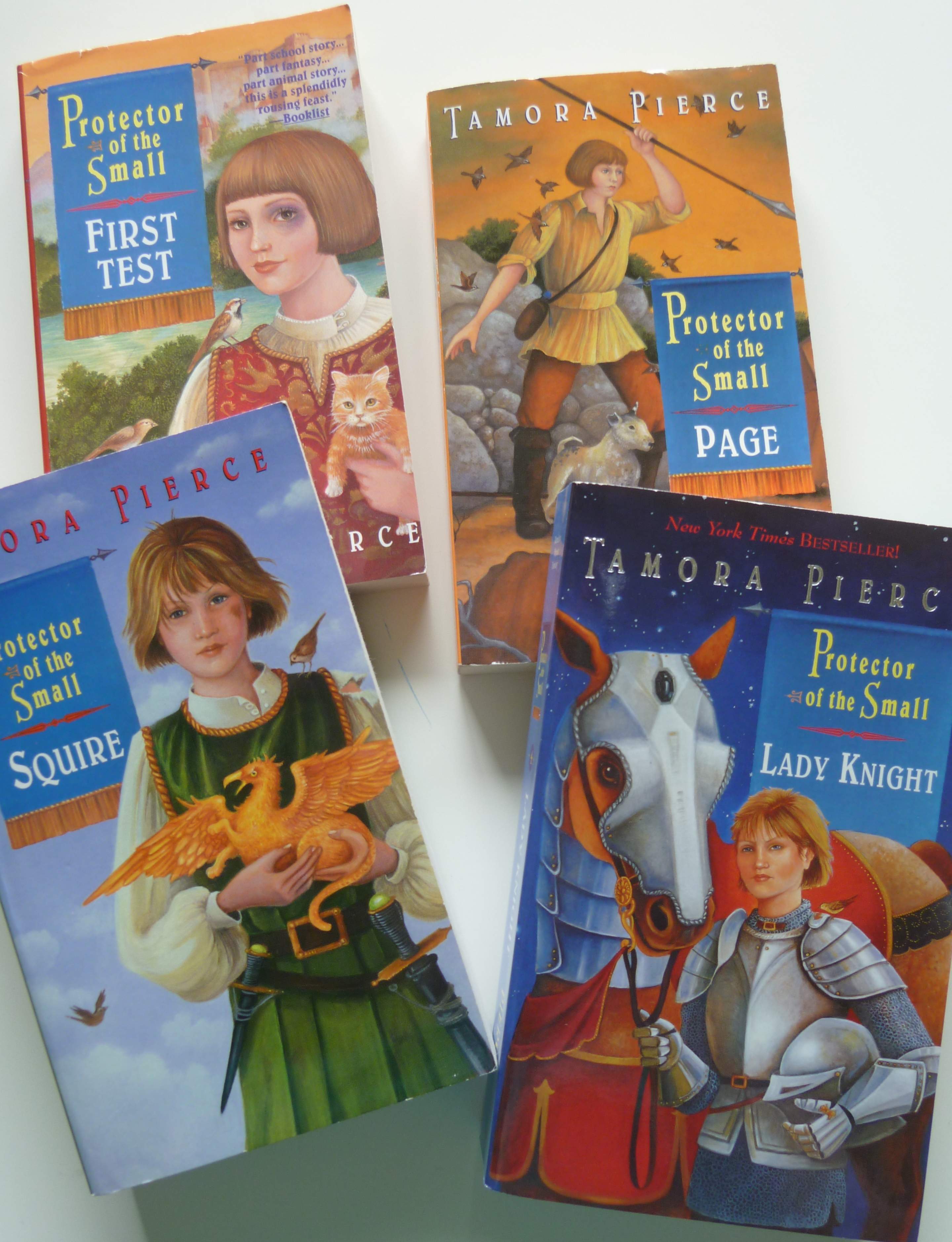
As part of my personal quest to re-read all of Tamora Pierce’s Tortall series (18 books!), I re-read her Protector of the Small quartet during March…then took forever to get to this review!

The heroine of Pierce’s third Tortall quartet is Keladry of Mindelan.  The first time I heard about this series, she was described as a girl with a knack for animals who wants to become a knight.  And I thought…well, isn’t that just a combination of The Song of the Lioness, about Alanna who wants to be a knight, and The Immortals, about Daine with her magical knack for animals?  It kind of is–but in most ways it’s not.

Alanna had to disguise herself as a boy to get her shield, but after her friend Jonathan becomes king, he decrees that girls can become knights.  Then for ten years, no girl ventures to try it.  Finally Keladry comes along, the daughter of a diplomat’s family who has lived most of her life in the Yamani Islands (a very obvious take-off on Japan).  Alanna is her hero (should I say heroine?) and she dreams of becoming a knight so she can protect the defenseless.  She becomes a page, but faces fierce challenges from boys and even instructors who don’t think a girl can be a knight.

The first three books (First Test, Page and Squire) follow Kel through her training, and the fourth book, Lady Knight, is about her first adventure as a knight, mostly commanding a refugee camp during a war.  (Sorry if that was a spoiler to tell you she does eventually get her shield…) In the first book Kel is only ten, but like Alanna, she’s a very OLD ten-year-old.  To diverge slightly, I actually have a theory about this.  Pierce originally envisioned Song of the Lioness as an adult book.  I’m guessing when she decided to make it YA, some editor told her the characters had to be younger, so she dropped five years off their stated ages; all of Alanna’s peers act pretty consistently five years older than they’re supposed to be.  Once Pierce had established that pages start training at ten, she was stuck with that in this quartet too.  I think my actual point here is, don’t be off-put by a quartet that starts out about a ten-year-old.  Kel never feels that young, and she gets older quickly.

The animals turned out to be a relatively minor point; Kel has a bad-tempered horse, a disreputable dog and a flock of very clever sparrows, but the intelligence of the animals is largely chalked up to Daine’s presence at court.  She has powerful magic that sort of seeps into the animals around her.  Kel doesn’t have any magic of her own, the only Pierce heroine not to have some kind of magical ability.

Protector of the Small is in many ways a transition series, both for Pierce’s writing and my personal engagement with the books.  These were written when I was in high school, so I read them later and less frequently than the first two quartets.  I’m not sure, but this may be only my second time through the series.  I like them, but I don’t madly love them the way I do the first two quartets–but I don’t know how much of that is simply my personal history and familiarity with them.  I do know two people who say these are their favorites.

I like Kel, but I don’t love her.  I admire her very much–more than Daine, if I really stop to compare admirability.  Kel is tough and brave and, as the quartet title suggests, constantly trying to protect those around her.  She wages a campaign against bullying among the pages in the first book, and gets into the defense of battered women in the second.  In the fourth, she’s fiercely protective of her refugees.  She’s a great character and a wonderful role model for girls.  And I do like her–but somehow I don’t quite love her.  Maybe she’s a little too serious, or a little too righteous, or maybe I just met her later than I met Alanna and Daine.  She’s inevitably the other lady knight.

Alanna is back in a small supporting role, and I’m always thrilled to see her.  Jonathan, Daine, Numair and a handful of other major characters from earlier books also have roles again, most notably Alanna’s friend Raoul, who if anything has a bigger part here.  As ever, it’s fun to see how characters’ lives are going along.  There are many good new characters here too.  My favorite is Neal, Kel’s very funny best friend (him I love), probably followed by Tobe, an orphan Kel takes under her wing in the fourth book.  There’s also a perfectly dreadful villain, Joren, who matches Duke Roger for charming viciousness.

I mentioned transitions in Pierce’s writing–Protector of the Small is definitely a changing point from the simpler earlier books to the more complex ones she’s writing now.  It’s a little hard for me to explain how they change, because Song of the Lioness has complex characters and complicated plots and good writing…but somehow the more recent books feel denser and grittier and more mature.  They do get darker, especially the fourth book, and the third and fourth are both much longer than earlier ones.  They were written right about when Harry Potter was getting popular, and Pierce directly thanks Rowling for opening the door to longer YA books.

There’s something more realistic about this series, although I’m struggling to put my finger on it.  Tortall has felt like a real, complex world from the beginning, but there is a certain amount of sorcery and legend feel to Song of the LionessProtector of the Small has less magic, and it gets into practical things like politics, diplomacy, the complications of supplying a band of knights, the difficulties of the legal system…  Alanna went through tough training, but Kel seems to keep count of the specific training and the bruises involved much more.  It’s just a bit of a different feeling.

In a way this quartet occupies an unfortunate space–I think I’d be more enthused about Protector of the Small if I didn’t love Song of the Lioness so much.  It really only falls short by comparison–and to be not as good as one of my most favorite quartets ever…well, that’s barely a criticism, really.  So, if it isn’t already clear, let me just say that this really is an excellent set of books, a fantasy series that is nevertheless gritty, with characters that are engaging and very human.  Well-worth reading.

And now I’m down to just two more Tortall books to re-read!  Stay tuned for a review of the Trickster books soon.  🙂

Author’s Site: http://tamorapierce.com/

Other reviews:
Respectable Collection
Young Adult Fiction & Whiskey Sours
The Literary Tally
I found a strange lack of reviews…I know other people are reading Pierce!  Point me to your reviews!  🙂

Favorites Friday: Discworld

The Discworld series by Terry Pratchett really is a world unto itself.  It’s a sprawling, chaotic hilarious tumult of a series, with forty-odd more and less connected books.  The biggest problem is where to begin, and that did put me off for a while…until a friend finally handed me one and told me to start.  I’ve read 18 since then (I think–I swear I counted my list five times and it kept coming out different, which is actually very appropriate for Discworld).  I found out it doesn’t really matter where you start, so if you enjoy humorous fantasy with a satirical bent, I highly recommend jumping in wherever you like.

But some places are perhaps better to start than others, and some books are more hysterically hilarious than others…so I thought I’d share a few favorites, to give you some ideas.  Don’t start with the first book in the series, The Colour of Magic; it’s fine, but there seems to be universal agreement that it’s not one of the best.

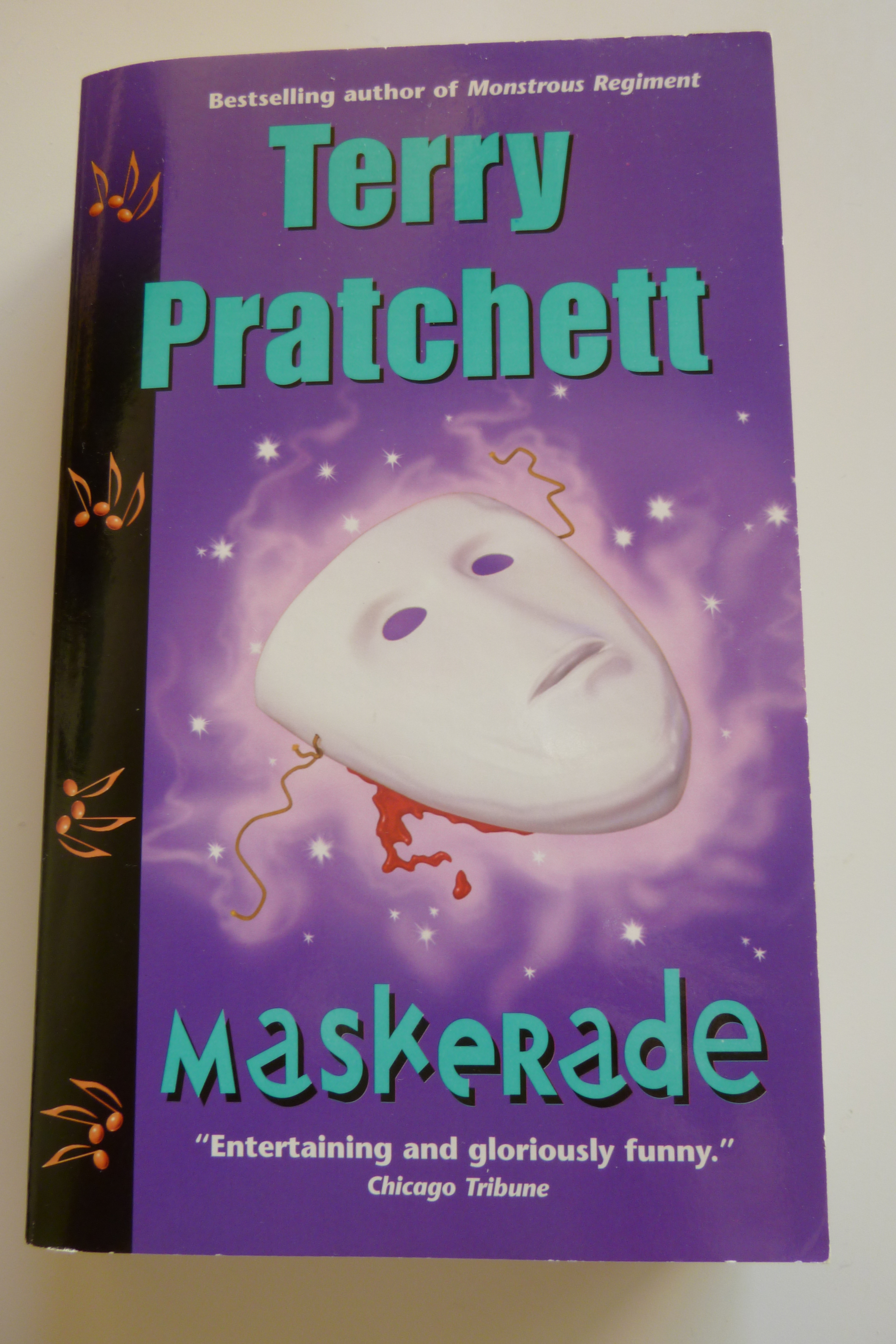
Maskerade is the first Discworld book I ever read, sort of.  I did read it first, but I came at it solely as a Phantom of the Opera retelling, had no context to put it in, and haven’t reread it (or enough of the books about the same characters) since reading others to really get it into my head as part of the larger whole.  But technically it was the first, and still a favorite.  There’s a masked madman who’s terrorizing the Ankh-Morpork Opera House with, among other things, little notes where he writes down maniacal laughter (as in “Ahahahahaha!!!!!  Yrs, The Opera Ghost”).  This book also has one of my all-time favorite lines.  Death, a recurring character, appears to a recently deceased man, and tells him he’s going to be a rat in his next life.  The character says, “But I don’t believe in reincarnation!”  To which Death replies… “But reincarnation believes in you.”  Actually, he says it in all capital letters, because he’s Death.

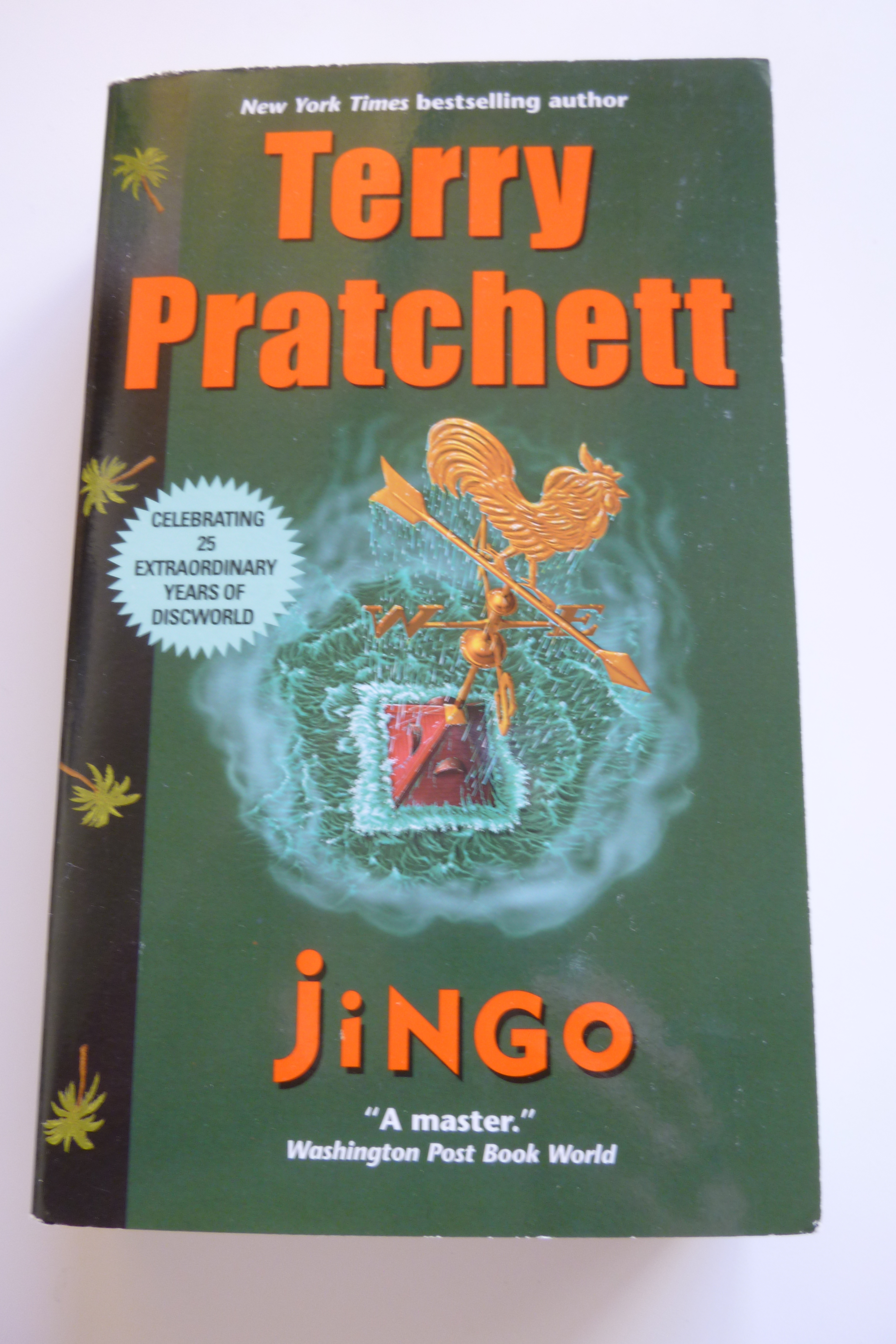
I began my proper reading of Discworld with The City Guard books.  There are eight books focused on Guard Captain Sam Vimes and his crew of more and less competent watchmen.  Guards! Guards! is the first, if you want to start there.  One of my favorites is Jingo, which satirizes the political jockeying around wars.  Vimes eventually prevents war by arresting both opposing armies for disturbing the peace.  Also, Nobby Nobbs gets in touch with his feminine side–which, trust me, says it all if you know the character, and is impossible to explain if you don’t.

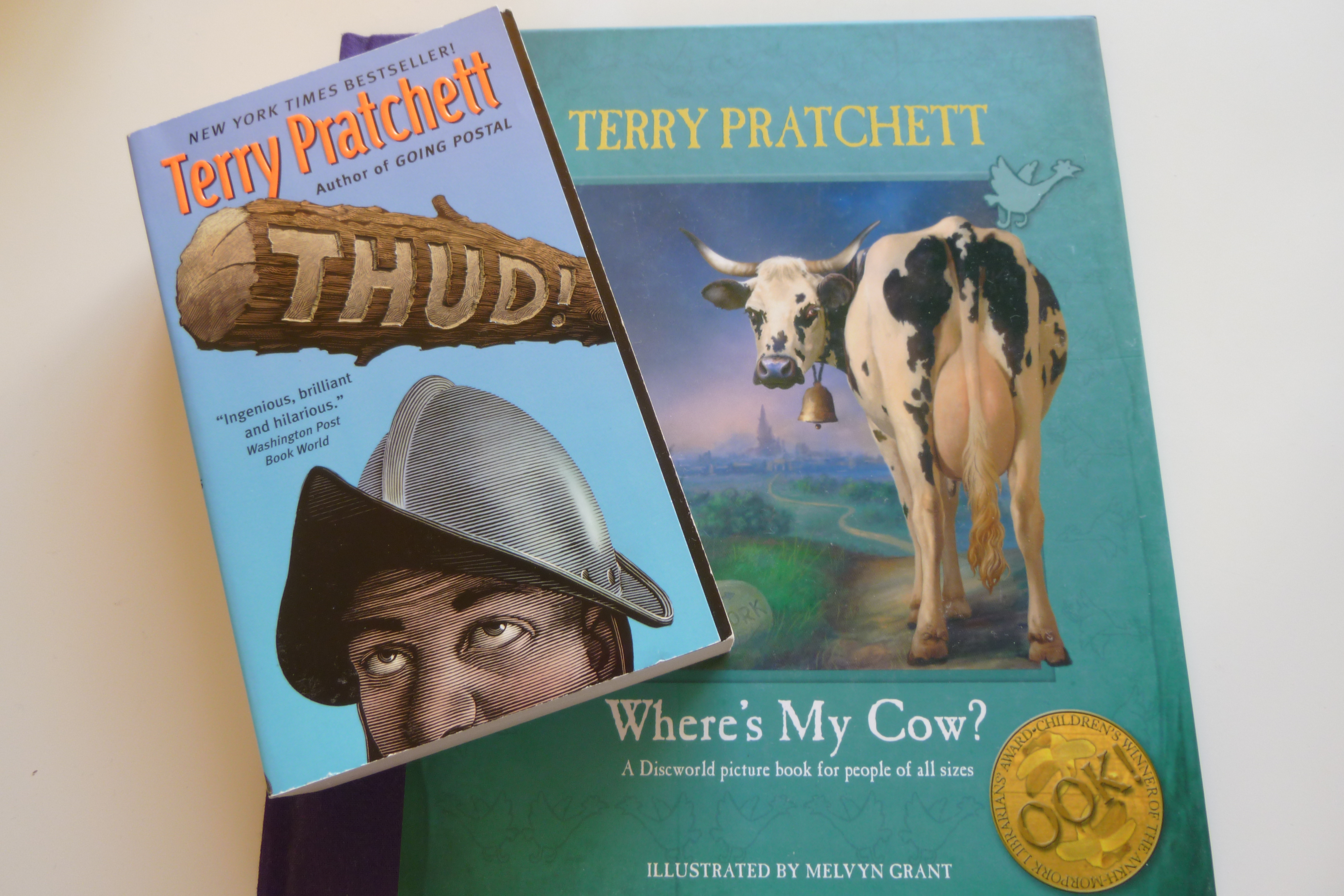
My other favorite City Guard book is Thud!  This one is about racial tension–and it’s hysterically funny.  No, really.  In this case, the two races are trolls and dwarfs, and Vimes has to prevent their ancient feud from exploding all over his city.  My favorite parts, though, are kind of sidenotes.  There’s a famous artist whose papers are almost impossible to decipher, because some of them were quite odd…even odder than “you are not a chicken.”  Also, there’s Vimes’ adorable practice of reading Where’s My Cow? to his son every night promptly at six o’clock, and he never misses.  Even if his men have to declare a state of city-wide emergency to get him home on time.  There’s a companion picture book of Where’s My Cow? which is simply adorably good fun.

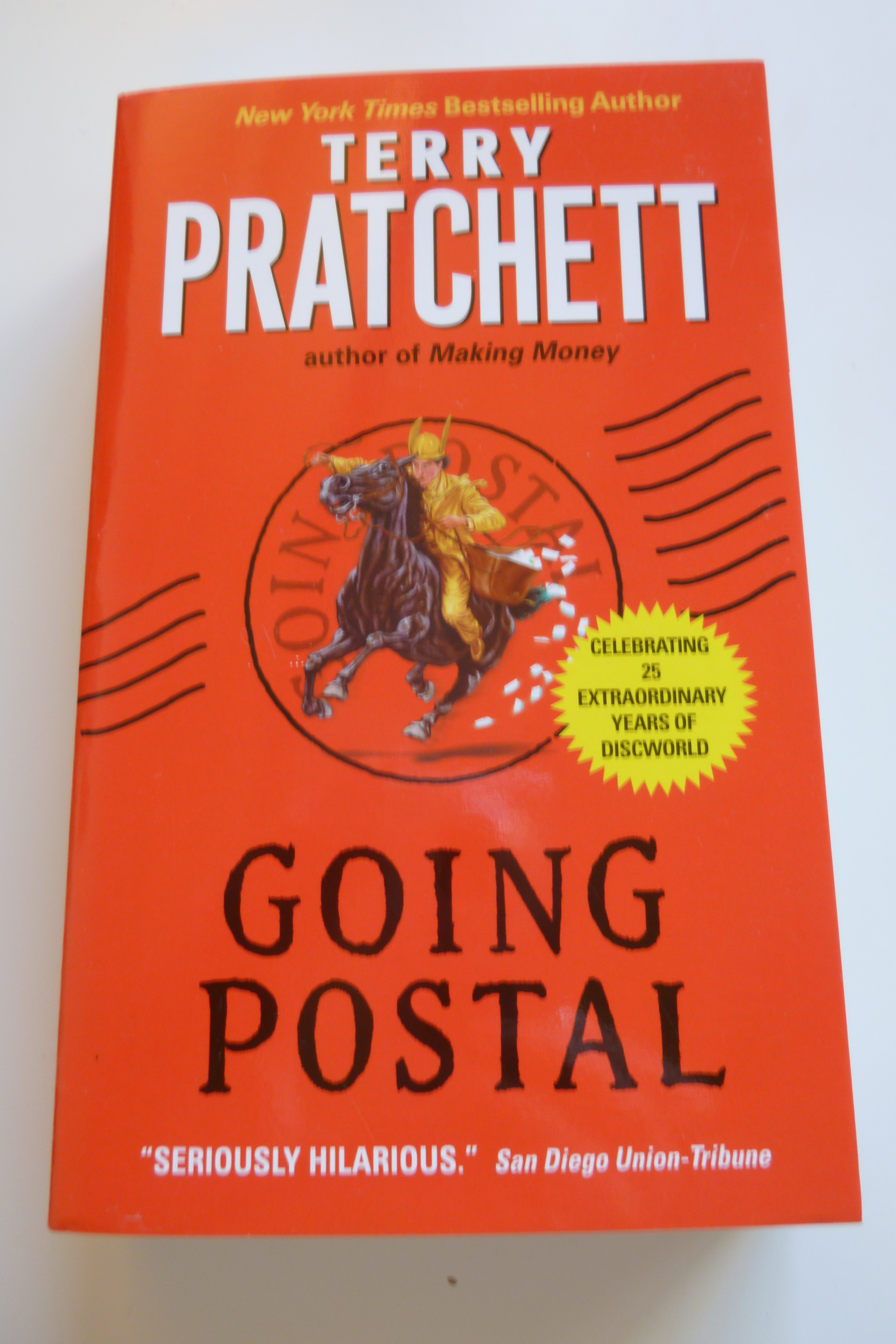
Going Postal is actually my usual recommendation to people of where to start.  I wrote a review earlier, so suffice to say here that it’s about a petty criminal who survives the gallows and is given a chance to become Ankh-Morpork’s new Postmaster.  The Post Office hasn’t functioned in twenty years and is literally filled with undelivered mail.  And I do mean literally.

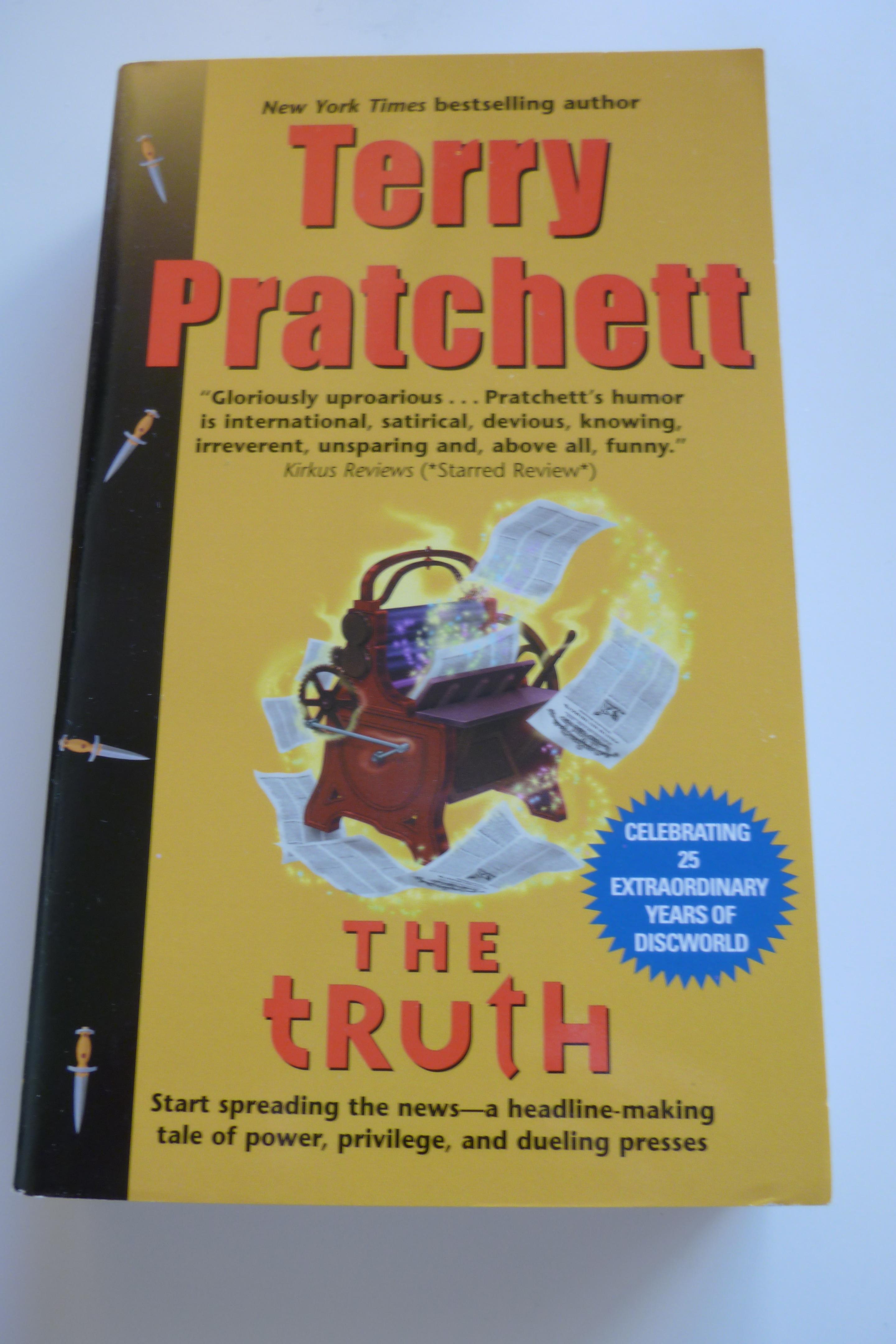
The Truth is another good starting place, another fairly independent one.  This one satirizes journalism, and features a vampire photographer.  The light from the flash turns him into dust every time he takes a picture.  But it’s okay, he has it rigged so he turns back again.

If this post is a little disjointed and incomprehensible, that’s just the nature of the series.  Not really disjointed and incomprehensible, but random and complex and marvelous.  You know you want to understand all my half-comprehensible jokes and carefully veiled references…so you ought to read the series!

Quotable J.V. Hart

“For every life situation there is a fitting quote from the hand of Shakespeare.”

– J.V. Hart

A few days late for Shakespeare’s birthday on April 23rd.  But really, the Bard is worth celebrating every day…