Breaking Out of the Story with the Three Pigs

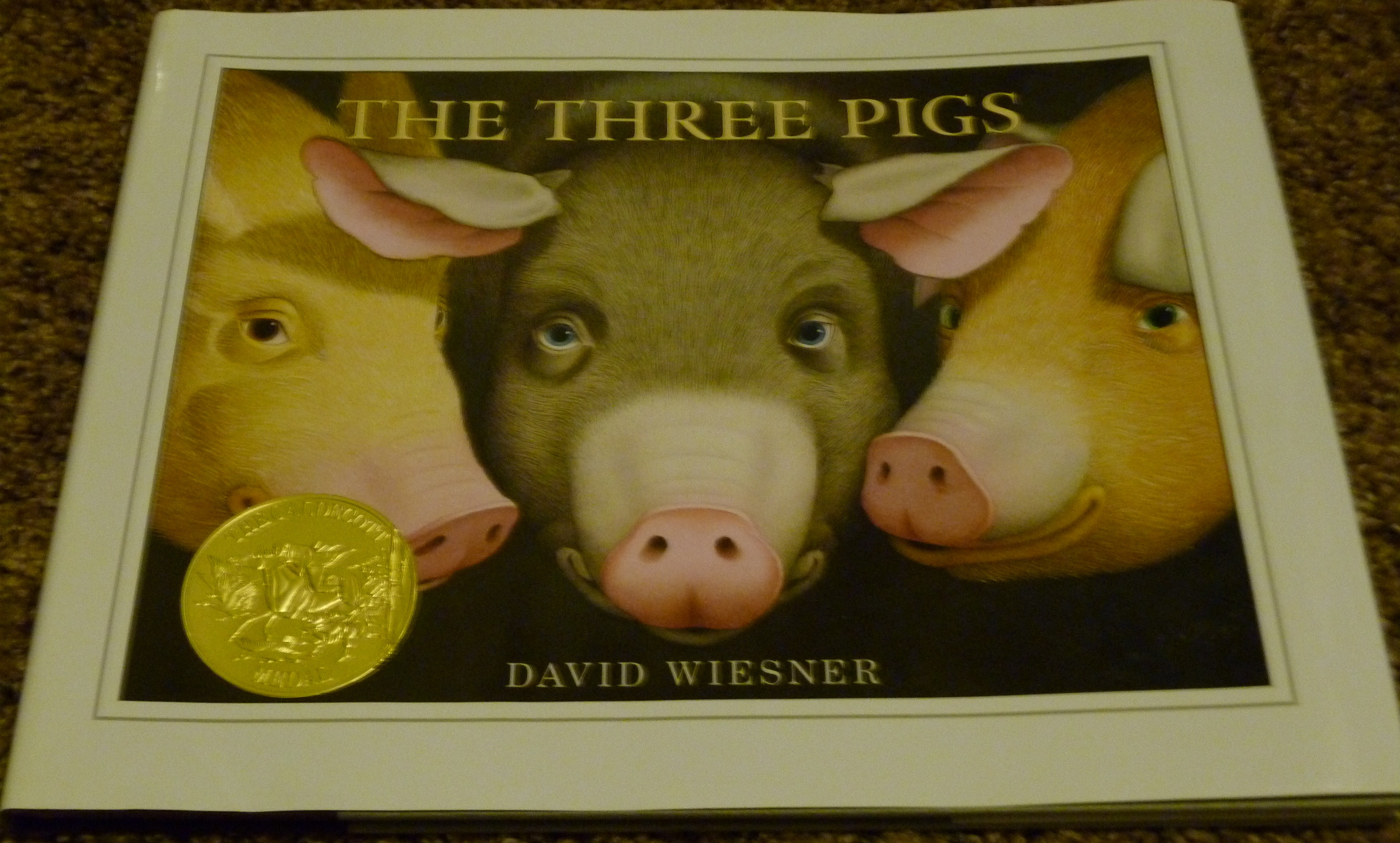
For my second post on picture books this week, I want to talk about The Three Pigs, written and illustrated by David Wiesner.  Unlike the Grandpa and Uncle Wainey books, this wasn’t a beloved childhood story for me–but that’s because it wasn’t written until I was already a teenager.  I somehow managed to stumble on it later in life, and I’m glad I did.  I’m pretty sure this would have been a beloved childhood story if I had been born twelve years later.

The story begins like the story always does, with the wolf coming to blow down the houses of the three pigs one by one.  But this time, the wolf blows the first pig right out of the story and into the margins.  He runs to get his brothers, and they escape from the wolf and go on an adventure out beyond their original storybook.  The pigs fold up one of the pages to make a paper airplane, and fly off into other stories.

I love the concept of characters coming out of the original story.  I love the absolute shattering of the fourth wall that entails.  I love the three-dimensional feeling of the book–the art makes you feel as though you can reach into it, or as though the pigs can lean out to look at you.

The art itself is beautiful.  I’ve read several books by Weisner, and he’s an incredible illustrator.  It really feels like there are works of art on every page.  He also does something very clever here where the art style changes as the pigs go in and out of different stories.  They go into a pen-and-ink drawn story at one point, and change to fit that art style.

I love retellings of traditional stories, and this is one of the most innovative and imaginative ones I’ve found.

Author’s site: http://www.hmhbooks.com/wiesner/index.html

Grandpa’s Tall Tales

I thought I’d do something a bit different this week.  I was recently talking to some friends about favorite picture books, which has got me thinking in that direction.  I usually review children’s and young adult books, but my goal is to highlight books that have cross-age appeal.  So when I recommend a book, even if its target age is officially twelve years old, my hope is that you can enjoy it even if you’re much older than twelve–after all, I enjoyed it!  So this week, I decided to review a couple of favorite picture books, which I think also have some of that cross-age appeal.  I hope you can enjoy them, even if you advanced to chapter books many years ago!
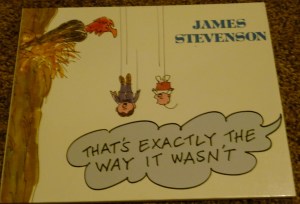
One of my all-time favorite series of picture books was written and illustrated by James Stevenson.  I don’t know if the series has a real name, but I always called them the Grandpa and Uncle Wainey books.

Whenever I get into a conversation about picture books (it comes up now and again!) I always ask if people have read them.  So far, I’ve only met one person who has.  This strikes me as a minor tragedy, because they are truly wonderful.

Each book follows roughly the same trajectory: Mary Ann and Louie come to see their Grandpa, and complain about something.  For example, it’s been raining too long.  And Grandpa always responds with a story about how, when he was a boy, it was SO MUCH worse…  Then the story continues in nearly comic book form, with Grandpa as a little boy with his baby brother, Uncle Wainey, having a tall tale adventure.  Because Mary Ann and Louie are imagining this, Grandpa and Uncle Wainey look like little boys with moustaches, which sounds strange but looks adorable (if you click the picture, you can see it larger, and hopefully see what I mean!)

We Hate Rain! is one of my favorites, when it rained for weeks and weeks, and Grandpa’s entire house filled up with water.  But at least there was plenty of company–neighbors kept floating in to visit, in through one window and out through another.  When the rain stopped and the water receded, they still had a problem because the house was full of water.  Fortunately, Grandpa hit on the idea of pulling the plug in the bathtub, and all the water drained away.

The books are full of funny, absurd details like that.  One of my favorite parts is the way Grandpa, Uncle Wainey, and especially their parents take all of these happenings so matter-of-factly.  One of the best bits of We Hate Rain! is when the water starts coming in under the door.  Grandpa’s parents very calmly stand in ankle deep water and watch it rise.  His mother says, “Oh my.  The water seems to be coming under the door,” to which his father responds, “So I see, my dear.”  And over the next few panels they continue about their life, reading and cooking and playing the piano, in steadily rising water.

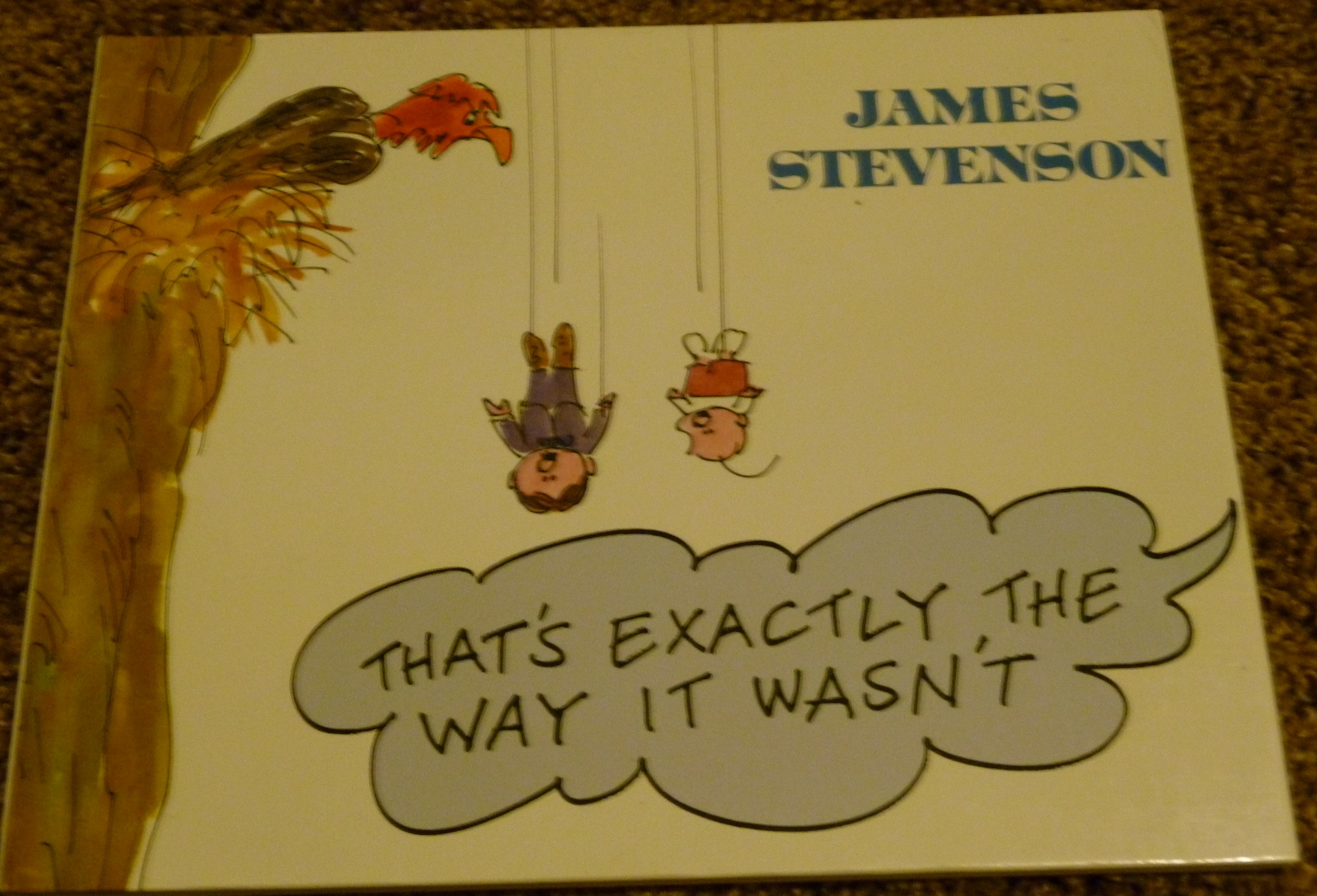
There’s at least ten books in the series.  Another of my favorites is That’s Exactly the Way It Wasn’t (cover above), in which Grandpa and Uncle Wainey keep disagreeing about everything–including whether or not they’re falling off a cliff, a point they debate as they fall headfirst through the air (including politely asking the opinion of a bird as they pass her nest).

The stories always end up happily, with Mary Ann and Louie’s problem being resolved (or dwindling into unimportance by comparison), and with the grown-up Uncle Wainey coming to visit bearing ice cream.

I loved these as a kid, and I still love them now.  I think I took Grandpa’s stories much more at face-value when I was younger–all kinds of fantastical things happen in picture books, after all–and I can see more clearly now that perhaps there was a message in there about not complaining about rain, or about not arguing with your brother.  This probably never consciously occurred to me when I was actually in the target age group. 

But just because I’ve migrated a little from Mary Ann and Louie’s point of view over to seeing things from Grandpa’s angle, that doesn’t change how much I enjoy the books.  And they’re still just as funny.
Guest Post Featured on the O.W.L.

I’m very happy to say that I have a guest book review up on the O.W.L. today!  Jill at the O.W.L. posted a few weeks ago about her plans for an I ❤ Lois Duncan month on her blog.  Lois Duncan is my favorite scary story writer, so I talked to Jill about participating.

You can read my review of The Twisted Window by Lois Duncan on Jill’s blog.

I’ve never been a fan of horror, but I do like suspense and sometimes a little supernatural creepiness.  I like to think of Duncan as the Hitchcock of writers–there’s something similar in her dark, sometimes mysterious, always suspenseful stories.  The Twisted Window is a particular favorite of mine; it lives up to its name with so many twists that you can never be sure you really know what’s going on…

But I won’t ramble on here.  I already talked all about it in my guest post.  🙂

Writing Advice from Gail Carson Levine

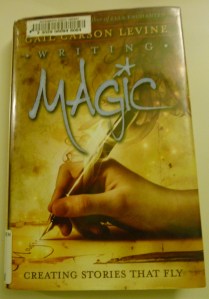
If I had read Writing Magic by Gail Carson Levine when I was twelve, I think it would have changed my life.  Unfortunately, it wasn’t published until I was several years past twelve, and I didn’t read it until I was in college.  But it was still an excellent read then.

Writing Magic, as you may have guessed, is a book about writing, by one of my favorite authors.  I reviewed her best-known book, Ella Enchanted, early on in this blog.  Writing Magic is a wonderful book for kids who want to write.  It’s filled with good advice of all sorts: save what you write; jot down ideas; pay attention to details; make your characters suffer sometimes.  She covers coming up with ideas, writing the actual story, and working through revisions.  The book discusses practical things like the best way to write dialogue, and discusses why you might feel inspired to write to begin with.  And there are writing prompts at the end of every chapter.

This is a great book on writing, and I think it would also be a lot of fun for anyone who has read Levine’s novels–at least, it was for me!  She illustrates writing lessons with examples from her own books–not only by plucking scenes out of the published books, but also sharing pieces of earlier drafts, or talking about what a story started out looking like, and how her ideas changed along the way.  I love knowing the story behind the story.

If you get to the end of the book and want more, there’s good news: Levine has a blog.  It’s a lot like an extension of this book, with discussions on aspects of writing (and writing prompts at the end of each post).  One thing I particularly enjoy about it is the emphasis on young adult/children’s fantasy.  It makes sense–that’s what she writes, after all–and it’s fun to see a genre written about which is not so much a focus in more literary writing books I’ve read, and not at all a focus in most of my writing classes.  And don’t feel that you have to write children’s fantasy to get anything out of her blog (or her book).  The advice is good across genres; it just has a flavoring of children’s fantasy, and is more likely to use fairy tales than Virginia Woolf to draw an example.

The only reason Writing Magic didn’t change my life was that it reached me at a point when I had already read other books on writing, taken a lot of writing classes, and just had already heard a lot of the advice Levine gives.  It was still helpful!  Just less life-altering than it would have been at a younger age.  The gift of this book is that she’s put all this advice I picked up piecemeal together in an engaging way that I think kids will find appealing and relatable.  It might have got me farther along faster in my writing to have all of this advice dropped in my lap at a younger age.  So if you know a kid who likes to write–send them to get advice from Gail Carson Levine.

Author’s blog: http://gailcarsonlevine.blogspot.com/ (and it’s linked over in my list too!)

The View from the Ground

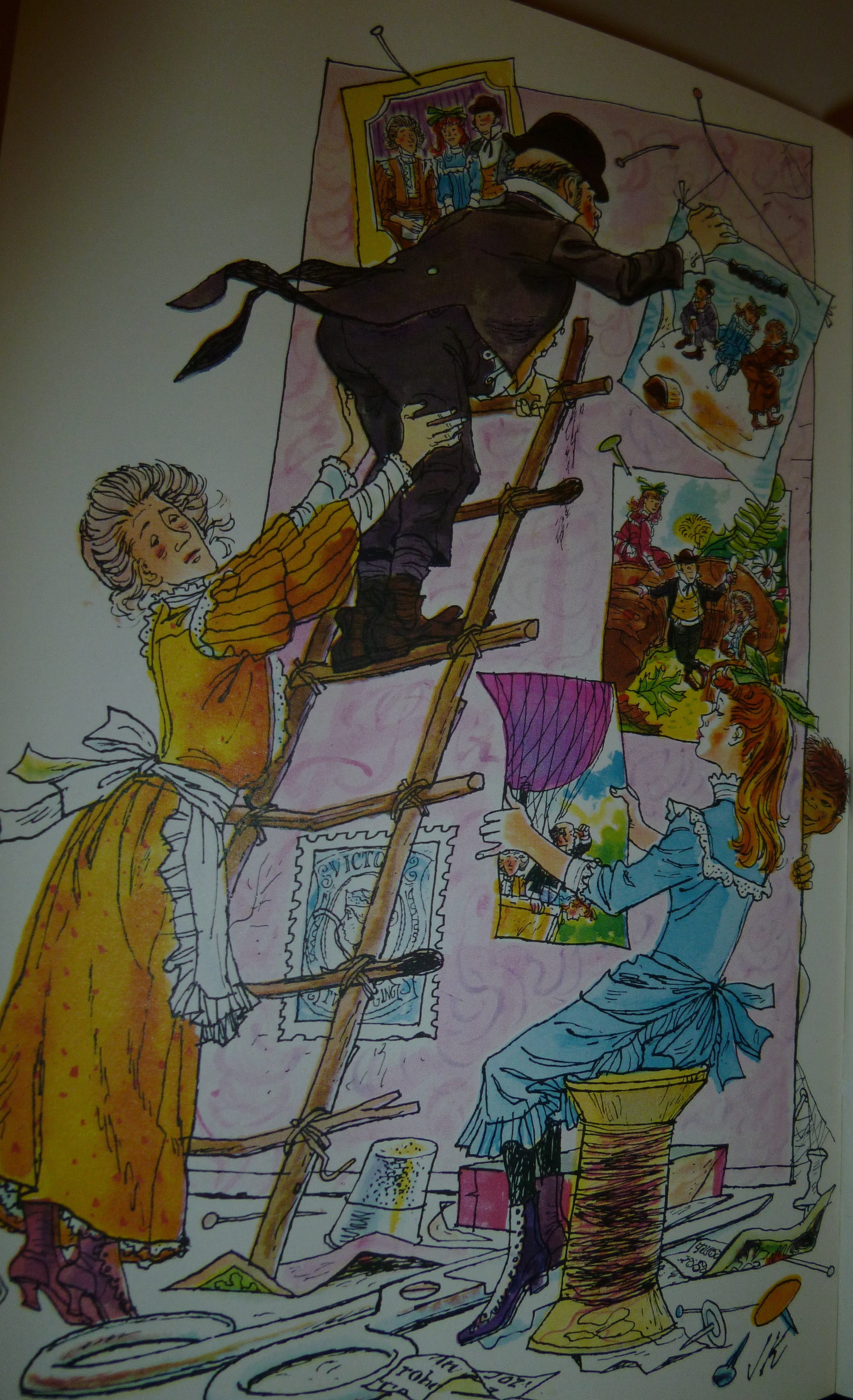
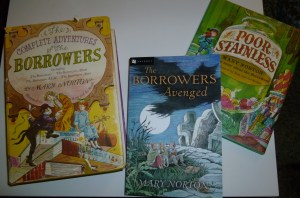
Have you ever lost your keys?  Or a safety pin or a paperclip or maybe a spoon or a roll of thread?  Maybe they were borrowed.  Not by a houseguest–at least, not a human one.  The Borrowers series by Mary Norton tells the story of tiny people who live among us, hidden from sight.  Only a few inches tall, they live inside walls and under floorboards, and survive by “borrowing” odds and ends from the human world.

One of my favorite parts of the whole idea is the details on how the Borrowers live.  The stories are set in England, I think in the early 1900s (though it’s a bit vague) and despite being so much smaller than everyone else, the Borrowers have clothes and rooms and furniture that is all quite proper to the time.  Except, of course, that the walls of the rooms are made of stacked books, the table was originally a pill box, and the chest of drawers is made out of match boxes.  I love the ways ordinary objects are cleverly and creatively repurposed.  And it’s fun to imagine the adventures of a family who can (and do) live inside of a boot in one book, and float down a stream in a tea kettle in another.

The Borrowers series focuses on Arrietty, who I think is about fourteen (although I’ve been paging through the first few chapters and can’t actually find an age!) and her parents, Pod and Homily.  It’s the greatest crisis in the world for a Borrower to be seen by a human–but Arrietty has a fascination with humans, which leads to any amount of trouble.

There are five books in the series (plus a very short prequel named Poor Stainless), starting with The Borrowers.  They’re all good, but I think they get better from the second one on.  It’s in the second one that they leave their home in the old manor house and go out into the wider world for adventures–as mentioned, living in a boot for a while, and ending up in a tea kettle floating down a stream, among others.  Norton keeps the suspense up through the Borrowers’ need to evade humans who want to capture and exploit them, and through the ongoing hazards of surviving in the world when you’re much smaller than everyone else.

One aspect to the book that’s interesting and I think unusual, is that it’s actually a family having an adventure.  In most children’s fantasy, the child in the story has the adventure–think of Dorothy, Alice, Jane and Michael, Wendy or any of the children in Edith Nesbit’s books.  The parents are dead, or oblivious to any magic goings-on, or can be conveniently left behind for the length of the adventure.  In The Borrowers, however, we see a family unit of father, mother and daughter launch into the world.  It’s slightly more Arrietty’s story than anyone else’s, but Pod and Homily are the next two lead characters.

One note if you pick this up and find the first few pages slow going–there is a frame story to this, something about humans who saw the Borrowers telling the story to others.  I can tell you intimate details about the Borrowers’ adventures, but I’m extremely hazy on the frame story because I’ve never actually read it.  I probably should someday, but it’s never seemed as interesting, and at some point (probably by the time I’d read the first book or two) I discovered that it’s very easy to just flip ahead a few pages until I found the first chapter that was from Arrietty’s point of view.  So I could be missing a few details of the story, but I’ve never felt their loss if I am.

As it is, the books are a wonderful adventure with excellent characters and a completely different perspective on the world, from the vantage point of a few inches off the ground.