Journeying to Mars to Meet Tavia

Having just reviewed one of my favorite authors, L. M. Montgomery, it seems only fair to also review my other favorite author this week: Edgar Rice Burroughs.

They have some interesting differences and similarities.  The differences may be more obvious: Montgomery wrote about the small things of life in a rural village.  Burroughs wrote exciting adventures set in the jungle, or on the surface of Mars, or deep under the Earth.  But they both knew how to create a vivid world (albeit very different ones!) and how to write beautiful prose and wonderful descriptions.  Montgomery almost always has a young girl as her lead character.  Burroughs almost always has a strapping, warrior man as his hero.  But they both wrote sweet and very discreet romances–those warriors of Burroughs are also perfect gentlemen.  They also have in common that I’ve read book after book after book by them, and very, very rarely found one that wasn’t top quality.

An odd coincidence of a similarity: they were born less than a year apart.

Since I showed all my Montgomery books, why not all my Burroughs books too.
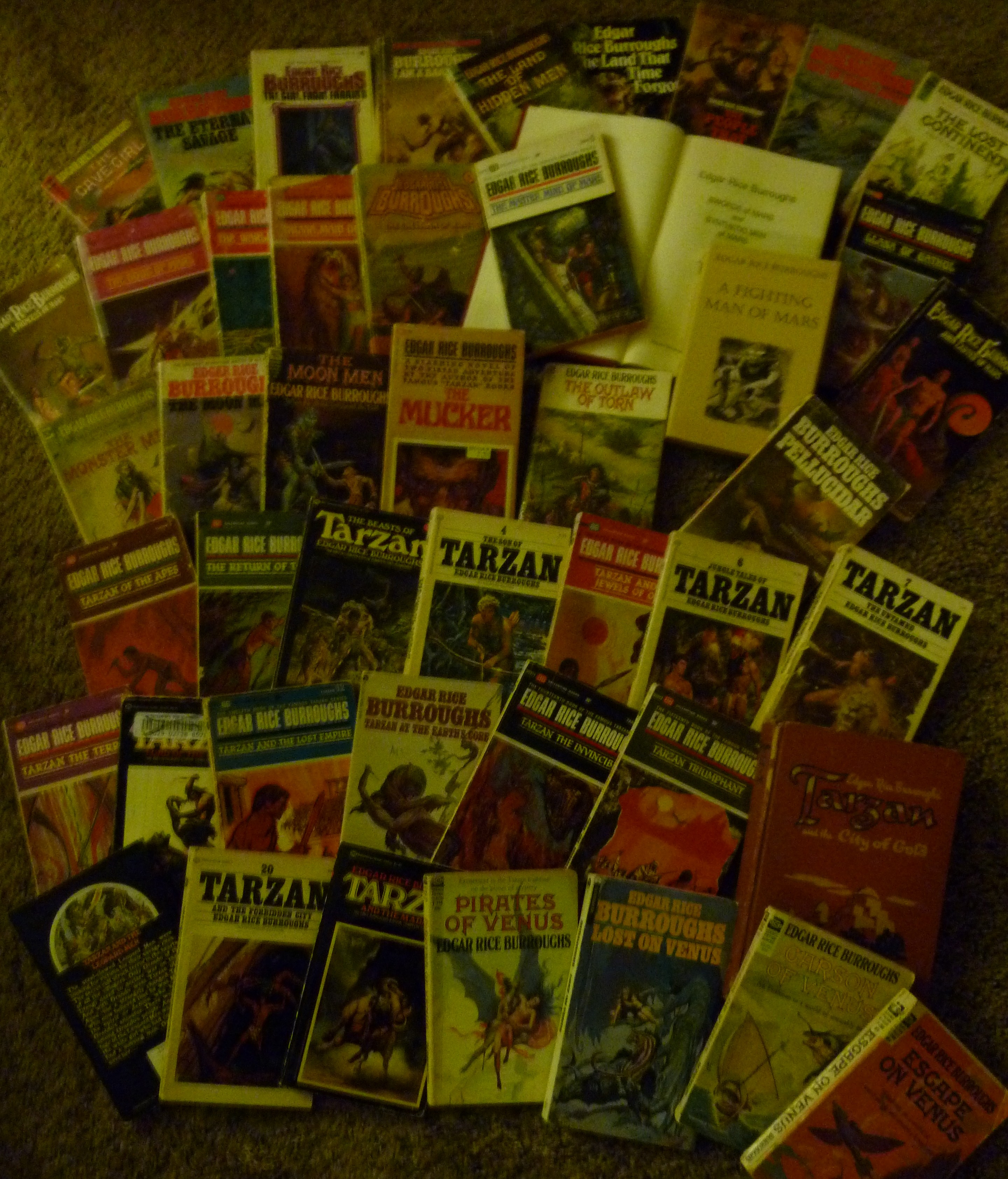
I already reviewed Burroughs’ most famous book, Tarzan of the Apes.  As you can tell from the picture above, he went on to write a lot of sequels about the lord of the jungle–over twenty.  But what I really want to write about today is his other most famous series: his Mars books.

They begin with A Princess of Mars.  John Carter is in a desert in Arizona, where he has a strange out of body experience.  He looks up at the sky, and sees the planet Mars.  He holds his arms up to the sky, and wishes–and finds himself on the plains of Mars.  In Burroughs’ world, Mars (called Barsoom by the natives) is populated by a number of warlike races, from the red Martians who look much like us, to the giant, twelve-foot-tall green Martians.  There are all kinds of other strange animals with six legs or weird stripes or bizarre abilities.  John Carter goes on to have a series of adventures full of swordplay and races against time and endless hazards and escapes, all to win the beautiful Dejah Thoris, princess of Mars.

The first three books in the eleven book series, as well as a few later ones, focus on John Carter.  My favorite, however, is A Fighting Man of Mars.  John Carter is referenced, but the action focuses on Tan Hadron, a red Martian warrior.  In some ways it’s not unlike every other Burroughs adventure: swordplay and kidnapping and a desperate quest to rescue the girl.  (Burroughs only had two plot devices, kidnapping and castaways, but he spun them into 70 adventures.)  A Fighting Man of Mars, however, is different because of Tavia.

Image taken from ERBzine.com

People who have known me on the internet for a long time will know that when I need a fake name online, a username for example, I will usually use Tavia or some variation on it.  In a way it’s a habit–I started doing that at about thirteen, and it’s easy to carry on using the same name whenever this comes up.  And it got started because Tavia is a wonderful character in a wonderful book by one of my favorite authors who, I must admit, rarely wrote a really good heroine.

But Tavia is actually capable.  She escaped on her own out of a harem (fleeing when the King first noticed her–Burroughs heroines get into dangerous situations but are never actually harmed).  She’s pretty much as good with a sword as Tan Hadron.  She’s extremely capable at almost anything that needs doing on their adventure.  Though I do think she’s pretty, her internal characteristics are emphasized much more than her external beauty.  And I find this to be one of Burroughs’ more meaningful and compelling romances.

Sure, there are more impressive heroines when you look across the range of literature.  But Tavia is a great character in her own right, and she’s the best of the ones that Burroughs gave us.  It’s the combination of all of Burroughs’ strengths of writing and excitement and world-describing, combined with a much more appealing heroine, that makes A Fighting Man of Mars my favorite Burroughs book.  It’s the seventh book in the Mars series, but don’t feel obligated to read the first six first.  They’re great books too, but it’s an independent story and Burroughs even provides a helpful overview of Martian society in the foreword.  So I think you’ll do fine if you want to jump ahead to number seven to meet Tavia.

Exploring the World of L. M. Montgomery

It occurred to me that I have not actually reviewed L. M. Montgomery.  She’s been woven throughout this blog, referenced here and there, but somehow I have not actually reviewed her yet.  Even though she’s among my top two favorite authors!

Maybe the problem has been that I don’t know where to begin.  I’ve read 20 novels, 199 short stories (believe me, I’m searching for a way to get my hands on a 200th one!), her autobiography, three books of letters, and her five volume journal.  If it’s in prose, I’ve read it.  And now, where to start?

My L. M. Montgomery collection. I have...a few of her books.

I suppose I could take the obvious route.  Anne of Green Gables was her first novel, and the one I name when people look blank after I say L. M. Montgomery is my favorite author.  It’s a good place to start reading if you’re not familiar with her books.  Anne is a red-headed orphan who is adopted by Matthew and Marilla Cuthbert by mistake–their friend was supposed to bring them a boy from the orphanage, who could help Matthew on the farm.  The story follows how Anne found her place in Green Gables.  Anne is precocious, whimsical, imaginative, deeply in love with nature, and, though always well-meaning, apt to get into scrapes.  Once she dyes her hair green–another time she breaks her leg after walking on a roof on a dare.  Anne is a wonderful character and her adventures are funny and endearing.

That’s a good place to begin.  But I don’t want to stop there.  Because there’s also Emily, a dreamy writer, and Pat, who fiercely loves her home, and Valancy, who only starts to live her life when she thinks she’s dying.  And beautiful, tragic Kilmeny; Marigold with her imaginary and magical friend; capable and confident Jane.

I don’t know why Anne of Green Gables is Montgomery’s most famous book, because she wrote so many others that were at least as good.  The great gift of Montgomery is her ability to create appealing characters and place them in a beautiful world.  With very few exceptions, her books are all set in small towns in Prince Edward Island.  She herself grew up in Cavendish, a small town in PEI, and her books very much harken back nostalgically to the Cavendish she remembers in her childhood–a close-knit community where everyone knew everyone, and the chief social events were quilting circles, lectures and small dances–and weddings and funerals, of course.

Her books are also filled with nature.  Like Anne, Montgomery had a passionate love for the beauties of nature.  Pine trees, flowers, a range of hills against the sunset–from her journal you learn first-hand how deeply these affected her, and that carries into her books.  I once read a book that combined quotes from Montgomery about nature, with pictures that were meant to correspond.  I was amazed to find that none of the pictures were as beautiful as what she was describing.  She felt beauty so intensely–she was able to see it and then convey it in words, where someone else wouldn’t have seen the same thing at all.  A picture may be worth a thousand words, but not when the words were written by L. M. Montgomery.  She has a very unique writing style, which I obviously love–it may not appeal to everyone though, which is why I sometimes recommend starting with her short stories to see if it’s a style that works for you.  The Road to Yesterday or Chronicles of Avonlea are good collections.

Don’t get the impression, though, that her books are long treatises on nature.  The beautiful surroundings are the backdrop to human adventures.  They’re funny, exciting, romantic, sometimes tragic.  She had a gift for drawing out the emotions in events small and large–from the pettiness of carping relatives to the deep betrayal of a disloyal suitor to the fun of a picnic in the woods to the humor of an awkward dinner party.

There are some books I feel I’d love to live inside, and L. M. Montgomery’s certainly sit high on the list.  After reading her journals, I think she felt the same way.  Her life was not always happy, and the sunny world of her writing was sometimes an escape.  Fortunately, she’s made that world available to the rest of us too.

Stories About Pursuing Your Dreams

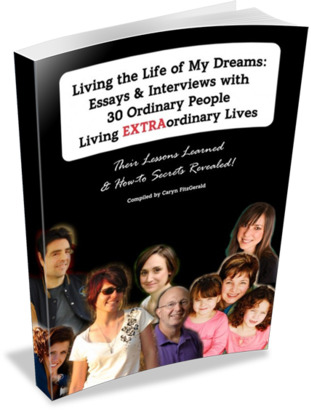
Something a bit different today.  A big theme that tends to come up in my writing is pursuing your dreams.  I like that in books I read too, and today’s book is all about that.  Living the Life of My Dreams, compiled by Caryn Fitzgerald, shares stories from 30 people who have pursued their dreams.  It’s a bit different, in that it’s not young adult, or even fiction.  It’s thirty essays from real people sharing about their lives.

It’s not my normal genre, but it’s showing up here because I was slightly involved in the creation of it.  As is mentioned a few times around here, in my day job I work for UniversalGiving.  My boss, Pamela Hawley, is one of the people who contributed an essay to the book, and I was involved in putting that together.  I’ve also been coordinating with Caryn about the launch of the book.  She asked if we knew any bloggers who would review it.  Well, it so happens, if you need a book review blogger…

So yes, I’m probably a little biased when it comes to Pamela’s essay!  But I’m less biased about everyone else.  Caryn sent me an advance copy of the book, and I’ve been reading through the essays.  It’s very interesting in that you can see the many different writing styles and voices that went into this, since each essay was contributed by a different person.  Some follow a set of questions Caryn provided, others are reflections.

There are many very different stories, but most follow a path of not liking the life they were in, making changes, and finding a new, more rewarding direction.  There are a lot of entrepreneurs, and a lot of writers (which I guess makes sense, when you’re asking people to write an essay!)  I love seeing the many different ways people find greater fulfillment–traveling, writing, starting a craft business, helping others, spreading a cause…  I think the two main messages I take from this book is that you can always change your life, and that there’s no one path to happiness.

This is presently published as an ebook, and you can find it online here–it comes out today.  If you enjoy stories about pursuing dreams, it’s a good read.

Spinning Stories from Straw

I think Vivian Vande Velde and I have similar feelings about fairy tales–wonderful stories, except for all those parts that don’t make sense.  She explores all those weird bits of “Rumpelstiltskin” in The Rumpelstiltskin Problem, and to very funny effect.

This book excellently shows the versatility of fairy tales.  This is a book of six short stories, all retellings of “Rumpelstiltskin,” and all very different.  Sometimes Rumpelstiltskin is well-meaning–sometimes the villian–once even a woman.  We meet a host of different miller’s daughters, clever and stupid and greedy.  Some kings are nice and some are cruel.  Some stories have magic, some don’t.  But all the stories follow the basic premise of “Rumpelstiltskin,” and all are funny.

I think my favorite part of the book is actually the introduction, when Velde discusses the inspiration behind the book–and analyzes all those parts of “Rumpelstiltskin” that don’t really add up.  Why does the miller tell the king his daughter can spin straw into gold when she can’t?  Why does Rumpelstiltskin want a baby?  Why does the miller’s daughter want to marry the king, after he kept threatening to cut her head off?  Why did Rumpelstiltskin agree to the name-guessing contest when, according to their original agreement, he’s already won, and has nothing more to gain?

I love fairy tales.  But they often don’t make sense, and I enjoyed Vivian Vande Velde’s discussion, and then retelling, of one I haven’t thought as much about.

I do believe that classic fairy tales, especially the best known ones, must have something in them that makes us keep telling them.  Some core truth, or spark of an idea that appeals.  What do you think it is for “Rumpelstiltskin”?  In a way it’s a “deal with the devil” story, so perhaps it’s that story of being pushed to desperation, making a questionable deal, and then the forces of good still triumphing in the end.  Well, assuming you consider the miller’s daughter and the king to be on the good side.

And that depends how you interpret the story–or which of Vivian Vande Velde’s retellings you’re reading.

Author’s Site: http://www.vivianvandevelde.com/

Quotable Gail Carson Levine

“There’s nothing wrong with reading a book you love over and over.  When you do, the words get inside you, become a part of you, in a way that words in a book you’ve read only once can’t.”

–Gail Carson Levine, in Writing Magic

Gail Carson Levine is the author of a number of fantasy books for children and young adults, best known for Ella Enchanted.  You can follow her blog at: http://gailcarsonlevine.blogspot.com/