A Multiplicity of Jacks, and One Tom

I really, really wanted to love The Secret History of Tom Trueheart by Ian Beck.  But I didn’t.  My feelings were much more mixed.

I really do love the premise.  Tom has six older brothers named Jack, who all go on adventures in the Land of Stories.  How fun is that?  First, the idea that you can walk through a gate and enter a magical land where fairy tales happen to you, and that there’s a family where they have this tradition of going off on adventures…love it!  And I love the idea of gently poking fun at the way fairy tale heroes (non-princes, at least) are always named Jack.

Tom is the youngest (making him the seventh son–very fairy tale proper, that) and the smallest, and he’s convinced that he’s the least brave.  He’s the only one who hasn’t gone off on adventures, but when all his older brothers mysteriously disappear, then it’s up to him to find out what happened.  I’m not going to try to claim that that’s terribly original, but it’s from the children’s section, and I like stories about characters who don’t think they’re brave and have to find qualities in themselves they didn’t know they had in order to save the day.

So far we’re doing great.  But.  (And you knew this was coming.)  But…we have to read what happened to go wrong with each Jack.  And we have to read what happens when Tom ultimately helps them.  Don’t forget, the Jacks are in the Land of Story to embark on fairy tales.  So what this ultimately turns into is a lot of retelling of fairy tales.

We get the first half early on in the story: Jack gets halfway into Sleeping Beauty’s castle (or whatever) and gets into some kind of trouble.  The book goes on, Tom has his adventure, we come back later, and Tom helps Jack rescue the princess.  (Sorry if that was a spoiler, but I doubt it surprised anyone).  The trouble is, nothing all that original happens to the fairy tale itself.  Tom is thrown into it, but it’s not really that different.

Tom’s story is original, when we’re following him, but when we’ve also got six Jacks to get through, I felt like I spent way too much of the book just reading stories I already knew.  This might have been better with about half as many Jacks, and only half as many fairy tales.

That points directly to my other problem: while I love that idea of six characters named Jack, they do run together.  Beck tried to distinguish them, by giving them all a nickname like Jacques or Jackson or Jake, but I was still getting them mixed up.  I’m not very good with character names though, so that might just be me.

Like I said, I have mixed feelings on this book.  I love the premise.  However, I’d only recommend reading it if you’re also in the mood to reread the Brothers Grimm or Charles Perrault, because that’s more or less what you end up doing, in between Tom’s adventure.

I recently found out there are two sequels, and since the premise is so good, I just might investigate them.

Author’s site: http://tomtrueheart.com/

The Strangest Family in England

Some of my favorite characters live inside of Ordinary Jack by Helen Cresswell.  Ordinary Jack is Book One of the Bagthorpe Saga.  The Bagthorpes are a family of geniuses, each with a precise number of “strings to their bows.”  That is, a number of talents.  All except for Jack, who is ordinary, and politely disdained because of it.  Jack is complaining about it to his Uncle (by marriage) Parker one day, who hits on a scheme to convince the rest of the family that Jack is in fact a gifted psychic who can see visions and predict the future.  Chaos, to a degree unusual even for the Bagthorpes, ensues.

Jack and Uncle Parker are a fairly rational pair, who will chart you through the madness of the rest of this cast of truly hilarious characters.  There’s Mr. Bagthorpe, a TV writer who loudly and frequently complains that everyone is disrupting the delicate vibrations he needs to write.  There’s Grandmother, who cheerfully starts an argument with everyone, and is in years-long mourning for her beloved pet cat Thomas, who everyone else remembers as the worst-tempered animal who ever lived.  There’s Uncle Parker’s daughter Daisy, who is four years old and likes to write on walls and set fire to things, often with literally explosive results.  There’s one scene involving a birthday party and a box of fireworks hidden beneath the table…  Daisy’s mother, Celia, is a poet and far too ephemeral and dreamy for this world.  She thinks Daisy’s spirit shouldn’t be restrained.   For reasons Jack never quite understands, Uncle Parker is madly in love with her.

That’s only a sampling.  They are all people I would never want to know in real life, and would definitely never want to let into my house (especially Daisy!) but they’re enormous fun to read about.

There are ten books in the series, of which I’ve read the first nine.  For reasons I can’t explain book number ten is extremely obscure and only available for very high prices.  The later books do vary in quality somewhat–they’re all fun, but at some point Cresswell stops having plots and just starts throwing the characters together and letting them react off of each other, and some of the books are better than others.  But the first few are excellent.

And Ordinary Jack is worth the read if only for the scene about the birthday party and the fireworks.

Getting Your Ears on Straight

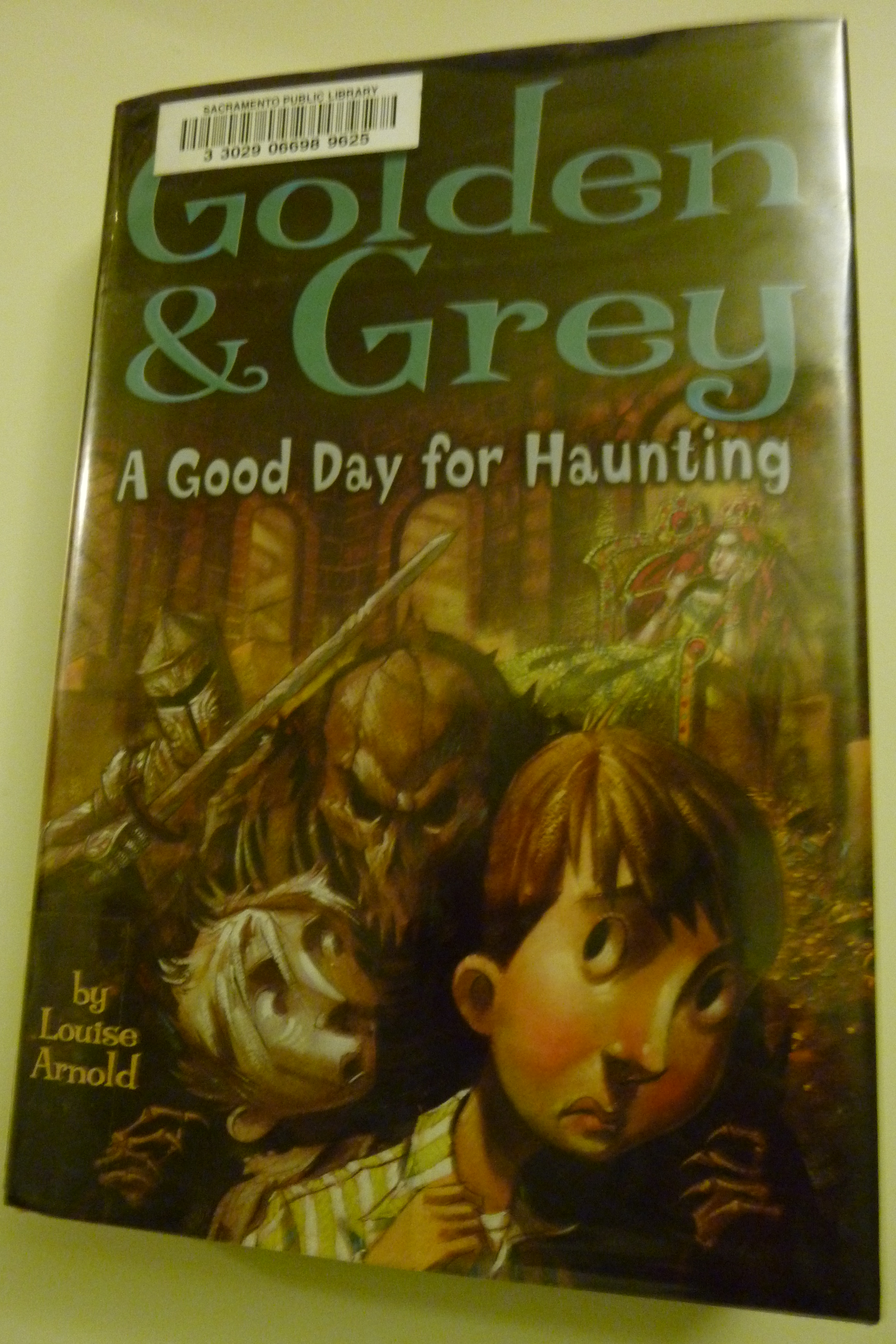
I’ve been having a bad run lately of books with bland characters.  Even some books I’ve enjoyed have had flat, not very memorable characters.  Golden and Grey by Louise Arnold, however, has been a glorious exception to the rule.

It may just be that Grey Arthur can’t get his ears to line up.  It really may be as simple as that.  But I think that’s just part of it.

Let me back up a little.  I don’t usually like to spend large swathes of time explaining plots, but this one has a particularly complicated premise, so here goes.  Golden and Grey is the story of Tom Golden and Grey Arthur, the story of the world we know, and the world of ghosts.  Ghosts are not what you think they are.  They aren’t the spirits of humans who have died; they’re simply another kind of people who exists side by side with humans, only back when people got very scientific and logical and realized that ghosts didn’t fit their scientific and logical rules, they decided it was easier not to see ghosts–and they haven’t ever since.

Grey Arthur is a young-seeming ghost who has been trying for 300 years to figure out what he is.  He tried to be a Poltergeist, but he kept feeling bad and returning the socks he stole, so that didn’t work out very well.  When he tried to be a Sadness Summoner, his attempts at depressing poems kept turning out to have happy endings…and so on like that.

Tom Golden is a perfectly ordinary and normal human boy, who nevertheless has found himself labeled Freak Boy and picked on by bullies at his new school.

When Tom Golden and Grey Arthur both mutter “Life isn’t fair” at the same moment, a connection is formed and Grey Arthur has a revelation.  His role is to be Tom’s Invisible Friend: pulling “Kick Me” signs off of Tom’s back, putting Tom’s forgotten lunch into his locker for him, and sitting with him in the cafeteria so he won’t be alone, even if Tom doesn’t know he’s there.  And then an accident occurs and Tom becomes able to see ghosts…and things really become crazy.

This is a delightful book on so many levels.  The ghost world is elaborate and varied.  Every kind of ghost from legend seems to be represented here, from funny to scary, each neatly labeled and categorized as a type, from Headless to Faintly Real to Screamer to Thesper (you don’t want to meet a Screamer, but a Thesper would be all right).

I think it’s a good element that Tom is normal but still a social outcast–because isn’t life just that irrational and inexplicable and unfair sometimes?  If he had a weird habit or a shadowy past it would be easy to explain but not as real somehow.  He becomes much more relatable by being normal.

The plot is a good one, with twists and turns that I didn’t even get into here.

And as I started out by saying, there are excellent characters in this story.  They’re memorable, fun, and vivid.  It’s even more impressive that they’re vivid, when you consider that a lot of them are invisible.  There’s cheery Grey Arthur with his mismatched ears and his host of ghostly friends; Tom and his parents (who are just quirky enough to be interesting but stay normal); and a handful of human characters at school.  I can bring most of their names to mind, which doesn’t sound impressive, but I’m bad at remembering names, so it actually does say a lot.

There are at least three books in the series, of which I’ve read the first two (and I plan to pick up the third!)  Arnold keeps up the quality and the interest in the second by introducing a new group of very amusing characters, as well as a new threat.

Whole-hearted recommendation for these books.  Funny, entertaining, well-worth the read.

Author’s site: http://greyarthur.com/

UPDATE: I recently read the third book (and added its cover picture), and was glad to see the high quality maintained.  Arnold continues with the characters she introduced in the second book, and raises the stakes for the conflict to keep things exciting.  And of course I LOVED some very funny references to Grey Arthur’s mismatched ears.

The Curse Strikes

This week for Fiction Friday, I thought I’d share another excerpt from The People the Fairies Forget, my young adult fantasy novel.  You can read a little about the premise here, and catch up with previous excerpts here and here.

            In brief, the story so far: Princess Rosaline was cursed by the Evil Fairy Echinacea at her christening to prick her finger on a spinning wheel and die.  Good Fairy Marjoram transformed the death curse into a spell for enchanted sleep until awakened by a kiss.  Tarragon (a free agent fairy unaffiliated with either group, and our narrator) thinks the whole thing is kind of stupid.  He also has a wager on with Marj about whether True Love can be found among non-royalty; he says yes and she says no.  He’s chosen a goatherd named Jack and a kitchenmaid named Emmy, who works at Rosaline’s castle, to prove his point, although the details of how this will be demonstrated have yet to be revealed to the reader.

            As we join, Rosaline has just pricked her finger.  Marj, out of deep concern that Rosaline will be lonely if she wakes up in a hundred years and everyone else is gone, has put the rest of the castle to sleep too.  Tarry has seen to it that Jack and his herd of goats, including the Little One, a baby goat, have come to the castle to investigate.

*********************************

           When we arrived at the main entrance to the castle, Jack stopped short to stare at the yards and yards and yards of thorns.

            The area around the castle was by no means deserted.  A considerable crowd had gathered already, and more were arriving.  Many looked on with eager curiosity and loudly theorized regarding what had happened—they were plainly onlookers, come to see the excitement.  Others, the ones who appeared more distressed, had to be friends and relatives of the people inside.  Marj should’ve seen what she’d caused.  But she wasn’t there, of course.

            The goats settled in and started eating the lawn.  Jack eyed the thorns.  They weren’t just thorns.  Marj would never dream of magicking up something that plain and ugly, so she’d made enchanted roses instead. There were roses swarming all over the outer wall of the castle and spreading at least three hundred feet out into the fields in a tangled mass far above our heads.  They had vivid red blossoms and sharp thorns.

            Jack scratched the Little One’s head, and stared at the roses.  “I have to get through there.  How am I going to get through there?”

Continue reading “The Curse Strikes”

Inspired by Shakespeare–Or So I Was Told

Today—a rant.

I picked up Starcrossed by Mark Schreiber because it was described as a retelling of Romeo and Juliet.  Also because I wanted to query the agent, but that’s another story.  I even read a review of the book that described it as being a really obvious retelling of R&J.  And I thought, all right, I like Shakespeare, I can go for that.

I am now giving fair warning—if you’re looking for a good retelling of R&J, watch West Side Story.  Don’t read Starcrossed.  This book is no more Romeo and Juliet than it is Hamlet, and I was immensely gratified to see the hero actually point that out halfway through the book.  He was having this discussion with the heroine, who was adamantly convinced that R&J was telling the story of their love.

"Do you bite your tongue at me, sir?" -- The Capulets and the Montagues--not appearing in Starcrossed

But she’s kind of a flake, so that doesn’t signify much.  I’ve read Romeo and Juliet and I’ve seen it performed by the Royal Shakespeare Company in Stratford, so I feel I can make a claim on knowing how the play goes.  Am I right in thinking that the feuding families are just a LITTLE essential to the plotline of R&J?  You can replace them with feuding gangs, I’m fine with that, but if no one’s feuding with anyone, you don’t have Romeo and Juliet.  All you have is a teen romance with some ups and downs, and that’s pretty much every teen romance ever written.

I might forgive this for not being Romeo and Juliet if it was a decent story in its own right…but it’s not.  It’s the love story of Christy and Ben.  They’re together.  They’re not together.  They’re back together.  This gets in the way, that gets in the way, one obstacle doesn’t have much to do with any other obstacle, yeah, yeah, the course of true love doesn’t run smooth, but I would like to feel that the course has some kind of point to it rather than obstacles thrown up for the sake of obstacles.  Especially obstacles like OH NO, you lied to me about your birth date and now our astrological signs are not aligned!!!  I swear I’m not making this up.  This book is contrived, it’s angsty, I disagree wholeheartedly with the reviews it’s getting on Amazon, to the point that I refuse to link to them.

And for heaven’s sake–who names their heroine Christy Marlowe in a book that, theoretically at least, is supposed to be based on a Shakespeare play? Maybe someone who believes Marlowe wrote the plays (by the way–he was dead at the time.  I’m a Stratfordian).

It just goes to show.  Claiming to be inspired by the Bard, A) does not mean you really are and B) does not guarantee a good book.

My sympathies, Mr. Shakespeare.  You deserve better.