The Irrepressible Jacky Faber

I recently read the eighth book in the Jacky Faber series, and I’m wondering how long L. A. Meyer can keep this going.  And I’m hoping it will be a long while!

The series follows the adventures of Jacky Faber…sailer, soldier, pirate, fine lady, spy…oh, and Lily of the West.  Among other things.  Set around 1800, it all starts in Bloody Jack, when orphan Mary Faber decides that the way out of the gutter is to sign onto a Royal Navy ship as a Ship’s Boy.  Obviously that second word presents complications, so Mary becomes Jacky and disguises herself as a boy.

Jacky is an incredibly fun character.  She’s endlessly creative with her schemes and ideas, wildly emotive, rarely depressed no matter what life throws at her, fiercely loyal to her friends and endlessly ambitious to better her life and the lives of the people she cares about.  She has dreams of creating a worldwide shipping industry, and despite usually being only one step ahead of a vast number of people chasing her, she also manages to keep chasing those dreams.  Honestly, she’s like a cork–the world keeps trying to push her down, and she just keeps bobbing merrily up again.

Throughout the series, Jacky gathers a cast of equally memorable characters around her.  A couple of favorites: there’s Higgins, who always maintains the exemplary dignity of a gentleman’s man servant, is enormously helpful faithfully following Jacky through all her adventures, and always makes sure that she keeps her hair at least moderately clean.  And there’s Amy, a very proper young lady from Boston who is frequently shocked by Jacky but loves her like a sister anyway.

There’s also Jaimy, Jacky’s “own true love.”  To be honest, I’ve never been all that impressed by him myself, but she seems to like him.  I don’t dislike him, but (at the risk of a slight spoiler) they don’t spend a lot of time together and after the first few books I lose interest in their romance.  It actually feels like Meyer keeps contriving ways to keep them apart (not emotionally, more often physically apart) as a way to keep the adventure going.  While I approve entirely of keeping the adventure going, I wish he’d either just get them together and let them have adventures together, or break them up and move on.

However, that’s my one biggest criticism of the series.  And it’s a wonderful series–funny, suspenseful, exciting.  Jacky travels from England to America to Australia having a neverending series of mishaps and adventures.  I like to read before going to bed, and I’ve had to stop doing that with some of these because they’re too exciting and it wasn’t relaxing!

Adventure after adventure, I keep turning the pages with usually the same question: how is Jacky going to get out of this one?  After eight books, I don’t feel like the quality has dropped off–so I’ll keep reading to see how Jacky will escape from her latest entanglement.

Author’s Site: http://www.jackyfaber.com/

Books As Objects

I’ve lost track of how many conversations I’ve had over the subject of e-books.  Wonderful new revolution in books?  Horrible travesty attacking the very nature of reading?  Well, I’m not sure I’d come down quite at either of those extremes.  But it has made me think about books as books.  Not as keepers of stories, though they’re that of course, but books as objects.
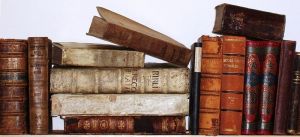
Books, by their very nature of being books and not e-books, function in a completely different way.  And I don’t mean function in the sense that you turn pages.  I mean their physical shape, what they look like, the space they take up, the markings they hold, and all that means.

Looking over my bookshelves, some are very marked-up.  Not marked by me–I rarely write or highlight in books–or even marked by anyone else trying to note favorite passages.  But I love buying used books and I’m a frequenter of my library’s sale section, so I have quite a few books that look as though I ought to be paying late fees on them.

This isn’t true of every book I’ve bought from the library, but a number have been sold with all their library stickers and designations still intact.  So I can look along the shelves and tell you that this book used to belong to the Rancho Library, and that one came from McKinley.

I enjoy that, maybe because 95% of the books I read come out of a library.  With the volume of books I read, I would be very poor if it weren’t for the institution of libraries.  Since most of the books I’m holding from day to day have stickers on their spines and stamps on their tops, somehow I feel fond of the ones I own that look that way too–even though I’m sure it would lower their resale price.

This also says something about books as remembering objects.  Somewhere I read a quote–and I can’t remember where–about objects having value for their ability to connect us to the past, and to the future.  Books are the main objects I own that give me that feeling.  I like being able to hold a book and know that it has existed through past years.  Most of my books were bought used, so they’ve been read by other readers before me.

Those library stickers give the books history.  Rancho was my library growing up.  McKinley is my library now.  I don’t have any books with stickers from the libraries I went to in college, but I wish I did.

I love books with history, either mine or their own.  Whenever I’m buying an old book, I try to find the oldest edition I can (provided the prices are reasonable!)  I always hope to find a used book with an interesting inscription written on the flyleaf, especially something with a very old date.  I have two that are particularly good.

I have a copy of Poems by Robert Browning.  It was my grandma’s, and from the inscription I know one of her best friends gave it to her on her 18th birthday.

I also have A Window in Thrums by J. M. Barrie, published in 1897.  The inscription reads, “For Grandma from Mary Eunice, December 25th, 1898.”  I’d so love to know who Mary Eunice was, and who else owned the book in the last century.

Those are my most extreme “books as pieces of history.”  Most of my books don’t have such a colorful past.  But most have some story behind them, if only “I bought this/received this as a gift/somehow acquired it at this time for this reason and I wanted it because…”  And I like it enough to carry it around with me ever since, and here’s the history of my life during the time I’ve had it.

I gave thought to the physical appearance of a lot of my books before I bought them.  Do I like the cover, or does the main character not match my image of her?  I just passed up a very cheap copy of a book at a library sale because it was the movie cover edition, rather than the original cover (and it’s not a very good movie).  I’ve bought new copies of some books because all my other books in that series are new, and bought used copies of other books because all my books in that series are used.  I once gave away a new copy of a Burroughs book and bought a used edition because the new copy was disrupting my set of battered 1960s paperbacks.  I’ve created my own covers for paperbacks that have cover images I don’t like, and discarded the dustjackets of hardbacks that look better without them.

I went searching for a beautiful copy of Peter Pan when I already owned a battered paperback, and bought the edition with illustrations by Scott Gustafson.  When I bought copies of Alice in Wonderland and The Wind in the Willows, they had to meet the same criteria of beauty.

I’m not against e-books to a 100% extent.  I think they’re a nice idea for text books, for travel, and for anyone who doesn’t feel any of the things that I’ve written about today.  And not everyone does.  If you hold on to your history another way, then perhaps you don’t need physical books.

But I, and I think a lot of readers, do need physical books.  Because I can’t imagine any way that e-readers will ever duplicate what I’ve been writing about.  It’s hard to imagine scrolling through an e-book collection on a Kindle or a Nook or an iPad and thinking, oh, I remember I bought this back when…and I’ve transferred it from device to device…  Maybe.

But I’m never going to look at inscriptions in e-books and wonder what little girl gave it to her grandmother more than a century ago.  I doubt my granddaughter will be keeping an e-book that belonged to me as an heirloom.  An e-book will never connect me to the past or to the future.  I’ll never line e-books up on a shelf and feel satisfied with how nice they look.  Can I choose an e-book based on its illustrations?  Maybe, but not for the weight of its paper, the shininess of its pages, or the size of it.  I can’t buy an e-book that was published in 1902, or a 1914 copy of Anne of Green Gables (same cover as the first edition).  You can’t ask an author to sign an e-book.

It’s true an e-book will give you the story.  But a book will give you so much more.
A Magical Lady Knight

I’m going to try–I really am–not to wax too enthusiastic today.  But it’s hard when I’m talking about a favorite series–when it would actually not be inaccurate to use phrases like “changed my life” and “favorite character ever.”

Am I talking about some great inspirational work?  Well…not a traditional one.  I’m talking about the Song of the Lioness Quartet by Tamora Pierce.

The first book is Alanna: The First Adventure.  Alanna is a girl who wants to become a knight, except that girls aren’t allowed to become knights.  So she disguises herself as a boy and sets out to become one anyway.  Alanna is an incredible character.  When I was younger, I basically wanted to be her when I grew up.  She’s stubborn, determined, and incredibly brave, but also human–she makes mistakes, she has struggles, and she’s not always sure of herself.  She was my favorite character when I was a kid, out of any book I’d read.

The series has a host of memorable characters, with new ones arriving in later books as well.  A couple of favorites include Prince Jonathan, every girl’s dream of a handsome and charming prince, and George Cooper, the roguish and equally charming King of Thieves.

They all live in a world of swordplay and tournaments that is nevertheless grounded and believable–swing a sword around too long and you’ll have sore muscles.  They also live in a world of magic.  Alanna possesses the Gift, which she can use for various spells, some practical and some dramatic.  There is also an entire pantheon of gods who occasionally step into mortal affairs.

The books are funny, exciting, engaging…amazing.

And they changed my life.  I’m a firm believer that a girl can do anything a boy can do, that women have the same rights as men, and that we all ought to be equal, whether in pay rates or in who cleans the house.  I’m sure a lot of that belief comes from my parents, especially my mom, but I think reading about Alanna at a young age helped.

I also met one of my best friends because of Tamora Pierce.  We were freshmen in high school, and were both shy book-lovers.  We were in a class together, but hadn’t talked.  She was reading a Tamora Pierce book, and so was I.  I can’t remember now who talked first, but we’ve later admitted that we each noticed the other one’s book, and each took out our own book before class started in the hopes that the other one would notice and use it as an excuse to start a conversation.  She’s still one of my best friends; we’re both eagerly awaiting Tamora Pierce’s next book, promised for this February.

You may also be recalling right now that in Fiction Friday, I’ve featured some of my writing about a girl who disguised herself as a boy so that she could become a pirate.  It’s not a coincidence that my character’s name is Tamara.

Song of the Lioness is my favorite quartet by Tamora Pierce.  She’s written other books set in the same world, and many characters, Alanna included, turn up in those books.  I recommend those as well.

Much as I still love her, I don’t think I want to be Alanna anymore.  Now, I think that when I grow up, I want to be Tamora Pierce.  I don’t know anything about her personal life, but I’d like to be her from a writing perspective, at least.  🙂

Author’s Site: http://www.tamora-pierce.com/

My Tamora Pierce Collection

2011 Reading Challenges

I’ve been searching the blogosphere for new reading challenges to join, and decided to compile them all here in one post.  I found a lot of fun ones, and picked out a few that are in line with what I like to read, but might give me a push in a direction I’d like to go more often.  So here’s what I have:

This one is hosted by A Few More Pages (love that name!)  The goal is to read a number of books that are the first in a series.  I’ve been wanting to look for new series to fall in love with, so that sounds perfect.  I’m going to aim for “Series Expert,” reading 12 books. 

So far this year, I’ve read:

1) Sarah’s Story by Ruth Elwin Harris (and the rest of the quartet too)

StilettoStorytime

I already had a goal to read more classics, so this fits in nicely.  This one’s hosted by Stiletto Storytime and has a great definition of classic on the challenge page.  I debated what level to aim for–from the definition I think I can legitimately count children’s books and classic sci fi as “classics,” so I’ll aim for fifteen.  Alas, I don’t think I’ve read any yet this year…

Photobucket

I think we know by now that these are a favorite of mine, so I couldn’t resist this one, hosted by Among the Muses.  I’m going to aim for the Enchanted level, 6-9 novels.  That’s probably conservative.  Looking forward to following this one for some new book ideas!

Read so far this year:

1) Spindle’s End by Robin McKinley (Sleeping Beauty retold)

I’m moving this one from its separate post to here to join with all the others.  Hosted by Home Girl’s Book Blog, all you have to do is read books from the library.  Since most of my reading comes from the library, I’m being un-conservative on this one and aiming for 100 library books read in 2011.

Progress thus far:

1) Frenchman’s Creek by Daphne du Maurier

2) Palace of Mirrors by Margaret Peterson Haddix

3) Spindle’s End by Robin McKinley

4) Looking for Marco Polo by Alan Armstrong

5) Stolen by Vivian Vande Velde

6) Enter Three Witches by Caroline B. Cooney

None of these are exclusive lists–that is, you may see books landing on more than one.  A classic novel of a fairy tale retold that comes from the library and starts a series could be on…every list.  I also haven’t seen any rule that says books have to be first-time reads, although I do have a goal of reading new classics, new fairy tale retellings, and new series, so hopefully a good percentage will be for the first time.

I’ll try to update the lists every month or so.  We’ll see how it goes!  🙂

A Magical Retelling of Cinderella

When I reviewed Ella Enchanted, I said it was “one of the best retellings of Cinderella I’d ever read.”  There was actually a very specific reason I didn’t just say it was the best retelling.  That reason is Silver Woven in My Hair by Shirley Rousseau Murphy.

I read this originally from the library when I was…maybe nine?  I don’t really remember.  Young.  I read it several times, and then it somehow disappeared off the shelf.  But miraculously, I remembered the title.  I usually don’t.  I usually remember something like, there was a bit in there where the girl is watching the royal family come back from the island and she sees the goatherd, and then she invites him into the kitchen at the inn to have dinner and it makes her stepfamily mad but he just laughs so it’s all right…oh and then they had a picnic later on in the book, and there was that really good part about the owner of the sword.

And that’s not going to help anyone find the story they’re looking for.  But fortunately I remembered the title, and by the time I was in high school the wonderful world of online booksellers existed and I was able to buy Silver Woven in My Hair for my very own, and I spent an entire afternoon rereading the whole book.  It was lovely.

It’s one of the best retellings of Cinderella I’ve ever read.  It’s a story about Thursey, and her terrible stepfamily.  The royal family was coming back from that island because they were there while the queen and the prince recovered from being captured in a war.  Thursey’s father went to the war and never came back, so this Cinderella actually has a reason to stay where she is–even though she knows he’s probably never coming back, she can’t bring herself to leave, just in case.

Thursey doesn’t have a sparkly fairy godmother, but she does have friends who want to help her go to the ball at the palace.  There’s Anwin the monk, and there’s Gillie the goatherd, who’s funny and charming–and pretty far from a sparkly fairy godmother.  🙂

One part of the story I love is that Thursey is a Cinderella who loves Cinderella stories.  Her family runs an inn, and she collects stories from the travelers who pass through–all the different Cinderella stories from different cultures, Cendrillon and Aschenputtel and Catkin and so on.  Even though Thursey’s life isn’t very good, she never stops dreaming.  The ball is one aspect of the story, but Thursey’s dreams have a lot more substance than dancing a single night at a ball.

The characters, from Thursey to Gillie to the nasty stepfamily, are well-drawn and life-like.  The story is very grounded in reality, in a practical world where dishes have to be washed and goats have to be fed and there’s none of the impossible and imcomprehensible leaps that the original fairy tales often make.  Yet there’s also something whimsical about the tale.  For some reason the word “gossamer” keeps coming to mind, and I think it has to do with the writing style.  Murphy has kept some of the poetry of the old tales, while giving us characters and a plot that are more tangible.

Silver Woven in My Hair isn’t exactly a fantasy…or it could be.  Murphy leaves it up to the reader to decide whether some elements are really magic or not, and I’m not entirely sure what I think.

But even if you decide it’s not a fantasy, it’s definitely a magical story.  And a marvelous tale.