I’ve written about book pet-peeves before, and today I thought of writing about the opposite–though I’m not sure what those would be called! I’ve written often enough about the kinds of books or characters I like, such as strong heroines and slow-burn romances, but those are fairly broad concepts and (fortunately) fairly common! So here are a handful of more specific and more unusual things sure to delight me when I find them in a story…
1) Cross-book references: I love it when I’ve read the same book as a character I’m reading about, and the more obscure the better. It gives me a little thrill of commonality. So naturally I loved the Libriomancer series (so many references! SO many!) and Breadcrumbs.
2) Settings I’ve visited: I always get excited when a book goes to somewhere I’ve actually been (or when I can go somewhere that I’ve read about). The more specific, the better. London is nice; Kensington Gardens is better; the bench closest to the Round Pond when walking south on the Broad Walk is the best. (Thank you, J. M. Barrie, that’s a real example!)
3) Narrators who talk to me: Speaking of J. M. Barrie, he’s the master of a narrator who addresses his story right to the reader–and Catherynne Valente is just about as good. Of course, this only applies to friendly narrators. One of my pet peeves is the flip of this, narrators who talk to the reader but are hostile or insulting (I really don’t know why anyone ever writes this way, but sometimes it comes up…)
4) Villains who think they’re heroes: There’s something marvelous about truly awful, ruthless characters who staunchly believe they’re in the right. Because I think that’s how people really are! To pull an example from TV, Gul Dukat on Deep Space Nine is the best for this. Those Bajorans just didn’t appreciate his guidance while he was running the military occupation of their planet…
5) Heroes who think they’re villains: This can go too far with angst, but when done right I love a character who is so clearly good but doesn’t believe it. This is a variation on my “brooding heroes with hearts of gold” character type that I enjoy so much.
6) Under-valued kids: Delight might not be the right word since these are always kind of sad characters, but I have a big soft spot for kids who seem to be unappreciated by the adults around them. Usually these are kids who are imaginative and introverted and really want to make their parents/teachers/guardians happy, but said-authority figures just can’t fathom how much or why they’re struggling to do that. Hazel from Breadcrumbs, Sym from The White Darkness, and Sophie from The Freedom Maze are all this kind of character (and would probably do better if they could meet each other!)
7) Common sense: Some absurd situations repeat across literature–for example, a stupid misunderstanding separating lovers, so easily cleared up if they just talked to each other. So I’m delighted when characters actually use common sense (and possibly, use their words!) in defiance of cliche plot lines to solve unnecessary problems in sensible ways.
8) Cameos in history: A little like the cross-references above, I love when real people show up in historical fiction. Fiction based around a real person is one thing, but it’s a fun little treat when a story is mostly about original characters except, say, Dickens wanders into the pub one day. Extra points for literary historical figures!
9) Easter eggs across books: I love it when authors drop references or connections across disconnected books. Gordon Korman used the name “Gavin Gunhold” in three different unrelated books, and Terry Pratchett’s Death, while mostly a Discworld character, also turns up in Good Omens and a short story I can’t recall the name of!
10) ??? – I really wanted to do ten, but I got stuck at number nine! So I need your help…what’s your favorite book pet-delight? Maybe you’ll come up with something I love too! 🙂
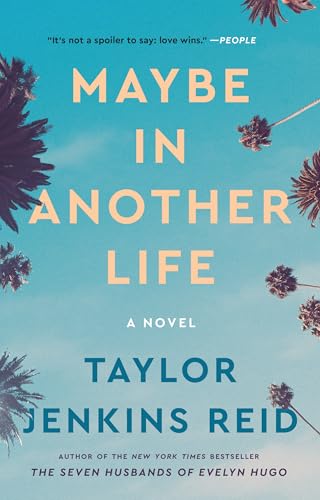 After quite a few YA parallel world books, I wanted to find some more adult ones. Here, There and Everywhere was quite different from the YA ones I’d been reading, and Maybe in Another Life by Taylor Jenkins Reid is also about adults…even if it’s another love triangle (sort of).
 This week’s question for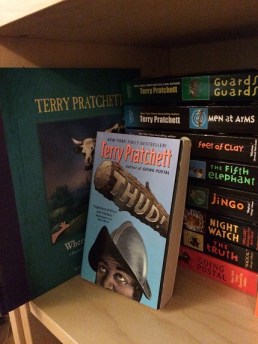
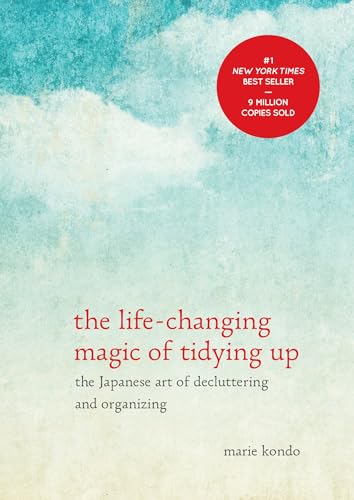 I try to be pretty light on my possessions, but I can always use more inspiration to clear more stuff out. So I was curious to read The Life-Changing Magic of Tidying Up by Marie Kondo–though not so eager that I couldn’t handle waiting when 400 other people were in line at the library before me! The book got to me eventually, and it was interesting…though a little odd too.
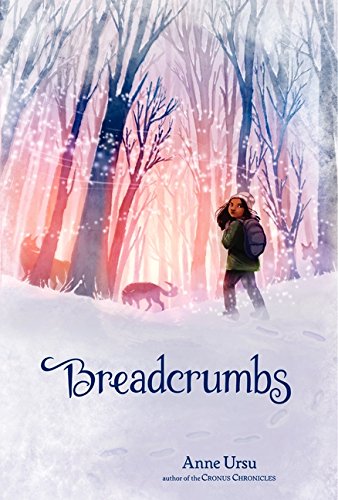 We’re a long way into the Once Upon a Time challenge, and I’ve finally read a fairy tale retelling! Breadcrumbs by Anne Ursu was recommended to me by Katy (AKA, A Library Mama) long ago, and she was absolutely right. It was a wonderful retelling of the Snow Queen–loosely, though a lot closer than Frozen was!
