A Suspicious Eye on Cinderella

Apologies for the placement of that sticker--I don't know what the librarian was thinking!

What ever happened to the twelve dancing princesses, after they quit dancing?  Well, according to Jessica Day George, one of them got mixed up in the plot of Cinderella.  Princess of Glass is a loose sequel to Princess of the Midnight Ball.  The plot is entirely different and so are most of the characters but the events of the previous book are mentioned so frequently, I think you’re better off reading it first–though you could probably start here if you really wanted to.

So, a quick summary of both stories, with a minimum of spoilers.  The twelve princesses are cursed to dance at the Midnight Ball, with twelve demon princes.  If you know the Grimm story, it’s no spoiler to say that a soldier breaks the spell on them, and marries the oldest princess.  The second book is about Poppy, another of the princesses, who is off to a fantasy country based heavily on England (complete with Tutingham Palace as a substitute for Buckingham).  Poppy is there as part of a royal exchange program.  When a serving girl shows up at a royal dance, decked out in finery and mesmerizing the prince Poppy had been growing fond of, Poppy and her friends have to investigate what spell is afoot.

This is a really clever and unique Cinderella retelling.  I love that we get it from such a different perspective.  And since Cinderella, as a person, completely annoys me in the original version, I love that this version is not such a sweet, innocent (and spineless!) character.  This book also addresses a key question the original fairy tale never answers–where did this fairy godmother suddenly appear from anyway?  The godmother’s ultimate motivations felt a little bizarre to me, but the things she does are so fascinating, I’ll forgive her doubtful reasons.

Poppy is an enjoyable heroine (aside from that dreadful name).  She’s tough and resourceful, but has emotional uncertainties too.  I particularly like it that she has all kinds of emotional issues when it comes to dancing–which totally makes sense, right?  Prince Christian is a sweetheart, even if not the most complex prince I’ve ever encountered.  There’s a good complement of secondary characters to round out the cast, including a Cinderella with unexpected depth.

One aspect that really sells me on this book is the description.  It’s lush and vivid, describing dresses, magical transportation, and truly strange glass shoes.

If I had to choose, I liked Princess of the Midnight Ball a bit better, but this was a very lovely follow-up.

Author’s Site: http://jessicadaygeorge.com/default.aspx

2011 Reading Challenges – Three-Quarters There!

It’s the end of another quarter, which probably means lots of things in the business world, but around here means it’s time for an update on reading challenges!

It’s been a solid quarter on just about every challenge (and I went a little crazy on the retold fairy tales!) Things may slow down in November and December, so I’m glad I got more read now.  I still need to work on First in a Series; it’s the hardest one to go look for somehow, so any suggestions of favorite series are welcome!

Linked titles go to my review of the book.   Asterisks indicate I have a review coming soon.  If you see something you’re curious about that doesn’t have a review or one promised, let me know!  If I don’t feel like I have enough to say for a full post, I’ll at least let you know what I thought in a reply-comment.  Rereads are designated with an R for all but the Library challenge, and aren’t counted.

Here’s what I’ve read so far Continue reading “2011 Reading Challenges – Three-Quarters There!”

Sleeping Beauty’s Sister, Questing Through Fairy Tales

I decided to give E. D. Baker another chance.  She wrote the highly disappointing Frog Princess–but I was so intrigued by the premise of The Wide-Awake Princess, I decided to try it anyway.

The story is about Sleeping Beauty’s younger sister, Annie.  She’s immune to magic (in fact, she nullifies it around her), so when the entire castle falls asleep, she stays awake.  She goes in search of princes to kiss her sister, picking up a handsome guard for a traveling companion.

To give Baker due credit, she’s really good at ideas.  I mean, the princess kisses the frog and turns into a frog–that’s brilliant.  The chancy part is what she does with the ideas.  Fortunately, this book was packed with clever ideas, and the follow-through was an improvement on The Frog Princess.

While out looking for princes, Annie encounters elements from half a dozen other fairy tales–Hansel and Gretel, Snow White and Rose Red, Rapunzel, the Princess and the Pea, even the Frog Prince.  They’re all a little bit tweaked, mostly in clever ways, and the fast flow of them all keeps the book interesting.

My main reservation towards the book was a lack of depth.  The major characters had some development but were not very complex, and they didn’t seem to feel anything very deeply.  As an example–all the royals, including Annie’s family, are magically enhanced from christening gifts.  Since Annie nullifies magic, they all become less beautiful, less graceful and so on while around her (again–brilliant idea).  As a result, Annie is forbidden to touch her family, and they never hug or kiss her.  In Susan Kay’s Phantom, the Phantom has the exact same problem, that his mother refuses to kiss him.  For him, it’s a deeply scarring situation, causing him real pain as a child, and on into adulthood.  Annie, on the other hand, seems to be a little wistful on the subject.  (Really–her mother never touches her–that should be painful!)

To some extent it’s apples and oranges–Phantom is high drama, this is a children’s comedy.  But characters in comedies can still feel things.  And children’s books can have depth–the end of The House at Pooh Corner has real pathos, and Abel’s Island is about a character’s existential crisis.

Then there was the treatment of life-threatening situations.  Characters choose to plunge into danger without much motivation.  And while in dangerous situations, Annie is never afraid.  She’s uncomfortable, irritated, occasionally worried, but not afraid.  It got to the point where I was rooting for her to get scared some time, just to prove that she’s human.  I love feisty heroines, but even Alanna (a lady knight dubbed the Lioness) gets scared sometimes.  I don’t care how light your story is meant to be, your characters still have to be believable according to human nature.

But the ideas were really good.  The plot was fine.  Annie, despite not having much depth, is a fun character, and her love interest is a good guy.

In the end, it’s a fun story.  Just don’t expect it to be more than that.

Author’s site: http://www.edbakerbooks.com/

Under the Sea

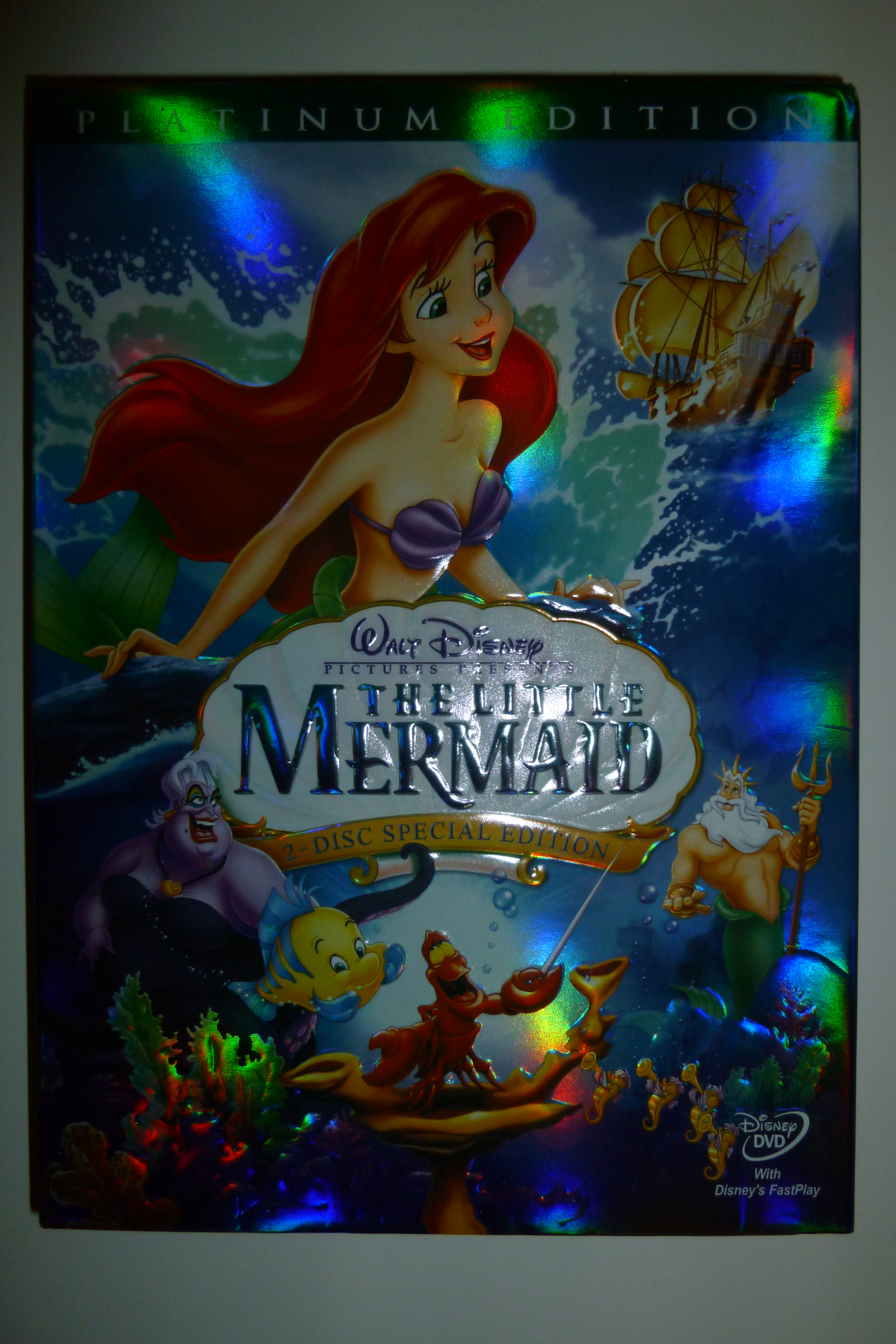
As you may have noticed, I’ve been revisiting some favorite kids’ movies lately–most recently, I went under the sea for The Little Mermaid.  Definitely one of Disney’s best!

The plot is straight-forward enough: Ariel, a mermaid princess, sells her voice to Ursula, the Sea Witch, in exchange for legs so that she can try to win the human prince she’s fallen in love with.

There could be a horrid problem here where Prince Eric clearly is only interested in her face (since she can’t talk to him!) but I actually think the movie did a pretty good job developing their relationship–you know, as much as you can in very brief time, and without any mutual dialogue.  Still, I felt like it worked.

However, I discovered that for my adult self, Ariel and Eric are of limited significance.  I like Ariel’s independent thinking, and Eric is a slightly more impressive Disney prince than most that came before him.  But…the movie’s really all about Sebastian.  The irritable, anxious, well-meaning though crusty crab sidekick totally stole the show for me.  He’s a composer too!  Did you ever notice that Sebastian gets two major songs (both nominated for Academy Awards), while Ariel only has one (plus a reprise)?  Not to mention–Sebastian’s just really funny.  Flounder and Scuttle were great too–how is that the animal sidekicks quite often end up being the best parts of animated movies?

Chef Louis is also wonderful, and clearly made a big impression on me as a kid, considering I was surprised by how little he’s actually in the movie when I watched it again.  And as a kid, I didn’t even know that he’s voiced by the same actor who played Odo in Star Trek: Deep Space 9.  My dad saw Rene Auberjonois at a Star Trek convention once, and he sang “Les Poissons” for the audience.

Aside from Sebastian and company, there were a couple of things that struck me here.  The first is one I’m sure my child-self would have understood.  I was fascinated by Ariel’s hair.  It was the way it floated when she was underwater.  All flowy and floaty and…yeah, having a girly moment, obviously.

The second thing that struck me was a very grown-up observation.  It’s nice and all that the prince got married, but at the end of the movie, the big news in the kingdom shouldn’t be the wedding, or even that she’s a former mermaid.  You know what the real news is?  Good grief, fish are intelligent!

The discovery that fish are on an intelligence-level with humans would have major ramifications.  I mean, what does this do to the fishing industry?  (Sidenote: if you look at the scene with Chef Louis from Sebastian’s point of view, and with the premise that fish are intelligent, it becomes something out of a heavy-duty slasher film.  Body parts everywhere!)  Considering Eric’s kingdom is on the coast, he could have a major economic slump on his hands if they have to give up fishing.  Though on the other hand, they have an entirely new trading partner in Triton’s kingdom, so maybe it would work out.  Plus you could expect all the marine sciences to develop at an astronomical rate.

You know I love picking fairy tales apart…but I love this movie too.  Good romantic leads, Ursula’s a fantastic villain (the tentacles–how cool are the tentacles?), great music, and of course…a funny and irritated crab!

Scented Flowers and Lucky Frogs

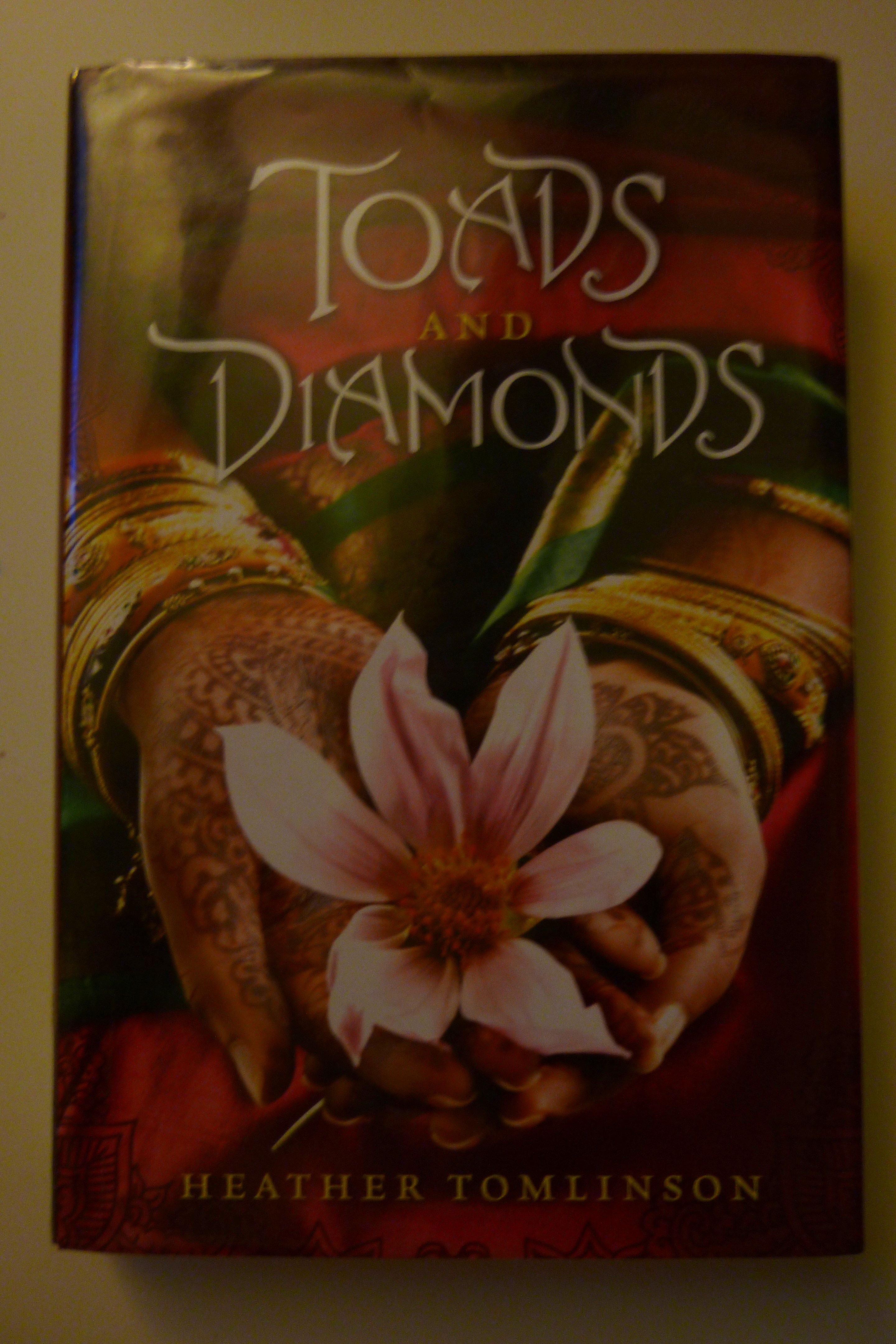
When you see a title like Toads and Diamonds on the shelf, you know you’ve found a re-told fairy tale.  I was trying to remember the title of the original–it turns out it’s usually known as “Toads and Diamonds” too (or “Diamonds and Toads”), although Perrault called it by the not at all descriptive title, “The Fairies.”

Whatever you choose to call it, the story is about two sisters (sometimes step-sisters), who each encounter a magical woman.  One sister is enchanted to drop flowers and jewels from her mouth whenever she speaks.  The other speaks, and drops toads and snakes.  Either one definitely creates a lot of opportunity for bizarre results!  I’ve read some other versions of this, and usually authors like to play with whether the enchantments are really blessings or curses.

Toads and Diamonds by Heather Tomlinson follows this trend, but does so in masterful fashion.  It follows two sisters, Diribani and Tana, who live in pre-colonial India (with some fictionalizing) and are struggling to make ends meet since their father’s death.  They’re devout followers of a fictional, polytheist religion which I think loosely resembles Hinduism.  They each encounter the goddess Naghali; Diribani begins speaking jewels, and Tana drops reptiles.

From the beginning, though, there’s a twist on the usual presentation–in their culture, certain frogs and snakes are considered lucky or even blessed.  Right from the start, it’s not so clear which sister is blessed and which is cursed.  As the story goes on, both girls find both benefits and drawbacks to their magical gifts.

I liked the character development here, as each sister comes to terms with her gift and learns about herself and her role in the world in the process.  They tell the novel in alternating chapters of limited third-person narration.  This is handled very deftly, because even though Diribani and Tana are separated for much of the book, Tomlinson keeps the two parts of the story feeling connected.  Part of that is thematically, but it’s also that each sister keeps thinking about the other, so the reader keeps being reminded of the connection.

My favorite part of this book was the atmosphere.  The Indian culture is vivid and colorful, and the details are excellently handled.  I don’t think Diribani ever speaks a jewel or a flower without a mention of what kind it is.  Potentially that could drag, but it’s not dwelled upon, just quickly described, so that you have constant images of lilies and rubies and orchids dropping past.  Tana’s snakes and frogs are described too, and we also hear about clothes, food, scents…  I love the descriptions of colors.  Rather than saying that a rug is orange and red and tan, it’s described as mango and ruby and apricot.  It brings it all much more to life, with an exotic flare.

I enjoyed seeing a familiar fairy tale put into a very different setting, especially one so vividly realized.  Highly recommended!