The Magic Hill Rewritten

A. A. Milne is best known as the author of the Winnie-the-Pooh books (which are lovely, by the way), but he also wrote a picture book called The Magic Hill.  It was about Princess Daffodil, a little girl who made flowers grow wherever she walked (a gift from the Fairy Mumruffin).  To keep the palace gardens looking nice, Daffodil was only allowed to walk in the flowerbeds, while the other children could only walk on the paths and lawns–and never the twain shall meet.

Spoiler alert here if that worries you!

Daffodil becomes very depressed because she’s separated from the other children, and finally the court physicians decide the answer is to let her go play on a hill outside the palace.  Flowers grow there, it becomes known as the Magic Hill, and everyone is much happier.

It’s a cute story, but, with all due respect to Mr. Milne, I’ve never liked the ending.  Why should Daffodil be happier playing alone on a hill rather than alone in the flowerbeds?  So after I read it, I wrote a new ending–which is what makes this a Fiction Friday rather than a book review.  🙂

A note before we begin: this is a little cutesy in spots, but bear in mind that it’s a continuation of a picture book (one with characters named Daffodil and Mumruffin!) and I was echoing Milne’s style a bit.  🙂

My writing picks up just before the physicians tell the King and Queen that Daffodil should visit the hill.  In the original, they say she must be like other girls, and then send her to the hill.  Mine goes differently…

**********************************

“In short, Your Majesty, although she is a princess, she must do what other little girls do.”

“But she is not like other little girls,” the Queen sighed.  “She is a princess, and one who spreads flowers besides.  What are we to do?”  So the King and the Queen fretted and fussed and the Doctor shook his head wisely and no one knew quite what to do.  They consulted physicians and herbwives and tried to contact Fairy Mumruffin but she had gone away for a long trip (and wouldn’t be back for at least a year and a day, and probably longer) and so everyone went on fretting and fussing.

Continue reading “The Magic Hill Rewritten”

Belle and the Beast

One of the “Once Upon a Time Challenge” Quests involves watching fantasy or fairy tale-based movies.  So today we’re going to take a side-trip into Cinema-land.

I decided to revisit a favorite fairy tale, and watched Disney’s Beauty and the Beast.  I haven’t watched it in a long time–not since I got serious about finding the originals of the fairy tales.  Disney’s Beauty and the Beast is pretty far distant from Jean-Marie LePrince de Beaumont’s version–but I like the way they tell it.  Disney’s was the first version I ever saw/read so I’m sure that slants my view, but I do think they manage some clever revisions of elements of the original.

I like the handling of the rose.  Threatening to kill someone because they picked your flowers is, um, unstable behavior.  But that’s pretty much how it goes in the original.  Having the Beast freak out because it’s a special, magical rose tied into his curse is far more reasonable.  I also like it that the Beast locks up Belle’s father for staring at him, rather than messing with the garden.  Sure, it’s a huge over-reaction either way, but if he has to over-react about something, it makes so much more sense that he’d be overly sensitive about people looking at him funny.

I can’t decide how I feel about Belle finding the castle and volunteering to stay, rather than the Beast demanding that Maurice send a daughter to take his place.  On the one hand, I’m sure the goal was to reduce the Beast’s villainy.  But on the other hand, at least in the original he was taking a proactive step towards breaking the spell.  He needs a girl, so he tries to get a girl.  Not in the best possible way, but at least he was making an effort instead of just moping around.

It’s kind of too bad that Belle lost all her siblings who were in the original, but my guess is that was to make space for other supporting characters, so it was probably worth it.  Lumiere and Cogsworth are really wonderful, and Gaston is a brilliant addition too.

Gaston, besides adding extra comic relief, is a great idea because it gives the story a villain.  In the original, Beauty’s sisters are pretty nasty, and I think a case could be made for the enchantress as the villain, but nothing is clear-cut.

Gaston’s main contribution, I think, is all in the last couple scenes.  First, bringing the mob adds great extra tension, as well as being a fantastic example of mob mentality.  It just needs one charismatic leader and everyone else is swept along (you see the same thing in Disney’s Hunchback, only more so; that crowd makes hairpin turns about three times).  I also love the way the mob demonstrates fear of the Other.  The line “we don’t like what we don’t understand; in fact, it scares us, and this monster is mysterious at least” says it all.

Gaston’s most important purpose, though, is that his presence means there’s someone to kill the Beast.  In the original we have this disturbing bit where the Beast tells Beauty she can leave if she wants to but it’ll kill him, and then when she goes, he tries to starve himself to death.  That’s seriously manipulative and unhealthy.  It’s so much better to have it play out with the Beast sad that she left but not dying–until he’s stabbed by Gaston.

There’s just one thing I don’t understand in this movie.  The spell has to be broken by the Beast’s 21st birthday?  Lumiere tells us, “ten years we’ve been rusting.”  So…this encounter with the enchantress happened when the Beast/Prince was eleven?  Isn’t turning a bratty kid into a monster kind of an over-reaction?  Okay, he was nasty to her, but show a little maturity!  And it doesn’t seem to me that the Beast learned anything much about seeing past appearances.  Belle did that (and as a reward, she gets to marry someone handsome…?) but the Beast went and fell for a beautiful girl, so what’s proved?

But aside from a few of the weirdnesses that often crop up in fairy tales, it’s a wonderful version.  And when I hunted down and read the original, I was so glad to find out that Belle’s love of books goes back to Beaumont.  That’s a favorite part of the movie–and I think everyone I know who loves to read wants the Beast’s library!

Cursed by Christening Gifts

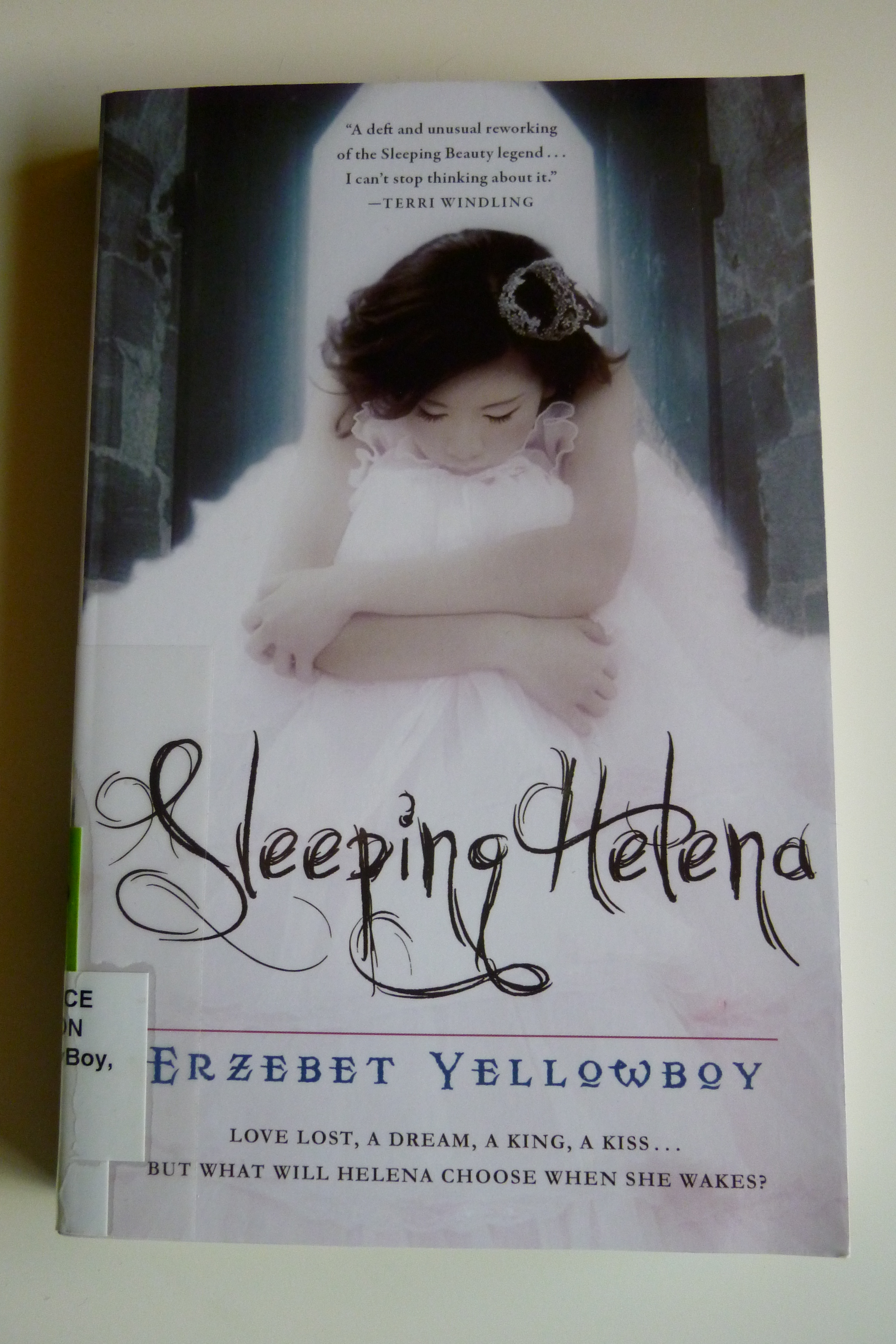
My quest for retold fairy tales most recently brought me to Sleeping Helena by Erzebet Yellowboy. As you can probably guess from the title, it was a retelling of Sleeping Beauty.  And it was…an odd one.

Helena has eight aunts, who all give her special gifts at her christening.  Six offer her well-meaning things like beauty and dancing ability.  One issues a complicated prophecy that seems to predict death.  And the eighth uses her gift to try to undo the curse.  Seven of the aunts raise Helena together, while desperately trying to protect her from the curse.  As the book goes on, we realize that the aunt who issued the curse, Katza, has more complicated motives than it seemed.  It’s all tied into the tragic death of their brother, a century before.

Yes, they have a brother who died a hundred years ago.  Everyone in the family is blessed (or cursed) with extraordinarily long life, which is the first place this starts to get odd.  It’s a little disconcerting when most of the characters are 105 or thereabouts.  Especially when they haven’t been given youth–they really are 105, and apparently feel that way.  I have nothing against elderly characters, but it makes it kind of hard to relate to.

It’s also rather depressing to think about seven sisters living together from childhood into old age, and if any of them ever got married or formed any meaningful attachments outside of their family group, we don’t hear about them.

The purpose of it is so that Helena’s sixteenth birthday can be exactly 100 years after Katza’s sixteenth birthday, which is also when their brother died tragically.  So you get Sleeping Beauty’s hundred years–but going back from the day the curse strikes, instead of forward.

Helena is the most interesting character, although more as a concept than as a person.  I love the way this examines what it would be like to have eight christening gifts.  Helena is so filled with her gifts, there’s no room in her personality for anything else (and they forgot to give her compassion or sympathy or kindness…)  She is utterly absorbed in herself and her gifts, which are constantly clamoring at her to be used–she wants always to dance, to sing, to admire her beauty, and so on.  In some ways, they seem more like curses than the curse.

This does take some interesting turns, and I particularly liked the flashbacks to Katza and her brother, Louis, when they were young.  I ended up disappointed by the ending, though.  I won’t give away the details, but essentially just when it was getting to something really interesting–it ended.

I have to come down somewhere in the middle on this one.  It wasn’t so bad that I’ll talk a friend out of buying it (The Frog Princessactually, she was going to buy one of the sequels and I convinced her it was a terrible idea) or so good that I’ll push it on friends (Robin McKinley–anything by her, really).  It was okay.  So if you have a particular fondness for Sleeping Beauty or some of the elements sound especially interesting, you could give it a try.

Author’s Site: http://www.erzebet.com/

Questing with the Once Upon a Time Challenge

If you’re a regular visitor, you probably know a couple of facts about my reading: I love fairy tales retold; and I’ve signed on for a number of reading challenges this year.

With those facts together, it seems a natural that I would jump on the Once Upon a Time reading challenge being hosted right now by Stainless Steel Droppings.  And I was intrigued when I first heard about this a month or so ago.  But I hesitated.  I had just gone on a rampage of fairy tale retellings in the previous month, and I felt I needed to explore some other books for a while.  And since this particular challenge only runs for about three months, I didn’t feel ready to commit when I wasn’t sure when I’d want to come back to the land of fairy tales.

Well…I’m feeling the fairy tale vibe again.  So I’ve decided to get on board with the challenge too!

Since the timing is different for this one, I’m going to keep it as a separate post from my others.  Also, it’s more complicated!

The Once Upon a Time Challenge has a variety of quests, and now that I decided I’m in, I decided to jump for several of them:

Quest the First: Read five books that are fantasy, fable, fairy tale or mythology.  Half of what I read is fantasy, so it would be silly not to join up for this one!

Quest the Second: Read four books, one from each category.

Quest the Third: Quest one or two, plus reading or watching A Midsummer’s Night’s Dream in June.  Love Shakespeare–so in for this.

Quest on Film: Watch any movies or TV that also tell stories fitting the categories.

The challenge runs from March 21st to June 20th, throughout spring.  I’ll let you know how it goes!

Sleeping Beauty, Awake and Fighting

What if Sleeping Beauty didn’t turn out the way all those fairies at her christening intended?  That’s one element–and my favorite–of Spindle’s End by Robin McKinley.

There’s a line in The People the Fairies Forget when Tarry wonders what christening-gifted people would be like without the enchantments.  How does it change a person to be enchanted to be compassionate?  In my book, Sleeping Beauty is only a minor character, and is about what you’d expect her to be like if you’ve ever read Charles Perrault.

But Rosie isn’t.  Rosie is Sleeping Beauty in Spindle’s End, and is wonderfully NOT what she’s supposed to be.  She has long eyelashes and fair skin and golden hair, but she keeps the hair cut short so it doesn’t have the chance to fall into ringlets (and ends up a fuzzy, curly mass).  She hates dancing and embroidery, so it doesn’t matter that she’s enchanted to be good at them.  Her laugh may resemble a bell, but it must be a very large and unusual bell.  And most importantly, she is wonderfully, obstinately, stubbornly herself.  She’s not at all sure she even wants to be a princess, and she’s not going to just take a curse lying down.

McKinley does in Spindle’s End some of my favorite things about retold fairy tales.  We all know this story–princess cursed to prick her finger and die, fairies carry her off into the woods to keep her safe, spindles get destroyed, etc.  But she’s retold it with lots of clever, unexpected, practical twists.  What was Sleeping Beauty’s relationship with those fairies, considering they’re the only family she’s ever known?  Does she have her own plans for her life?  What’s it like to get princess-ness dropped into your lap one day?  And how do all those christening gifts turn out?

The gifts are wonderful, Rosie is wonderful, and the fairies–very practical fairies who are human-sized, don’t shed sparkles, don’t have wings, but do some impressive magic–are wonderful too.

I hate to say it, but one reservation here–I’ve never found the romance wonderful.  There is one, but it’s never felt right to me.  I’ve read this at least twice, so the most recent time I knew the romance was coming.  I really, really tried to see it coming, to anticipate it and wrap my head around it, but…while there are one or two cute moments, on the whole it just didn’t feel right.

It may be me.  It’s the kind of romance I often have trouble with.  Sometimes books like to create a friendship between a girl and an older man, which then turns into a romance when the girl grows up.  Once in a while it works for me.  Usually it doesn’t.  (On that subject, as a minor spoiler to the unwritten sequel of Red’s Girl, Red and Tamara are never going to be romantically involved.  Ever.)

But don’t let this turn you off the book.  Because honestly, I think Rosie’s relationships with her “aunts” (the two fairies) and her best friend are the more important ones than the romance, and they’re all very good.

And I love practical fairy tales.  The book opens with some lovely pages about how magic works in this country, and it’s this fantastic combination of total fantasy mixed with practical details about how people go about living their lives with this magic around them.  Magic sort of accumulates around cooking pots, for example, and fairies have to disenchant them every so often, by laying a finger on them.  Absent-minded fairies tend to have burn-scars on their fingers.  And when the evil fairy’s curse goes out, a decree is issued to lop off the tips of the spindles on all the spinning wheels.  How much more reasonable than burning every spinning wheel, and decimating the cloth industry!

My particular fairy tale retold is all about pulling out the most absurd bits of fairy tales and having more practical-minded characters try to work around them.  But I love retold fairy tales that work around those more absurd bits and make them make sense.  And I so enjoy McKinley’s rational, funny, sweet retelling of “Sleeping Beauty” that is the original story…but not quite the way Perrault told it.