Chaos and Disorder at Summer Camp

I’m a big believer in re-reading books, and I don’t think there’s any book I’ve read more times than I Want To Go Home by Gordon Korman.  My guess is I’ve read it fifteen times–I lost count at twelve.  Most of those times were also before the age of twelve, but I’ve reread it in recent years too, and even after all those times, it still makes me laugh.

I’ve reviewed some of Korman’s other books, about the deep metaphor of a garbage bag and a hilarious series about a boys school.  This one is another of his best.  This is a story about a summer camp for boys, held on Algonkian Island.  The story centers on Rudy Miller, who hates camp.  He’s a loner, perpetually bored, and has no interest in participating in the many sports played at camp.  His only interest is escaping–which, when you’re on an island, requires considerable planning.  Rudy does become friends with Mike Webster, a comparatively normal boy who doesn’t enjoy camp either.  Rudy has a dry wit, and is creative and intelligent–mostly using those skills to think up wild schemes for escape, dragging Mike along with him.

As per his usual setup, Korman surrounds a relatively normal lead (meaning Mike, not Rudy) with crazy characters.  To name just a few, there’s Mr. Warden, the bow-legged camp director who firmly believes that all boys love camp and never quite registers that Rudy may be a problem.  There’s Chip, the counsellor for Rudy and Mike’s cabin; he’s constantly driven up the wall by Rudy, and has a tendency to fall into the lake.  There’s Harold Greene, Rudy’s nemesis and a twit (Rudy’s dubbing).

Rudy and Mike wind up in a whole series of adventures, involving stolen boats, a pillow fight that destroys a cabin, the startling discovery that Rudy is brilliant at any and all sports, and a good dozen escape attempts.  Before the summer is over, Rudy comes very close to destroying Algonkian Island.

It’s a great book.  Simple, short, and the target age group is probably about ten years old.  But it’s very, very fun even if you’re much older than that.  If you want a quick read that will make you laugh, give it a go.  I have–fifteen times.

Author’s Site: http://gordonkorman.com/

Other reviews:
Lucky Book Deals
Amie Kaufman
SirTheory’s Treatise on Life

Yours?  And by the way–just a brief scan of reviews suggests I’m not the only one who has read this one again and again!

Robotic Psychology

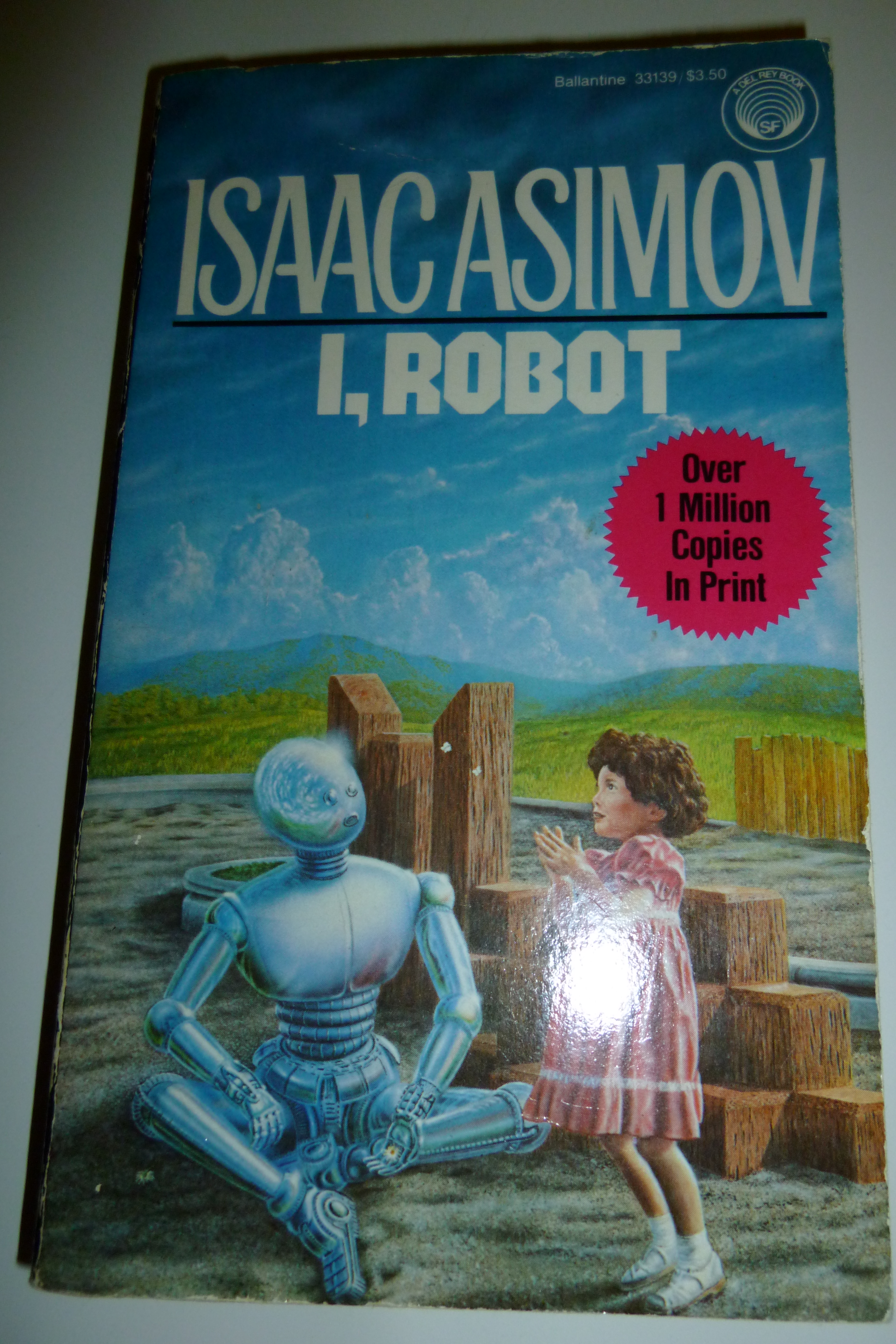
For my second Sci Fi Experience book, I read I, Robot by Isaac Asimov.  It hasn’t been sitting on my shelf, but it is one I’ve been meaning to read for ages.  And as with a lot of books like that, it turned out to be a faster read than I expected–and not much like my preconceptions of the book.

I always thought this was a collection of short stories, and it is, but they’re far more inter-connected than I had expected.  They’re set in what, at the time of writing, was the future (although we’ve since caught up).  It’s a world like ours, except humans have built advanced robots.  They’re exactly what you’d expect of science fiction robots (maybe they set some of the expectations!)–metallic, roughly humanoid, capable of walking and talking and performing a surprising amount of what at least looks like independent thought.  They’re governed by the famous Three Laws of Robotics.

In brief, the laws are: First, no robot can harm a human or allow a human to come to harm through inaction; Second, robots must obey human orders, unless they conflict with the first law; Third, robots must preserve themselves, unless that would be in conflict with the first or second laws.

The stories, not surprisingly, are mostly about robots that are malfunctioning or otherwise acting oddly, often because of an issue involving the Three Laws.  The stories are loosely linked by a frame-story, an interview with Dr. Susan Calvin, the leading robopsychologist.  She recounts stories from the history of robotics, primarily focusing on two groups of characters: either Powell and Donovan, two scientists who keep getting into trouble with robots on the fringes of civilization; or Dr. Calvin herself and the executives at U.S. Robots Inc.

The Three Laws seem straight-forward enough, but Asimov finds plenty of ways for their application to become confused, contradictory or otherwise corrupted.  There’s a robot who gets drunk when he can’t figure out which law to obey; another takes literally the order to go lose himself.

Characters, even though they are recurring, are not really the strong point of this book.  Most of the humans are not very distinctive.  It’s the robots who make the book interesting–and sometimes have more developed personalities than the humans!  One of my favorite stories is about a robot who doesn’t believe it when humans say they built him, and decides to reason out the truth of the world himself; he swiftly creates a kind of religion for robots, with himself as its prophet.

In some ways, the level of personality in the robots became a little disturbing.  This book is primarily about protecting humans from robots.  There’s nothing about protecting robots from humans–and when you have robots with independent thought, who appear as fairly developed characters, it gets hard to not look at them as people.  In particular there was one scene where Dr. Calvin was interviewing a robot.  She starts addressing the robot as “boy,” while the robot is calling her “ma’am.”  Suddenly you have the language of slavery, and it feels strange.  I know Asimov wrote other Robot books; I’ve read “Bicentennial Man,” which is largely about robot rights, so it’s not an entirely ignored issue…but it would be nice to see it addressed somewhere in this book too.

My favorite story is the first one, “Robbie.”  It’s certainly the sweetest, and is the one depicted on the cover.  It’s about a little girl and her beloved robot nursemaid, and what happens when her parents try to take the robot away.  (That makes it sound like Bradbury’s story, “The Veldt,” and it’s actually not at all like that!)

My last sci fi read made me think about humanity.  This one felt more like it was genuinely about the psychology of robots.  And how we relate to them, and what they say about us…but mostly how their minds work.  But that’s all right, because they work in fascinating ways!

And I think I can safely say that this one is not only classic sci fi, it’s a sci fi classic.  🙂

Other reviews:

Eclectic Reader Book Review
Expressions
Running Forums

Yours?

A Look at Humanity Through Sci Fi Lenses

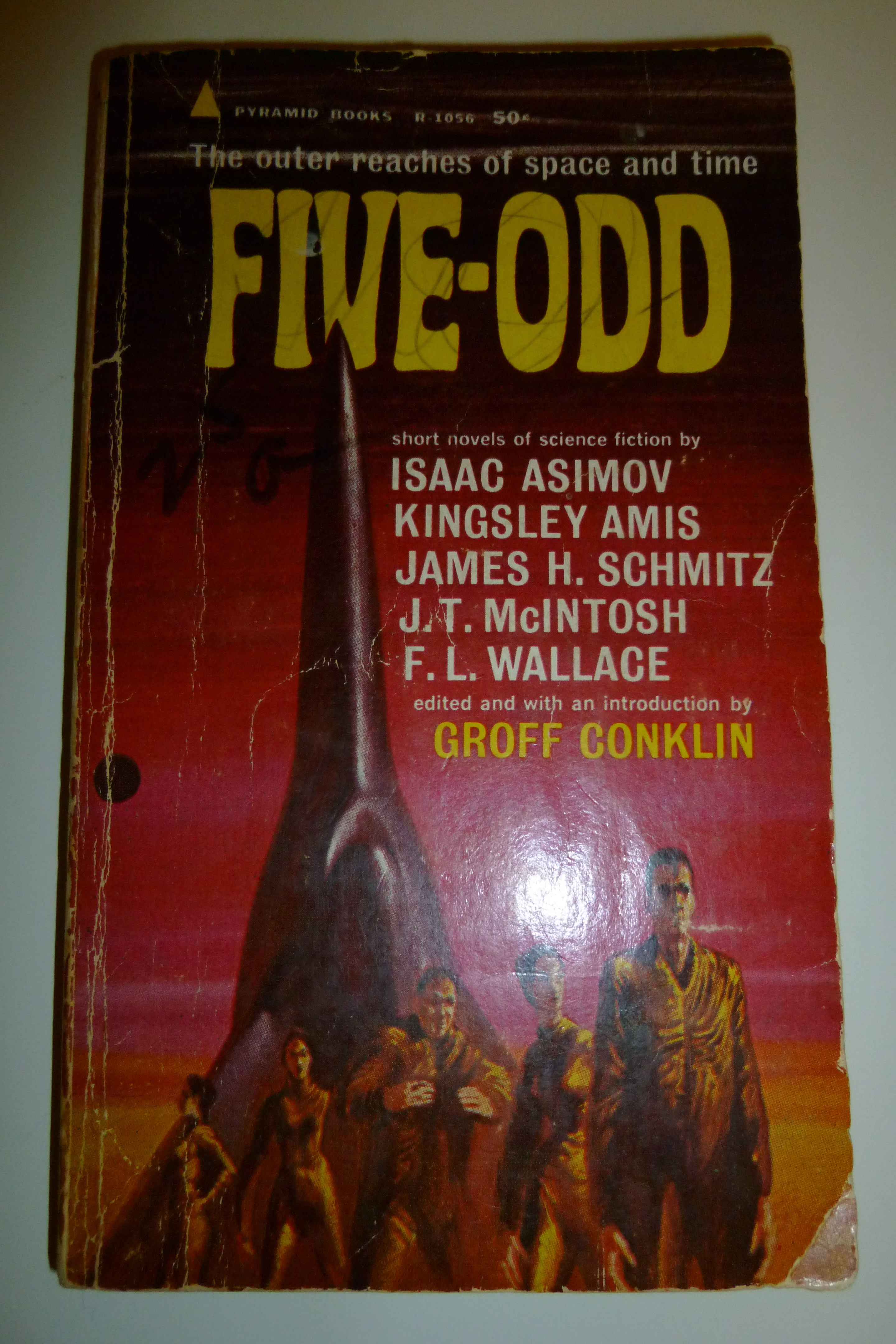
I finished my first book of 2012 and, feeling very virtuous, I managed to make it one which applied to two of my challenges!  Five-Odd, a collection of five (longish) short stories, edited by Groff Conklin, applies to both the Sci-Fi Experience and the Dusty Bookshelf Challenge.

I’ve decided Dusty Bookshelf reviews deserve a little back-story.

How long has it been on my shelf? Since August, 2011, so about four months.

I almost never buy unread books, so how did I get it? My Book Club had an all-holiday party in August (because there aren’t any major holidays in August), and I picked this up at the White Elephant gift exchange.

Now that I’ve read it, am I keeping it? I haven’t decided.  I liked it–but I have high standards about what books I own.  I’ll see how I feel about it when I have a little distance–say, next month.

Five-Odd is a nice mix of intriguing technology and of philosophy.  It’s definitely not action-adventure sci fi.  Most of the stories are about futures not so different from our present, except for some crucial advance in technology, and changes in thought because of it.  Almost every story made me think about some aspect of the world and, more often, of humanity.

Isaac Asimov’s “The Dead Past” asks whether the past really is dead, while also looking at government repression and the end of privacy–but not at all the way that sentence makes it sound.  The story centers around a fascinating device that will let anyone look at past moments.

“Something Strange” by Kingsley Amis felt like the weak link here to me.  It’s about four people living together on a small space station, but the characters were too surreal in some ways, and then the story ended just as it felt like it was coming to the most interesting part.

J.T. McIntosh’s “Unit” addresses a question about identity.  It then veers off into a story more about prejudices, piracy and collaborative intelligence, which was also interesting though I would have liked more about the idea the story started with–about people who choose to wipe away their entire past, and be entirely remade as new people with new personalities.

“Gone Fishing” by James H. Schmitz is about a conman who thinks he’s going to steal a transporter device from a befuddled scientist, only to wind up stranded on a distant planet for five years.  The transporter was interesting, but more interesting was the idea of how he would cope with five years of solitude.

“Big Ancestor” by F. L. Wallace is set the farthest in the future, when humans from Earth have reached the stars, and met humans from a hundred other planets.  A team of scientists from various planets goes in search of their common ancestor.  There’s an excellent twist to this, and I recommend not reading Conklin’s introduction, which blatantly hints at it.  There’s also an interesting passing line here, when one human mentions that most of the human races discovered space travel on their own, and then they helped the ones that didn’t.  After all my years of hearing about Star Trek‘s Prime Directive, General Order Number One, to never ever ever ever interfere with less developed races, this was shocking.  And yes, I know Star Trek does it all the time anyway 🙂 but it felt very different hearing it as an accepted thing!

I felt a little doubtful about reviewing this one because I wondered how easy it would be for anyone to find it.  But it turns out it’s available cheap on Amazon if you do want it (and no one paid me for that link!)  If you like philosophical sci fi, it’s a good read.  The stories were written in the ’50s and ’60s and have that flavor.  I don’t know that I’d call them sci fi classics, but they are classic sci fi…if you see the distinction there!  🙂

Robin McKinley’s Very Dark “Sunshine”

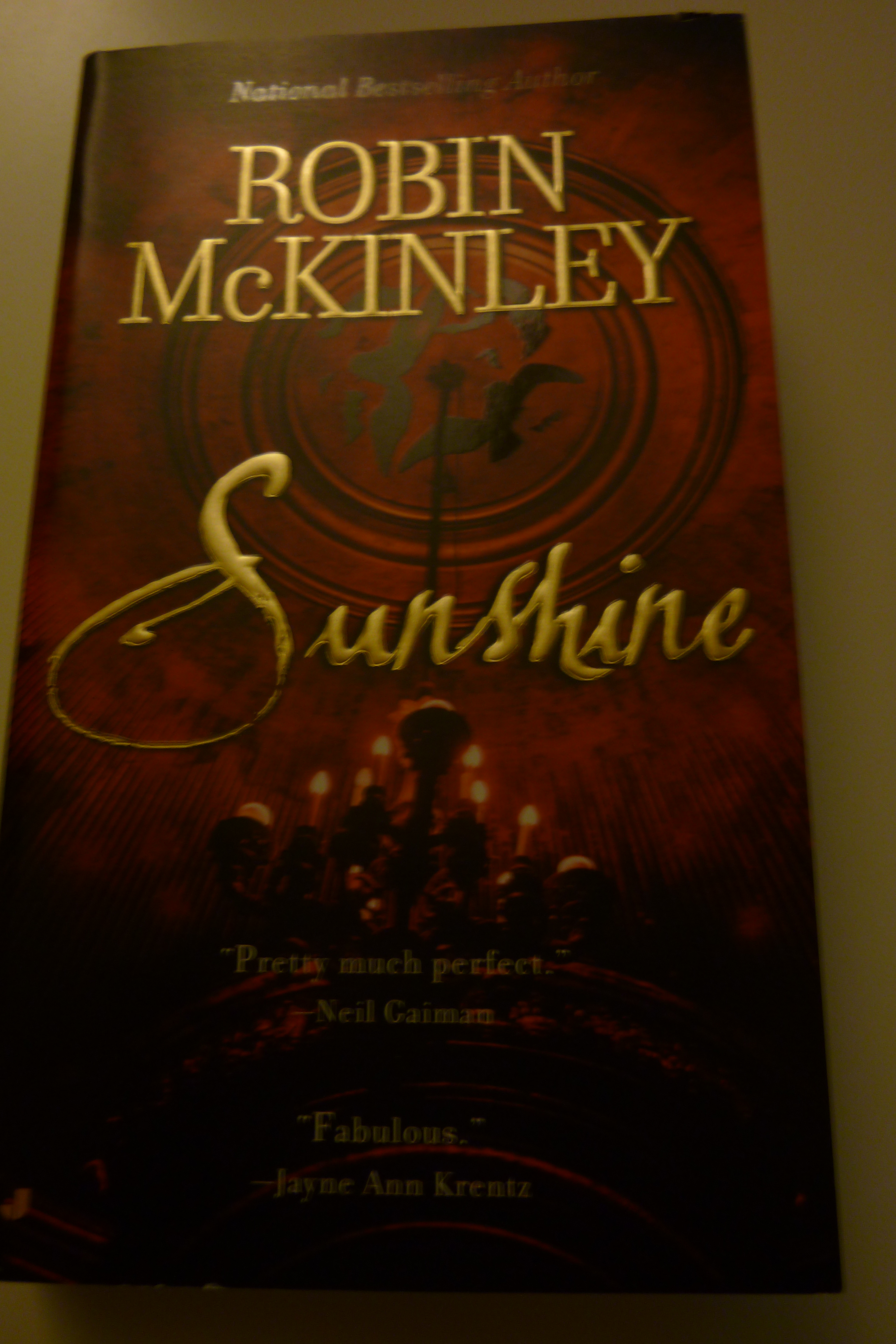
I think I should begin this post by saying that I love Robin McKinley’s books.  You’ve probably seen her referenced around here as one of my favorite authors.  That said, now I can tell you why I didn’t love Sunshine.

Sunshine was very nearly the last McKinley book I hadn’t read (the only other one is Pegasus, and a friend tells me it has a cliffhanger so I’m waiting for the sequel to come out first).  The funny thing is, I used to know why I hadn’t read Sunshine.  See, it’s her vampire book, and I’ve never been a vampire fan.  It’s also darker, and has a more modern setting.  So I just wasn’t that interested.

But all of my friends had read Sunshine, and they all really loved it (possibly because they are vampire fans), and it was the last one (more or less) that I hadn’t read…so I kind of forgot why I wasn’t reading it.

I finally read Sunshine recently.  It wasn’t a bad book, but I did have problems with it, and it very much was not my kind of book.

Sunshine is set in a world much like ours, but the creatures of gothic novels are real: vampires, werewolves, demons.  Humanity is in an ongoing war, and losing.  The book centers on Rae, nicknamed Sunshine, whose life revolves around her family’s coffee house, where she’s the head baker and cinnamon roll queen.  Life takes an unexpected turn when she drives out to the lake one evening, and ends up captured by vampires.  They chain her up in an abandoned house, an offering for their other prisoner–a vampire named Con.

Con, for reasons more mercenary than merciful, doesn’t drain Sunshine’s blood immediately, and the two of them end up working together to escape.  Sunshine gets back to her normal life, but can’t shake the experience.  She starts discovering that she has strange powers, and that she’s still tied somehow to Con and his enemies.

I liked Sunshine (the character).  The book is in first person and we spend a good chunk of the book reading her thoughts and memories.  She’s pulled in an interesting way between two lives–her ordinary baker life, and this dark world of vampires.  She’s a reluctant hero who just wants to go back to her cinnamon rolls, but finds the other world thrust on her, and with it strange powers and plenty of danger.  She’s a strong character, and I liked following her journey.

I didn’t like Con.  It may not have helped that my friends set me up to expect him to be a great romantic hero, and then…it didn’t come out that way in my reading.  Quite apart from the blood-drinking aspect of things, I didn’t find him likable and I didn’t get any chemistry between Sunshine and him.  She keeps describing him as ugly, for one thing (and yes, sometimes I like the ugly characters because of that–see the Phantom of the Opera–but not in this case).  The larger problem is that he never expresses emotions.  I like Vulcans and I like the occasional mysterious enigma, but I just couldn’t get any sense of Con, or whether he cared at all about Sunshine, because he wouldn’t express anything, ever.

I didn’t much like Mel either.  Notice Mel wasn’t mentioned in that summary up there?  That’s how irrelevant he is, even though he’s Sunshine’s boyfriend and theoretically the other point on the romantic triangle.  Somehow, despite being a tattoed, former biker turned chef, he’s an incredibly bland character.  I think the clincher for me was when Sunshine asked him, sort of rhetorically, who he was, and he answered, “I’m your friend.”  That doesn’t really feel like the right response from a long-time boyfriend and narrative love interest…

I actually liked the more minor characters better.  There’s a whole family of people who work or are regular customers at the coffee house, and some of them are quite interesting and entertaining–like Sunshine’s stepfather Charlie, one of the “big good guys” of her universe, or a customer who turns out to be part demon and can turn himself blue.

My problems with Con and Mel may be me–anecdotally I can tell you that I have three friends who love them, so take from that what you will.  The plot of the story is exciting, and the world is intriguing, although it takes some time to get a proper picture of it.  That’s normal for McKinley, who sometimes makes things mysterious at first, and you gradually start putting pieces together.  This is a dark book, with a lot of blood in it–not too graphic, mostly, but there’s a lot of it.  That’s what makes this not my kind of book, so you’ve been warned…  Also, definitely an adult book, not YA.

It does make me impressed with McKinley in a way, though.  For most of my favorite authors, most of their books are similar (which in a way is nice, because I know what I’m getting).  McKinley has impressive range to write very different books: Dragonhaven, Beauty and Sunshine read like they were written by three different authors.

One more point to address–a sequel.  There isn’t one, but fans have been asking for one for years.  McKinley has said that she’ll write one if she has an idea for one, which says to me that she has, for now at least, no intention of writing one.  (If you ever meet her, don’t ask about a sequel–based on her blog, I guarantee she won’t like it!)

I have to say I agree with McKinley.  I don’t think the book needs a sequel.  I may think that in part because I just don’t care which man Sunshine ends up with…  But the larger point is that I think the book came to an ending.  There’s plenty of plot room for a sequel, and questions left unanswered.  However, I think the book really was about Sunshine’s growth, and her acceptance of herself, both the baker and the monster-fighter.  She comes to a realization at the end, and for me, that is the end.

Final analysis: if you like vampires, read Sunshine.  If you don’t like blood, read Beauty or Spindle’s End instead.

Author’s Site: http://www.robinmckinley.com/

Other reviews (including some who loved the book far more than I did!):
Suite 101
Angieville
Writegray
Bookshelf Bombshells
There are many more–want to tell me about yours, or one you enjoyed?
2011 End of the Year Round-up

It’s the start of a new year, and the perfect time to look at the last year–including how my reading went!  I already gave you some of an update in the Reading Challenges Post, but I wanted to do a round-up of favorite books (and least favorite!)

To give you some stats, my total books read in 2011 was 169.  I’ve been keeping track for the last 7 years, and 169 is about normal for me.  My last two years of reading were lower, so I’m glad to see that rise again.  Of those 169, 50 were rereads, or about 30%.  I’ve decided to only choose from new books for the selections below.

Here’s the good and the bad of 2011.

1) Best Book  –  I am having trouble making a decision here.  Jane Eyre by Charlotte Bronte was amazing; I stayed up late two nights in a row reading it, and I loved the writing and the romance.  Turnip and Arabella from The Mischief of the Mistletoe by Lauren Willig were, as I expected, my favorite characters I met all year.  And The Hunger Games by Suzanne Collins really is as good as all the buzz suggests.  So there’s my top three, very different, best books of the year.

2) Worst Book  –  No question here.  Alcatraz vs. the Evil Librarians by Brandon Sanderson was awful on almost every level.  Honorable (or dishonorable?) mention to How I Stole Johnny Depp’s Alien Girlfriend by Gary Ghislain; you wouldn’t think a book with that title could go wrong, but it did, by being all about a teenage boy’s crush on a girl who was completely horrible to him—but beautiful.

3) Most Disappointing Book  –  Mockingjay by Suzanne Collins.  My hopes were very high (see #1) and they were sadly dashed.

4) Most Surprising (in a Good Way)  –  Probably this one goes to 2001: A Space Odyssey by Arthur C. Clarke.  After seeing the movie, I was surprised by how coherent the book was!

5) Best Series You Discovered – Since I have started a lot of series and need to read through them, I’m basing this one more on promise than on what I’ve actually read.  With that in mind, I’m giving the nod to The 500 Kingdoms by Mercedes Lackey.  Sleeping Beauty was good, and based on the world and the writing, I’m hopeful about the rest of the books in the series.

6) Most Hilarious Read  –  I read several of Terry Pratchett’s Discworld books, and I’m tempted to give it collectively to them.  To choose one, I’m saying Going Postal.  Funnily enough, Terry Pratchett was my most hilarious read of last year too.  I’m not really surprised…

7) Can’t Believe I Waited Until 2011 to Read It  –  I could say Jane Eyre, but I somehow feel more inclined to say The Eyre Affair.  I first heard about The Eyre Affair in high school, and have been meaning to read it ever since.  I suppose the same is true of Jane Eyre, but I was actually more fascinated by the premise of The Eyre Affair—ironically, since I ended up liking Jane better.

8) Most Looking Forward To in 2012  –  I’m not sure this year.  A lot of authors I follow are working on something interesting, but they won’t necessarily be out in 2012.  So I think I’m most looking forward to the next Jacky Faber book by L. A. Meyer.  I don’t know for sure he’ll have one out either, but I have faith.  🙂  He always has, for the last several years.  But even if I’m not anticipating a lot of new books in 2012, there are plenty of already-published ones I’m looking forward to reading!