An Enchantress or an Alien–or Both

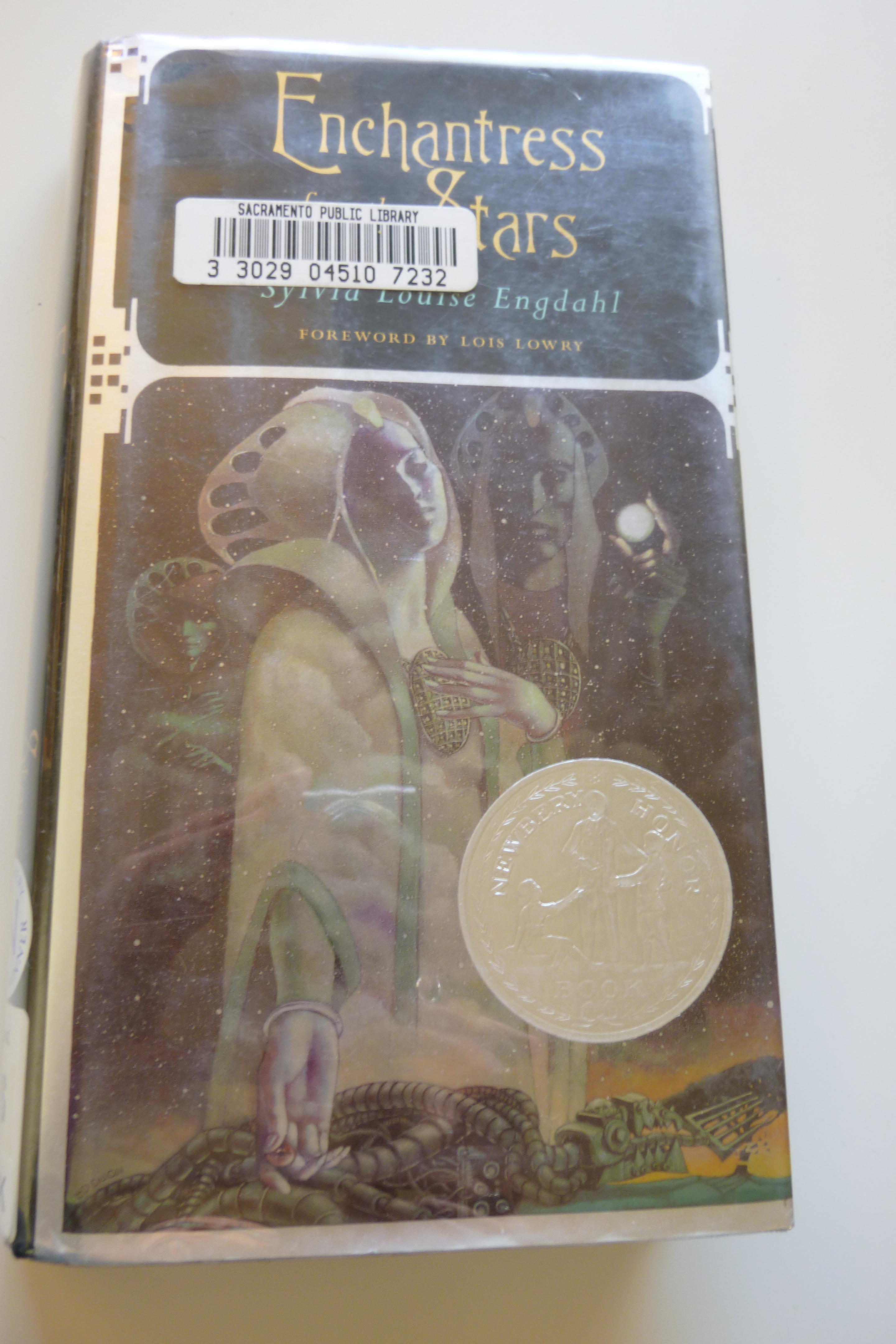
Science Fiction and Fantasy get lumped together all the time, in discussions, in “Best of” lists, in the bookstore.  But you rarely see them together in a single novel.  Enchantress from the Stars by Sylvia Engdahl is a brilliantly-devised story that could be in Earth’s distant past–or even more distant future.

The story is told by Elana, who belongs to a society far advanced beyond present-day Earth.  She is part of a Federation of many planets, joined together in peaceful cooperation.  They study less advanced worlds, but have a strict non-interference policy, believing that it’s best for cultures to develop without knowing about more advanced races.

(For the Star Trek fans–I know, I know.  All I can tell you is that this was written in 1971, but feels less like Star Trek when you’re actually reading it.)

Elana is training to be one of the scientists who studies Youngling worlds, when she stows away on a mission to Andrecia.  Andrecia’s native people are at roughly a Middle Ages level of development.  Their future is threatened by colonists from another world–the Imperials have developed space travel, but have not yet achieved the level of Elana’s people, either technologically or culturally.  The Federation team’s mission is to induce the Imperials to leave, without harming either race’s culture.

Elana ends up taking on the role of Enchantress, to relate to the Andrecians in a way they can comprehend–she especially connects with one, Georyn.  She teaches him magic spells (combinations of technology and telekinesis), so that he can go fight the dragon (the Imperials’ digging machine).  The hope is that if an Andrecian uses powers the Imperials can’t understand, they’ll be convinced to give up their colony.

The brilliance of the story is that it’s told from three very different points of view–Elana, from her advanced, enlightened perspective; Georyn, who tells a Brothers Grimm-style story about a beautiful Enchantress, a dragon served by terrifying demons, and magical spells; and Jarel, an Imperial who questions what his government is doing but doesn’t know how to act–and is probably the closest to all of us who are reading.

The three perspectives are intertwined and so different, yet work so well together.  It’s emphasized, in Elana’s sections, that Georyn’s perspective on events isn’t wrong either–he simply has a different understanding, a different way of viewing what’s happening.  In some ways, he proves to be the most intelligent and the most insightful of any of the characters.

Elana is very interesting too, because we see her as the uncertain, often naive girl she is on the mission; as the strong and wise enchantress Georyn sees her as; and as the more mature voice telling the story after it’s all over.  Her character growth, throughout the story and from the after-perspective, is very excellently done.

This is a good adventure with compelling characters, and it’s ultimately a very hopeful story.  Engdahl is careful to place Andrecia, Elana’s home world, and the Imperials’ home planet all in the position of third from their stars.  It notes in the introduction that any of them could be Earth–this could be a story about our past, or a story about our future.  Ultimately, I don’t think it matters.  We’re all of them.  The hopeful part is that the book makes it clear that Georyn’s people, and Jarel’s, and us, can all learn and grow and eventually reach the wisdom of Elana’s people.

In that way I guess it is like Star Trek, as a vision of a hopeful future.  But if you want to take this as science fiction, as fantasy, as philosophy, or even as something with some of the same elements as Star Trek, it’s worth reading–it’s a wonderful book.

Author’s Site: http://www.sylviaengdahl.com/index.htm

Other reviews:
Book Snatch
Jenna St. Hilaire
Yours?  Let me know!

Capturing Ten Moments in Time

How often do you really think about a photograph?  You’ll look at photos in a whole new way if you read Smile! by Geraldine McCaughrean–or, as I did, listen to the audiobook.

Smile! is about Flash, a photographer whose small plane crashes in a remote area.  He manages to save only one camera–a simple Polaroid, with ten shots.  Flash is taken in by a primitive village, which has rarely had contact with the outside world.  As he speaks to the villagers, he realizes that none of them have ever seen a photograph.  Accepted by the villagers as “the magician who fell from the sky,” Flash must decide what to spend his ten photographs on–what sights will he preserve for the villagers?

Flash comes to love the villagers, and it’s not hard to relate to that feeling.  There are Sutira and her brother Olu, two children who adopt Flash.  And there’s “the old, old man,” the village elder who helps Flash decide what pictures to take–and what shouldn’t be photographed.

Seeing the photographs through the villagers’ eyes is fascinating.  All of us, with our digital cameras and our Google image searches, are so used to the idea of photographs.  But through the eyes of the villagers and through McCaughrean’s gorgeous prose, a photo becomes something magical–a moment in time, frozen and preserved.  Through photos, “the dead can still smile in the land of the living.”  A little boy is ten years old forever.  When the village goes through hungry times, they can look on the feast in their past.  In sad times, the image of their joyful dance.

The book is about photos, and about Flash, as he learns from the villagers–about beauty, about memory, and about what’s really valuable.  It’s a simple, fairly short, and lovely book.

McCaughrean’s writing is beautiful, and I’m sure it was enhanced in the audiobook (available on iTunes) by the reader.  I was thrilled to discover this was read by Richard Morant.  He was the voice of Titus Oates in the audiobook for another of McCaughrean’s novels, The White Darkness.  I won’t wax on again–I’ve done it before–but suffice to say he has a beautiful voice.

This book is listed as a children’s book, and in its simplicity, perhaps it is one.  But it’s another wonderful example of a children’s book with depth, with meaning, and which can be read on so many levels.

Author’s Site: http://www.geraldinemccaughrean.co.uk/index.htm

Other reviews:
Big A little a

I couldn’t find others!  Any you’d like to share?

Hunting a Lost Prince

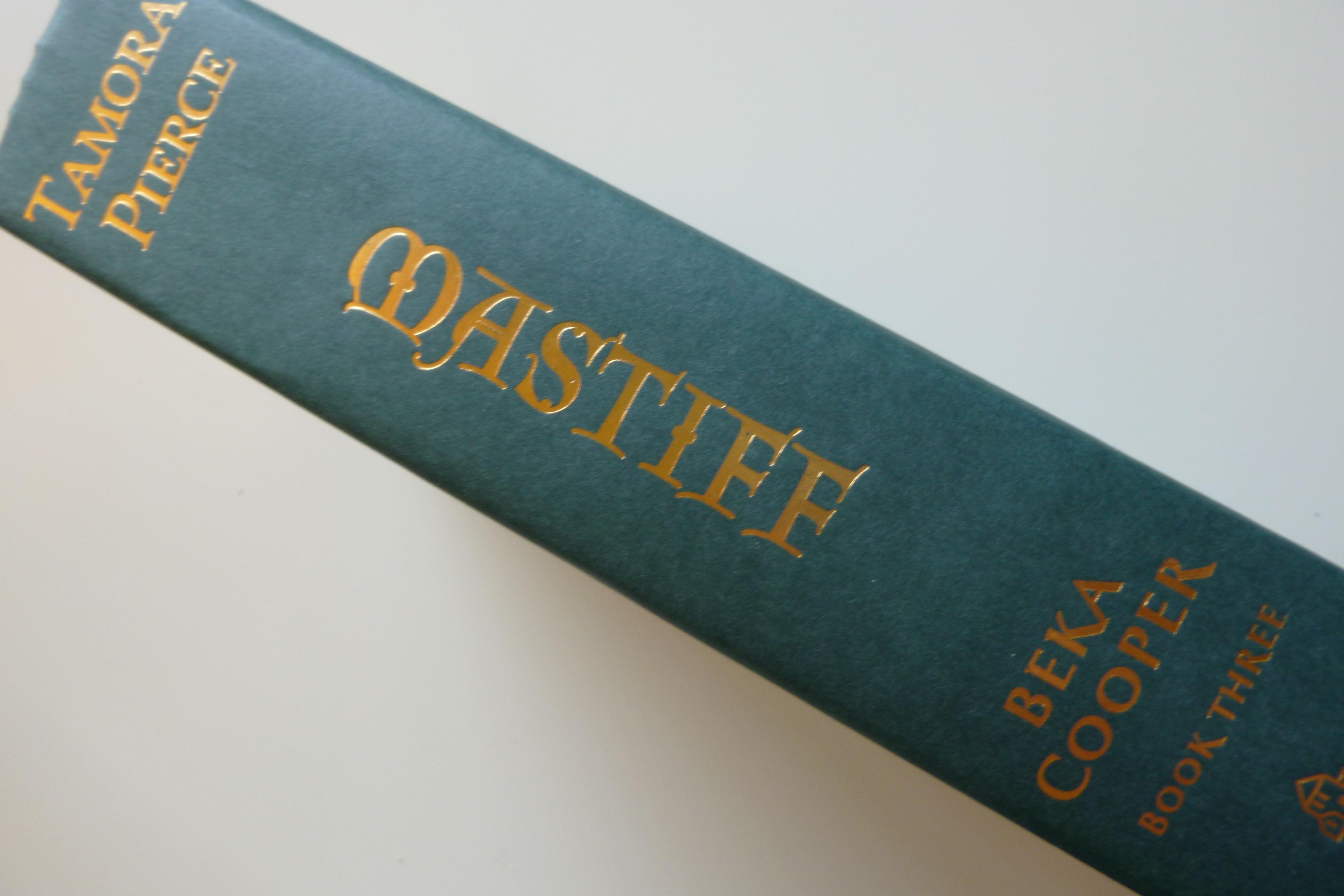
I’ve been promising a review of Mastiff, the final book in the Beka Cooper Trilogy by Tamora Pierce.  It was a good resolution to the story, an exciting adventure that tied up plenty of ends.

It begins a few years after the previous book, as Beka mourns the death of her never-before-mentioned fiance (more on him later).  It turns out she was on the verge of breaking up with him, and she’s glad of the distraction of a new Hunt–slang for a case to be solved.  In some ways this is the most focused book of the trilogy–Beka and her friends are on the trail of a kidnapped prince, and the entire book centers around this journey.

There are some strong villains in here, and I loved Beka’s friends too.  The lady knight, Sabine, had a bigger role in this book, and we had more of Pounce, Beka’s black cat.  There’s also Farmer, a new character who’s a very interesting mage.  I love it that he’s very powerful, but hides that behind a bumbling, cheerful exterior–although he really is wonderfully cheerful!

Despite a very cheery new character, this is darker than Pierce’s earlier books.  Dark things have always happened–death, slavery, violence, kidnappings.  The Beka Cooper Trilogy has always got more into the grittiness of it, though, and that’s very true here.  There’s more detail and more description of the disturbing elements.  One scene about a dead slavegirl is enough by itself to make this upper Young Adult, while Pierce’s earlier books often bounce between the Juvenile section and YA.

On the more positive side, there’s eventually some romance here, although it takes a while.  Though considering my chief problem with Bloodhound was that the romance was too fast, I won’t complain about this one!

Actually, the romance I wish there had been more of was the one with the dead fiance.  The book begins with the fiance already dead, and we only get hints about Beka’s relationship with him.  I was hoping for some kind of extended flashback, but it never came.  The hints are enough to suggest that it may have bordered on an emotionally abusive relationship, and in a strange way I think that would have been a wonderful story for Pierce to tell.  Her stories about strong women are so inspiring, and it would have been so valuable to portray one of these strong women getting emotionally mixed up and into trouble.  Beka is very capable in some ways, but she has uncertainties about relationships.  I would never believe that she’d stay with a man who hit her, but I could believe that she could be emotionally manipulated, and that would be so good for girls to see–that you can be strong and capable and still get into a bad relationship, and it doesn’t make you pathetic or worthless.

But that’s my idea, and evidently not Pierce’s vision for the book, and I can’t really criticize her for not taking the story the direction I wanted it to go.  One more serious objection I have involved a traitor in Beka’s group.  They realize someone is probably betraying them as they travel, but Beka doesn’t give much attention to that.  When the traitor’s identity finally comes out, it didn’t ring true to me.  It feels more like someone acting out of character than like a shocking reveal.

Those problems aside, it’s a great adventure with strong characters and an engaging world.  And now I can go back to looking forward to Pierce’s next book!

Author’s Site: http://tamorapierce.com

Other reviews:
YA in the Second City
Sew Skate Read
Ms. Martin Teaches Media
Yours?

The Dolphin Girl

What makes us human?  The Music of Dolphins by Karen Hesse asks this question, by looking at the world through the eyes of Mila, a human girl raised by dolphins.

Mila is picked up by the Coast Guard one day, after living in the sea for 13 years.  She’s taken to a facility where scientists help her learn language, skills, and how to live among humans.  The story centers on Mila’s growth as she learns about the human world, and on her longing for the dolphin world she knew.

My favorite part of the book is the way it’s written.  Mila tells her story herself, in a journal, and it changes dramatically as she learns.  The earliest pages are very simple, “Dick and Jane” style writing.  The font size shrinks and the words grow longer and more complex as Mila develops greater skills.  It’s a similar device as Flowers for Algernon.  Mila’s journal is punctuated by three separate passages in Mila’s head, describing her life with the dolphins.

I read this as a child and loved the change in the font and in the words.  Rereading it now, I’m more conscious of the growth in Mila’s character, from a very simplistic view of the world to a growing complexity.  She asks more questions involving “why,” has her own opinions and her own desires, and demands to be seen, not as a test subject, but as a person.

I’m sure this is a more realistic portrayal than Tarzan or The Jungle Book (fun though those are).  I don’t know enough about psychology or dolphins to be able to fully judge how accurate this is, but it feels realistic.  The ending requires a suspension of disbelief, although as a child I don’t think I realized that.  And I still find it a satisfying ending, even if I know now how completely unlikely it is.

This is a short and simply written book–Mila never approaches Shakespeare even at her most complex writing–but despite that, it gets at deep questions.  There’s a character in Pratchett’s Discworld who is described as simple but not stupid.  I think that applies here too.  It’s a simple book, but that doesn’t mean it can’t be profound.

Exploring the Origins of Dracula

What could be a better review for Halloween than the ancestor to so much horror fiction–Bram Stoker’s Dracula.  I’d been meaning to read Dracula for ages–it was one of those classics I thought I ought to know about.

I kept not getting to it for a couple of reasons.  Mostly, I thought it might be disturbing.  It is horror, after all, and being old doesn’t prove anything–Poe can be pretty disturbing.  Or, I thought it could be very literary and difficult to read.  Fortunately, both fears proved unfounded.

To address the second one first, Dracula isn’t a difficult read, though it is slow at times.  Some books transition into the current day just fine; with others, it’s immediately obvious that they were written in the 1800s.  It’s a stylistic thing, but it’s not difficult, just dry sometimes.

As to being disturbing, it really wasn’t.  But, to give you fair warning, I do most of my reading during the day.  I’m convinced that we have some kind of deep-seated primordial instinct that makes everything seem much creepier when it’s dark out.  I have two friends who read this at night–one said it was fine, the other said it was terrifying (and she’s usually good with horror) so take from that what you will.  For me, it certainly had some dark moments and images, but it didn’t particularly give me chills and thrills.  Honestly, nothing had the tickle-your-spine creepiness of Bela Lugosi descending the stairs and purring, “I am…Drrrracula.”

Speaking of Mr. Lugosi, he’s always been my image of Count Dracula.  So I was taken aback to find Dracula described as a white-haired old man with a drooping mustache and hairy palms.   I was actually fascinated by how consistently Dracula is described as ugly and repulsive.  And this is the origin of the culture’s vampire obsession?  (But then, I find the Phantom of the Opera a plausible romantic lead, and that’s equally strange if you only read Gaston Leroux.)

The leap from Bram Stoker to Stephenie Meyer is mind-boggling.  Dracula to Twilight is a long trip.  I couldn’t imagine how we got from Stoker’s ugly, foul-smelling demon spawn, all the way to Meyer’s breathtakingly gorgeous (and sparkly!) Edward Cullen.  I talked to a friend who’s more interested in vampire literature than I am, and she tells me that the bridge is Anne Rice.  Apparently she’s the one who made the vampires seductive.  Stoker’s Dracula is not in the least seductive–the female vampires are a bit, and the Count has a certain mesmerizing quality, but it’s much more hypnotic than attractive.  110 years has clearly made a big difference in the perception of vampires.

Speaking of the gulf between portrayals, there are few characters less like Hugh Jackman than Stoker’s Van Helsing.  The Hugh Jackman movie is a fun romp about a man fighting monsters, but the original character is a sweet old man.  He wields a stake when he needs to, but he’s much more an intellectual than a fighter.

To circle back to Stoker vs. Meyer, another interesting question is whether the vampires are damned.  In Stoker, there’s no doubt about it.  He doesn’t allude or hint.  He just flat-out says that God has forsaken any and all vampires–even if you didn’t want to become one.  You get bitten a few times, drink some vampire blood (even force-fed), and you’re condemned.  It bothers me from a narrative and especially a spiritual perspective  that people could lose their souls unwillingly.  I actually have to give a nod to Meyer here for making it more complicated–the after-life of vampires is no more certain than for anyone else, and the mere fact of being a vampire doesn’t mean someone is evil.

On the other hand, when it comes to strong female characters, I’m giving that one to Stoker.  He has a couple of major female characters.  Lucy is endlessly described as sweet and good and beautiful, and not much else.  Mina, however, has got it all over Bella.  She’s right in there with the men devising their plans for fighting Dracula, and I think she has as much nerve and brains as any of them.  She ends up constrained by her gender a few times, but the men clearly hold her in immense respect, and when they do occasionally try to push her out of something (for her own protection, of course) I get the sense that she thinks she’s equally capable–and that she’s right!  Not bad, for 1897.

“Not bad” is probably a fair estimate of the entire book.  I didn’t love it, but it was definitely interesting for its place in literary history.  Taken simply as itself, it had some good characters, a good premise, it was kind of slow and I’m not crazy about the writing style.  All in all though, it was pretty good–or not bad!